Tag Archives: Disability

Can We Understand What It Is Like To Hear Sound for the First Time?

17 Jan

listen(Image by Jay Morrison used under CC license via)
 
In the 1990s, Cristina Hartmann was one of the first of a few hundred deaf and hearing impaired children in the United States to undergo surgery for a cochlear implant. She has written extensively about the experience of hearing sound for the first time after the implant in her right ear was activated, most recently this month on Quora.com:

My mother was the one who told me, “Raise your hand when you hear something.” That statement left me baffled. What was I looking for? It was a bit like searching for Waldo when you didn’t know what he looked like.

In that tiny, windowless room deep in the large Manhattan hospital, the audiologist began tapping away at her keyboard. Everyone stared at me, even a woman standing in the doorway whom I had never seen before. I felt the heavy weight of expectations on my shoulders. I had to do something. I concentrated very hard, searching for the mysterious, indefinite Waldo. Whenever I felt anything, an itch or a breeze, I raised my hand slowly, searching everyone’s expressions for whether I had gotten it right or wrong. Nobody gave me any confirmation, so I went on guessing. Twenty-five years later, I realize the whole thing was a show that I performed. I knew this was a momentous event, and I didn’t want to disappoint….

As a congenitally deaf child (who was a bit long in the tooth at 6), I had never formed the neural pathways for my brain to even begin processing auditory stimulation. In the fashion of the ostrich, my brain ignored the strange stuff, and I remained as deaf as I had been an hour prior…

It took months and plenty of therapy for her brain to adapt. Thirteen years later, the activation of a second implant, this time in her left ear, proved a more harrowing experience than the first:

As the audiologist began the beep sequence, I burst into tears and involuntarily clenched the left side of my face. She looked up, puzzled. “Why are you crying? You’ve had this before!” she said. The pain was like sparklers going off on the left side of my head. The stimulation, as little as it was, completely overwhelmed me.

Even though I had already laid the neural pathways for auditory stimuli for my right ear, my brain was unprepared for the stimuli coming from the left side. Since my brain had already experienced this type of stimuli, it could process it, but it was still sensory overload. That stuff hurts. It took me months to acclimate myself to the new implant, but in the meantime, I cringed every time I turned it on. As I said, laying new neural pathways takes work.

Hartmann was later told by the mother of another patient, “Once they started with the beeps, [my daughter] screamed and cried.”

Such narratives exist in stark contrast to the YouTube videos of newly activated implant users laughing and smiling—and, in one case, crying for joy—that have been bouncing around the Internet with far greater frequency. While both narratives provide important information for those considering cochlear implants for themselves or their children, they are also an important contribution for the greater public in our understanding of what it means to be deaf.

It makes sense that crossing out of the world of silence into the world of sound is just as disorienting as its opposite. A hearing person with a middle ear infection strains to perceive the sound of speech, and a deaf person with a new cochlear implant strains to tune out noise pollution: the knocks of a radiator in another room, car doors slamming on the street, wind, footsteps, not to mention the countless background beeps and clicks of the Digital Age. After all, when a baby leaves the womb, she does not instantly adapt to her new home. She comes out crying. There’s too much light and not enough warmth. And, if she is not deaf, there is too much sound.

Speech is no less difficult to learn than Sign language, just as English is no less difficult than Chinese. The ease with which we learn one form of communication or the other depends entirely upon our personal experience and place in the world. For those of us who have grown up hearing speech, the viral videos communicate something very different than for those who grew up in Deaf culture.

While the experiences of utter delight portrayed in the videos are valid, their popularity contributes to an oversimplification of the issue. Watching a toddler smile upon finally hearing his mother’s voice for the first time sends a very strong subliminal message: Being deaf must be worse than not being deaf, and therefore anyone would want to join the world of the hearing. But the general public as an audience is already biased toward the hearing world’s standards of happiness. We are moved by the sound of loved ones uttering our names but not at the image of them signing our names because our culture does not rely on—and therefore does not highly value—Sign language.

This what inspired Lalit Marcus, the daughter of deaf parents and an active promoter of Deaf culture, to pen an article for The Wire titled, “Why You Shouldn’t Share Those Emotional ‘Deaf Person Hears for the First Time’ Videos”:

I want to make it clear that I don’t have a problem with people who choose to get cochlear implants. Medical decisions are painfully personal… I’m all for people making the health choices they think are best for them. What bothers me are the maudlin videos produced out of someone’s intense, private moment that are then taken out of context and broadcast around the world. What bothers me is how the viewer never learns how the individual came to the decision about their implant, which factors they took into account, whether their medical insurance covered it. Sometimes we don’t even learn their names.

This gives me pause. I consider the clip of me removing my casts to look at my newly lengthened legs, which featured 15 years ago in the HBO documentary Dwarfs: Not A Fairy Tale and last year on Berlin’s public station. The moment was simply joyous—as was the moment I stood up, let go of my friend’s hands and took my first steps—but the story behind it was abundantly complex. Which hopefully both documentaries portray.

I have endeavored to communicate that through this blog and all the media work I have done for the past 20 years.

Limb-lengthening and cochlear implant procedures are markedly different in several ways. Limb-lengthening, for example, does not threaten to endanger another language. But it does threaten to break ranks in the dwarf community through the controversy of altering versus accepting extraordinary bodies. Both procedures have proven to evoke vitriol among their proponents and detractors.

Hartmann reveals:

Most of my deaf friends were good about my CI. They didn’t mind it, except for the fact that my speech therapy cut into play time. That being said, people in the Deaf community felt free to make pointed and derisive comments about my CI. I still get these comments, even almost 24 years after my surgery. To some, I’ll always be a CI-wearer and a turncoat.

The CI advocates aren’t any better, if not worse.

I have very pleasant relationships with many parents of implanted children and CI users. I, however, have also been called a failure because I still use [American Sign Language] and don’t speak perfectly. I’ve also seen a mother run across a room to prevent her child from signing to another deaf child. I’ve been scolded for making gestures and looking too “deaf.”

The debate, of course, is ongoing.

But for those of us not faced with opting for or against a cochlear implant, we are faced with the challenge of overcoming our bias and remembering that Deaf culture is no less valid than the hearing culture we inhabit. Especially when those admittedly tantalizing videos wind up in our Facebook feeds.


We Gotta Watch Our Language When It Comes to End of Life Debates

13 Sep

Jerzy body

(Image by Ekaterina used under CC license via)


On Friday the British Parliament resoundingly struck down a bill that would guarantee its citizens the right to physician-assisted death. Yesterday California’s legislature voted to make it the sixth state in the U.S. to legalize it.

Robust, nuanced arguments have been made for and against physician-assisted death for terminally ill patients, and none of these arguments could be successfully summarized within a single article. This is why a conclusive stance on the issue will never appear on this blog. It is nothing but moving to hear the deeply emotional pleas from those in the right-to-die movement who have thought long and hard about the prospect of death, who feel empowered by having some choice when facing down a daunting fate, who don’t want to find out which of their loved ones may turn out to be unskilled at care-giving. And it is equally moving to hear the experiences of those working in hospice and palliative care who face the approach of death every day with the determination to make it as minimally painful and emotionally validating as possible for all involved.

However, despite the emotional validity of both sides, there are tactics the right-to-die movement should avoid if it does not wish to make our culture more ableist than it already is. Openness about end of life decisions can shed light on a subject previously cloistered away, but the more the right-to-die movement celebrates the idea of ending someone’s life before it transforms into a certain condition, the less willing the public may be to engage with and invest in those who live in that condition.

Which is why no one should call physician-assisted death “Death with Dignity,” as lawmakers in Washington, Oregon, and New York have done. The implication that anyone who opts out of assisted death might live an undignified life is reckless and arrogant. A patient declaring the prospect of invasive life-saving interventions “too much” is fair. A writer declaring the quality of life of those who opt for them “pathetic” is ostracizing. It insults not only those enduring late-life debilitation, but the everyday conditions of many, many disabled people of all ages around the world.

Even today, when so many movements push to integrate disabled people into the mainstream, the average person is generally isolated from the reality of severe deformity, high dependence, and chronic pain. This isolation feeds fear and is therein self-perpetuating. As opponents have pointed out, many right-to-die arguments quickly snowball, equating terminal illness with chronic illness and disability, and portraying all three as a fate worse than death. Hence the name of the New York-based disability rights group Not Dead Yet.

Vermont’s recent law, the Patient Choice and Control Act, bears a far less polemic name than the others currently on the books. That’s a start. Experts are divided as to whether the current openness about end of life decisions in the U.S. has led to more terminally ill Americans considering and opting for hospice and palliative care. Regardless, both sides should be encouraging well-informed discussions that honor a patient’s right to voice his beliefs based on personal experience, and a disabled person’s right to not be further marginalized by a culture that has historically feared her existence.


*Note: I use “physician-assisted death” and other terms in deference to World Suicide Prevention Day this past Thursday and the media guidelines from the Center for Disease Control, which discourage use of the word “suicide” in headlines to avoid contagion.


Happy Birthday, ADA!

26 Jul


This week marks the 25-year anniversary of the passing of the Americans with Disabilities Act. As others have noted, the law was ground-breaking not only because of its international ripple effect, but because it recognized disability not as an issue of health, but of human rights.

Author of the bill, Robert L. Burgdorf, Jr. writes in The Washington Post why this was so necessary:

People with disabilities were routinely denied rights that most members of our society take for granted, including the right to vote (sometimes by state law, other times by inaccessible polling places), to obtain a driver’s license, to enter the courts and to hold public office. Many states had laws prohibiting marriage by, and permitting or requiring involuntary sterilization of, persons with various mental or physical conditions, particularly intellectual disability, mental health conditions and epilepsy. A number of states restricted or denied the right of people with mental disabilities to enter into contracts. Several U.S. cities, including Chicago, Columbus and Omaha, had what became known as “ugly laws” that banned from streets and public places people whose physical condition or appearance rendered them unpleasant for other people to see. These laws were actually enforced as recently as 1974, when a police officer arrested a man for violating Omaha’s ordinance.

In some instances, discrimination threatened the very lives of individuals with disabilities: Lifesaving medical treatments that would routinely have been made available to other patients were denied to patients with disabilities; in 1974, the New York Times cited an estimate that unnecessary deaths of babies with disabilities in the U.S. resulting from withholding of medical treatment numbered in the thousands each year.

Things have improved substantially, which is cause for celebration. But not complacency. Which is why NPR’s article “Why Disability and Poverty Still Go Hand-In-Hand” is well worth your time, as is the above TED Talk by the late, great Stella Young, whose unexpected death last winter was a tremendous loss to the disability rights movement and to anyone who enjoys a good dose of sarcasm with their social critique.


Difference Diaries Wants to Hear from You

19 Jul

Copyright Difference Diaries


I have recently become the Director of Educational and Multimedia Outreach at the Difference Diaries, and today marks the launch of the Difference Diaries Blog. We want submissions and we want them now.

The Need. This week Freeburg High School in Illinois jubilantly voted down a petition by Little People of America to retire their school mascot, the Freeburg Midgets.

Such incidents are hardly isolated. Dwarfs rarely make the news, and when we do, we often wish we didn’t. Two summers ago Slate magazine, one of my favorite socio-political periodicals geared at young adults, kicked off a blog about Florida with an opening article called, “True Facts About the Weirdest, Wildest, Most Fascinating State.” Among the facts that apparently render the Sunshine State weird are the python-fighting alligators and “a town founded by a troupe of Russian circus midgets whose bus broke down.” On the day of its release, Slate ran the article as its headline and emblazoned “A Town Founded By Russian Circus Midgets” across its front page as a teaser.

Face-palm.

Here’s the thing about dealing with all this. You get used to it, but not forever and always. Sometimes it rolls off your back, sometimes it hits a nerve. This time, seeing a magazine as progressive as Slate brandish RUSSIAN CIRCUS MIDGETS on its front page while leaving disability rights out of its social justice discussion brought me right back to college, where friends of friends called me “Dwarf Emily” behind my back and someone else defended them to my face. Where classmates cackled about the film Even Dwarfs Started Off Small—“because it’s just so awesome to see the midgets going all ape-shit!”—but declined my offer to screen the documentary Dwarfs: Not A Fairy Tale. Where a professor was utterly outraged that her students didn’t seem to care about immigration rights or trans rights, but she never once mentioned disability rights. Where an acquaintance asked to borrow my copy of The Curious Lives of Human Cadavers, but awkwardly turned down my offer to lend her Surgically Shaping Children. Where roommates argued vociferously that they would rather be euthanized than lose the ability to walk. Where jokes about dwarf-tossing were printed in the student newspaper.

I won’t go into certain crude comments that involved me personally, but I will say that when a friend recently, carefully tried to tell me about how shocked he was to find a certain video of dwarfs in a grocery store, I cut him off and said, “Lemme guess, it was a dwarf woman porn video? That’s one of the top search terms that bring people to my blog.”

This is not to ignore all those I’ve met who, despite their lack of experience with disability, ask carefully constructed questions and consistently make me feel not like a curious object but like a friend who is free to speak her mind about any part of her life experience. And some young adults are doing awesome work for disability rights and awareness. But when a journalist and mother of a disabled twentysomething recently said to me, “No one wants to talk about disability rights – it’s not seen as sexy enough,” I knew exactly what she was talking about.

Maybe this is just a matter of my growing up, leaving the cocoon of childhood and finding out how uncaring the world can sometimes be. But ableism among young adults in the form of silence and/or sick fascination is a lot more prevalent than many would like to admit. And why does it have to be? Are physical differences truly not sexy enough? Is it because we associate disabilities, diseases and related issues—like caregiving—with older people and with dependence? Dependence is usually the last thing to be considered cool. But does it have to be?

The Means. As a non-profit organization, Difference Diaries aims to ignite ongoing conversation that will contribute to better lives for those living with defining difference as well as friends, families, and perfect strangers who “just never thought about it.” The young adults who share their stories offer real insights and an opportunity for viewers and readers to know a little more about “what it’s like.”

We focus on conditions as diverse as the individuals living with them including: cancer, hemophilia, dwarfism, sickle-cell anemia, albinism, facial deformity, blindness, HIV, amputee, hemangioma, vitiligo, diabetes, renal disease, Crohn’s disease, cystic fibrosis, cerebral palsy, OCD and more.

This is why we want to hear from you. We are seeking blog submissions about living with Difference as a young adult. Prospective bloggers should consider: What does Difference mean to you? What is your personal experience of being Different? What has to be explained most often at work, school, out in public? What would be the most helpful thing for people to know about your Difference? How would you like to see society improve in how it handles Difference?

Send us your submissions via e-mail to info[at]differencediaries.org


Mother Petitions to End Germany’s Nationwide Youth Games

5 Jul

BXP135660(Image by Tableatny used under CC license via)
The Nationwide Youth Games (Bundesjugendspiele) are a 95-year-old annual tradition here in Germany wherein students ages 6 to 16 spend a day competing against each other in track and field, swimming, and gymnastics. The total scores are read off in a ceremony before the entire school, and those who accumulate a certain number of points are awarded either a “certificate of victory” or a “certificate of honor.” Since 1991, “certificates of participation” have been handed out to the rest of the students.

After her son came home sobbing at having received a mere certificate of participation two weeks ago, journalist Christine Finke started an online petition to put an end to the Games. She explains on her blog:

I’m doing this for all the children who feel sick to their stomach the night before the Nationwide Youth Games, for those who wish they could disappear into the ground during the Games, and for those who want to burst into tears during the awards ceremony… Sports should be fun and make you feel good about your body. But the Nationwide Youth Games are founded on grading: on the upgrading and degrading of some at the expense of others.

She dismisses the Games as a relic of the Nazi era, and while the original Reich Games preceded Hitler, founder Carl Diem did go on to be active member of the regime who instrumentalized the Games as propaganda for the Nazi obsession with bodily perfection. Finke points to the Nazi-like language of her critics on Twitter: “Our children shouldn’t be allowed to turn into sissies.”  Indeed, mottos such as Only the strong survive commonly found in sports culture in the U.S. and other countries are not taken lightly here in Germany, where sick and disabled citizens were murdered in mass numbers less than a century ago. 

As a semi-disabled kid, I had plenty of physical limitations, but, like most kids, I enjoyed the sports that I could play fairly well (baseball, tennis, jump rope) and I quickly got bored with those that put me at the bottom of the class (basketball, football, soccer).  Due to the vulnerability of the narrow achondroplastic spinal column, I wasn’t ever allowed to participate in gymnastics, and contact sports were forbidden after the age of 10 when my peers began to tower over me.  I countered the feelings of exclusion with feelings of pride for holding the pool record for staying underwater (1 minute 15 seconds), and for surpassing everyone in the joint flexibility tests. But what about the kids whose bodies ensure that they will never surpass anyone else in any competition? The best advice I ever got came from my primary school physical education teacher: “If you had fun, you won.” 

But then came adolescence, and with the onset of puberty, the body suddenly is no longer merely something that gets you from place to place. It becomes an object you are expected to sell to others in the brutal competition of dating and mating. It’s no wonder that an almost debilitating self-consciousness encompasses so many, whether in the form of sitting out of sports, refusing to ever dance or, in extreme cases, developing disordered eating habits.

I asked adult German friends how they felt about the Games. “It is the most humiliating memory I have from school!” one responded.

“It’s more likely to teach people to stay far, far away from sports for the rest of their lives, rather than inspire them to be more physically active,” argued one mother.

“Ach, it wasn’t humiliating,” insisted one man. “It was boring. It was all about skipping out to go smoke cigarettes while the super-athletes had their fun.”

“Exactly!” chimed another. “No one cared about it except the ones who won everything.”

I spent my high school years as the scorekeeper for the girls’ volleyball team at the urging of one of the two coaches, whom I both admired greatly. Throughout three years of volleyball games, I witnessed edifying examples of cooperation and self-confidence, and I witnessed a lot of childishness and borderline cruelty from overemotional adults as well as teens.

From that time on, I’ve generally viewed competitive sports the same way most people view rodeos or yodeling clubs – i.e., good for you if you derive joy from that sort of thing, but the competitions and the medals say nothing to me about whether or not you’re a lovely person. 

Of course athletic achievement can signify important life skills like self-discipline and team work, as a recent Michigan State University study has found. But sports are not necessary for developing those skills. Self-discipline can also be demonstrated by reading two books a week or vowing to learn a foreign language and actually doing it.  Tolerance, self-confidence and decisiveness has been shown to increase among students who study abroad.  Team work can be learned from playing in a band.  Or, as LeVar Burton taught us on Reading Rainbow, an aerobics-inspired dance troupe. 

In arguing to keep the Games, physical education teacher Günter Stibbe says, “Sports are brutal, of course.  But students have to learn how to deal with humiliation.”

Indeed, narcissism is characterized not just by excessive bragging but also by reacting badly to criticism or failure.  Performing poorly in sports—or in any field—can be an opportunity to learn to accept all the moments in life when you won’t be seen as special. But the idea that the body is only worth what it can do is deleterious. And too many educators fail to teach students the dangers of being too competitive and fearing weakness

The heavier burden may in fact fall on those who come out on top in high school and risk later panicking when they learn that the big wide world doesn’t really care about how many points they accrued in the discus throw back when they were 16.  Both the losers and the winners would benefit from learning that athletic competitions in youth are no more important than rodeos or yodeling competitions at any time in your life.  After all, points and medals are no indication of whether or not you’ll know how to pursue healthy relationships, be a responsible member of your family and community, or find a fulfilling career. Those who heavily brag on into adulthood about how hard they just worked out down at the gym—or how many books they read, or how much they earn—usually appear to be compensating.

This is perhaps why Stibbe criticizes the tradition of reading of the scores in front of the whole school as “pedagogically irresponsible.”

But in Der Spiegel’s online survey, there is no option for arguing for the Games on the grounds of sportsmanship and accepting one’s limitations. The two arguments to click on to support the tradition are “For God’s sake! It was the only thing I was ever good at in school!” and “What else would we do with our crumbling race tracks?” The majority of the 57,000+ respondents chose the latter.


And the Name of the Drug That Might End Dwarfism Is Vosoritide

28 Jun

Medicine 3(Image by Marosh used under CC license via)


Pharmaceuticals company BioMarin announced last week the first results of their clinical trials for the drug BMN-111, now named vosoritide by the World Health Organization. Researchers have been developing vosoritide in hopes of one day curing achondroplasia, the most common type of dwarfism. Vice-President Dr. Wolfgang Dummer reported:

In children receiving the highest dose of 15 micrograms per kilogram daily, we observed a 50% increase in mean annualized growth velocity compared to their own natural history control growth velocity. This increase in growth velocity, if maintained, could allow children with achondroplasia to resume a normalized growth rate. More importantly, vosoritide was well tolerated in all dose cohorts and we have observed no major safety concerns to date.

Whether or not vosoritide could reduce an achondroplastic person’s increased risk for chronic joint pain, bowed legs, spinal stenosis, sleep apnea, or hydrocephalus remains to be seen.

Since many of my readers are new to the blog, I’m re-posting my article “Will We Live to See the End of Dwarfism?” about how some of us with achondroplasia feel about all of this.

* * *

Medicine has been transforming the fate of human society since the first moment someone bandaged a wound. Bearing this in mind, along with the more recent advances in genetics, I have realized for the past decade or so that there is a future, however near or distant, that promises a world without dwarfism. But what if this world arrives as soon as the next generation?

Pharmaceuticals company BioMarin reported earlier this year the start of clinical trials for a drug called BMN-111. If it ends up doing what it promises, repeated injections could transform the bone and cartilage growth of children born with achondroplasia, essentially curing them of the condition. Could this mean that I might someday belong to the last of the dwarfs?

To be clear, BMN-111 could cure only achondroplasia, the most common type of dwarfism, not the other 200+ types. (So the attention-grabbing name of this article is a tad misleading.) Dwarfism caused by growth hormone deficiency—which affected circus performer General Tom Thumb and most of the actors playing the Munchkins in The Wizard of Oz—has already been cured by hormone injections invented at the end of the last century. But 70% of all dwarfs have achondroplasia. Without us, the small number of people identifiable as dwarfs would become much smaller.

Because I’m a fully grown adult, I can’t ever cure my achondroplasia. But would I have chosen to do so if I could? Were my doctor to offer me a pill that would transform my joints and my muscle tone, allowing me to walk and stand around for longer than an hour without my feet swelling with pain, I would take it in an instant. The same goes for a pill that would endow me with more normal fine motor strength, so that I could open jars and push down sticky buttons and do all those tasks that leave me swearing and/or asking someone else for help. I would gladly have taken a pill that would broaden my Eustachian tubes so that I would stop getting ear infections every year. And I would have embraced any sort of medicine that would have widened my spinal column so that I would never have had to have a laminectomy, and so that I could cook and clean my house without back pain. All of the discomfort and inconvenience I just listed are part and parcel of achondroplasia – parts that limb-lengthening could never alter.  

But when I consider a pill that, in ridding me of all that pain, would also rid me of every physical marker of achondroplasia, I suddenly hesitate. My wrists, my feet, my skull, my face would look significantly different from the one I have. The idea of never having had to learn how best to react to being the most physically remarkable person in school, of never having undergone limb-lengthening, of never having lived in an institution with children with all sorts of serious conditions, of never having had to explain my unique history to others – it makes me have a hard time imagining an Emily Sullivan Sanford that is anything like the one I know today. My dwarfism is only part of who I am, but it has been a significant part of who I am. This is why I understand the Little People of America members who balk at BMN-111, put their fingers in their ears and chant, “Go away, go away, go away!”

We must approach the future rationally because our emotional attachment to life as we know it can lead us to delude ourselves with an unrealistic sense of control. History after all demonstrates that future generations will never know all kinds of things we treasure today. Give or take a few centuries, people in our part of the world will most certainly not face the same illnesses, speak the same language, wear the same clothes, eat the same foods, or observe the same traditions we do. Whether we’re debating the politics of Hawaiian Pidgin or that punk’s not dead, we do not get the final say on what future generations will know and what will be lost to the ages.

Identity is a construct, but a construct that is as powerful as any other. As Andrew Solomon writes, “I don’t wish for anyone in particular to be gay, but the idea of no one’s being gay makes me miss myself already.”

Granted achondroplasia is not merely a difference like a dialect or homosexuality. It is a medical condition that causes very real physical pain and health risks. Like diabetes. I can write with certainty that the vast majority of people with diabetes, while rightfully proud of the obstacles they’ve overcome, would happily rid themselves of the disease. They would celebrate never having to check their blood sugar, inject themselves with insulin, or worry about developing dangerous complications. We can safely make the same assumption for people who have to deal with migraine headaches or deep-vein thrombosis.

But let’s consider a condition that, like achondroplasia, has as many social ramifications as medical ones. I bet most people who wear glasses would gladly take a pill that guaranteed perfect vision. No more headaches, no more pressure sores on the bridge of your nose, no more wondering where you set them down, no more worrying if they break, no more bills! But would they so easily let go of their bespectacled appearance? Although he no longer needs glasses since his laser surgery, comedian Drew Carey wears non-prescription glasses to maintain his look.

I surveyed a handful of friends in Europe and the U.S., and most answered that they would indeed take a pill guaranteed to improve their vision, and also that they would never wear anything but sunglasses again. If this scenario ever becomes reality, the movement of the past 100 years to broaden beauty standards to include the bespectacled will begin to fade. The 20% of my respondents that answered, “I would wear non-prescription glasses because it’s a part of my identity,” will belong to a shrinking minority left to fend for itself. They will likely start counting the minutes until they hear something marginalizing like: “Isn’t it great you won’t have to look like a nerd anymore?”    

Once again, people with achondroplasia must admit that our distinguishing condition involves far more innate physical complications than simply needing glasses or being gay. Activist Harry Wieder bemoaned the reticence among people with dwarfism to even admit that we are disabled, and he was right to be so critical. Downplaying the pain and surgical risks everyone with achondroplasia faces is a matter of denial. But such denial is often rooted in the worry that others will overemphasize our pain, distancing themselves from us in a way all too similar to the fear and pity that fuels ableism. Such distance imposed by other minorities can break solidarity and lead to hierarchical thinking along the lines of, “At least I’m not like that!

Anyone who reacts to the idea of BMN-111 ridding humanity of the achondroplastic appearance with a sigh of relief has a problem. It’s a problem we can never afford to ignore. The lessons of diversity awareness and inclusion are priceless. If dermatologists some day offer a cure for vitiligo, Winnie Harlow’s recent successes in the world of modeling will still have only been a good thing.

My attachment to my starfish hands, my achondroplastic nose, and my scars is not rational. But the human experience is never purely rational. And self-acceptance is an achievement like no other. Almost every person with achondroplasia has a jarring moment when they see themselves in photos or on film and are reminded that their hands are not at all slender, like most of the hands they see in photos or on film. Or that their hips sway when they walk. Or that their skulls are larger. Learning to live with the shock is a difficult but worthwhile experience. When a mother of a girl with achondroplasia wrote to me, asking about her four-year-old daughter’s future, my family awwwwwed at the photos she sent us. “I remember having an adorable little girl with a forehead like that!” my dad grinned.

I was not nearly so moved by the recently published images of celebrities photoshopped to “reimagine them with dwarfism” next to an image of Peter Dinklage photoshopped to “reimagine him without” because only their legs were modified.

The project itself is thought-provoking, but Daniel Radcliffe simply wouldn’t get into the achondroplasia club with those ridiculously long arms. And Peter Dinklage—whom GQ declared a “stud” in its 2011 Men of the Year list—would have a dramatically different forehead, cheekbones, jaw, and nose.

One of the respondents to my survey who said he would keep his glasses explained, “Not really for aesthetic reasons, exactly, though that’s part of it (and it is fun to buy glasses). But because they’re a part of my face! I’ve never considered contacts, either, come to think of it. They serve some other function, beyond utility and style, I guess.”

Similar feelings have been expressed by people who underwent surgery to remove the sixth finger on their right hand for convenience, while opting against the removal of the sixth finger on their left: “Why would I cut it off? It’s a part of me.”

Syndactyly runs in two sides of my family. One relative remarked about her child, “I was so happy when she was born to see she didn’t have those fused toes!”

To which another relative with fused toes later said, “Why? It hurts a bit more when you stub them, but otherwise, what’s the big deal?”

Replace the word “fused toes” with red hair or monolids or pale skin or dark skin or freckles or whatever intrinsic part of you might somewhere be considered unfashionable and you’ll know a little how dwarfs feel about BMN-111. As with limb-lengthening, BMN-111 threatens to out the uglier feelings some people have about our appearance. We must remember that it’s the feelings that are ugly, not the body.    

Talking out my endlessly complex thoughts about a world without dwarfism feels like moving through a labyrinth that is partly my own making. During one such recent talk, a close friend said to me, “If we could look at a version of you that never had achondroplasia, I understand that you would miss yourself and I would miss you, too.  But you would be awesome in a different way that would still be your own way, and it would be without all the pain and complications and danger.”

This is what people with achondroplasia need to hear from those who truly accept them.


What Makes A Story “Depressing”?

24 May

I recently read Good Kings Bad Kings by Susan Nussbaum, winner of the PEN Bellwether Prize for Socially Engaged Fiction and several other accolades. When describing it to friends as a story told from the perspectives of patients and staff at an institution for severely disabled minors, I got a common response: “Well, that sounds like a fun read!”

I will perhaps never fully grasp what distinguishes a depressing story that brings you down from a great drama that hooks you from the start. The bestselling books in the English language are about a boy who must face down his parents’ killer, a girl who spends hours in her lover’s Red Room of Pain, and a high schooler who can’t wait to have a monster baby with an emotionally disturbed vampire. Crime shows and novels continue to be wildly popular through the generations. If you turned on the closed captioning for most of the top-grossing films of the last 30 years, you would be reading, “[scary music],” every few minutes.

Why do we embrace all this while believing that a book that starts off with the rants of a teen in a wheelchair might be too heavy to handle?

Of course, realistic portrayals of suffering pack a far more visceral punch than contrived ones. Pirates of the Caribbean and Star Wars will widely be perceived as less distressing than The Piano and Love Is Strange because, despite their carnage, the adventure stories never get inside their victims’ heads. Touchy-feely tales embraced by mass audiences tend to have happy endings, or at least the satisfying downfall of an easily identifiable villain. This is why, as Salon’s book critic Laura Miller has pointed out, a story is schlocky and sentimental insofar as it lies to the audience.

And Good Kings Bad Kings does not lie to its audience. I embarrassingly ended up having to conceal tears streaming down my cheeks while sitting on a bus as I read about one particularly beguiling character who (SPOILER ALERT) dies after getting third-degree burns in the shower due to human error and then catching pneumonia after surgery. I can attest that such a tragic scene is representative of reality, not sheer melodrama. I lived in a pediatric hospital for five months when I was a pre-teen, and the next year I learned that one of my friends had died after his breathing apparatus failed due to human error, and another one had died from catching pneumonia after surgery.

Living at that hospital was far from easy. As I’ve written before, listening to others share their realities in group therapy was one of the most humbling experiences I’ve ever had. But while the human fear of death and suffering is rational and something I never lost, living alongside the patients did knock down many of my fears of illness and disability that were irrational.

Within a few weeks on the ward, I was no longer disconcerted at the sight of head injuries, tracheostomy tubes, stumps, or burned faces. At first I stared. Many of the owners stared back at me and my Ilizarov fixators. We all stared at anyone with a condition we hadn’t seen before. And sometimes we stared at each other’s wheelchairs out of envy. But the constant exposure soon rendered such features as mundane to us as glasses, braces, and freckles. We were used to it. What is the harm in allowing the rest of the world to get used to it, both through inclusion in society and representation in books and film?

As a study published in Science found, reading literary fiction makes you more emotionally intelligent. As The New York Times reported, “This was true even though, when asked, subjects said they did not enjoy literary fiction as much. Literary fiction readers also scored better than nonfiction readers — and popular fiction readers made as many mistakes as people who read nothing.” The results are unsurprising when literary fiction distinguishes itself from popular fiction by avoiding formulas and stereotypes. We’ve already seen that avoiding stereotypes fosters more creative, innovative thinking. Now it makes us better at understanding each other, too.

Indeed, literature provides characters who are realistic because they are just as complex as we all are. Realistic characters don’t make us the readers like them. They make us understand them, while simultaneously being a little bothered by them because we recognize their faults and selfish impulses in ourselves. In other words, a great literary feat doesn’t show you good people triumphing over the bad. It shows you how and why we hurt each other.

The harm in Good Kings Bad Kings is not wrought by cackling villains upon innocent angels. It comes from the fear, anger, and selfishness easily recognizable in everyday life. And it is visited upon disabled people who are not dying to escape their diagnoses but who are sick of the condition our society has left them in. As Susan Nussbaum writes in her afterword:

I used to wonder where all the writers who have used disabled characters so liberally in their work were doing their research. When I became a wheelchair-user in the late seventies, all I knew about being disabled I learned from reading books and watching movies, and that scared the shit out of me. Tiny Tim was long-suffering and angelic and was cured in the end. Quasimodo was a monster who loved in vain and was killed in the end, but it was for the best. Lenny [in Of Mice and Men] was a child who killed anything soft, and George had to shoot him. It was a mercy killing. Ahab [in Moby Dick] was a bitter amputee and didn’t care how many died in his mad pursuit to avenge himself on a whale. Laura Wingfield [in The Glass Menagerie] had a limp, so no man would ever love her…

None of the characters I write about are particularly courageous or angelic or suicidal, bitter for their fate, ashamed to be alive, apt to kill anyone because they have an intellectual or psychiatric disability, or dreaming of being cured or even vaguely concerned with being cured.

And that’s what makes realistic portrayals of disabled people so significant. Not for the sake of inspiration porn. Not to make us proud of how good we have it. But to welcome disabled people’s lives, stories, and perspectives into the arts and therein mainstream society.

The assumption that a story about severely disabled characters must be overwhelmingly upsetting is precisely the mentality that marginalizes severely disabled people. If we won’t read their stories because they’re too sad, we’re not very likely to know how to approach them in real life.

And for all its lines about the importance of realistic stories for the sake of galvanizing greater empathy, The New York Times never reviewed Nussbaum’s award-winning book.


When It Comes To Health, Who Should Minorities Trust?

12 Apr

Medication diet squircle(Image by Barry used under CC.20 via)


At the beginning of this year, I underwent orthopedic surgery and rare complications immediately arose from it, causing me to take three months of sick leave. In that time, both my country of origin and my country of residence experienced outbreaks of measles that have set the Internet ablaze with raging arguments about medicine, personal choice and the greater good. While the critics of Big Pharma have plenty of good points, recent studies of Big Herba—which is unregulated in the U.S.—have debunked an array of flaws that can be deadly. Glossing over the vitriol, at the crux of the matter lies a very reasonable question: When it comes to health, who should you trust?

“Trust to your doctor” sounds simple enough until we consider the many instances throughout history when medical professionals have abused this trust, particularly in regard to minorities. Health organizations around the world classified gay people as mentally ill as late as 2001. A panelist on Larry Wilmore’s The Nightly Show last month cited the Tuskegee syphilis experiment, which treated African-American men like lab rates from 1932 to 1972, as the basis for his overarching distrust of government health organizations. Investigations recently revealed that the U.S. Public Health Service committed similar crimes against mental patients and inmates in Guatemala in the 1940s. The polio vaccine, which has saved millions of lives globally, was first tested on physically and mentally disabled children living in asylums and orphanages. Researchers advocated the forced sterilization of trans people and ethnic minorities as recently as 2012. And of course there were the Nazis and the many, many scientists before them who passionately promoted eugenics. ITV recently rebroadcast a documentary hosted by Warwick Davis detailing Dr. Mengele’s horrific experiments on dwarfs at Auschwitz.

In other words, minorities don’t have to dig too deep to come up with plenty of reasons to be wary of scientists and doctors. Regulation, transparency and a never-ending, highly public debate on bio-ethics and human rights are necessary to prevent such crimes from happening again.

But an ideological opposition to all doctors based on such abuses ignores the myriad successes. A Slate article appearing last fall, “Why Are You Not Dead Yet?” catalogs the thousands of reasons so many of us are living so much longer than our ancestors did—from appendectomies to EpiPens to everyday medications—which we so often overlook because we have come to take the enormous medical advances of the past 200 years for granted.

And yet, as so many scientists are only too ready to admit, science does not know everything. Almost no medical procedure can be guaranteed to be risk-free, and many people base their distrust of doctors on this fact. My current post-surgical complications were just cited to me by an acquaintance as reason enough for why I never should have had the operation at all and instead gone to a TCM healer.  

In my 33 years I have undergone 14 surgeries, physical therapy, hydrotherapy, occupational therapy, electro-muscular stimulation therapy, and the list of medications I’ve taken undoubtedly exceeds a hundred. I have also been treated with reiki, shiatsu, osteopathy, acupuncture, massage, prayer, and herbal remedies based on macrobiotic, homeopathic and detox theories. Some of these treatments I chose as an adult, and some of them were chosen for me by adults when I was a child and a teen. Some of the medical treatments worked, some didn’t, and some caused new problems. Some of the alternative treatments rid me of lingering pain, and some were a complete waste of time, money and energy as my condition worsened. I won’t ever advocate any specific treatment on this blog because my readership is undoubtedly diverse and the risk of making inaccurate generalizations is too great.

Indeed, a grave problem in the public debate on health is the frequent failure to acknowledge human diversity. Most health advice found online, in the media, at the gym or a healing center is geared not at minorities but physiotypical people, who are seeking the best way to lower their risk for heart disease, fit into their old jeans, to train for a marathon, or to simply feel better. They are not seeking the best way to be able to walk to the corner or have enough strength to shop for more than half an hour. Those in the health industry who endorse one-size-fits-all solutions—“We just need to jog/Start tai-chi/Eat beans, and all our troubles will go away!”—rarely address minority cases that prove to be the exception to their rule. But atypical bodies have just as much to teach us about our health as typical bodies, and leaving them out of the conversation benefits no one but those seeking to profit off easy answers.

When it comes to seeking treatment for my condition, I follow a simple rubric: I don’t want to be the smartest person in the room. I have no professional training in medicine or anatomy. As this physician explains so well, self-diagnosis is a very dangerous game. Yet I sometimes am the expert on my body thanks to the relative scarcity of people with achondroplasia—there are only 250,000 of us on earth, or 0.00004% of the world population—compounded with the scarcity of people with achondroplasia who have undergone limb-lengthening and sustained bilateral injuries to the anterior tibialis tendons. A visit to a healing center or a hospital often entails conversations like these:

Shiatsu Healer: You’re walking with a sway-back. Your wood energy is obviously misaligned because you are stressed.

Me: My hips sway when I walk because the ball-and-socket joint in the hip is shaped instead like an egg-and-socket in people with achondroplasia.

***

Physical Therapist: Your hips sway when you walk because one leg is obviously longer than the other.

Me: No, I have my orthopedist’s report documenting that my legs are precisely the same length. My hips sway when I walk because the ball-and-socket joint in the hip is shaped instead like an egg-and-socket in people with achondroplasia.

 ***

Nurse: Your temperature is pretty high. I’m a bit worried.

Me: These anesthesiology guidelines I got from the Federal Association for Short-Statured People say that hyperthermia is to be expected post-op in patients with achondroplasia.

Sometimes the information I offer goes unheeded. In both the U.S. and in Germany, I have found arrogance is equally common among doctors and healers. Some of them are delightfully approachable, and others are so socially off-putting that they make you want to throw your wheelchair at them. The same arrogance, however, can take different forms. I have documented before the particular brand of pomposity so endemic to doctors, and it is safe to say that holistic healers are less likely to treat their patients like products on an assembly line because, by definition, they are more likely to take psychological well-being into account. But they are also more likely to endorse a one-size-fits-all solution for health, which invariably marginalizes minorities like me.

Those of us with extremely rare conditions are far more likely to find specialists among those licensed in medicine than among alternative healers. Living Naturally, the only website on alternative treatments I could find that even mentions achondroplasia, emphasizes that none of the therapies they suggest for achondroplasia have ever been tested on patients who have it. To be fair, rare conditions by definition are not well-known to your average GP either. But physicians more often know how to work with the facts, embracing the medical literature on achondroplasia I hand to them. Some alternative healers also embrace such literature, while others dismiss anything written by anyone in a white coat.

Even when a visceral hatred of hospitals and their hosts is irrational, it is understandable. My most recent stay involved some of the kindest medical professionals I have ever encountered but nevertheless left me waiting for two and a half hours on a metal bench with no back support in a hallway glaring with fluorescent lights and echoing with the cries of patients in pain. I respect everyone’s right to opt against surgery, or any medical treatment, as long as their condition does not cause others harm. But no matter how much modern medicine has abused minorities’ trust, disabled people are the only minority that cannot afford to forgo it.

A worldwide study presented to Little People of America found that, at this point in history, dwarfs have a higher quality of life—i.e., access to effective health care, employment opportunities, acceptance in society—in Northern Europe than anywhere else on earth. Reductive arguments that demonize all of Western medicine because the Nazis! can be canceled out by reductive arguments that dismiss anything developed outside the West because Asia’s terrible disabled rights record!  

Broad generalizations like “Natural is better” can only be upheld by those ensconced in the privileges of a non-disabled body. In 2011, the parenting website Offbeat Families banned the term “natural birth”—urging writers to instead refer to “medicated” and “unmedicated” birth—because “natural” had so often been used to imply “healthier.” An unmedicated birth is wonderful for anyone who can and wants to experience it, but it is important to remember that it is a privilege. A privilege, like a disability, is neither your fault nor your achievement.      

“Healthy” is a relative idea. Our choices about our bodies will always be limited. This is a sometimes terrifying fact to face. But in the public debate, we must remember that it is a fact those among us with rare disabilities and conditions can never avoid. In failing to remember it, we fail to make decisions about human health that are truly informed.


Could FDR Be Elected Today?

26 Oct

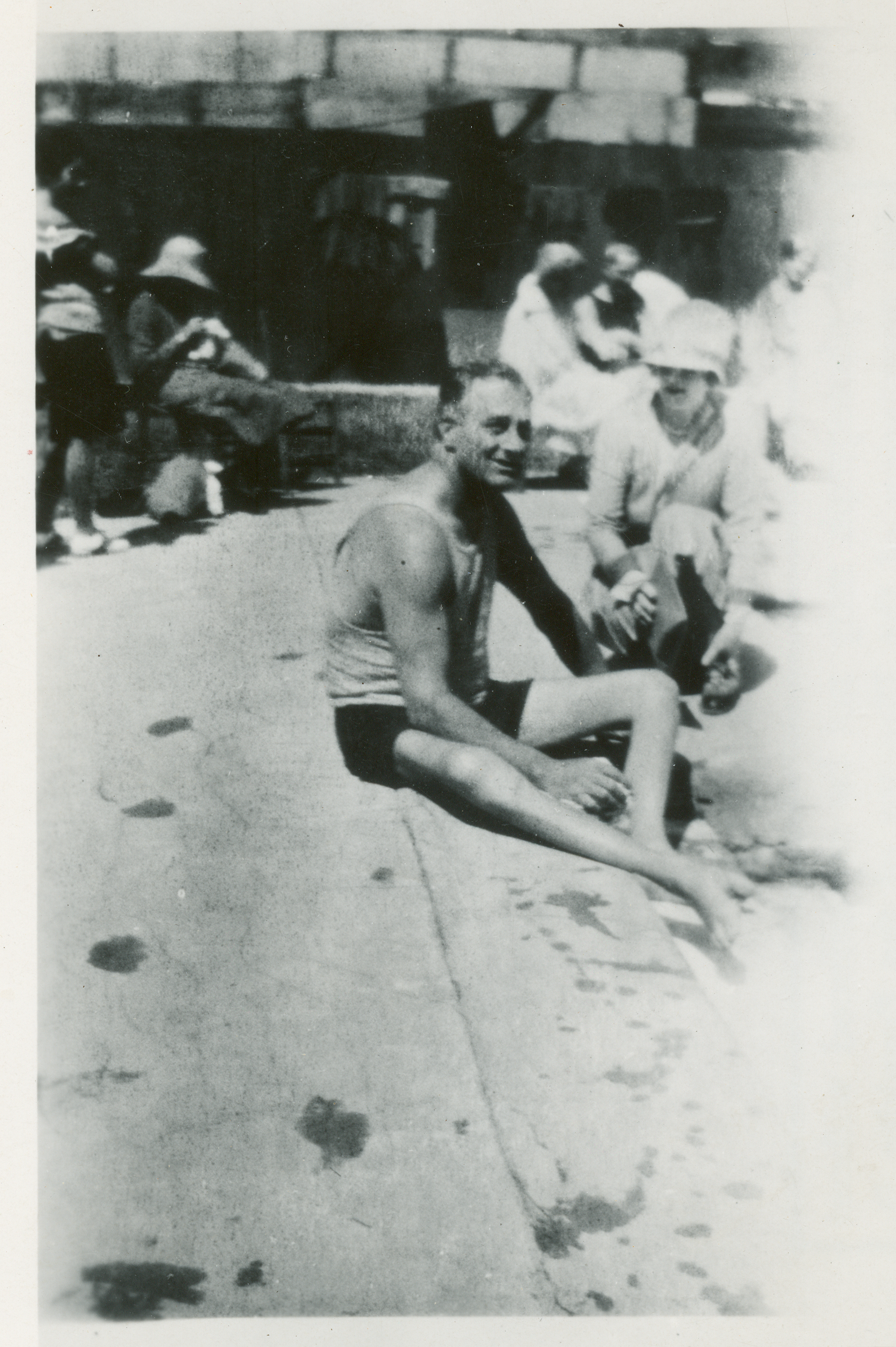
47-96 2331(Public domain image used under CC 2.0 via)


If you’ve happened to set aside 14 hours in the last month for Ken Burns’ The Roosevelts: An Intimate History, which aired on public television in the U.S., you know it affords considerable attention to FDR’s disability. Most touching is a 10-minute feature about Warm Springs, the Georgia health spa and rehabilitation center for polio patients, which Roosevelt founded and which soon became his primary vacation destination throughout his political career. Former employees and patients tell of him shaking the hands and asking the names of every patient, swimming alongside them and dunking whoever got within arm’s reach.

His biographer Geoffrey C. Ward explains:

It allowed him to be unself-conscious about polio… I don’t care how magnetic or self-confident you are, or you think you are… At Warm Springs, he could: not wear his braces, and go to the swimming pool, and have everybody see how small his legs were and it didn’t bother him at all because there were people there with worse problems…

He loved being one of them and the number one of them at the same time… To see someone so famous, who suffered from exactly the same problems that you suffered from, meant an enormous amount to all of the people who went there. Most of the people who went there went there mostly out of despair, at least at first. There wasn’t any other place to go. And here was this laughing giant who would kid them, and who would make the kind of awful sick jokes about being handicapped that other handicapped people love, but that you can’t share with anybody else. He loved doing that.

FDR told the staff that all at Warm Springs were equals, and many interviewees point to this as the beginning of his dedication to humanitarian, egalitarian projects. “It is tempting and probably true to say that polio gave FDR the gift of empathy,” says George F. Will. “There was no suffering that he could not in some sense relate to. And also, just as soon as the iron [brace]s were clapped onto his legs, the steel entered his soul. By having to fight through the constant pain of therapy that was unforgiving in its demands and not very fulfilling in its success.”

FDR had intended to market Warm Springs as both a vacation resort and a health spa, hoping the profits from the hotel would fund the rehabilitation center. The hotel ultimately failed, according to Burns’s documentary, “because prospective guests were scared off by the presence of polio patients.” Outside Warm Springs, attitudes toward disabled people were hardly tolerant. When voters elected a disabled president in 1932, 1936, 1940 and 1944, they did so in spite of his disability, not in acceptance of it.

Doctors attested to his physical and mental fitness in newspaper articles that asked, “Is he healthy enough to be president?” When Teddy Roosevelt’s family publicly opposed FDR’s candidacy, his daughter Alice took an ableist tack. Her famously hyperactive father had had the strength and will power to overcome his affliction, she argued, referring to TR’s childhood bout with asthma, while FDR’s paralysis from polio was a sign of his weakness and the reason why he embraced such wimpy social policies.

And here I thought Ann Coulter was a modern phenomenon.

Both Ken Burns and Geoffrey C. Ward contend that FDR could not be elected today. Ableism was pervasive in the 1930s and 40s, and it was well understood that publishing photographic evidence of his disability—his braces hidden by the podium, his difficulty getting in and out of cars, his regular falls—would be too detrimental to his image. But the press obliged. Photos like this one remained out of the public eye. Today neither the media nor bystanders with cell phone cameras afford anyone such privacy.

Appearance is as important as ever to politicians, if not more so since images in film, in print, on television, and online are countless times more prevalent now than they were in FDR’s time. This ubiquity is both the cause and the result of our expecting to see celebrities up close and from every angle. While Germany distanced itself from the idea of demanding charm and showmanship from their political leaders in the post-war era, America became ever more preoccupied with it, giving more credence to the photogenic Kennedys than any other presidential family.

The power of representation cannot be underestimated. We all like to be able to identify with famous and successful people because it imbues us with optimism about our own chances for success. We watch documentaries about celebrities’ lives in the hopes of discovering that they are the kind of person we would like, and who therefore would like us, if they ever had the chance to get to know us. Such idol worship, whether severe or mild, is of course ultimately irrational. But it satisfies the emotional need for recognition. If we cannot go on to be president for whatever reason, we can enjoy living vicariously through someone who does.

Ward is right when he speaks of how meaningful it was for ordinary patients with polio to see a sitting president with polio. But it is discouraging to consider that only those who could make the trek to Warm Springs were able to have the experience. And it is discouraging to consider Ward and Burns’ contention with its implication that disabled people today cannot have the experience of seeing a visibly disabled president because the American people will not elect one. Are they right?

In our age of a million media images, we commonly see senators, singers, elite athletes and film stars visiting disabled and ill children to boost their morale. But none of these celebrities are simultaneously as enormously powerful and as visibly disabled as Franklin Roosevelt was. Indeed, no one since his time ever has been.

Would You Rather Be Born Disabled or Become Disabled? (Part Two)

28 Sep

Dead body(Image by Stéphane Lavoie used under CC 2.0 via)


Most of them were not born with dwarfism. This is what I observed from a history of eminent dwarfs who enjoyed some degree of success outside of freak shows before the minority rights movements of the late 20th century. Most of them, such as Toulouse-Lautrec, experienced stunted growth as the result of an accident or an illness well after birth. Well after it would have been socially acceptable for their parents to give them up or hide them away. Such cases account for a very small minority of people with dwarfism, yet they dominated the scene of non-marginalized dwarfs for most of Western history. This got me thinking.

I conducted a crowd-sourcing experiment on Facebook, asking friends to name very famous people with severe physical disabilities. They had to be household names, nothing along the lines of “that little guy on Game of Thrones” or “that comic on that show from the Eighties who had a muscle problem.” The list of responses bore no surprises: Helen Keller, FDR, Beethoven, Frida Kahlo, Ray Charles, Christopher Reeve, Stephen Hawking, Michael J. Fox. All but two of them—Stevie Wonder and Oscar Pistorius—incurred their disability after infancy. Was this another sign of congenitally disabled people being hidden away? The vast majority (85%) of disabled people become disabled after birth. But the 15% whose conditions are congenital appear to be underrepresented in public.

Does society more readily accommodate those who lose certain abilities than those who never had them to begin with? Anthropologists know that for most of human history any injury or illness without a visible cause was presumed to be the result of black magic or a vengeful deity. From the European mythology of the changeling right up to the Nazi condemnation of genetic “monsters,” congenitally disabled people have been traditionally viewed as non-human and segregated accordingly. Vestiges of this remain in our general tendency to simply not consider congenitally disabled people as potential friends or partners or even peers, in contrast to the conviction that we should stick by our loved ones no matter what befalls them. Pop icon Dick Clark was warmly welcomed back to television as a co-host after his debilitating stroke, but I’ve yet to find a TV presenter in America who was born with a speech impairment like the one Clark developed. I don’t have the funding to empirically test my hypothesis, but you don’t have to delve too far into mainstream media to come up with stories, articles and interviews spotlighting someone who seemed to have it all until one fateful day when tragedy struck. And notice the comparable paucity of such resources on people who have always lived that way.

I squirm as I write this for fear of implying that those who become disabled have an easy time of it. Far from it. It would be utterly callous to ignore the often indescribable strain illness and injury can inflict on relationships, and the horrific social isolation that too many patients face. There’s a reason that “fair-weather friend” is a well-known term. And the human fascination with suffering can be more voyeuristic than empathic.

But no matter the motive, it is always accompanied by the unspoken understanding that no one would ever want to become disabled. This is, in essence, the most universal view of disability: Who on earth would want to lose an ability of any kind?

Even as a congenitally disabled person I understand this. I would never choose to erase my dwarfism from my life experience. But I do not like becoming more disabled than I already am. After tendon injuries and surgery to combat stenosis, I miss being able to ride a bike, to walk barefoot, to cook and type and sit on benches for long periods without pain. And if tomorrow I were to lose my ability to hear, see, or walk, I would be distraught, to put it mildly.

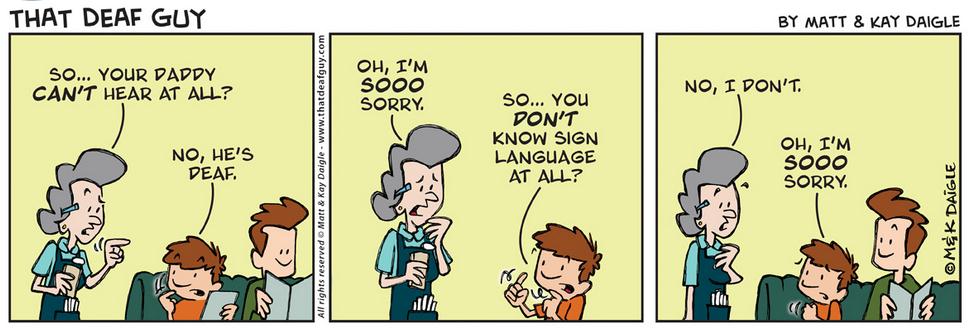
But in voicing this, it is crucial for me—and everyone listening to me—to recognize that my becoming deaf would be a profoundly different experience from that of my friend who has been Deaf since he can remember. Many Deaf people with cochlear implants have told of how overwhelmingly unpleasant hearing sound for the first time can be: One man has “discovered that, far from being adorable, the voices of his grandchildren were rather shrill and often best experienced with the implant turned off.” That Deaf Guy comic strip tells of the authors’ son pitying people who don’t know how to sign.

Similarly, those who have always needed a wheelchair to get around tend to see it as no worse than needing shoes to get around. Yes, it’s inconvenient in a world where ramps are all too rare, just as it would be inconvenient for those of us who are ambulatory if most public facilities didn’t accommodate the shoes on our feet. But that difficulty is imposed by a society that fails to accommodate certain minorities, not by the disability itself. Congenitally disabled bodies do not notice what they lack. As so many have said before me, How can you miss something you never had to begin with?

Researching all of this has brought me to the following conclusion: As individual humans, it is harder for us to deal with becoming disabled than with being born disabled. But as a society, the reverse is true – it is harder for us to accept someone who is born disabled than someone who has become disabled.

As a result, those who were born disabled and those who have become disabled often find themselves on opposite ends of the argument. A woman like Stella Young, who has never been able to walk, is rightly insulted when people tell her she is brave and inspiring just for getting up every morning. (Her TED Talk below is worth every minute.) But a woman like Christine Miserandino, who is slowly losing the ability to walk, is rightly seeking others’ encouragement and support as she struggles to do something she once took for granted. (Her oh-so-quotable Spoon Theory has already been linked on this blog before.)


Because the majority of disabled people are like Miserandino, not Young, the discourse on disability is dominated by sympathy, fear and lamentation. It is hard for us to remember that we shouldn’t pity a woman with cerebral palsy for her spasticity when so many people with multiple sclerosis openly mourn their loss of agility. Those who become injured or ill are entitled to their grief and no one should ever attempt to silence them. But everyone should think beyond their own experience before they publicly decry their condition as unbearable. Especially when it ends up joining the chorus of ableism led by non-disabled people.

One of the most read articles at The Atlantic this month is a piece by bioethicist Ezekiel Emanuel who explains why he hopes to die before age 76:

[Living too long] renders many of us, if not disabled, then faltering and declining, a state that may not be worse than death but is nonetheless deprived. It robs us of our creativity and ability to contribute to work, society, the world. It transforms how people experience us, relate to us, and, most important, remember us. We are no longer remembered as vibrant and engaged but as feeble, ineffectual, even pathetic.

Emanuel is an amateur mountain-climber and a professional writer. He is entitled to feel upset at the idea of losing the abilities he currently holds most dear. And his other arguments about the drawbacks to longevity are as thought-provoking as physicians’ personal opinions on life-saving interventions. But his decision to openly denounce dependence and weakness as unproductive and undignified increases the lifespan of our culture’s ableism. How can we ever stop marginalizing disabled people if we continue to openly voice our fear of becoming like them?

The experiences of those who are born disabled and the experiences of those who become disabled are profoundly different and equally valid. Simply remembering that would change a lot.


Would You Rather Be Born Disabled Or Become Disabled? (Part One)

21 Sep

Abstract Body(Image by srslyguys used under CC 2.0 via)


Imagine your body just as it is, in a world that looks exactly like the one we live in, but for one crucial difference:

You’re at a dinner party with some friends and some new faces, and you excuse yourself before heading to the bathroom. When you return to the table, you notice a few people exchanging looks. You wonder if your friends explained your absence to those who don’t know you well. You’re not sure if you should explain it yourself. Do you owe it to them? You’re not embarrassed, but they look a bit embarrassed for you. Then again, maybe you’re just being paranoid? You’re not really in the mood to get into it, and maybe these people would find it inappropriate dinner conversation. Maybe they’re the kind of people who would cringe, and you’d rather not discover that about them just now because the evening has been going pretty well and they seem nice so far.

Just when you decide not to say anything, the woman next to you asks, “Is everything okay?”

You reply, “Um, yeah.”

“Why did you get up and leave? Do you smoke?”

“Oh, no. No, I had to use the bathroom.”

“Oh… Wait, you mean like… you’re one of those… um… what’s the word for it?”

“Yeah. I’ve got frequent excretion syndrome. I have to use the bathroom a couple times a day.”

“Like, more than once a week?”

“Yeah, a couple times a day.”

“Like, every few minutes?”

“No, not that often. Just every few hours or so.”

“So you can’t hold it in?”

“Well, I’m—we’re—not supposed to. Not for too long. The doctors say it’s not healthy.”

“Wow. That must be so hard! How do you it?”

If 99% of humankind evolved in a way that they only needed to excrete once a week—as ball pythons do, for example—then modern society would look pretty different. The number of toilets available in public facilities would decrease significantly. A home with a bathroom would not be unheard of, but it would be a bit of a luxury, like an apartment building with an elevator. No one would assume that dinner at a restaurant or a friend’s house would guarantee access to such facilities. And the 1% of people who still needed a bathroom a few times a day would be considered disabled.

Eventually debates would crop up as to whether needing to excrete so often is “defective” or “just different.” There would be arguments as to who should accommodate whom: Should society provide more bathrooms, or should the minority wear diapers? Would you date someone who did? It must be so hard for parents and partners to deal with someone like that! I read on the Internet that those freaks do it in the shower! I would never get in a pool with one. You shouldn’t let your kids near them!

If you lived in this world, where most people’s bodies did not need to excrete more than once a week but yours did, you would undoubtedly experience frustration, as most disabled people do. But the source of your frustration would depend upon how you got to be the way you are.

If, after an accident, you suddenly belonged to a small minority of people who needed a bathroom more than once a week, you would experience a good deal of stress adjusting to your new schedule. Losing an ability you had taken for granted would feel unfair. Life was so much easier before this happened! Why me?! Some would be arguing that they would rather die than live like that. Depending on your support network and self-image, you might join that argument. But no matter how accepting your friends and family were, you would probably struggle with some internal shame about being less independent.

But if your body had always functioned that way for as long as you could remember—as it presumably does in the real world—most of your problems would stem from how alien the majority would make you feel. In the real world, we can all admit that needing a bathroom a few times a day can be inconvenient, especially on car trips, but it doesn’t feel “wrong,” “sick,” “crippling,” “freakish,” or “sad.” In a world where you’re the minority, you might accept the idea of wearing diapers rather than demand more bathrooms be built for you, or you might be deeply insulted by it. You might decide to combat the stigma of diapers. You would likely be upset hearing people say they would rather die than live like you.

That’s the difference between people who are born disabled and those who become disabled. The latter understandably experience stress, sometimes trauma, adjusting to a new condition. The former rarely feel the need to miss what they never had to begin with. Society likes to offer both groups pity. But they often respond to this pity with different answers because they have many different experiences. As we’ll see next week, conflict can only be avoided if everyone involved—those who were born disabled, those who became disabled, and those who are non-disabled—tries to understand the others’ point of view.


Everyone’s Sexuality. Everyone’s.

7 Sep

mjaxmi1inge5ntm3ymu4ngnkytg5


Don’t read the comments. Don’t read the comments. Don’t read the comments. 

That’s what raced through my mind as I read “The Challenges of Having Sex As A Little Person” at The Atlantic. Of course I read the comments anyway. 

And I was only slightly startled to find nothing but solipsistic snickering and overdone puns. The Atlantic doesn’t win any points for ending the article on a pun, either. But praise is due for addressing the topic at all. Based on an extensive interview with Dr. Marylou Naccarato, who has Kniest dysplasia, the article takes a wonderfully sex-positive approach to the experiences of people with dwarfism and the physical obstacles they can face in bed.

As per nearly every feature on dwarfism in the mainstream media, there are some factual errors. For example, one dwarf couple is quoted claiming that people with achondroplasia require “no medication, surgeries, special needs, nothing.” (See here for a list of the many complications we are at risk for.) But Naccarato is doing great work that is revolutionary in light of the fact that Little People of America, and probably most disability advocate organizations, repeatedly shy away from the topic of sexuality.

A simple reason for their silence is that almost all disability organizations comprise just as many parents and relatives of disabled people as disabled people themselves. And who wants to debate the best way to masturbate with Mom or Dad sitting next you? A more sinister reason for the silence is one of the building blocks of modern prejudice against disabled people: that is, the presumption that they are innocent, and therefore asexual. Most positive portrayals of disabled people are cute and cuddly. Is it the only way society can accept us? Refusing to see a minority as anything but asexual is to deny them their full humanity, on par with slut-shaming, prude-shaming, queer bullying, and objectification.

Before I go any further, let me say this: I do not want to talk publicly about what I do in the bedroom and I do not want to know what you do in the bedroom. My firm belief in sex-positive feminism and equality does not mean I think that you are sexy or exciting or impressive. Unless we’re close confidantes or I’ve indicated otherwise, please assume I don’t want any mental images of you and your naughty bits, no matter what they look like.

That said, I fully support anyone’s right to desire any sort of consensual sex imaginable. Without double-standards. Without the pressure of competition. Without the nuisance of others turning their personal preferences into rigid rules.

Take, for example, the way virginity is so frequently turned into not just a game but a high-stakes tournament. When and how did you lose it is an idea all of us are expected to base much of our identity on, even as adults. This is despite the fact that, according to medicine, virginity doesn’t exist. After all, what kind of sex does a guy have to engage in to officially “lose” it? And what about girls born without hymens? When exactly do lesbians lose their virginity?

Like race, virginity is a social construct and, in the words of a very wise person on Tumblr, what can be socially constructed can be socially changed. Last year the great Tracy Clark-Flory interviewed acquaintances about the sexual experience they considered to be their “first time.” The glorious thing about her inclusive project was that it revealed human sexuality to be just as diverse as everything else about us. Some defined their first time by their first orgasm, others by a particular first touch or experience of being touched. The problem with her stretching the definition of “losing your virginity” so broadly is that it robs competitive, insecure people of their ability to set standards with which they can gloat and put others down. Wait, no. That’s another glorious thing about it. There really is no problem with recognizing everyone’s experience as equally valid.

Failing to include everyone not only causes unnecessary humiliation, but it causes us to miss out on opportunities for true enlightenment. To quote the authors of You Can Tell Just By Looking: “Sexual minorities—people whose sexual desires, identities, and practices differ from the norm—do a better job talking about sex, precisely because they are constantly asked to explain and justify their love and their lust to a wider culture and, even, to themselves.”  The more you examine harmful traditions, the less necessary they become.

This does not mean that minorities have better sex. Indeed, too many activists in the sexual revolution end up repulsing readers and listeners when they allow pride in their sexuality to devolve into arrogance, insisting their sex life is better than yours, rather than merely different. For a year, the BDSM club at my alma mater ran the slogan: “I do what you’re scared to fantasize about.” Not helpful. And kinda pathetic the more you think about it.

I will never judge someone for liking any particular kind of consensual sex, but I will judge anyone who tries to turn sex into a competition to calm their own self-doubts. Whether you’re a wise-cracking online commenter or a sex-positive pioneer, true sexual liberation is about moving beyond the middle school clique mentality, not indulging in it. It’s pretty much the least attractive thing there is.

Would You Give Up A Disabled Baby, And If So, Why?

10 Aug

Youri(Image by Naoya Fujii used under CC 2.0 via)


Tonight 60 Minutes will feature the very first interview with the Australian couple that has attracted international scorn ever since the Thai woman they hired to be their surrogate mother publicly accused them of adopting one of the twins she gave birth to while refusing Baby Gammy, the one with Down Syndrome. Hiring a surrogate mother who lives abroad is both legal and unregulated in Australia, with none of the criminal background checks or counseling that are required for domestic surrogacy arrangements.

The Digital Age has seen the rise of prospective parents independently seeking out surrogate mothers online without any oversight, as well as a rise in “re-homing,” wherein adoptive parents join Facebook or Yahoo groups to seek out new parents for a child they’ve decided is harder to handle than they had thought. A disturbing Reuters report last fall profiled a couple who handed over a girl with medical problems they had adopted from Liberia to a new family they had found online, only to later discover that the new parents were known sex offenders.

Yet while black market adoption may be on the rise thanks to the Internet, the history of people rejecting only certain kinds of children is depressingly long. Only 2% of all babies born are disabled, yet half of the children up for adoption in the United States are disabled. Half of them are also black. Chad Goller-Sojourner told NPR this year that prior to his adoption by a white family, he was passed over by more than one black couple for being “too dark.”

I am deeply grateful that my parents did not put me up for adoption, like so many parents of dwarfs before them. Being rejected by your own parents simply for your body feels like a rejection of your very life. But I will not start chanting that parents should never ever make adoption plans for their children until we admit that not everyone is capable of being the sort of parent certain children need. The skills required for accepting your child’s skin color or body shape are not the same skills required for accepting a lifetime of waiver agreements about the deadly risks of invasive surgery. In the real world, some marriages do break down and some parents do become abusive and some parents do murder their half-grown children when they try and fail to cope with their child’s disability. I know a good number of people who are great at working independently but terrible at caregiving. In Far From the Tree, Andrew Solomon profiles a British woman who eventually relinquished custody of her severely disabled daughter to a foster mother, telling the NHS, “I’m not the right mother for this child.” Such honest humility requires some degree of bravery and, as Solomon points out, honors the skills of the foster mother and all parents who keep their commitments to disabled children.

Do some parents give up too easily? Absolutely. But are some children better off far away from their parents? Evidently. Because no two parents are alike, what is best for the child is best decided on a case-by-case basis. The Australian case sounds dreadful, but I’m withholding judgment until the parents have had their say. And as long as there is reproduction, there will always be parents who put their children up for adoption or terminate pregnancies, and society must thus ensure that the means for doing so are absolutely safe and heavily regulated.

But we cannot deny that too many parents end up failing to support certain kinds of children because the society they live in fails to support such kinds of people. Parents can usually see through the B.S. of those who urge them to stand by their kids no matter what and who also regularly make disparaging remarks about scars, fat, or dark skin, and openly wince at the idea of looking like a freak, a wimp, or a pussy. We won’t ever lower the disturbing number of prospective parents who would reject a child with an extra finger or toe until we as a society confront what would cause a parent to think that having an extra finger or toe is too horrific to endure.

During a discussion in college about the individual’s right to make their own medical decisions, I was shocked to hear a bunch of my friends insist that they would rather die than lose the ability to walk. Is it possible to attach such extreme shame to a hypothetical situation for yourself without attaching shame to the situation of others who live that way every day?

When I told one of my fiftysomething mentors about how upset I was by the incident, she smiled and said, “Well, that’s something young people are certainly more likely to say than anyone else.”

A fortysomething friend piped up, “Yeah, that is a very young person thing to say. I swore when I was young that I’d shoot myself if I ever went bald and yet here we are!”

Indeed, while the strains of physical pain and special accommodations and repeated doctor’s appointments are very real, perfection is not. And no matter how far technology advances, the belief that we can guarantee ourselves “normal” children is delusional. After all, unlike Baby Gammy and I, 85% of all disabled people were not born disabled. That’s something to bear in mind when heading to the obstetrician’s or the adoption agency.  


CPS: The Sticky Business of Not Minding Your Own Business

20 Jul

(Via)


A South Carolina woman was arrested earlier this month for allegedly letting her 9 year-old daughter play alone in the park while she went to work at McDonald’s. The mother had given her daughter a cell phone for safety’s sake, but a concerned stranger’s call to Child Protective Services led to the mother’s incarceration and loss of custody. Bloggers on both sides of the political spectrum are outraged over what they are calling a case of helicopter parenting gone mad. On Twitter, stories of “When I was a kid…” abound.

I wholeheartedly share their shock and dismay. (Seriously, couldn’t CPS have merely talked to the mother and helped her find a friend or a caregiver whose home could be a base for the girl during mom’s eight-hour shift?) But I am concerned about the mounting vitriol aimed at those whose job it is to protect the child. I grew up among social workers. And these bloggers, while rightfully critical, are failing to acknowledge that the mind-your-own-damn-business mentality they advocate is exactly what prevails in societies where everyone looks the other way when a child is neglected or abused.

Of course there are terrible social workers out there, just as there are those to be found in any profession who should really be working elsewhere. More importantly, it is dangerous to pretend that institutionalized xenophobia does not exist. A 2012 report revealed ableism appears to be a tremendous problem at CPS, with many disabled parents living in fear of being declared incompetent by social workers with a poor understanding of their abilities. In the South Carolina case, it seems reasonable to postulate that two of the American South’s most infamous cultural institutions—classism and authoritarianism—are what led to a cruel and unusual punishment doled out for what was, at best, a misdemeanor by a working mother.

But while attention to this case is warranted, news outlets tell real-life tales of wrongly accused parents to such an extent that one would assume most actions by CPS are unjustified. The media bias tends toward parents because parents are legally allowed to talk publicly about their children. Were a social worker to attempt to tell his side of story, he would be breaking the law. And children and families grateful to CPS for repairing broken homes rarely head to their local news station to rehash their past personal struggles.

We must acknowledge and condemn every instance of misconduct by social workers, just as we must acknowledge and condemn every case of medical malpractice, and of police brutality. But unlike doctors or police officers, social workers do not enjoy a wealth of Hollywood blockbusters and TV shows glamorizing what they do. Most portrayals in film and on television are fiercely unflattering: from the soulless bureaucrat too obsessed with rules to know love when she sees it, to the more sinister instrument of a government conspiracy to threaten political dissidents by taking away what they hold most dear. These stereotypes invariably evoke sympathy for the devastated parents and children, who wish those heartless busy-bodies would just learn to stay out of other people’s business. Rarely are social workers featured fighting the good fight.

And yet, that’s what they are there to do. Not to get a thrill from ripping crying kids away from their distraught parents, but to listen to every member of the family until they understand the source and extent of the problem. While pop culture promotes individual therapy as a path to wellness on par with yoga or meditation, the idea of family therapy tends to be seen as an outrageous invasion of privacy imposed by some glaring ice queen who is just waiting for the parents to slip up. Yet adept social workers know that the parents of neglected children sometimes have significant learning disabilities or were the victims of abuse themselves. When funding allows, parenting courses are available for those who have a hard time remembering how often diapers need to be changed, or that there are often alternatives to screaming and spanking. Adept social workers also know that neglected children are often overly forgiving of an abusive loved one, just as victims of domestic violence often are. And adept social workers know that children are far more likely to be abused, molested, or kidnapped by a member of their family than by a stranger. As with women, the most dangerous place for a child is their own home.

When I was an 11 year-old on Long Island, there was a report that a girl my age named Katie Beers had been kidnapped from a local arcade where I’d attended birthday parties. The perpetrator turned out to be a friend of the family, who kept her locked in his basement for 17 days. When he broke down and confessed to police, Beers was not returned to her mother, but placed in a foster home. I clearly remember the mother’s tearful face plastered across the headlines: “I just got her back and now they’re taking her away from me!” CPS investigators had discovered that, prior to the kidnapping, Beers’s mother had left her for years in the care of her godparents, where she was treated “like a slave” and repeatedly raped by her godfather. Beers writes today that she was ultimately relieved to be placed in foster care and that, had she not been taken out of her home, she never would have graduated high school, let alone college.

When it comes to the legal rights of the child versus the rights of the parent, the court of public opinion will always be fueled by vitriol. Family court, of course, should transcend this, putting reason and research first and foremost. CPS is undoubtedly rife with problems, many due to its miserable lack of funding. But we as a society will never put forth a sincere effort to endow social workers with enough funding to do their job well until we truly value what they do in the first place.


* Please note that while my sympathy for the social worker’s perspective is inspired by what I’ve learned from those I know, the views and conclusions expressed here are mine and mine alone.


What Do We Want? Visibility!

8 Jun


Leaving you this holiday weekend with the brilliant Maysoon Zayid whose TED Talk above includes myriad revelations well worth your time, among them:

One fun fact I learned while on the air with Keith Olbermann was that humans on the Internet are scumbags. People say children are cruel, but I was never made fun of as a child or an adult. Suddenly, my disability on the world wide web is fair game. I would look at clips online and see comments like, “Yo, why’s she tweakin?” “Yo, is she retarded?” And my favorite, “Poor Gumby-mouth terrorist. What does she suffer from? We should really pray for her.” One commenter even suggested that I add my disability to my credits: screenwriter, comedian, palsy…

Disability is as visual as race. If a wheelchair user can’t play Beyoncé, then Beyoncé can’t play a wheelchair user. People with disabilities are the largest minority in the world and we are the most underrepresented in entertainment.

Indeed.


Segregation Loses In German Court

25 May

Untitled(Image by Angela Schlafmütze used under CC 2.0 via)


People must learn to accept their disabled neighbors, a Rhineland court ruled this week in a case that—thankfully—has attracted controversy. A woman in the town of Kaltenengers, near Koblenz, filed suit against the construction of a home for severely disabled citizens near her apartment block. According to the Rhein-Zeitung, the woman and several other residents had expressed outrage at the supposed imposition upon their community, while their court arguments sparked outrage among the public. The plaintiff claimed that, “The vocalizations and noises made by the disabled will injure our own psychological well-being.” Talk about not-in-my-backyard.

All of us have sympathy for the NIMBY mindset to some extent. I’m fine with my neighbors playing music as long as it’s the right kind of music. (ZZ Top, yes. Opera, no. I can attest that nothing pierces through paper-thin walls at 2 am like a soprano aria.) When it’s the night before the most important exam in your academic career, you want everyone within a five-mile radius of you to shut up. When it’s the night after you’ve passed that exam with flying colors, you wish those prissy neighbors interrupting the celebrations to tell you to pipe down would let go and live a little. Such moments serve as reminders that Everybody matters is easier said than done.

There will always be debates about pristine parks, where the grass is there to be looked at, versus people’s parks, where the grass has been picnicked to the brink of death. (Berlin votes today on that very issue in deciding the fate of Tempelhof Park and, for many, the definition of Berlin itself.) But NIMBY descends into a segregationist mentality the moment we reject the idea of certain types of people outright. And in this court case, pitting disabled residents against their huffy neighbors, it makes you wonder who is really the most challenged in becoming a well-adjusted member of society.


How to Help Your Doctor Get the Job Done

23 Mar

(Via)


If you’ve ever had to undergo strings of medical tests or lengthy procedures, you know that there are plenty of doctors, nurses and technicians out there who could do with a few lessons in etiquette and bedside manner. I could spend years on this blog documenting every moment I was snapped at, interrupted, or made to feel like a nuisance while I was fretting about test results or mounting pain. It would take me a decade to do justice to all the horror stories I’ve heard from friends and fellow patients.

But the poor manners of all those (probably overworked) professionals who made a tough situation worse render the kindness of others all the more dazzling. (I love you, Nurse Wilson!) And it’s crucial to bear in mind that the patient’s version of things is only one side of the story. Medical professionals rarely get to see people at their best – their job is to witness and inflict pain all day. They must remain objective while navigating a sea of misery and fear, where not everyone claiming to be severely sick really is.

In order for doctor and patient to have the best possible experience, both have to be aware of what the other requires. Which is why I’m handing over the mic to Dr. Leana Wen, who’s penned an excellent article called “The 10 Types of ER Patients” this week. Her pieces of sound advice include:

No. 3: The Googler. The Internet can be a powerful tool for empowering patients, but please use it responsibly. Looking up your symptoms yourself might turn up that you have a brain tumor when you have food poisoning or that you are pregnant when you have belly pain (and you’re a man). Use the Internet to help you understand your diagnosis and treatment and to come up with questions—not to diagnose yourself.

No. 4: The “Pain All Over” Patient. We call it the “positive review of systems” when you say yes to everything we ask. Headache? Chest pain? Shortness of breath? Fatigue? Muscle aches? Yes, yes, of course, yes. Some illnesses really affect many parts of the your body, but more often than not, patients will say yes to convince us they are ill. We know you aren’t well, so tell us the truth. (If you don’t, you run the risk of undergoing unnecessary testing.) If everything hurts, try to tell us your story. When did you last feel normal and well? What happened then? And please don’t exaggerate. If you say that your pain is 15 out of 10, but you’re eating lunch and texting on your iPhone, it’s hard for us to calibrate your symptoms.

Head over to Slate to read the whole thing.


Barbie vs. Lammily

9 Mar

Lammily is Barbie’s new contender(Image by Day Donaldson used under Creative Commons license via)

Barbie turns 55 today and her birthday risks being overshadowed by a rival. Designer Nickolay Lamm has kicked off a very successful crowdsourcing campaign to fund the production of Lammily, a doll whose body is modeled after the mean proportions (taken from the Centers for Disease Control) for an American 19 year-old because, as her slogan goes, “average is beautiful.” The center photo above shows Lammily at her earliest design stage in contrast to Barbie. The left and right photos show her updated, final form.

Despite that her name sounds like the way most toddlers mangle mine, Lammily does seem quite lovely. But mostly because the problems with her competitor are countless. Barbie represents—and was very much intended to represent—an idea born in the middle of the last century that little girls should play not just with baby dolls or girl dolls, but with a woman doll, a post-pubescent beauty they should aspire to. The very first Barbie was inspired by the German Lilli, a character featured in tabloid comics who worked as a secretary by day and an escort by night. While it’s disputed whether or not the Lilli doll was in fact a sex toy, the longer you look at Barbie, the more that explanation makes sense.

Barbie is all fantasy: too thin to menstruate, with breasts so big she’d have to crawl on all fours to get around. (Sporty Lammily could knock her to the floor with a light kick.)  Fantasies about beauty are fine as long as they remain a niche, not a standard. If her fame and influence were not so unparalleled, Barbie wouldn’t be a cause of much trouble. But she is the most famous doll in the world, and while she often changes jobs and outfits to bend to society’s trends, her body type never budges from the sex toy standard.

My mother swore I would never own a Barbie—how could it be healthy for a girl with dwarfism to idolize a lady who’s all legs?—but a neighbor bought me one for Christmas, and within the next 10 years I owned 12: Tropical Barbie, Superstar Barbie, Ice Capades Barbie, Gymnast Barbie, Fun-to-Dress Barbie, Loving You Barbie, Hollywood Hair Barbie, Cool Times Barbie, Dreamtime Barbie, Dream Glow Barbie, Dream Date Barbie, and my mother’s own, dragged-out-of-the-attic Barbie from the 1960s, whose earrings had turned her cheeks green. The funny thing is that every one of these Barbies had a slightly different face and slightly different blond hair with varying lengths and textures. But, just like the Disney Princesses, the bodies were all exactly the same. Barbie’s oh-so-80s Rocker friends Diva (brunette), DeeDee (black), and Dana (possibly Asian?) represented a broader range of hair and skin, but their bodies were all replicas of Barbie’s. This is what makes Lammily so radical.

But I don’t want an answer to Barbie. I want many answers to Barbie. Lammily correctly demonstrates that an average girl in the Western world is not blond. But blondes shouldn’t be any more excluded or celebrated than anyone else. Declaring “average” bodies and physical features a beauty standard continues to marginalize girls who deviate from the average. Another word for average is “normal” and it’s never fun for a young girl to hear that her body is “not normal.” Both Barbie and Disney have dared to dabble in the beauty of different ethnicities, but they haven’t been brave enough to try different body types – short, curvy, bony, disabled, with freckles or scars or glasses or birthmarks in the shape of Mexico.

In the words of artist Glenn Marla, there is no wrong way to have a body. If Mattel can invent over 50 varieties of blond hair for their preeminent princess, surely doll manufacturers can find a way to profit from providing a rainbow of body types. Maybe they will be brave enough by the next time International Women’s Day rolls around. That’s my fantasy, anyway.

What Makes A Cast Look Cool?

23 Feb

LegsOrthopedic casts haven’t changed much in 50 years, until now. Engineering student Jake Evill of New Zealand has designed the Cortex cast, a brace made from 3-D printing. While all casts could effectively be described as exoskeletons, the Cortex looks like one. Its lattice structure allows for ventilation, which Evill advertises as its greatest asset. The Cortex is still at its conceptual stage, but, as with almost all new technology, reviews in the media have been pulsing with excitement.

The problems of plaster and fiberglass casts are well known to anyone who’s had to wear one. They’re fairly heavy and very bulky. Worst of all, they make your skin itch like the dickens and you are forbidden from using any implements to scratch because the smallest cut can become badly infected in the dark, suffocating conditions damp with sweat and dead skin. I had to wear casts on both legs after two tendon surgeries and once after having Ilizarov fixators removed. The itching alone was bad enough to make me wish I had the fixators back on.

Anything that claims to be lighter and breathable is a very attractive proposition. But while the Cortex website boasts that the cast is waterproof and therefore perfect for bathing and swimming, this probably means that there is no cloth involved. The cloth lining between a traditional cast and your skin contributes to the itching, but it’s there to prevent abrasion. Watchmakers, jewelers and BDSM professionals all know that any material other than cloth or leather can pose serious risks to human skin.

And the claims that the innovative appearance of the new cast is stylish? What exactly makes a cast stylish? While I could see goths maybe being partial to the Cortex if they could order it in black, reviewers seem to be fawning over the look of it simply because it’s new. And the promotional photo for the Cortex features a well-toned, scarless, unbruised arm that looks a bit too healthy to contain a broken bone.  (I half-expect the owner of the model’s fist to be shouting, “BY THE POWER OF CORTEX!”) 

Style is all about what you do with what you’ve got.  Fiberglass casts come in assorted colors. I had hot pink ones while performing in a school play and ended up enhancing one dream-like scene lit only by ultra-violet light. When I had neon green casts, friends painted my toenails to match. And the good old tradition of letting your loved ones cover your limbs in graffiti is worth mentioning. A friend who is a professional painter adorned the bottoms of my feet with elaborate sunflowers.

Then again, some casts do not conceal only injuries. A young friend of mine once stuck a chunk of steak down her cast in order to get out of having to eat it before dessert. She managed to retrieve only part of it after dinner – the rest tore away and remained lodged deep in the plaster caverns enveloping her arm. Her parents remained unaware for days until the entire house began to reek of rancid meat. With the new cast design, families with deceptive children need not fear such hazards.  The Cortex offers not only porousness but transparency!


Does It Matter If It’s Genetic?

16 Feb

Photo 02-07-14 12 29 21(Image by Eduardo Unda-Sanzana used under Creative Commons license via)


There is an argument gradually gaining momentum in the LGBT movement: “So what if being gay is a choice?” Rather than lecturing social conservatives that homosexuality is an inborn trait and not a chosen lifestyle, we should ask them what’s so bad about two consenting adults loving each other. With bisexual, pansexual, and genderfluid identities becoming more visible, and all sorts of people becoming more open to experimenting, who really cares if any of it is a choice?

It’s an important question in the broader debate about sex and gender. And it forces me to question the parameters of this blog.

Painting On Scars is founded on the rights of people who are viewed as minorities based on qualities they have no choice about: gender identity, sexuality, ethnicity, nationality, class background, physical traits, and mental abilities. This foundation is built on my own minority status being indisputably determined by factors beyond my control. There is no doubt whatsoever that I was, as Lady Gaga hollers, born this way.

And when it comes to confronting bigotry, there is something particularly painful about being belittled for something you have no choice about. All of us can feel insecure about the decisions we make, but being told that you’re seeking work in the wrong field or that you talk too loud on the phone is still far less harrowing than being told that your natural appearance is universally repulsive or that your gender makes you intellectually or emotionally inferior. Every one of us wants to be accepted for the way we were born because a rejection of it feels like a rejection of our very lives. As autism activist Jim Sinclair explains:

When parents say, “I wish my child did not have autism,” what they’re really saying is, “I wish the child I have did not exist and that I had a different, non-autistic child instead.” Read that again. This is what we hear when you mourn over our existence. This is what we hear when you pray for a cure. That your fondest wish for us is that someday we will cease to be, and strangers you can love will move in behind our faces.

For this reason, Painting On Scars examines the existence of minorities who are born this way and the myriad reasons why any of us still struggle to accept them. (More on the complexities of parenting disabled children here.)

However, the born-this-way rubric is not always helpful. What about the explicit decision to not conform? What about the human right to the pursuit of happiness? It seems only natural—for lack of a better word—to defend alternative traits and behaviors that are very much a choice but do no harm. Women who don’t wear makeup. Filmmakers who dare to feature minority accents. People who want to preserve their parents’ cultural traditions rather than assimilate for assimilations sake.  Men who don’t identify as transgender but still very much like wearing dresses. Objection to these choices usually stems from a rigid belief in homogeneity or simply a difference in taste. Such objections make it clear to me as a blogger that as long as a difference doesn’t cause real harm, it is worth protecting from harm.

And conversely, I tend to defer to others when it comes to minority traits that people have little choice about but that do cause a good deal of harm: personality disorders, psychosis, sexual attraction to children, paranoia, trauma, suicide, or anything that precipitates emotionally abusive tendencies. I research these issues voraciously, not only because I have personal experience with many of them, but because they raise questions about human rights and individual freedom, as well as the greater good and personal safety. (The pro-mia and pro-ana movements, for example, argue that any attempt to treat or cure people with eating disorders qualifies as oppression rooted in narrow-mindedness.) Yet I refrain from opining about these issues publicly because my knowledge of them is as simplistic as they are complex.

Whether to change society or change oneself is a persistent predicament that accompanies every stage of life. When exploring the answer as it applies to minority issues, I keep coming back to the same question: Who suffers more in the change?  Humans have repeatedly proven to cause less suffering when we accept body diversity, intellectual disabilities, LGBT identities, and gender equality than when we oppress them.

Of course, what constitutes oppression and what constitutes acceptance is sometimes disputable. Alex Andreou argues this week in The Guardian that the current search for the gene for homosexuality is quite harmful. While LGBT activists have traditionally opposed the idea of homosexuality as a choice to combat those who argue for a cure through therapy, LGBT critics of the genetic research fear that discovery of a gene for homosexuality will lead to its elimination. Those of us whose conditions are genetically determined and socially marginalized have been acutely aware of this problem not just since the advent of the Human Genome Project 30 years ago, but since eugenicists began sterilizing all sorts of peoples over 100 years ago. In democratic societies where governments no longer dare to be too vocal about medical decisions regarding minorities, everyone still fears the coming of the day when insurance companies inform expecting parents that they will not cover children who will cost more. Because the existence of minorities precludes the efficiency of a one-size-fits-all system, we will always cost more.

In the spring of 1994, I was headed into the operating room to have my Ilizarov fixators removed. While prepping for surgery, one of the members of the surgical team excitedly told my mother, “Have you heard the news about achondroplasia? They found the gene! We can test Emily for it!”

My mother signed a release allowing for them to perform the test during the operation. Several weeks later I received a letter confirming that my fibroblast growth receptor gene 3 had the achondroplasia mutation. My first reaction was, “No shit. Who cares?”

I had been officially diagnosed with achondroplasia on my third day after birth, though admittedly, such an early diagnosis back in the 1980s was a stroke of luck. A girl with achondroplasia who later became my best friend had been born at the same hospital six months earlier, so the doctors recognized our similarities and ordered x-rays on my limbs. My achondroplasia was obviously a result of nature, not nurture.

Then again, in olden days dwarfism was often thought to be caused by mothers with loose morals. I myself had once asked my mother if perhaps I got achondroplasia because of the decisions she had made about the birthing process. (I had just watched Look Who’s Talking and had learned a lot about the pop culture understanding of what goes into having a baby.) The gene for achondroplasia explained how I got it, how I could pass it on, and lay rest to any modern blame-it-on the-mother mindset that might suspect it was because of aspirin or salami or cinnamon. Such information can—but does not have to—affect your sense of self.

A few years ago a woman living in the U.S. contacted me because her two-year-old daughter had been diagnosed with achondroplasia. The girl’s grandparents lived in another country and had steadfastly dismissed the diagnosis. “Americans are famous for over-diagnosing every little thing,” they shrugged. “She’ll grow out of it!” (Pun intended?)

A friend from the same country explained to me that disabled people there generally have few support networks and even fewer opportunities for independence. Perhaps the grandparents’ refusal to believe in achondroplasia stemmed from their fierce desire to remain hopeful about her future.

Would running a genetic test finally convince them to accept reality? When I was born, my parents and I benefited greatly from the dwarf rights movement of the 1970s and 80s, which had emerged due to the egalitarian spirit of the times that indulged in civil rights and celebrating diversity. As with the gay rights movement, millions of supporters showed that they did not need to see the results of genetic testing in order to justify and defend a minority’s right to exist and be accepted. If they could do it, so can we.