Segregation Loses In German Court

25 May

Untitled(Image by Angela Schlafmütze used under CC 2.0 via)

 

People must learn to accept their disabled neighbors, a Rhineland court ruled this week in a case that—thankfully—has attracted controversy. A woman in the town of Kaltenengers, near Koblenz, filed suit against the construction of a home for severely disabled citizens near her apartment block. According to the Rhein-Zeitung, the woman and several other residents had expressed outrage at the supposed imposition upon their community, while their court arguments sparked outrage among the public. The plaintiff claimed that, “The vocalizations and noises made by the disabled will injure our own psychological well-being.” Talk about not-in-my-backyard.

All of us have sympathy for the NIMBY mindset to some extent. I’m fine with my neighbors playing music as long as it’s the right kind of music. (ZZ Top, yes. Opera, no. I can attest that nothing pierces through paper-thin walls at 2 am like a soprano aria.) When it’s the night before the most important exam in your academic career, you want everyone within a five-mile radius of you to shut up. When it’s the night after you’ve passed that exam with flying colors, you wish those prissy neighbors interrupting the celebrations to tell you to pipe down would let go and live a little. Such moments serve as reminders that Everybody matters is easier said than done.

There will always be debates about pristine parks, where the grass is there to be looked at, versus people’s parks, where the grass has been picnicked to the brink of death. (Berlin votes today on that very issue in deciding the fate of Tempelhof Park and, for many, the definition of Berlin itself.) But NIMBY descends into a segregationist mentality the moment we reject the idea of certain types of people outright. And in this court case, pitting disabled residents against their huffy neighbors, it makes you wonder who is really the most challenged in becoming a well-adjusted member of society.


Should You Be Allowed To Hide From Google?

18 May

Big Google brother ?(Image by Alain Bachellier used under CC 2.0 via)


The European Court of Justice ruled against Google this week in upholding an individual’s legal right to be forgotten. That is, while newspapers and most online sites will retain the right to publish information about me (and anyone else living in the European Union), I can now petition Google to remove its links to such sites so that they will no longer appear in search results for my name. The ruling has a good deal of support here in Europe, but Google, Wikipedia and newspapers across the Atlantic are crying censorship.

I personally don’t plan on making such a request any time soon, but I am disappointed that both the ruling and Google’s opposition to it fail to distinguish between public figures and private citizens. Under U.S. law, public figures are defined as those involved in public affairs (politicians, officials, etc.); those who actively seek public attention in order to influence the discourse of one or more issues (activists, pundits, outspoken celebrities or entrepreneurs); and those involved in issues of public interest whether or not they seek attention (criminals, all celebrities ever, spouses and relatives of politicians and celebrities). Public discourse benefits from search engines being able to produce a comprehensive collection of resources about public figures. Yes, this will always result in a plethora of worthless vitriol, but as unfortunate as this is, public figures must respect everyone’s right to hold and express free opinions about them, whether someone thinks that George W. Bush is a fascist or that Jeff Bezos is a fascist. But I believe private citizens deserve greater protection.

While we can all control what we publish about ourselves on the Internet, we cannot control what other people publish about us. Photos often require our permission, outright lies can be punished by slander laws, and children are also heavily protected from exposure by anyone other than their parents.  But private citizens usually have fewer resources for combating defamation and slander. And there are no laws against a friend of a friend outing you as gay on their blog or blabbing about your medical history on Tumblr. 

While it may be crucial for certain people – for example, weapons retailers or nursery school employers – to know if you have a history of mental illness, such information is otherwise considered strictly confidential by law. The Health Insurance Portability and Accountability Act (HIPAA) of 1996 imposed heavy punishments for any medical professional who breached doctor-patient confidentiality at the height of the AIDS crisis. But in the Age of Google, any tangential acquaintance of yours with a blog and a tendency toward loudmouthery can tell the world about any diseases you may have. Google is fighting for their right to include such gossip in the piecemeal biography that is their search results for your name, available to pretty much everyone on earth.

Particularly in the case of medical minorities, even those bloggers with the best intentions can be atrociously revealing.  Most of us know the embarrassment of our parents posting our baby pictures to Facebook, but in my research for issues of disability, I’ve come across countless parents posting public confessionals like:

My daughter was heart-broken to learn today that she’s the infertile one!  

My husband wanted me to put her up for adoption because he was just too ashamed.

I wonder if anyone could ever love him looking the way he does.

Any parent facing terrifying conditions or social adversity with their child deserves a place to vent their deepest fears. But there’s a difference between opening up in a counseling session and turning the Internet into your therapy couch. Discussing such fears in books and documentaries can contribute to the greater debate on disability, especially when it leads to examining what exactly instills such fears in parents. And too much parental openness is certainly preferable to the widespread shame of previous centuries that led so many to abandon their disabled children. But disabled children will grow up someday and may not want their parents interviews following them wherever they go. What young adult wants their friends or employers or potential lovers accessing statements like those above by merely entering their name into the search field of the world’s most popular website?

And while parents may readily take down such comments at upon request, what about acquaintances who gossip about you online? (Remember the Mark Zuckerberg character blogging about his ex’s bra size in The Social Network?) I’ve dealt with friends of friends trashing my medical experiences online by writing my own blog entries about the incident and the issues it raised, but I don’t believe everyone should be required to. Responding to a breach of privacy not by defending yourself but by simply removing yourself from the grid should be the right of any private citizen who’s ever been humiliated for personal information that truly affects no one but their closest friends and family. One of the very foundations of bigotry is the widespread belief that freaky people owe it to the world to answer any question we have about their lives.   

My favorite aspect of the Court ruling is the very thing Jimmy Wales bemoans: “A very strict reading of the law leads to this very bizarre conclusion that a newspaper can publish information and yet Google can’t link to it – it makes no sense at all,” said the Wikipedia founder. It makes sense in that, by untangling your company’s website from your high school’s website, the new ruling endows us with the ability to compartmentalize. This ability—to separate your work life from your social life, or your medical condition from your love life when you have no intention of becoming a public figure—seems like a right well worth protecting.

Sherri G. Morris writes of the time, back in the Internet 1.0, when she had met a great guy through her local chapter of Mensa. After a few dates, he googled her name and immediately discovered she belonged to a support group for people with intersex conditions. He and Morris eventually married, but there are undoubtedly many members of minority support groups who would prefer to restrict the fact of their membership to visitors of the group’s homepage. And, when it comes to private citizens, I’m not convinced such a restriction would qualify as censorship.

To compartmentalize, to reveal certain information about yourself at your own pace, is something which we all value in our lives, and which Google has been eroding with its every update. Until now.


Does Pride In Being Different Lead to Narcissism?

11 May

Being different(Image by Niccolò Caranti used under CC 2.0 via)


Long before there was Buzzfeed, there were online personality quizzes. (Back in the Analog Age, they featured in teen magazines like Sassy and YM.) Today they’re the rabbits of the Internet, every new one that pops up signifying ten more in gestation. “Which Mad Men Character Are You?” “Which Star Wars Character Are You?” “What City Are You?” Leading columnist Emma Roller to wisely observe, “No one cares.

Just for once, I’d love to see a quiz-taker being told: You’re Werda, Germany! Or You’re Selden, New York: You’ve got some nice areas and some sketchy areas, and a lot of perfectly fine but nondescript highways and sidestreets. A famous person passed through once, though that was ages ago. Some people like you, some people don’t. Most people haven’t heard of you except the couple thousand people who live there, plus the people who visit them or send them mail.

Or how about a quiz that announces, You’re one of the soldiers in Star Wars who gets killed in the first three minutes. Without you, and a bunch of other characters like you, there would be no shoot-out scene, and without the shoot-out scene, the audience wouldn’t know soon enough that they should fear the Empire. You are certainly useful—that’s why the actor who played you got paid after all—but no one will be looking for your name in the credits.

If such a result on a personality quiz sounds unthinkably cruel, then maybe we really do have a narcissism epidemic on our hands. Narcissism, after all, is the tendency to put your own needs ahead of others’ because, deep down inside, you believe you are more deserving of praise and sympathy. Because you’re different and special. (“Maybe there are a lot of Werdas and Seldens out there, but not me!”)

Every single one of us needs to feel special to someone, but the severity of this need can determine the difference between being self-confident and being self-involved. And when minorities embrace our exceptionality and take pride in being special, are we part of the problem?

It is easy to understand why minorities celebrate diversity with pride parades and slogans. Anyone who has been beaten up, harassed, or excluded for qualities they have no control over is understandably in need of a salve, whether that means spilling their hearts out in group therapy or singing along with the Columbus Gay Men’s Chorus, “I am beautiful, no matter what they say.” When I mentioned to my mother that I’d been asked at school at least ten times in one month, “Why is your head so big?” she replied, “Just tell them you have an extra package of brains, honey!”

It was a sweet, wonderful piece of advice. With one hitch. My ten year-old self took her explanation literally, thrilled by the news that dwarfs are neurologically advantaged! And even when I later found out that she meant it figuratively, I continued to believe for a period that I was truly smarter than any ignoramus who had questions about my body. Society does have many hang-ups about difference that fuel rude questions and comments, and this is indisputably problematic. But it is also problematic to counteract these hang-ups with the conviction that your difference makes you essentially better than everyday people.

It is no coincidence that the minority rights movements of the 1970s and 80s peaked right before the height of the self-esteem movement. With self-determination seen as the key to obliterating prejudice and fear of the Other, millions of children in my generation grew up chanting, “I’m special!”  I remember singing along with Piglet and Tigger:

If everybody were like everybody else,

How boring it would be.

The things that make me different,

Are the things that make me, Me!

Stand tall.

You’re in a class by yourself.

Be proud.

You’re not like anyone else.

No doubt about it.

You’re second to none,

’Cause you’re the one and only,

Genuine, original,

You’re the one and only one!

This approach was very well-intentioned, but half-baked.  Everyone is special insofar as everyone is unique. But we so often use “special” interchangeably with “extraordinary,” as in: not merely unique, but better than the rest. It is statistically impossible for everyone to be second to none. We can simultaneously be unique and ordinary, yet it’s a fact that is hard for us to wrap our heads around and even harder for our egos to accept. It is unsurprising that raising a generation of individuals to celebrate their exceptional qualities has unleashed millions of adults who are now struggling to deal with the countless moments in which they are reminded that they are not all that different from anyone else. And who wince at the thought of being called “average.”

This doesn’t have to yield narcissism, but it can. Narcissism causes people to repeatedly bring up their differences not in order to feel comfortable with them, but in order to prove their exceptionality. It causes them to talk more than they listen, to abandon relationships after the initial shine wears off, to justify hurting their partner or bailing out on their families. Narcissism causes non-famous people to pity themselves as underappreciated, undiscovered geniuses lost in a sea of lowly idiots, and it causes famous people to fanatically envy those who are more famous. Narcissism can cause someone to not merely believe in changing the law in the pursuit of justice but to see herself as being above the law. And while it may help her keep her head held high when someone criticizes her unfairly, narcissism leaves her bitter and spiteful when the criticism is on the mark. 

And where there is narcissism, there is the savior complex – the desire to help people not because you would want someone to do the same for you in the same situation, but because you recognize an opportunity to be seen as special. This attitude betrays a very bleak view of minorities and those in need – the self-appointed savior believes they should be grateful to him because he is exceptionally open-minded, unlike normal people, who would be repulsed by them.

This is why the minority rights movement is inherently opposed to narcissism. Narcissism upholds hierarchies and depletes empathy, and there can be no human rights without empathy.

In fact, being seen as ordinary is the ultimate goal of any minority rights movement. After counteracting fear and hatred with enough celebration of diversity to preserve everyone’s well-being, most minorities hope to one day garner about as much recognition as left-handed people. In the West today, no one tries to nervously change the subject or get ready for attacks when someone brings up their left-handedness, nor do they gush about how great it is to know someone so different! The idea of putting left-handed people on display in a theme park is unthinkable. Not only would that be spectacularly inhumane, but who on earth would go? Left-handedness is interesting, but it’s not that interesting.

Narcissism fosters an addiction to the idea of being recognized as interesting. Encouraging a wallflower ostracized for her looks to question mainstream beauty standards can help boost her self-satisfaction and all-around happiness.  Encouraging her to disregard anyone who doesn’t explicitly praise how she looks can trigger anti-social behavior. So how do we avoid this?

Superb articles at Slate and The New York Times have been exploring better methods for teaching children modesty and emotional intelligence, while recent novels like this and articles like this have been making self-proclaimed progressives examine our sometimes monstrously selfish habits. And how did I come to stop thinking that my dwarfism made me superior?

A few months after our discussion about my exceptionally sized skull, I was bragging to my mother about being the only kid at my elementary school with dwarfism. Although I don’t remember exactly what I was bragging about, I vividly remember my mother’s concerned look before she said, “I hope you don’t think you’re special.”

W-w-hat? Wait, I’m not special? Her words stuck with me like a stone in my shoe, as most good pieces of advice are wont to do.

My parents are the most supportive people any child could wish for. They also called me out whenever they sensed I was taking up too much space.   

My dad beamed upon hearing that I had passed all of my exams after having struggled to find time to study during a year of two surgeries and lots of physical therapy. But he laughed in my face the next summer when I tried to boast about working TWENTY hours a week.

At the end of one of my limb-lengthening procedures, when six metal rods were unscrewed from my thigh bone without local anesthesia, I screamed until I couldn’t hear myself anymore because the femur is the biggest bone in the body and the pain matched its size. The last coherent thing I remember shrieking was directed at my surgeon: “I HATE YOU!” My mom later told me he apologized to me with every turn of the screw, but I was too hysterical to notice. What I do remember is lying on the table with no one left in the room but my mother and her friend who had come along to help, my eyes stinging with the salt of the tears, hyperventilating and moaning until the friend interrupted me: “Emily, stop it! You’ve cried enough. It hurt, you were upset, but now IT’S OVER.”

That’s what friends are for. To be proud of your achievements, sympathetic to your pain, and to also tell you when you’re being ridiculous.


Who Needs To Look At Dwarfs In A Theme Park?

5 May

Caged Beauty #1

(Image by Howard Ignatius used under CC 2.0 via)


Belgian photographer Sanne De Wilde’s journey into the Kingdom of the Little People in Kunming, China is featured this week at Slate’s photo blog. “For me, it’s about how this kind of place can exist,” she told Slate. “What does it tell you about a person who starts this and creates it? What are his intentions?”

She goes on to explain that one of the hardest things to capture on film was the overwhelming boredom among the performers. “A lot of time the people are just hanging around in their room or on their beds lying around,” she said. 

That circus freaks get bored should not be too surprising, but it is still often radical today to consider that people categorized as freaks can in fact be boring. (More on that next week.)

A theme park funneling in people who pay to look at dwarfs and the state of disability rights in China are worth a zillion words each. But for now, De Wilde’s photos alone have plenty to say on the matter. The feature is definitely worth your time, and to those who do check it out, I leave one question open to you:

Does Slate’s reporting on the exploitation of dwarfs in freak shows now make up for its past SNAFUs?


The Real Reason You Should Learn A Foreign Language

27 Apr

Language Scramble (Image by Eric Andresen used under Creative Commons license via)


“Emily Sanford speaking, how may I help you?”

“Yeah, hi, I just got put through to you by one of your coworkers, and that guy can barely speak a damn word of German! Why do you hire foreigners? Because they’re so cheap?”

“I’d be happy to help you if you could tell me why you are calling, sir.”

“I need to ask about where to distribute some flyers your company mailed me, but I really want to know first why on earth you hire foreigners? I mean, seriously? Is it to save money?”

I pressed him for the details about the flyers, suppressing the urge to blurt out something in German to the effect of, “I American. I no understanded what you say me in Deutschy language.”

Contempt for immigrants who can’t speak the local language at the C1 Level or higher seems to pervade every country. I’ve witnessed an initiative to make English the official language of my parents’ tiny village in Upstate New York after some white farmers heard two words of Spanish on the street, and I’ve been yelled at here in Germany by surly locals for speaking English in public. These complaints are usually steeped in the explicit or implicit stance that if you can’t speak the language, you shouldn’t be here.

Yet speaking a second language is unlike any other skill. Plenty of fiercely intelligent people are terrible at foreign languages and, unlike being terrible at arithmetic or project management, this weakness will render any of their other talents virtually invisible if the job market does not operate in their mother tongue. Speaking the local language flawlessly and eloquently is the best bet to integration in any society. And if it doesn’t happen to be a language you grew up speaking, it’s a lot of work.

I speak German, French, Russian, Spanish, Swedish, and Dutch, but “speak” is a relative term. I can hold basic conversations in Russian and Spanish, but they’re always peppered with errors. (Im probably the American equivalent of the intelligible but amusing foreigner who says things like, I vant you to come sit on de table.) A few years of self-teaching have led me to understand almost anything written in Dutch, but I can’t understand the nightly news and I can’t say anything not in the present tense. My in-laws in Stockholm sweetly praise whatever I dare to say in their language, but I miss most of the details of whatever they say among themselves. After starting a book called Swedish In Three Months seven years ago, I’m still on chapter four.

I’m fluent in German and French, but “fluent” is too simplistic a word for the complexity of what it denotes. My German feels about as good as my English was back when I was in middle school. That is, I can say almost anything I want to say, but I sound a lot less diplomatic and nuanced than I would like to. I still learn new words every day. (Added to my vocabulary this week were “chisel,” “epic,” and “sexual exploitation.”) Explaining an intricate issue like a budget report to a superior at work can still make me falter. I occasionally hear myself using the wrong gender or preposition, an instant giveaway that I’m foreign.  And because double-digit numbers in German are said in reverse order (e.g. “twoandthirty” instead of “thirty-two”), I hate taking down numbers. Always have and always will.

This is why it would be deceptive of me to simply say, “I speak seven languages.” To Brits and Americans, it sounds like bragging, and to Europeans, it sounds suspicious. After all, it’s an unspoken but well-known fact that Brits and Americans who fancy themselves cosmopolitan love to exaggerate whatever knowledge of a foreign language they have, especially when they’re in the company of those who can’t possible test them on it. As British-Canadian satirist Christian Lander writes at Stuff White People Like:

… two years of college Italian does not confer fluency.  For the most part, these classes will only teach a white person how to order food in a restaurant, ask for a train schedule, and over pronounce words when they are mixed into English. Amazingly this small amount of proficiency is more than enough to warrant inclusion on a resume under “spoken languages.”

… When you hear a white person say that they speak your native language, you will probably think it’s a good idea to start talking to them in said language.  WRONG! Instead you should say something like “you speak (insert language)?” to which they will reply “a little” in your native tongue.  If you just leave it here, the white person will feel fantastic for the rest of the day.  If you push it any further and speak quickly, the white person will just look at you with a blank stare.  Within a minute you will notice that blank stare has shifted from confusion to contempt.  You have shamed them and your chance for friendship is ruined forever.

Finally, though they won’t admit it, white people do not believe that learning English is difficult. This is because if it were true, then that would mean that their housekeeper, gardener, mother-in-law … are smarter than them.  Needless to say, this realization would destroy their entire universe.

Indeed, my linguistic repertoire doesn’t sound at all impressive to the 216 million people around the world who speak four languages or more. Most of these people live in Africa and, unlike me, their range always encompasses completely unrelated languages like French and Bangangte, or English and Wolof. 45% of my Facebook friends speak two or more languages well enough to say or describe whatever they want to say. For them, and half of the people on earth, speaking more than one language is like knowing how to drive or swim. Sure it requires dedication and practice, but it’s not something you flaunt once you learn how to do it. You just do it.

Conventional wisdom says it’s best to be complimented on your language skills by a native speaker.  But if that native speaker is monolingual, they will only notice what you can’t do.  It takes a polyglot to appreciate how far along you are because they know just how much work goes into what you’re trying to accomplish. Anyone who’s lived 24 hours a day in another language knows about the headaches, the falling into bed exhausted at 8 pm, the horrors of meeting someone who talks fast.

Tech reviews across the Interwebs have been abuzz this year about a new language program called DuoLingo. The online program claims to be revolutionizing the way Anglophones learn other languages via the addictive nature of video games. That DuoLingo inspires passion and dedication is wonderful, and after checking out the advanced German program, I’m impressed with how authentically modern the dialogue is. (None of that old school drivel still found in too many online programs: “I am charmed to make your acquaintance. Which way to the discotheque?”) But I’m skeptical of the company’s insistence that you can learn a language without ever speaking to people.

Does the game teach you how to develop an intelligible accent? Does it teach you how to dive into a dinner conversation with sentences shooting at you from every direction? And, perhaps most importantly, does the game warn you about the crucial cultural connotations of certain words? To cite just a few examples, in German a “Pamphlet” isn’t just a pamphlet, it’s a manifesto. The word “deportieren” means what it sounds like except it’s only used to describe someone being sent away to a concentration camp. And you will come off as crass if you ever call a German woman “Fräulein.” As with all my knowledge of German slang, I learned these lessons from German people, not dictionaries. Language is culture and there are no cultures without people.

And just like every culture on earth, every language is a moving target. What sounds hip and what sounds sophisticated and what sounds rude and what sounds stuffy differs from generation to generation, from place to place, and from person to person. It’s exhausting, but it’s also pretty cool. In an increasingly homogeneous world, the most resilient differences are linguistic. American tourists are often disappointed to discover that businessmen in London dress more like Bill Gates than Winston Churchill, or that women in Barcelona don’t walk around with roses clenched between their teeth. But no matter the visual monotony, their ears are guaranteed to be confronted with new music.

Yet, despite its shortcomings, I suspect that DuoLingo’s personless approach to foreign language learning is exactly what many bilingual wannabes yearn for. In my experience, the number one reason adults will avoid or give up learning a foreign language is not that they dislike grammar or are overwhelmed by accents – it’s that whenever you try to speak a new language, you are bound to be laughed at.

Unlike learning to dance or sew or build a shed, you can only master a language by repeatedly practicing in the company of experts—i.e., native speakers—who are not paid to have the patience of teachers. No matter how good you are, the moment you venture out of the classroom to talk to others, someone will smirk at you and someone will correct you and someone else will get frustrated with how long it takes you to say the simplest thing. Someone is bound to make fun of you. And adults do not like being made fun of.  

They don’t like being corrected mid-sentence or being told they sound “cute.” It reminds them of being back in school, and they’ll do anything to avoid it. This is why trying to learn a foreign language from a romantic partner often puts strain on the relationship. Sure it’s fun to proudly whisper “I love you, my sweetness” to your boyfriend in another language. But it’s exasperating to try to discuss a film you just watched together and see a smirk creep across his face as you say, “I think that part not so good, but other part a little, little okay, but it hard understand why the… the… the… what’s the word?”

Adult pride can be so sensitive that there are debates as to whether or not it’s rude to correct a grown person’s linguistic mistakes outside of the classroom. I’m of the camp that insists on gulping down our pride because, as my French hostess told me my third day in Provence, “Do you want to learn French or don’t you?!” Her commitment to this credo was proven when she shouted grammatical corrections to me from another room while I was talking on the phone.

But there are other conflicts where the rules for etiquette are not so clear. My partner and I recently told a Danish-German couple about our latest trip to Stockholm. We had had a few tiffs about my being left out of the Swedish conversations and his relatives being left out of the English conversations. 

Our friends nodded knowingly. “The answer to that problem,” the Dane said with a grin, “is that it’s incredibly rude of them to leave you out of a conversation by speaking a language that’s hard for you, and it’s also incredibly rude of you to insist that everyone switch to a language that’s hard for them just for your sake.”

Indeed, being excluded from anything is a nasty feeling and nothing excludes like a foreign language. Then again, once a couple is fluent in more than one common language, the ability to speak in code is a pretty sweet reward. (Ex: “Do you mind if we change the subject, honey? I don’t want to hear him get going on this again… ”)

Many adults insist that they would have become fluent in a foreign language if only their parents had paid for early lessons because kids pick up languages better. There is truth to this argument children living abroad for a year or more are indeed more likely to become fluent than their parents are, but few understand why. I do not believe the pop science assumption that kids have an easier time learning languages because they are neurologically predisposed. Studies at Cambridge University—and my own experience as an English teacher in Berlin pre-schools—show that kids above the age of three start off a new language with the same bad accent and tendency to make mistakes as adults do. The three advantages children do have over adults are all social.

First of all, while they don’t exactly enjoy being laughed at, kids are far less self-conscious about making mistakes than teenagers and adults are. Secondly, immigrant and expat kids can easily be immersed in the local language simply by being enrolled in school, as opposed to their parents, who must first land a job in the language and therein already demonstrate some proficiency. Thirdly, and perhaps most importantly, kids have a lot less to learn to achieve fluency in their age group than adults do. A first grader’s mastery of a language involves being able to talk about Disney films and their favorite flavor of ice cream and all that other stuff found at the intermediate level of any language course. Fluency for an adult means being able to engage in debates about the next election or to write business letters or to make witty jokes with a killer punch-line, all skills for which we each need 12 years of schooling just to master in our first language, never mind a second one.

Learning a foreign language takes a lot of patience and a sturdy ego. In return, it endows you with empathy for students of your own language. And with this empathy it is not rude to smile at a non-native speaker’s mistakes or to poke fun at languages and accents. It’s hilarious to hear someone with a thick German accent try to say “weather vane” (usually comes out as “fezzerwane”), and it’s just as hilarious to hear Americans try to say, “Geschlechtergleichberechtigung” (“gender equality”).

When I was staying in Tokyo two years ago, my friend Kazumi would call me to dinner. “Em-i-liiii!”

Hai!” I’d reply with exorbitant enthusiasm.

This always made her and her fiancé burst into giggles. “So cute how you say, ‘Hai!’ ” she would smile.

“So cute how you say my name,” I’d smile back.

This exchange would not be so innocuous if one of us were portraying the other’s accent as a sign of stupidity, or complacently refusing to ever leave our own linguistic comfort zone.

When Brits complain about the invasion of other languages and dialects, they ignore that millions throughout Asia, Africa, Oceania, the Americas and the Caribbean gave up their first language for the King’s English lest they face punishment. When Americans insist that they shouldnt have to learn another language because immigrants and foreigners should learn theirs, they ignore that more than three-quarters of us are descended from ancestors who had to learn English as a second language. Many Americans seem to believe they did it so that we wouldn’t have to. But if they want to fully comprehend what exactly their ancestors achieved and what exactly they’re asking of immigrants today, then they will have to try to do it themselves. If I had wanted to be truly fair to my caller so angry about my coworkers German, I would have switched into my own language and waited to see how well he fared. 

Learning a foreign language is not about picking up enough exotic words to be able to show off at dinner parties.  Its about understanding why foreigners make mistakes in our language by exposing ourselves to the mistakes we are bound to make in theirs.  It’s about both the guest and the host, the tourist and the immigrant, not giving anyone attitude for failing to speak flawlessly to them in their own language. Its about forging a path to greater empathy, until it expands into your own backyard and all around the world.


A Challenge for Supporters of “Traditional Marriage”

13 Apr

(Via)


I’m all for toning down the emotion in politics and avoiding vitriol. But sometimes a silly idea reprinted for the umpteenth time just gets to you.

In an attempt to bridge the gap between proponents of marriage equality and the opposition, columnists Will Saletan and Connor Friedsdorf have been arguing that the former shouldn’t dismiss the latter as bigoted. Not all same-sex marriage opponents are homophobic, they declare, and comparing them to interracial marriage opponents is a false equivalency because plenty of traditionalists think gay people are perfectly okay. “Opposition to gay marriage can be rooted in the insidious belief that gays are inferior,” Friedsdorf writes, “but it’s also commonly rooted in the much-less-problematic belief that marriage is a procreative institution, not one meant to join couples for love and companionship alone.”

Childfree couples will take umbrage at this, and who can blame them? If we decide that the word “marriage” should only be awarded to those ready and willing to make babies, how about raising the bar a bit higher while we’re at it? How about limiting it to couples who have known each other for at least five years, have both completed their education, and are financially independent enough to pay for their own wedding? How about requiring premarital cohabitation for a period of at least 18 months—the infatuation phase lasts 9 to 18 months, after all—and of course requiring engaged couples to have sex a bunch of times, in order to make sure they know what they’re getting into? And why not reserve marriage for those who have never been previously married, never had a brush with so much as a traffic cop, and have passed an emotional intelligence test? In any case, conservatives who dare to argue that only baby-minded couples qualify for the marriage moniker shouldn’t be one bit surprised when this unleashes a barrage of opinions about which sorts of couples truly “deserve” it.

But while we all privately hold firm opinions about the best recipe for a partnership, and we all tend to voice these opinions here and there in public, there is something particularly revolting about those earnest attempts to argue that the ideal family is founded in a man and a woman’s physical capacity to make children. Five justices already decided last year that this argument doesn’t hold up in court. But Saletan and Friedsdorf’s insistence that the argument is nevertheless “rational” and “much-less-problematic” than other forms of bigotry is solipsistic and insensitive to the point of seeming cruel.

My extended family includes foster children and adopted children. There are scores of wonderful reasons for couples to adopt: they can’t physically have kids, they don’t want to physically have kids, their medical situation is complicated, they don’t want to increase the global population, they desperately want to do something about the crisis of unwanted children in the world. They recognize the indisputable truth of which most are aware but not all of us like to acknowledge – that family is what you make of it.

Some adopted children, like the subjects of the 2011 documentary Somewhere Between, feel compelled to make contact with their birth parents or culture of origin, and that is their right. Others, like Scott Fujita and Philipp Rösler and Steve Jobs, have felt no connection whatsoever and are at best amused by others’ fixation with their origins, and that is their right. When facing the myriad complexity of what makes a person who she is, guaranteeing everyone the right to self-determination is by far the fairest solution.

Some people admirably bend over backwards to honor their family ties, no matter how hard it may be, while others wisely save themselves a lot of grief by avoiding toxic individuals who share their DNA. For outsiders to implicitly value that DNA over genuine love and unwavering devotion is a pretty brazen putdown. Those who voluntarily commit and honor their commitment to be someone’s family deserve so much more respect than all of the deadbeat and emotionally abusive parents I’ve had the misfortune of knowing.

Because Ive said it once and Ill say it again. Caregiving isn’t just about having a big heart and finding joy in knowing you helped someone. It’s about sacrifice. It’s about reading a book for the fourth time no matter how much you want to throw it out the window. Or rubbing someone’s feet to distract them from the pain no matter how little sleep you’re running on. Or missing out on parties and events no matter how badly you want to go. Or suppressing your gag reflex as the one you love spits up something absolutely gross. Or mustering the strength to decide whether you should endure the anger being vented at you because everyone needs to vent, or whether you should call your loved one out on their self-pity lest their anger become an abusive habit. Caregiving is about testing your patience until it inevitably wears thin and you make a mistake or lash out, ensuring you’ll be up the next several nights wondering whether you just scarred someone for life. Caregiving is work and, regardless of whether it is paid work, it is one of the most psychologically taxing kinds of work there is.

Yet blood is still thought to be thicker than sweat, as the stigma of non-biological families persists. This traditional obsession with genealogy on a grand scale has led to classism and racism and aristocratic inbreeding and the sterilization of disabled people. On a smaller scale, it’s led to parents and children pushed to the brink of tears as they endure, again and again, some loudmouth’s opinion about “real” families.

Which is why I propose a challenge for all those well-intentioned supporters of “traditional marriage.” I won’t ever call you a bigot—if anything because name-calling has a pretty low success rate when it comes to changing society for the better—but do me a favor. Walk up to a childless couple planning to adopt and tell them that you’d like to see their marriage invalidated. Say it to their face. Tell them that their marriage is “wrong” or “not right” or less than or whatever it is you’ve been lead to believe is “real” because they didn’t use their own genes to make their children. Then visit them again after they’ve adopted and tell their kids about your wish to replace their parents’ marriage with a separate-but-equal civil union. And then tell me with a straight face that what you’ve said to them about their family is “much-less-problematic” than what Jim Crowe said about our president’s family.

Speaking of the president, he may have said it best: “What makes you a man isn’t the ability to make a child, but having the courage to raise one.”


Die Zeitumstellung

30 Mar

(Via)


Central Europe lost an hour last night in accordance with the most unpopular transnational tradition of the Modern Age. I’m taking the day off and leaving you with links to excellent articles here, here and here. Till next week!


How to Help Your Doctor Get the Job Done

23 Mar

(Via)


If you’ve ever had to undergo strings of medical tests or lengthy procedures, you know that there are plenty of doctors, nurses and technicians out there who could do with a few lessons in etiquette and bedside manner. I could spend years on this blog documenting every moment I was snapped at, interrupted, or made to feel like a nuisance while I was fretting about test results or mounting pain. It would take me a decade to do justice to all the horror stories I’ve heard from friends and fellow patients.

But the poor manners of all those (probably overworked) professionals who made a tough situation worse render the kindness of others all the more dazzling. (I love you, Nurse Wilson!) And it’s crucial to bear in mind that the patient’s version of things is only one side of the story. Medical professionals rarely get to see people at their best – their job is to witness and inflict pain all day. They must remain objective while navigating a sea of misery and fear, where not everyone claiming to be severely sick really is.

In order for doctor and patient to have the best possible experience, both have to be aware of what the other requires. Which is why I’m handing over the mic to Dr. Leana Wen, who’s penned an excellent article called “The 10 Types of ER Patients” this week. Her pieces of sound advice include:

No. 3: The Googler. The Internet can be a powerful tool for empowering patients, but please use it responsibly. Looking up your symptoms yourself might turn up that you have a brain tumor when you have food poisoning or that you are pregnant when you have belly pain (and you’re a man). Use the Internet to help you understand your diagnosis and treatment and to come up with questions—not to diagnose yourself.

No. 4: The “Pain All Over” Patient. We call it the “positive review of systems” when you say yes to everything we ask. Headache? Chest pain? Shortness of breath? Fatigue? Muscle aches? Yes, yes, of course, yes. Some illnesses really affect many parts of the your body, but more often than not, patients will say yes to convince us they are ill. We know you aren’t well, so tell us the truth. (If you don’t, you run the risk of undergoing unnecessary testing.) If everything hurts, try to tell us your story. When did you last feel normal and well? What happened then? And please don’t exaggerate. If you say that your pain is 15 out of 10, but you’re eating lunch and texting on your iPhone, it’s hard for us to calibrate your symptoms.

Head over to Slate to read the whole thing.


Heritage on St. Patrick’s Day? It’s Complicated

16 Mar

IMG_1606(Image by Folke Lehr)


Along with millions of other Americans, I used to boast a bit every March 17th: “You know, I really am Irish.” It’s a common American pastime to cite one’s known heritage, either as demonyms (“I’m English and Irish and… ”) or percentages (“I’m a quarter Irish, one eighth Polish…” ). I still believe in self-determination, but having lived in Europe for nearly a decade, I have ceased to rattle off these titles. Not only is the latter a vain attempt at exactitude with no chance of ever being exact—we’re not even really sure if my great-grandmother was Polish or Belarusian—but it resembles the sort of puzzle-piecing that only pseudo-scientists of suspicious political convictions find relevant. And it makes Europeans laugh. And then correct me. “No, you’re not Irish. Your ancestors were Irish.” Which is true.

While Americans sometimes refer to their ancestors’ nation as their “homeland,” they usually can’t construct a sentence in the country’s official language and certainly cannot name the country’s current head of government, the second largest city, or any of its history that isn’t directly related to U.S. history. At best they know a handful of expressions, a recipe or two, maybe the region where their parents’ parents’ parents lived. For this reason, their claims to nationality usually strike the natives as silly.

But the melting pot concept is often admirably used to celebrate diversity. It bungles any sense of loyalty and prevents jingoism. I can’t really argue that the English are “naturally” evil for what they did to my Irish ancestors when my last name is Sanford. My known ethnic heritage is a split between some of Europe’s most notorious conquerors (English, German) and their victims (Irish, Polish). To claim only one or two of them as “my people” feels ridiculous. If I ever have children, their great-grandfathers will have fought on opposite sides of World War II.

Then again, not everyone’s heritage is such a hodge-podge, and plenty of conservative genealogists try to prove why the blending of certain cultures is “better” than the blending of others. That the perpetrators of segregation, Nazism, apartheid, aristocracy, and the internment camps are the most famous fans of genealogy causes me to cringe whenever anyone claims pride in having Irish or Italian or Icelandic “blood.”

Such pride is much more understandable when coming from minorities who have been made to feel that they don’t belong in the country they were born in. My grandfather, Michael Sullivan, was the grandson of Irish immigrants to America. He was the oldest of 9 children, my mother has 43 cousins, and I’ve never tried to count how many of us there are in my generation. He often began sentences with the word “ ’Twas,” and liked to sing folk songs that seemed to have come from Ireland, but may very well have originated in immigrant settlements in the States. This is the extent of my experience with his Irishness, but his was far more profound. He grew up in a time when he could easily find signs reading, “Irish need not apply,” and “mick” was a word he hated in the way that only people who have been called a slur do. When he married Barbara Tupper and her grandmother found out he was Catholic, she crossed my grandmother out of the family Bible. All this made John F. Kennedy’s election in his lifetime radical. It is my grandfather’s story and it is important. But it’s not my story.

An attempt to make it my story would feel intellectually dishonest and pretty flaky to boot. As Andrew O’Heir writes this week at Salon: “Irishness [in America today] is a nonspecific global brand of pseudo-old pubs, watered-down Guinness, ‘Celtic’ tattoos and vague New Age spirituality, designed to make white people feel faintly cool without doing any of the hard work of actually learning anything.” Indeed, my middle name endows me with no expertise when it comes to picking out Celtic music or Irish books and films. I can’t tell what most Irish people actually enjoy and what’s just on display for tourists any more than I can tell what Finnish people actually enjoy and what’s just on display for tourists.

As said before, taking an interest in other cultures is always preferable to xenophobia. But it often comes with the temptation to flaunt minimal efforts like feats of greatness. Claiming credentials based on ancestry feels not entirely wrong, but not entirely right either.

The boundaries of countries and ethnicities are as blurry as our sense of self. Heritage is often seen as the recipe that resulted in an individual, yet there are so many more ingredients to the recipe. Yes, I wouldn’t be here today if the branches of my family tree were arranged any differently, but I also wouldn’t be here today if my parents had slept together in April 1981 instead of March. And placing too much importance on genetics insults any families who cannot or choose not to have children using only their own reproductive cells. Family is what you make of it.

This is not to say that everyone should always downplay their roots. Children with at least one parent who emigrated from another country often have undeniable ties to their ancestral culture – in any case, ties that are far more likely to be based on fact than fictitious romanticizing. Most of what constitutes our inexplicable sense of culture comes from traditions and foods and pastimes we experienced growing up, and great writers like Amy Tan, Gary Shteyngart, and Sandra Cisneros show that growing up with two cultures affords you special insights into both. If my German partner and I ever have children, we plan to raise them bilingually (English and German) and bi-culturally (Thanksgiving and St. Martin’s Day), teaching them anything there is to teach about where their mother grew up and where their father grew up. Whether or not to add some Swedish into the mix—my mother-in-law came from Stockholm—is a point of endless debate between us.

If we ever have grandchildren, it will be interesting to see how they approach their American heritage. If they’re at all ashamed or excessively proud, I’m determined to discuss it, but if they’re merely disinterested, so what? I predict that my great-grandchildren will not feel any strong connection to their American heritage, nor should they. As my partner points out, maybe they will be half-Czech or married to a Burkinabé and have their hands full raising their own children bilingually. Cultures and people move and morph constantly throughout time and space.

When I finally traveled to Ireland two years ago, there were traces of culture that seemed somehow familiar. And that was moving. But most of the charm—“The Irish Sea really is that green! They really do sing in the pubs!”—came from recognizing things I’d grown up seeing in movies, not in my grandfather’s house. And I also found traces of culture the following year in Amsterdam that were faintly familiar to me because, although I have no known Dutch forebearers, I grew up on Long Island.

My most impressive sense of belonging in Ireland came from the fact that I was not the palest person around. Not by a long shot. (Hence my captioning the above photo taken on the cliffs of Howth in an e-mail sent to friends: “If there’s anything Sullivan about me, it’s my complexion.”) Lookism can be a very powerful force. But it does not have to be. In Dublin, we were never once served by someone who didn’t have a Slavic accent. If the current flood of Eastern European immigrants end up staying in Ireland, their children will have much more of a claim to the place than I do.

They’ll at least be able to remember the name of the prime minister, after all.


Barbie vs. Lammily

9 Mar

Lammily is Barbie’s new contender(Image by Day Donaldson used under Creative Commons license via)

Barbie turns 55 today and her birthday risks being overshadowed by a rival. Designer Nickolay Lamm has kicked off a very successful crowdsourcing campaign to fund the production of Lammily, a doll whose body is modeled after the mean proportions (taken from the Centers for Disease Control) for an American 19 year-old because, as her slogan goes, “average is beautiful.” The center photo above shows Lammily at her earliest design stage in contrast to Barbie. The left and right photos show her updated, final form.

Despite that her name sounds like the way most toddlers mangle mine, Lammily does seem quite lovely. But mostly because the problems with her competitor are countless. Barbie represents—and was very much intended to represent—an idea born in the middle of the last century that little girls should play not just with baby dolls or girl dolls, but with a woman doll, a post-pubescent beauty they should aspire to. The very first Barbie was inspired by the German Lilli, a character featured in tabloid comics who worked as a secretary by day and an escort by night. While it’s disputed whether or not the Lilli doll was in fact a sex toy, the longer you look at Barbie, the more that explanation makes sense.

Barbie is all fantasy: too thin to menstruate, with breasts so big she’d have to crawl on all fours to get around. (Sporty Lammily could knock her to the floor with a light kick.)  Fantasies about beauty are fine as long as they remain a niche, not a standard. If her fame and influence were not so unparalleled, Barbie wouldn’t be a cause of much trouble. But she is the most famous doll in the world, and while she often changes jobs and outfits to bend to society’s trends, her body type never budges from the sex toy standard.

My mother swore I would never own a Barbie—how could it be healthy for a girl with dwarfism to idolize a lady who’s all legs?—but a neighbor bought me one for Christmas, and within the next 10 years I owned 12: Tropical Barbie, Superstar Barbie, Ice Capades Barbie, Gymnast Barbie, Fun-to-Dress Barbie, Loving You Barbie, Hollywood Hair Barbie, Cool Times Barbie, Dreamtime Barbie, Dream Glow Barbie, Dream Date Barbie, and my mother’s own, dragged-out-of-the-attic Barbie from the 1960s, whose earrings had turned her cheeks green. The funny thing is that every one of these Barbies had a slightly different face and slightly different blond hair with varying lengths and textures. But, just like the Disney Princesses, the bodies were all exactly the same. Barbie’s oh-so-80s Rocker friends Diva (brunette), DeeDee (black), and Dana (possibly Asian?) represented a broader range of hair and skin, but their bodies were all replicas of Barbie’s. This is what makes Lammily so radical.

But I don’t want an answer to Barbie. I want many answers to Barbie. Lammily correctly demonstrates that an average girl in the Western world is not blond. But blondes shouldn’t be any more excluded or celebrated than anyone else. Declaring “average” bodies and physical features a beauty standard continues to marginalize girls who deviate from the average. Another word for average is “normal” and it’s never fun for a young girl to hear that her body is “not normal.” Both Barbie and Disney have dared to dabble in the beauty of different ethnicities, but they haven’t been brave enough to try different body types – short, curvy, bony, disabled, with freckles or scars or glasses or birthmarks in the shape of Mexico.

In the words of artist Glenn Marla, there is no wrong way to have a body. If Mattel can invent over 50 varieties of blond hair for their preeminent princess, surely doll manufacturers can find a way to profit from providing a rainbow of body types. Maybe they will be brave enough by the next time International Women’s Day rolls around. That’s my fantasy, anyway.

It’s Probably Every Dwarf’s Dream to Be a Prop for Miley Cyrus

2 Mar

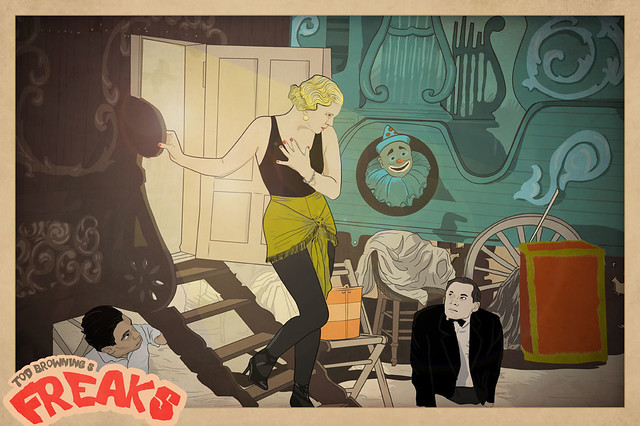
Freaks(Image by Mariana Rojas used under CC license via)


Miley Cyrus loves diversity. Just not, you know, discussing diversity and the complex history behind it. Since her performance at the Video Music Awards last September, she has drawn tremendous criticism for her treatment of the black backup dancers in her shows – cartoonishly imitating their dance moves, spanking them, simulating sex with them. Some, including Cyrus, have argued the portrayal is affectionate or even celebratory, while others perceive it as exploitative and reductive. Articles at Vulture and The Guardian likened it to a minstrel show.

Cyrus also uses dwarf dancers in a similar way. One of these dancers, Hollis Jane, has come forward to voice her regret:

Most of the time, getting a job purely because you’re a little person (in my opinion) is not a good thing. It is further fulfilling society’s idea that we are something to laugh at; that our value is simply to shock. We can all agree that right now all Miley Cyrus wants to do is make society’s jaw drop. So what’s more “weird” or “freaky” than having little people parading around in your show?

As someone who is trying to make it as a serious actress in this industry, not just trying to “be famous” or make money, there is nothing more frustrating than this stigma. The longer little people agree to be used as shock value, the longer it is going to take for us to be taken seriously.

I was a bear in Miley Cyrus’s VMA performance and it was my first time doing anything like that…anything where I was being used because of my height, not because of my talent. And I will be the first one to tell you that standing on that stage, in that costume was one of the most degrading things I felt like I could ever do. I realize not everyone shares my opinion and I might just be young and naive, but I feel like the acceptance of this kind of treatment has got to stop.

In an interview on Ronan Farrow Daily this week, Jane admirably pointed out that the problem lies in the broader culture, not just Miley Cyrus’s individual decisions.  Powerful stars, aspiring dwarf actors, the media, and media consumers all bear a responsibility to quell the demand for dwarfs in freak shows.

To which Cyrus said in her W interview with Farrow:

I don’t give a shit. I’m not Disney, where they have, like, an Asian girl, a black girl, and a white girl, to be politically correct, and, like, everyone has bright-colored T-shirts. You know, it’s like, I’m not making any kind of statement. Anyone that hates on you is always below you, because they’re just jealous of what you have.

To which I say, we really don’t need another Amanda Palmer out there, another millionaire whose ego is so very fragile we can’t ever expect her to buck up the courage to engage with people “below” her, or to admit when she’s been wrong. Every entertainer accused of perpetuating stupid stereotypes has the opportunity to prove whether they are a respectable artist or a pathetic narcissist. An artist is trying to communicate something, and therefore cares first and foremost about what they are communicating. A narcissist defaults to seeing themselves as the victim in every conflict.

Hopefully those who love Cyrus’s music don’t love the way she deals with minorities.


What Makes A Cast Look Cool?

23 Feb

LegsOrthopedic casts haven’t changed much in 50 years, until now. Engineering student Jake Evill of New Zealand has designed the Cortex cast, a brace made from 3-D printing. While all casts could effectively be described as exoskeletons, the Cortex looks like one. Its lattice structure allows for ventilation, which Evill advertises as its greatest asset. The Cortex is still at its conceptual stage, but, as with almost all new technology, reviews in the media have been pulsing with excitement.

The problems of plaster and fiberglass casts are well known to anyone who’s had to wear one. They’re fairly heavy and very bulky. Worst of all, they make your skin itch like the dickens and you are forbidden from using any implements to scratch because the smallest cut can become badly infected in the dark, suffocating conditions damp with sweat and dead skin. I had to wear casts on both legs after two tendon surgeries and once after having Ilizarov fixators removed. The itching alone was bad enough to make me wish I had the fixators back on.

Anything that claims to be lighter and breathable is a very attractive proposition. But while the Cortex website boasts that the cast is waterproof and therefore perfect for bathing and swimming, this probably means that there is no cloth involved. The cloth lining between a traditional cast and your skin contributes to the itching, but it’s there to prevent abrasion. Watchmakers, jewelers and BDSM professionals all know that any material other than cloth or leather can pose serious risks to human skin.

And the claims that the innovative appearance of the new cast is stylish? What exactly makes a cast stylish? While I could see goths maybe being partial to the Cortex if they could order it in black, reviewers seem to be fawning over the look of it simply because it’s new. And the promotional photo for the Cortex features a well-toned, scarless, unbruised arm that looks a bit too healthy to contain a broken bone.  (I half-expect the owner of the model’s fist to be shouting, “BY THE POWER OF CORTEX!”) 

Style is all about what you do with what you’ve got.  Fiberglass casts come in assorted colors. I had hot pink ones while performing in a school play and ended up enhancing one dream-like scene lit only by ultra-violet light. When I had neon green casts, friends painted my toenails to match. And the good old tradition of letting your loved ones cover your limbs in graffiti is worth mentioning. A friend who is a professional painter adorned the bottoms of my feet with elaborate sunflowers.

Then again, some casts do not conceal only injuries. A young friend of mine once stuck a chunk of steak down her cast in order to get out of having to eat it before dessert. She managed to retrieve only part of it after dinner – the rest tore away and remained lodged deep in the plaster caverns enveloping her arm. Her parents remained unaware for days until the entire house began to reek of rancid meat. With the new cast design, families with deceptive children need not fear such hazards.  The Cortex offers not only porousness but transparency!


Does It Matter If It’s Genetic?

16 Feb

Photo 02-07-14 12 29 21(Image by Eduardo Unda-Sanzana used under Creative Commons license via)


There is an argument gradually gaining momentum in the LGBT movement: “So what if being gay is a choice?” Rather than lecturing social conservatives that homosexuality is an inborn trait and not a chosen lifestyle, we should ask them what’s so bad about two consenting adults loving each other. With bisexual, pansexual, and genderfluid identities becoming more visible, and all sorts of people becoming more open to experimenting, who really cares if any of it is a choice?

It’s an important question in the broader debate about sex and gender. And it forces me to question the parameters of this blog.

Painting On Scars is founded on the rights of people who are viewed as minorities based on qualities they have no choice about: gender identity, sexuality, ethnicity, nationality, class background, physical traits, and mental abilities. This foundation is built on my own minority status being indisputably determined by factors beyond my control. There is no doubt whatsoever that I was, as Lady Gaga hollers, born this way.

And when it comes to confronting bigotry, there is something particularly painful about being belittled for something you have no choice about. All of us can feel insecure about the decisions we make, but being told that you’re seeking work in the wrong field or that you talk too loud on the phone is still far less harrowing than being told that your natural appearance is universally repulsive or that your gender makes you intellectually or emotionally inferior. Every one of us wants to be accepted for the way we were born because a rejection of it feels like a rejection of our very lives. As autism activist Jim Sinclair explains:

When parents say, “I wish my child did not have autism,” what they’re really saying is, “I wish the child I have did not exist and that I had a different, non-autistic child instead.” Read that again. This is what we hear when you mourn over our existence. This is what we hear when you pray for a cure. That your fondest wish for us is that someday we will cease to be, and strangers you can love will move in behind our faces.

For this reason, Painting On Scars examines the existence of minorities who are born this way and the myriad reasons why any of us still struggle to accept them. (More on the complexities of parenting disabled children here.)

However, the born-this-way rubric is not always helpful. What about the explicit decision to not conform? What about the human right to the pursuit of happiness? It seems only natural—for lack of a better word—to defend alternative traits and behaviors that are very much a choice but do no harm. Women who don’t wear makeup. Filmmakers who dare to feature minority accents. People who want to preserve their parents’ cultural traditions rather than assimilate for assimilations sake.  Men who don’t identify as transgender but still very much like wearing dresses. Objection to these choices usually stems from a rigid belief in homogeneity or simply a difference in taste. Such objections make it clear to me as a blogger that as long as a difference doesn’t cause real harm, it is worth protecting from harm.

And conversely, I tend to defer to others when it comes to minority traits that people have little choice about but that do cause a good deal of harm: personality disorders, psychosis, sexual attraction to children, paranoia, trauma, suicide, or anything that precipitates emotionally abusive tendencies. I research these issues voraciously, not only because I have personal experience with many of them, but because they raise questions about human rights and individual freedom, as well as the greater good and personal safety. (The pro-mia and pro-ana movements, for example, argue that any attempt to treat or cure people with eating disorders qualifies as oppression rooted in narrow-mindedness.) Yet I refrain from opining about these issues publicly because my knowledge of them is as simplistic as they are complex.

Whether to change society or change oneself is a persistent predicament that accompanies every stage of life. When exploring the answer as it applies to minority issues, I keep coming back to the same question: Who suffers more in the change?  Humans have repeatedly proven to cause less suffering when we accept body diversity, intellectual disabilities, LGBT identities, and gender equality than when we oppress them.

Of course, what constitutes oppression and what constitutes acceptance is sometimes disputable. Alex Andreou argues this week in The Guardian that the current search for the gene for homosexuality is quite harmful. While LGBT activists have traditionally opposed the idea of homosexuality as a choice to combat those who argue for a cure through therapy, LGBT critics of the genetic research fear that discovery of a gene for homosexuality will lead to its elimination. Those of us whose conditions are genetically determined and socially marginalized have been acutely aware of this problem not just since the advent of the Human Genome Project 30 years ago, but since eugenicists began sterilizing all sorts of peoples over 100 years ago. In democratic societies where governments no longer dare to be too vocal about medical decisions regarding minorities, everyone still fears the coming of the day when insurance companies inform expecting parents that they will not cover children who will cost more. Because the existence of minorities precludes the efficiency of a one-size-fits-all system, we will always cost more.

In the spring of 1994, I was headed into the operating room to have my Ilizarov fixators removed. While prepping for surgery, one of the members of the surgical team excitedly told my mother, “Have you heard the news about achondroplasia? They found the gene! We can test Emily for it!”

My mother signed a release allowing for them to perform the test during the operation. Several weeks later I received a letter confirming that my fibroblast growth receptor gene 3 had the achondroplasia mutation. My first reaction was, “No shit. Who cares?”

I had been officially diagnosed with achondroplasia on my third day after birth, though admittedly, such an early diagnosis back in the 1980s was a stroke of luck. A girl with achondroplasia who later became my best friend had been born at the same hospital six months earlier, so the doctors recognized our similarities and ordered x-rays on my limbs. My achondroplasia was obviously a result of nature, not nurture.

Then again, in olden days dwarfism was often thought to be caused by mothers with loose morals. I myself had once asked my mother if perhaps I got achondroplasia because of the decisions she had made about the birthing process. (I had just watched Look Who’s Talking and had learned a lot about the pop culture understanding of what goes into having a baby.) The gene for achondroplasia explained how I got it, how I could pass it on, and lay rest to any modern blame-it-on the-mother mindset that might suspect it was because of aspirin or salami or cinnamon. Such information can—but does not have to—affect your sense of self.

A few years ago a woman living in the U.S. contacted me because her two-year-old daughter had been diagnosed with achondroplasia. The girl’s grandparents lived in another country and had steadfastly dismissed the diagnosis. “Americans are famous for over-diagnosing every little thing,” they shrugged. “She’ll grow out of it!” (Pun intended?)

A friend from the same country explained to me that disabled people there generally have few support networks and even fewer opportunities for independence. Perhaps the grandparents’ refusal to believe in achondroplasia stemmed from their fierce desire to remain hopeful about her future.

Would running a genetic test finally convince them to accept reality? When I was born, my parents and I benefited greatly from the dwarf rights movement of the 1970s and 80s, which had emerged due to the egalitarian spirit of the times that indulged in civil rights and celebrating diversity. As with the gay rights movement, millions of supporters showed that they did not need to see the results of genetic testing in order to justify and defend a minority’s right to exist and be accepted. If they could do it, so can we.


What To Do About Sochi?

9 Feb


Opinion is split over the best way to protest Russia’s new homophobic laws that legalize the persecution of its LGBT citizens. Some are boycotting the Olympic Games in Sochi and urging advertisers and spectators to do the same. Others are pointing out how gay the Winter Games are to begin with. The Canadian Institute of Diversity and Inclusion has released a video about it. President Obama has sent a delegation of openly gay Olympians to represent the U.S. Germany’s heads of state are staying home while sending their athletes in suggestive uniforms. In his opening ceremony speech Friday night, IOC Chairman Bach stated, “It is possible—even as competitors—to live together under one roof in harmony, with tolerance and without any form of discrimination for whatever reason.” (This comment was edited out of the broadcast seen in the United States. The National Broadcasting Corporation claims it was merely “edited for time.”)

Fashion commentator Simon Doonan at Slate declared the opening ceremonies the “gayest ever”:

The ceremony started and my sense of impending doom evaporated immediately. As soon as I saw the smiling Olympic Snegurochka snow princesses with their huge filigree headdresses and their vampy runway walks, I relaxed. Why? Because I was reminded of the deep and profound gayness of Russian culture.

How gay is Russia? Sorry, Vlad, but it’s far gayer than you might acknowledge or wish. Russia is Tchaikovsky gay. Mussorgsky gay. Nijinsky gay. Ivan The Terrible gay. Diaghilev gay. Eisenstein gay. Erte gay. When I say gay, I mean the very best of gay. I mean inspired, dramatic, flamboyant, theatrical and fabulously haughty. I mean Rudolph Nureyev gay.

The gay (and therefore glorious) moments of the Sochi opening ceremonies came thick and fast…

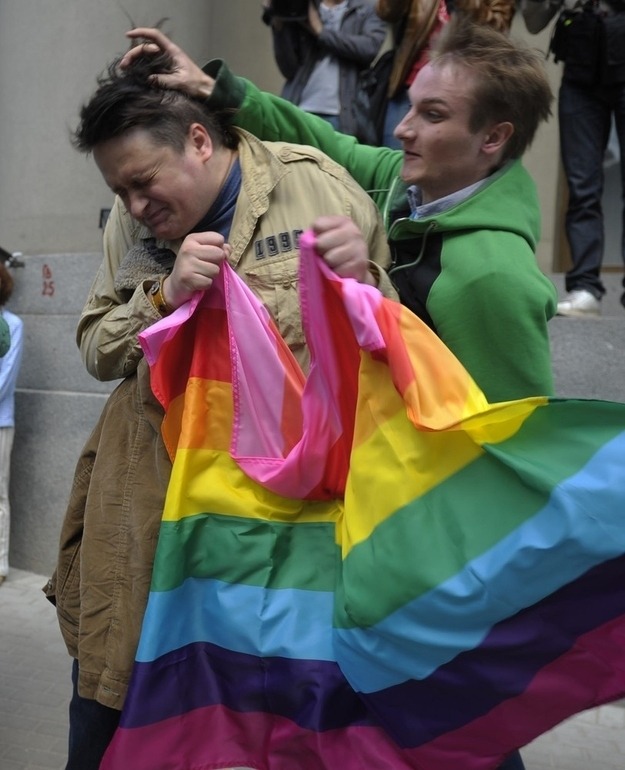
Meanwhile Dutch snowboarder Cheryl Maas, who is openly gay, has flashed her rainbow gloves in protest at the cameras.

Whatever tactic seems most effective to you, it is crucial to remain aware of the law and its very real consequences for everyday Russians:

The Health and Human Rights Journal finds rates of violence and suicide among LGBT Russian youth are rising.  From Human Rights Watch:


As the Games kicked off on Friday, four activists were arrested in St. Petersburg after unfurling a banner quoting the Olympic Charter’s ban on any form of discrimination. They were detained on Vasilevsky Island, where I lived 12 years ago during a summer language course.

As a longtime russophile, I am accustomed to seeing protests of this terrible legislation, or any of the Federation’s anti-democratic institutions, devolve into snarky racism against Russia or Russians. As one blogger observes: “Russia; foreign enough for you to characterise the homophobia as uncivilised, white enough for you to care about the victims.”

Criticism of a nation’s human rights record should never slip into complacent xenophobia. That the homophobic law is attracting so much international attention is a wonderful but all too recent phenomenon. No one protested the 1996 Olympic Games when they were held in Atlanta, where homosexuality was punishable by imprisonment. How would Americans have reacted had Western European human rights organizations demanded a boycott of the Games back then? International condemnation of an entire culture usually does little from the perspective of those who live in that culture – on the contrary, it usually galvanizes nationalistic sentiment.

The professor who taught me my first semester of Russian was also in charge of our school’s LGBT Studies program. Every year his memorial award goes to a student who demonstrates dedication to the field of Russian and Eurasian studies.  For him, there was no contradiction in passionately loving a culture and speaking out against its greatest crimes. The Live and Let Love project of Sweden also appears to understand this, having released this video last month:


Ten protestors in Moscow did the very same on the opening day of the Games. Unlike Tilda Swinton, they were promptly arrested:


Trying To Understand Mini-Me

2 Feb

170739265KI00117_The_World_(Image by Ricky Brigante used under Creative Commons license via)


This month actor Verne Troyer (above) is featured in a National Geographic documentary series, Incredibly Small World, about the experience of living with dwarfism.  (Incredibly creative title, by the way.) Examining everything from the average-sized family of Amish origin he grew up in to his burgeoning career, Troyer hopes to spread awareness about dwarfs.  “Don’t look at us like we’re circus people!” he recently told The Daily Mail. Right on. 

But wait.  If you don’t want the world to see you as a circus freak, what was going on with Mini-Me?

While one of his most recent stints was in The Imaginarium of Dr. Parnassus, Troyer is by far known best as Mini-Me in the Austin Powers films.  According to his profile in The Lives of Dwarfs, he had been in the acting business for years and was grateful to finally land a role in which he portrayed an adult human.  All of his previous work had mirrored Kenny Baker—the actor inside R2D2— moving about in robot, baby, alien, and animal costumes.  But to call Mini-Me “human” is debatable.   

While the Austin Powers plotline claims he is a clone (one-eighth the size) of Dr. Evil and therefore in training to step in for the villain at any time, Mini-Me has little to no agency.  He doesn’t even speak.  Other characters refer to him as “like a dog” or “that Chihuahua thing.”  Slapstick has its rightful place in film, and all the characters in Austin Powers are blunt stereotypes meant to parody the James Bond genre, but it’s hard to watch Mini-Me portrayed pretty much the way dwarfs were handled by the aristocracy in Early Modern Europe – like a pet.  (And when fully-grown adults are handled as nothing but pets, it’s called slavery.) 

Austin Powers could have used Mini-Me to skewer the James Bond character Nick-Nack, but instead it merely perpetuated the gag.  Most minorities can name a famous character/caricature that makes their skin crawl—Tonto, Aunt Jemima, Mrs. Danvers—and Mini-Me is certainly up there for the dwarf community.

It makes me uncomfortable, but not enough to keep me from watching the films.  A lot of the scenes are as dull as the back-pages of an eighth grader’s notebook, but the jokes satirizing the Bond films are lovely: 


And Mini-Me is a funny name.  Just not the third time, or the fourth time, or the fortieth time that any given person with dwarfism hears it hollered at them on the street.

Today Troyer remains friends with Austin Powers creator Mike Meyers.  Cynics might say that networking is networking, and what dwarf actor wouldn’t remain loyal to someone who’d lifted him into the spotlight, no matter how dehumanizing the role?  Beggars can’t be choosers or bite the hand that feeds them. The tradition of the groveling dwarf actor grateful for anything he can get is so pervasive that Peter Dinklage has spoken out about the importance of dwarf actors turning down such roles for the sake of self-respect.  But when I see photos of Troyer schmoozing with Meyers, it reminds me of something other than begging or groveling.

Back when I was in elementary school, one of my classmates liked to lay his elbow on my head because I “made a great armrest.”  He would also regularly ask me, “How’s the weather down there, shorty?” to which my response was always, “Clouds of your bad breath.”  Not exactly Abbott and Costello caliber, but then again, we were eight.  I didn’t mind being the target of his jokes.  I almost liked it.  He wasn’t a close friend who’d helped me through any of my medical ordeals, but we knew each other, he talked to me and not only to laugh at my expense.  For this reason, I took his teasing as openness. 

That year was not an easy one in the schoolyard.  To be ostracized there means that those who don’t know you at all will hurl insults at your minority status from a safe distance, while those who do know you will stay eerily silent on the subject. This is why when someone talks both to you and about your difference, they seem to be demonstrating a delightful lack of fear. 

The millions of people who have giggled at Mini-Me, whether they are his viewers or his creators, aren’t necessarily harboring nasty views of dwarfs.  The difference comes down to who can not only laugh at him but talk to him, and who’s afraid to.


Will Dove’s New “Selfie” Film Redefine Beauty?

26 Jan


In another installment of its positive body image campaign, Dove has released an 8-minute documentary called Selfie that premiered last week as the Sundance Film Festival.  For those of you who can’t watch it, the film can be summed up thusly:

***

Mothers with their teenage daughters talk about their insecurities about their own bodies.  One girl reveals that her mother’s urging her to wear cosmetics makes her uneasy. 

Cut to a high school gym, where a professional photographer addresses female students, telling them, “I’m here to talk to you about beauty.  You have the power to change and redefine what beauty is!  … The power is at our fingertips.  We can take selfies.”

Cut to her workshop about self-portraiture. “I’m going to ask you to take a risk that could change the way that people define beauty.  What if we find a way when you guys are taking your selfies to actually incorporate the things about us that we don’t like?” The girls list what they hate about themselves: braces, glasses, round faces, rosy cheeks. 

The photographer points out that mothers often pass on their own insecurities to their daughters, to which one girl vociferously agrees.  The girls then are given an assignment to teach their mothers how to take selfies, because “Your mom can redefine beauty just like you can.”

A touching montage of mothers and daughters learning to embrace their least favorite features plays, culminating in an exhibit of the selfies, where visitors leave Post-Its complimenting the girls on their looks.  The girls then smile at how good the compliments made them feel.  The mothers declare that social media is redefining beauty by putting the creativity in the girls’ hands.    

***

I absolutely love the way the film takes mothers to task, especially in light of this week’s report that parents are googling “Is my daughter ugly?” three times more often than they are posing the question about their sons.  We cannot teach our young women that they should not obsess over their looks if we don’t believe it ourselves.

I also like Dove’s idea of promoting the anti-duckface selfie, the least-favorite-traits selfie.  This film will do some good.  But does it truly redefine beauty for everyone?  Does it include everyone?

What about a girl with muscle spatisticity?  What about a girl with the physical markers of Down Syndrome?  What about a girl with scars, burns or chronic skin discoloration?  And, perhaps most importantly, what about that girl who is silently—obsessively—counting and comparing the compliments on her selfie to the compliments on others’ selfies?  Hierarchies survive through feelings of competitiveness.  What about the girl who ends up with the fewest or the least glowing compliments?  Does the project teach these girls how to deal with that, or does it leave them to their own devices?

This is not criticism for the sake of cynicism, but for the sake of empiricism.  The Love Your Body movement has been around for over 30 years, yet eating disorders are on the rise and our mainstream standards of “beauty” have not deviated from tradition at all.  (Go ahead and google “beauty” right now in an image search and see how diverse the results are.) 

As with so many Love Your Body projects, the girls in the video are not beautiful under the sociological definition of “super-normal” (strange and considered exotic), but they are far from the sociological definition of “abnormal” (strange and considered repulsive).  Everything they hate about their bodies—cheeks, glasses, eyebrows, braces—still falls smack in the middle of healthy human appearance.  It’s the equivalent of adults in the middle-middle class and lower-middle class discussing how “poor” they feel for not having made it into the top 1%.  Such insecurities are valid, but repeatedly restricting the discussion to those who only just barely challenge society’s definitions of “success” or “beauty” is safe to the point of almost seeming scared of rocking the boat too hard.

This is not to say that girls with more abnormal looks deserve more sympathy than those closer to average.  On the contrary, in my experience low self-esteem does not correlate to appearance.  I know many women who, being a few pounds overweight, are far less happy with themselves than other women with severe and rare deformities.  Perhaps parents are more dedicated to boosting self-esteem when their daughters more noticeably deviate from the norm. 

Or perhaps being excluded from the game from the get-go helps a girl to see how dumb the rules are to begin with.  Returning to the analogy of class, researchers have found that wealthier parents often have a harder time handling severely disabled children because they upset their need to be in control (“He breaks things!”), whereas parents living below the poverty line are more accepting of life’s unreliability (“Eh, there’s nothing in this house that wasn’t broken long ago!”)  Similarly, girls and the parents of girls whose looks could possibly near the standard of super-normal beauty may be more likely to spend time, money and anxiety trying to reach it than those who give up trying to wow the crowds and instead laugh at the delusional nature of it all.

Either way, I don’t think the Selfie project would be hurt one bit by a truly diverse sample of beauty.  (Let’s get some felfies in there, while we’re at it.)  Rather than monologuing about our own individual fears and demanding strangers allay them with compliments, we need a dialogue between the girl on the far end of the spectrum who’s been trashed for her looks and whoever it was who gave in to the temptation to trash her.  We need a dialogue between those who want to meet an elite standard of beauty and the type of people who support that standard.  We need a dialogue between the ugliest person you can imagine and your reasons for deciding they’re ugly.

That would redefine a lot.


If you enjoy this blog and want to support it, please like the Painting On Scars Facebook page.

The Best Book of 2013 (and the 21st Century)

30 Dec


“Though many of us take pride in how different we are from our parents, we are endlessly sad at how different our children are from us.”

So begins Andrew Solomon’s Far From the Tree: Parents, Children and the Search for Identity, a book that profiles families with children who are profoundly different from their parents – deaf, gay, autistic, short-statured, schizophrenic, transgender, intellectually disabled (Down Syndrome), multiply disabled, born out of rape, prodigious, and criminal. With every story, Solomon ends up returning to the same question: What is family? And in asking this, he demands, again and again, What is love?

He conjectures that true love is 30% knowledge of who someone is, 30% percent acceptance of who they are, and 30% projection of who they are. Projection is as indispensable as the other elements, but it is by far the most problematic. Love is threatened when it relies more on projection than anything else. When driven by a fear of being alone, projection can dangerously blind us to others’ faults: “You like the same bands I do?! You must be so deep!” When driven by a fear of being burdened, it can dangerously fuel our least empathic feelings: “I can’t handle taking care of a freak!” It would seem that our best hope for filling our lives with true love is to be better informed. If so, Solomon’s book is an ideal source of information.

He writes poignantly of his own mother’s difficulty accepting his homosexuality. In the West today, we are just as quick to judge parents who seem to hurt their children as we are to judge children who seem to hurt their parents. But in examining his mother, Solomon wisely observes that “she did, like most parents, genuinely believe that her way of being happy was the best way of being happy.” Who among us does not tend toward such self-righteousness?

I’ve never met anyone who doesn’t pride themselves on something they believe they do better than their parents did, an improvement they would like to pass on. Even my friends who take little interest in children tend to talk about their hypothetical progeny as projects: e.g. “My kids will never/always… ” And with projects come projection. The children in Solomon’s book, himself included, are dynamite to that projection.

While he is determined to understand his mother’s feelings that caused him so much pain, he is unwavering in his assertion that homophobia, ableism and all other irrational fears have no place in the future of a healthy society. He calls the forces that inspire current legislation limiting the rights of minorities a “crisis in empathy.” And he practices what he preaches – his determination to empathize with the United States’ most marginalized families is utterly humbling. He does it not only for the sake of compassion, but for the sake of practicality. We’ve already tried condemning and isolating the kinds of people who make us uneasy. On a grand scale, it hasn’t gotten us anywhere.

When I described the book to friends – many themselves minorities – several winced at the idea of rape victims and schizophrenic people. “Sounds like a fun book!” they sighed. Such reactions are hardly unknown to Solomon, who notes, “One’s own identity, replete with problems though it may be, usually looks more tenable than someone else’s identity.” Indeed, my own gut reaction is to glare at anyone who dares to compare the experience of having a child with dwarfism to the experience of having a child who grows up to murder students at Columbine High School. But gut reactions tend to be more hurtful than helpful. “At the mention of dwarfs,” Solomon writes, “[some of my] friends burst into laughter.” Fear always conquers by dividing us, and for this reason I adore  Solomon’s ferocious intersectionality. It is rare but contagious.

He profiles several different families in each chapter, which is admirable because it is comprehensive. However, at times it can feel like overkill. I might have preferred three families per chapter rather than seven or eight. The medium isn’t conducive to such a large cast because it’s difficult to keep the characters from blending together if you can’t physically see their faces or hear their voices. I thus found his videos series a source of clarification, not mere supplement.

But Solomon is an exquisite writer. Plenty of ink has already been spilled on the disabilities and social issues he examines, but it’s too often bogged down in language that comes off as dry or downright dreary. It’s not easy to push through 770 pages of the most marginalized lives imaginable, but Solomon’s writing is as poetic as it is sensitive. He is never too meek make assertions and yet, unlike countless journalists, he manages to do so without ever ignoring the agency of those he describes. True empathy never condescends because it transcends fear.

I am, of course, a biased critic. It was 32 years ago this month that my parents got the news that I had dwarfism. And they did everything right – the best any two human beings could when faced with a rare diagnosis that traditionally brought on social isolation. (As Solomon documents, mothers of dwarfs in olden days were often thought to have caused the condition by being lecherous.)

What my parents did perhaps best of all is something all the great parents of the world do – to make me feel so unconditionally loved that I always felt free to discuss with them what might have been done better. Sometimes my critiques are correct and sometimes they’re flat-out wrong. But the freedom to examine what you need to change about yourself in order to be a tolerable person and what you have the right to protect about yourself in order to be a happy person should be a freedom granted to every member of every family. On both sides of the parent/child relationship, or any relationship, “love is made more acute when it requires exertion.”

In a just world, no one should have to be any more grateful to their parents for accepting them than anyone else should have to be. As I’ve written before, caregiving is freakin’ hard, and our gratitude to those who raised us deepens when we consider that, as a whole, they have been more accommodating and respectful of their children than any of their historical predecessors. Solomon points out, “A hundred years ago, children were effectively property, and you could do almost anything to them short of killing them.”  But despite how far we have come since then, we have yet to reach an acceptable rate of justice for all. 

Solomon points out that 1 in 4 participants in a recent survey said they would choose abortion if their pregnancy tested positive for dwarfism.  At least half the children up for adoption in the United States have disabilities of some kind.  Crisis in empathy indeed.

Individuals who cannot parent a child profoundly different from themselves should not be forced to. Likewise, society’s hang-ups about difference should not encourage parents to flee from it.  Considering the current statistics, Solomon’s book is as necessary as it is beautiful.


“Fashionista Has Leg Amputated So She Can Wear High Heels”

2 Dec

L0066938 Illustration showing treatment of a clubfoot Credit: Wellcome Library, London. Wellcome Images images@wellcome.ac.uk http://wellcomeimages.org Illustration showing treatment of a clubfoot 1806 Memoria chirurgica sui piedi torti congeniti dei fanciulli, e sulla maniera di correggere questa deformità / Antonio Scarpa Published: 1806. Copyrighted work available under Creative Commons Attribution only licence CC BY 4.0 http://creativecommons.org/licenses/by/4.0/

(Image from Wellcome Images used & altered under CC)


Or so The New York Post would have you think.

21 year-old Mariah Serrano was born with a club foot.  By the time she was a teenager, she faced increasing chronic pain and her doctors strongly advocated amputating and replacing her leg with a prosthetic one. Now an assistant designer for American Rag and author of the blog Confessions of a One-Legged Fashionista, she recently shared her story with the Post:

Serrano struggled to look like the other girls in her high school who often called her “gimpy.”

“I felt silly in pictures, I was the only one in these shitty little ballet flats,” she recalled.

“I had to wear all sorts of braces. It was uncomfortable and frustrating because they weren’t solving the problem and I often felt embarrassed.”

The glamour girl wore patterned knee highs and flashy tights to mask her deformity. She even dyed her hair pink to distract people from staring at her leg. She eventually stopped going to classes and was home-schooled.

“Kids are mean,” she said. “It made things very hard.”

“A lot of times I felt left out because I loved to dance and go out.”

But even more mortifying for the teenage girl, was being forced to wear sneakers to prom.  “I was really devastated in the mall,” she recalled, after shopping for four hours to find a chic shoe.

The article never mentions any medical purpose for the amputation. Serrano is only quoted as hating the limited number of footwear options that had been available to her prior to the operation. The story ran four days ago and was quickly picked up the British tabloids.  And Serrano is not pleased.  She explains on her blog:    

I did not choose to cut my leg off so I can wear high heels, I had my leg amputated because I was very sick and the quality of my health and life were suffering. Doctors do not welcome the idea that you are unhappy with your footwear choices, so you should remove body parts.

This event was a real decision that I took very seriously. It was a decision my family and I made together, so that I would be able to live my dreams, and not mind you, dreams of footwear, but dreams of waking up and going about my life not in chronic pain.

I think it’s safe to say that The New York Post is not a feminist crusader on the issues of body image and beauty standards.  So why then would they decide to warp Serrano’s words to feed the image of the fashionista lifestyle as a vile instigator of self-mutilation?  The story of a young girl simply but bravely electing to trade chronic pain for a prosthesis is severely lacking in vitriol. This means there is no surefire guarantee that it will unleash a deluge of jaw-dropping, eye-rolling, and catty comments from readers about the girl in question.  That guarantee is essential to the business the Post is in.

Serrano is hardly the first individual to be misrepresented by the tabloids.  But who’s keeping the tabloids going by hungering after such headlines?  It’s this hunger that drives journalists across the spectrum to emphasize the most soap opera-like elements of a person’s life story.  I’ve seen the most loving, supportive families with disabled children portrayed as walking tragedies based on a few of their more emotional quotes taken out of context.  This approach knows that readers and viewers will consequently feel sorry for the pathetically confused freaks, and good about themselves.  Not unlike the mean classmates Serrano cites from her high school days.

So if anyone is interested in ending the tabloids’ tradition of tearing people’s personal lives to shreds, we can curb their sales by curbing our desire to use bits of information about people we don’t know as an easy way to prop ourselves up. Of course this is asking a lot, and so, once again, we must decide which is harder – altering the way we think or altering our bodies?


When Food Preferences Surpass Politesse

24 Nov

yuck(Image by Boris Drenec used under Creative Commons license via)


Perhaps not quite in the spirit of Thanksgiving, I’m about to alienate half the people I know: I don’t have much patience for openly picky eaters over the age of 20. The covert ones don’t bother me at all. But announcing to your host that you simply won’t eat mushrooms or mustard or millet is to revert to your 10 year-old self, brazenly acting on the assumption that anyone cooking for you will find your pig-headedness as endearing as your parent or guardian apparently did. I don’t particularly like pears or peas or plenty of other things, but if I learned anything from my time as an exchange student with the American Field Service, it’s that intellectually curious, culturally respectful, fully-grown adults eat whatever is set in front of them. Or at least try a few bites and then leave it to the side without advertising their distaste.

Unless, of course, it threatens their health. I recently hosted a friend who has celiac disease and who apologized several times in advance for the inconvenience. While the sincerity of his remorse was indeed helpful because it was convincing, I assured him there was no need for shame. I’ve had friends with juvenile diabetes and colitis and who need to be fed through tubes. At my wedding, where guests had been requested to bring cakes instead of presents, I chased down every single baker in order to mark any desserts containing traces of peanuts, oranges, or coconut. I never mind offering vegetarian options because they accommodate a wide array of dietary restrictions with both cultural and medical bases, just as alcohol-free beverages are helpful to kids, recovering alcoholics, devout Muslims, and pregnant women alike. But my tolerance generally ends there. Because beyond that boundary seems to be where stubborn intolerance for all sorts of food spreads like the plague.

According to the cover story of Die Zeit this week, less than 1% of Americans are gluten intolerant, yet 28% of Americans purchased gluten-free products last year. The percentage of Germans who purchase lactose-free products has tripled in just five years. Such sky-rocketing numbers sound much more like successful marketing trends than biological shifts in the population. Inordinate media attention to rare medical issues always inspires swathes of people to self-diagnose rather than check with their doctor. In response to what sometimes does seem like an epidemic of hypochondria, a kindergarten in Hamburg has recently taken to demanding medical documentation for any alleged food restrictions among its students. Die Zeit writes that parents were insisting their untested children had food allergies after the appearance of the slightest yucky face. Of course a child at risk for anaphylactic shock is better safe than sorry, but to teach a child to regularly cry wolf is to teach them to rely on their most narrow-minded instincts.

This is not a call to villainize health advocates or burn certain cookbooks. On the contrary, the greatest thing about the human culinary tradition is its diversity. When I grew up in the Eighties on Long Island, skim and lite and sugar-free products were in fashion,  but anything organic or “foreign” or “ethnic” was scarce because what’s wrong with some good old American spray-on cheese? Sushi was gross (“It’s raw fish, you know!”), vegetarian dishes were for pansies, and escargot was what made the French so weird in the first place. (See this Indiana Jones clip.) Kids today are growing up more environmentally conscientious and more open to exploring new cultures, and I am glad to see the American tradition of grimacing at all the icky cuisine of the savages and the smelly Europeans go the way of the Twinkie. But there’s no progress in simply switching the grimace from the sight of imported cuisine to the sight of anything that isn’t in line with the latest imported health fad.

While it seems many finicky eaters think their aversion to certain foods resembles a disability (“Please don’t criticize me for something I can’t do!”), it often resembles ableism (“I refuse to budge on this issue!”). We cannot be open-minded and at the same time refuse to leave our comfort zone. As the Food Commander writes in his excellent Huffington Post article, “Unless you suffer from a disease or real (unlike imagined) food allergies, … kindly embrace the fact that your body is not all that fragile. Humans survive every day in conditions way worse than, say, a four-course dinner in an Upper East Side townhouse.”

Outside of a meal, it can be fun to explore cultural differences and personal preferences: why so many Chinese love meat but dislike butter, or why German senior citizens detest turnips. It’s also amusing to try to argue the illogic of taste. (One such argument culminated in one of my relatives bellowing, “I am not a fan of the bean!”) It is also imperative that we eventually discover which food restrictions have been caused by environmental changes and which have been encouraged by marketing trends. But the fun comes to a screeching halt when these discussions ooze onto the dinner table.

Such candidness often has innocent origins. In these rather unrepressed times, where dinner guests discuss everything from politics to polyamory, why not share our honest opinion of what’s on our plates? This approach, however, ignores two very important facts. Firstly, unlike in a restaurant or your own home, the meal laid out for you has been paid for by someone else. Secondly, unlike the selection of films or games or whatever else it is you don’t like about the home you’re in, the meal laid out for you is the result of someone else’s time and effort. To go so far as to scrutinize it (“Is it organic?”) or disparage it (“It’s too bad it has olives in it!”) is to spit on the dinner invitation that was extended to you out of sheer generosity.

I know what it’s like not being able to participate in communal activities. This blog is all about those who have no choice about being an exception to the rule. Those who have bona fide difficulties digesting certain foods—perhaps akin to my difficulty walking long stretches—should not feel ashamed. But shame should not be supplanted with complacency, either. As my friend with celiac disease said, it is usually regrettable to have to limit one’s range of experience, and it is always regrettable when it involves rejecting an offer of kindness.

Indeed, my proudest moment during my bout of stenosis last year was pulling off a Thanksgiving dinner with my partner that fed 17 people while I was still recovering from spinal surgery. If any of this year’s guests cannot stomach something, they will hopefully follow the example of my more gracious friends who keep things discreet, at least at the table. I don’t subject them to judgment by examining their plates for leftovers and threatening to deny them dessert because they spare me the insult of telling me exactly how my offering failed to satisfy them.

They also resist the temptation to dive into an unsolicited monologue of healthier-than-thou moralizing, a tendency that accompanies food more than any other health issue. I’m usually the last to squirm at medical stories, but I’ve been thinking lately that if I have to hear about the details of the latest nutritional research every time I put a spoon to my mouth, maybe I should start lecturing about my back problems every time I see someone wearing heels or sitting at a computer.

Eating is a necessity and a health issue and an environmental issue and a cultural tradition. I love learning from friends and researchers about the different ways we all eat, and the socio-political forces of the food industries are absolutely fascinating. But I won’t ever admire someone merely for eating homemade bread or fine delicacies or simple fare or whatever it is that the Paleo diet currently dictates. Those I do admire cook joyfully in their own homes and, when invited to someone else’s home, plunge their hands obligingly into whatever their host has set out for them, whether it’s okra or Oreos. As minority rights activist Andrew Solomon has pointed out, a truly tolerant culture celebrates additive social models, not subtractive ones.

Or, more simply, I will always care a lot more about your table manners than your diet.


Is Dwarfism A Disability?

27 Oct

(Image by Ron Riccio used under Creative Commons license via)


A more sober ending to Dwarfism Awareness Month

I remember being around 10 years-old when I began taking care to never refer to my dwarfism as an “illness” or a “disease.” An illness is something that tries to destroy you. It demands you go into battle. Even if you end up grateful for its having made you stronger, you’re glad when it’s gone. My dwarfism has always been around and I’ve never tried to conquer it. It’s a condition, a word as neutral as it is fitting. But is it a disability?

Many in the dwarf community insist that it is not. The thinking goes that being extraordinarily short is no more serious than being left-handed. We don’t think of left-handedness as a disability. It’s merely a difference, one of many physical features that can shape someone’s identity, like hazel eyes or an outie belly button. Being left-handed is only an inconvenience insofar as the world is built for those who are right-handed, and populated by some who still cultivate fear and hatred of those who don’t conform to the majority. Needing left-handed scissors and mouse buttons is not really thought to be an issue of disabled access – it’s more akin to needing glasses or extra-moisturizing shampoo. Diversity awareness over the last 50 years has led the vast majority of Westerners to shrug at the idea of left-handedness.

And such a neutral shrug is what dwarf activists seem to be coveting when they insist that dwarfism is not a disability. In the words of Andrew Solomon, “Neutrality, which appears to lie halfway between shame and rejoicing, is in fact the endgame, reached only when activism becomes unnecessary.” But is dwarfism only an inconvenience insofar as the world is built for those who are taller? It’s a compelling thought experiment, but it ignores all the medical complications I’ve had to deal with. And it raises the question: What is dwarfism?

The official definition, which lumps hundreds of skeletal dysplasias and growth hormone deficiencies into one category, is in fact only concerned with height. Little People of America defines a dwarf as anyone who stands fully grown below 4’10” (1.47 m). But height is relative. Women in Indonesia and Guatemala are 4’10” on average, which means that the LPA definition is based on a certain culture, and cultures are always changing as we move through time and around the world. As a pre-teen, I always got a kick out of seeing my towering parents become the minority at LPA meetings, while as an adult, I got a kick out of seeing my German-Swedish partner tower over my parents.

Physically, Warwick Davis and Peter Dinklage have no more in common than a black-haired Korean does with a black-haired Irishman. But they share many experiences rooted in society’s reaction to their short stature. They were both cast as dwarfs in the second Chronicles of Narnia film because the fantasy tradition cares first and foremost about looks, making up its convoluted ideas about heritage and separate races as it goes along. Most forms of dwarfism are caused by genetic mutations, but others result from chromosomal abnormalities, malnutrition, or even child abuse. Thus, because it encompasses all sorts of conditions with a tremendous variety of causes and complications, dwarfism is a social construct. Can a social construct be a disability? What is a disability?

This blog recognizes disability as a medical condition that causes you to experience more pain and/or limitations than the average person in your peer group, and therein attracts inordinate attention from society. And the attention has traditionally been negative. Disabled people carry a burden most other minorities do not in that we must argue that our lives and identities are no less valuable than anyone else’s, while at the same time admitting that we will always experience a good deal of pain no matter how accepting or accommodating society is. (Poor people are the only other minority that shares this burden.) This idea of inherent pain is what causes many activists in the autistic community and the transgender community to buck the disabled classification.

But when pain is indisputably inherent to a condition, it is frequently relativized in the hopes that this will reduce ableist attitudes. When I was born, the doctor pointed out to my parents that “everyone has something different about their bodies. One person has bad knees, another has a chronic skin rash. Emily’s difference is just a lot more noticeable than other people’s.” But does this mean that bad knees and skin rashes and seasonal allergies are all disabilities? There’s more to it than that.

If a medical condition is only minimally limiting and can be treated with standard procedures, we don’t really consider it a disability and rightfully so. While there is value in relativizing everyone’s struggles in order to calm our fears of the Other, it carries the risk of our failing to recognize differences that have much to teach us. The regular migraines I inherited from my mother don’t make me disabled. The pain can be intense and it’s infuriatingly inconvenient to feel one coming on at a dinner party while also feeling the hollow echo of an empty pill box in my bag. But the migraines are treatable—and not exorbitantly expensive to treat—and easily understood by others because plenty of people get them. Having to explain to people what my back and joints can and cannot endure is a more complex task.  Alleviating or avoiding the pain is even harder.

I interviewed friends and acquaintances with achondroplasia about the physical difficulties they regularly face. Some described always needing to lie down for at least half an hour whenever they vacuum for 10 minutes or more, and needing to get up earlier than everyone else on weekdays in order to afford themselves more time for walking to work or class. Everyone has trouble finding comfortable shoes that fit—women’s business shoes and sandals pose the biggest challenge—and many need to wear orthotics. Camilla, a college student who has not undergone limb-lengthening, told me:

I definitely believe I feel fatigue more easily than people my age. I went out dancing with friends last night and I had to stop and just stand for a while because my legs were starting to hurt. Also, when I walk places with my average height friends, my joints start to hurt while they feel almost no effects of fatigue at all… I would say that the hardest physical aspect of having dwarfism would not be the height difference but the extreme muscle and joint pain that seems to be more and more easily triggered as I get older.

And by “older” she means approaching her mid-twenties. These physical limitations would sound less surprising coming from senior citizens, which is why, as an advisor explained to me, your eligibility for disability status decreases as you age and aching joints become more common to your peer group.

A friend who had limb-lengthening at the same time I did told me, “I know if I’ve been on my feet all day, my ankles get really stiff and I’m limping around at home at the end of the night… as compared to my friends who work all day and still manage to hit yoga class, the gym, or cycling class afterwards.” Those of us who have undergone limb-lengthening can test whether achondroplasia is a disability because we control for the socially-constructed advantages of height. Yet in my interviews, I noticed that many who have had limb-lengthening are often reticent to talk about their current physical hardships lest someone conclude that all that time spent breaking and healing and growing bones was for naught.

Indeed, pride complicates our perceptions of pain. While hypochondriacs rejoice when they qualify as “disabled,” those who have regularly been reminded by peers and institutions of the supposedly pitiful nature of their condition are often less willing to revel in it. Those who reject the idea of calling dwarfism a disability are often motivated by the desire to de-stigmatize dwarfism. I of course understand this desire, but I don’t see how we can make the argument without stigmatizing disability. And I am suspicious of any mindset that supports a hierarchy by essentially saying, “At least I’m not like them.”

Like people of color, people with dwarfism are united only by society’s reaction to them, not by any medical traits. This is why I do not believe dwarfism itself is a disability. However, most types of dwarfism are. The way in which the physical pain brought on by achondroplasia intersects with social limitations is explained very well by Spoon Theory, an idea invented by Christine Miserandino, who has lupus. It bears repeating that I can only begin to imagine what living with lupus is like.  In the presence of someone needing to vent about the pain, I hope to be as wonderfully deferential as so many non-disabled friends have been to me. But the fact that lupus is an illness while achondroplasia is a not is no reason to ignore the fact that Spoon Theory perfectly illustrates the broader concept of chronic pain and fatigue experienced by people with all kinds of disabilities. Emily Brand described it eloquently in The Guardian last year:

The basic idea is that you have a limited number of spoons available for the day and each action will cost a given number of them – the more demanding the task, the more spoons would be required. The phrase “running low on spoons” can be a useful way of communicating the need for rest to fellow “spoonies” who also use this system and to friends and family who are in the know. Reading up on this is one of the best things anyone could do to help with providing day-to-day support to someone with a chronic health condition, as it’s a powerful analogy that can help people to empathise with how much of an impact even an invisible symptom like chronic pain can make.

I love the idea of “running low on spoons.” I used it just last week in explaining to a friend that I couldn’t peer with her into a store window because my swollen feet were begging me to keep off the cobblestones. But at the risk of sounding, well, confused, I’m not entirely comfortable calling myself a “spoonie” because experiences in college have left me averse to glamorizing conditions with labels that sound like club memberships. And between dwarf and has dwarfism and midget and little person and LP and short-statured and disabled and physically challenged and differently-abled, I’ve got enough labels to sort through.