They Don’t Care That We’re Angry

29 Sep

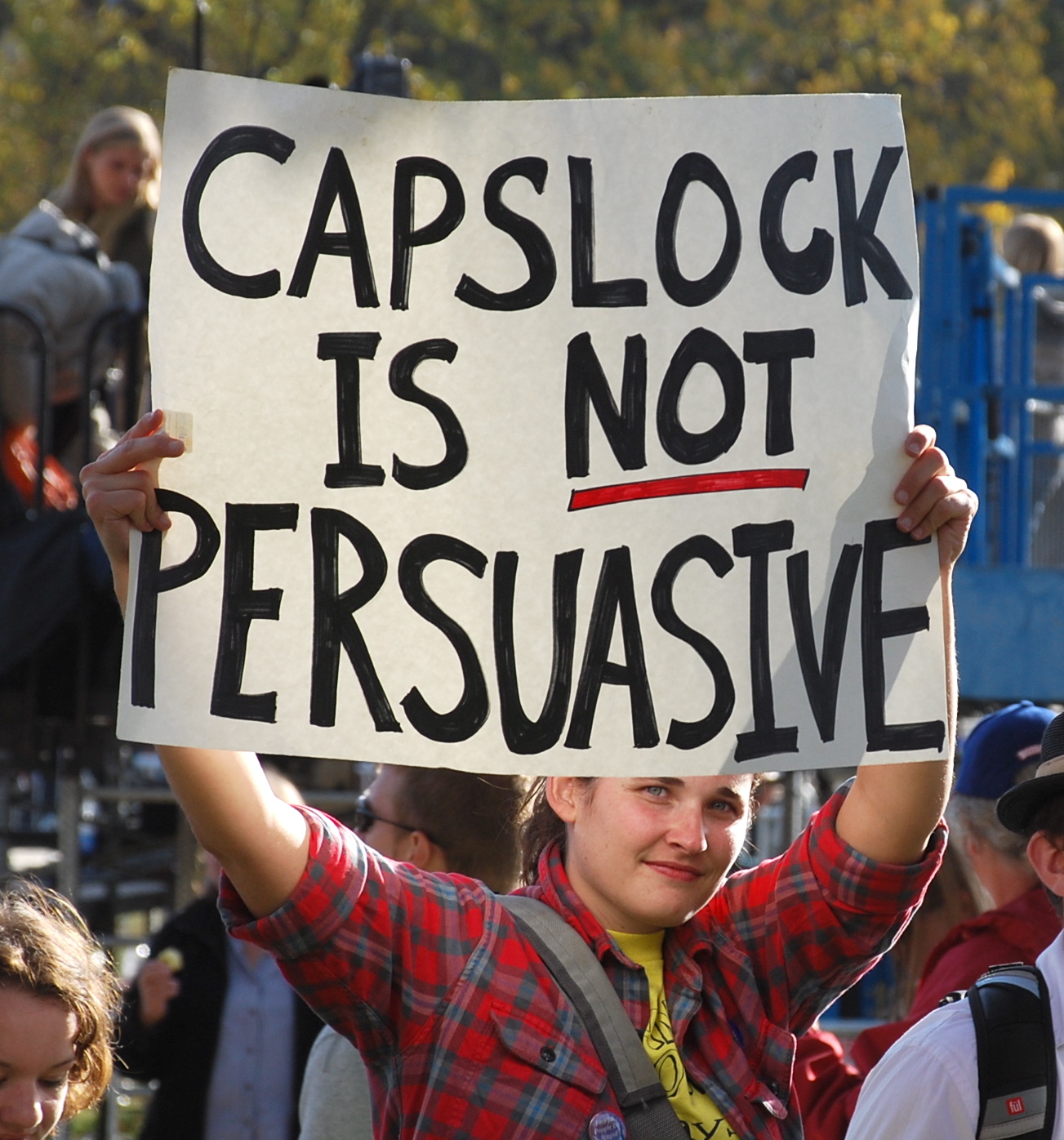
Capslock is NOT persuasiveHere’s a shocker: North Americans don’t like activists, especially feminists and environmentalists. Results from a study featured in The Pacific Standard show that these groups are associated with an abrasive, in-your-face approach to politics, and this repels more people than it attracts. Reporter Tom Jacobs urges these groups to change their tactics if they want to get anything done, while Alexandra Brodsky at Feministing has taken umbrage at any call for women to “hush up.” Jacobs has my attention. As someone who’s constantly clogging her Facebook friends’ Newsfeeds with social justice editorials, I’m happy to hear from anyone who can tell me how to entice more people to join the discussion.

Activism is recognizing injustice and inequality when you see it, and taking the time to ask, “Why?” It doesn’t have to be angry. But several of my friends echo the results of the study, saying they’re turned off by the way so many activists—feminists in particular—walk around like ticking time bombs, ready to explode at anyone who dares disagree with a woman ever. One of these friends cited a feminist who once told her, “The problem is people don’t like my writing because I’m just too controversial for them.”

I can see how that kind of self-righteousness would fail to impress, and I can also see where it comes from. Emotions run high whenever we try to talk about injustice and inequality because these are issues that threaten personal safety and pride. Debaters on both ends of the political spectrum all too often tend toward the obstreperous, topping off their arguments with the age-old threat: “You don’t want to make me angry.”

To which I must say, You’re right. I don’t. Because you can be rather boring when you’re angry. Speaking up requires some degree of bravery, but simply getting angry requires no talent whatsoever. A toddler can get angry. (Calling someone a Nazi requires even less skill.) Hollering until your opponent cowers may feel like you won the debate, but it usually means you’ve humiliated them, which will cause them and their supporters to hate you and your beliefs more than they did prior to the encounter. If you’re concerned with no one’s opinion but your own, then your activism isn’t about seeking justice. It’s about seeking attention. And anyone can play that game.

That said, it is unfair of anti-feminists to use a few belligerent narcissists as an excuse for dismissing an entire movement, for denying inequality and injustice exist, for refusing to listen to anyone who speaks up about it. In reaction to this year’s spate of female celebrities claiming “I’m not a feminist, but—”, the great Mary Elizabeth Williams wrote:

Ladies, it is OK to say that you’re a feminist, full stop. You don’t have to twirl your hair and stamp your toe delicately into the ground and sweet-talk that maybe you guess it’s OK that men and women be treated equally…

You can call yourself or not call yourself whatever you want, but consider this. Nobody enjoys it more when a woman says she’s not a feminist than a misogynist. Nobody gets more gloatingly self-congratulatory about it, or happier about what “real” women don’t need than someone who doesn’t like women very much…

A woman will usually strike me as rather petty if she trashes the entire feminist movement just for the sake of making sure no one thinks of her as unattractive or unlikable. And a man will usually strike me as rather creepy if he downplays the importance of women’s rights or refuses to see the ways in which feminism benefits men tremendously. Complacency is just as self-righteous as belligerence.

There are many people who opt out of activism for very good reasons. Some have had terrible experiences with prejudice and for them, avoiding political discussions means avoiding deep and harrowing pain. I myself have had days—sometimes years—when I just did not want to think about my dwarfism in any political way. Constantly reminding yourself of all the narrow-mindedness out there is not a lot of fun. To those on the receiving end of bigotry, it’s perfectly fair to want a break from the tough stuff.

It’s also fair to take a more nuanced approach to politics, to believe in an idea but not the execution, or to question the usefulness of labels like “feminist” or “environmentalist.”  But we would look cock-eyed at anyone who said, “I’m not into human rights, but—” And so I react with the same “WTF?” to anyone who goes out of their way to disassociate themselves with feminism, or any other social justice movement. In the words of my husband, “Why would anyone explicitly say they don’t like feminism? That’s like saying you don’t like democracy.”

And to those who still think feminism is inherently humorless and activism is overly serious, I direct them to a story featured in The New York Times in 1990, wherein feminist activists broke into toy stores and switched the computer chips of Talking Barbie and Talking G.I. Joe, which left the blonde roaring, “Vengeance is mine!” and the soldier musing, “Will we ever have enough clothes?”

(And for those of you who like your jokes a little bluer, there’s this and this.)

I very much want to reach those participants in the study, that majority of North Americans who associate activists with repugnant rage. This issue is of particular concern to me because, among my closest friends and family, no one has ever called me soft-spoken.

Toward the end of my senior year in high school, I got wind of a rumor that I was going to be voted “Most Argumentative” in the yearbook. As soon as I heard about this, I campaigned for it. “You’re not voting for me? Why the hell don’t you think I’m the most argumentative?!” In jest, of course.

But not without truth. I had published my first angry letter to the editor at 14, followed by a couple more over the years. I spoke at school board meetings and political rallies. When I heard a speech I gave described by a family friend as overflowing with “righteous indignation,” I could not have been more pleased. It felt in part like a revolution against old-fashioned gender roles—because everyone knows a woman who talks too much is castrating, while a guy who can command the room is powerful—but mostly it just felt like me. When I like something, I love it to pieces, and when I don’t, everyone braces themselves for a rant. Assertiveness over insecurity. Honesty over likability. I don’t care what you think, anyway. I am woman. Rar.

Years later, as I began writing for wider audiences, I began wondering if my Medea-like rage had ever changed a single mind. Righteous indignation sounds passionate to those who already agree with you, but what if my I-HAVE-NO-TOLERANCE-FOR-INTOLERANCE approach had actually scared off someone who may have been willing to hear my argument in lowercase letters? I refuse to back down, but I don’t want to threaten anyone, either.

Make no mistake, I still love to argue with righteous indignation at all hours of the day with anyone willing to engage me. (As I explained to my sleepy-eyed partner in the middle of a rant about cultural appropriation one morning before work, “Sorry, honey, but you married a walking manifesto.”)  But whenever it comes to public debate, I try to remember to put on the brakes and ask myself, Do I want to silence my opponents or convince them?

And if the answer is the latter, then Desmond Tutu certainly said it best: “Don’t raise your voice—improve your argument.”


Simple Language & Democracy

22 Sep

My country of residence votes today in what my partner has called “possibly the most boring German election in recent memory.”  Sure the new Euro-skeptic party may be prove to be a rising star while the Pirate Party sinks (no pun intended), but with voter non-participation at an all-time high, conventional wisdom anticipates pretty much more of the same.  There is, however, one new feature of this campaign season distinguishing it from years past – all of the major parties offer translations of their platform and websites in Leichte Sprache

Leichte Sprache (“Simple Language”) is a variant of German developed by professionals who work closely with citizens with intellectual disabilities.  It avoids long sentences, abbreviations and acronyms, jargon, foreign words, and Roman numerals.  The text is often accompanied by images that convey meaning.  Commonly used words supplant those used to signify sophistication; e.g. “allow” is preferred to “authorize.”  Instead of “public transportation,” Leichte Sprache translators use “buses and trains.”  Repeating the same word (“You should take these pills because these pills are the best”) is preferable to using synonyms (“You should take these pills because this medicine is the best”).  Adverbs signifying time (“Maybe tomorrow it will rain”) are used in lieu of verb tenses (“Tomorrow it could rain”), because complex verb tenses should be avoided altogether.  Figurative descriptions (“Rabeneltern” = “raven parents”) are replaced with literal ones (“bad parents”).  The German custom of smashing compound words together without dashes or spaces (as in “Eheunbedenklichkeitsbescheinigung”) is also discouraged.     

The closest English equivalent to Leichte Sprache is Simple English, which thusfar has only really gained traction on Wikipedia.  While the Leichte Sprache Netzwerk focuses on the needs of citizens with intellectual disabilities, most advocates of Simple English in the U.S. list immigrants and other non-native English speakers as their primary target group.  This is also a revolutionary idea.  If you think the contractual agreement at iTunes is hard to wade through, imagine trying to read it in whatever foreign language you studied in high school. 

Indeed, most expats I know who have only a basic knowledge of German tend to simply hand their contracts, tax forms, and newspapers over to a German friend for an explanation.  For such people, Leichte Sprache versions would be a much more surmountable hurdle. 

And anyone about to scoff at the idea of lazy immigrants trying to take the easy way out should try the following exercise.  If you’ve studied little to no German, see how long it takes you to understand the Leichte Sprache version of this text:
 

Leichte Sprache


Need a dictionary?  Now compare reading that to reading the original version:


Schwere Sprache


Which one would encourage you to at least give it a try?  Naturally plenty of immigrants and expats strive and pride themselves on reaching the level of language used in the second text.  But for those scientists and doctors and painters and cooks and economists who admit that foreign languages were never their strong point, something is far better than nothing.

Some have voiced concerns that this is a slippery slope toward an anti-intellectual populace; that all the poetry, intricacy, and subtlety of refined language will be thrown out with the bathwater if Leichte Sprache has its way.  As a writer, I’ll be the first one at the barricades whenever anyone proposes that all public discourse accommodate the lowest common denominator.  I’m the type to shudder at someone saying, “We’ve come 360 degrees” when they mean 180 degrees; at reporters saying “he’s a graceful person” when they mean “gracious”; at friends mistaking “literally” for “extremely.”  Because when our language becomes shallow and meaningless, our ideas become shallow and meaningless. 

But Leichte Sprache is no cause for worry because it is intended as an option, like Braille, not an imposed standard, like the Newspeak in Ninety-Eighty-Four.  Far from stigmatizing intellectuals, it is a means of empowering groups of people that are all too often excluded from the discussion.  And, perhaps most importantly, Leichte Sprache is a conscientious effort, a carefully constructed means of expression with many, many rules, whereas any shift toward linguistic parochialism among those of us without cognitive disabilities usually comes from an unwillingness to give much care or thought to what we say.

Indeed, it bears repeating that Leichte Sprache is not a matter of merely dumbing down the way we speak to certain people, with no concern for how patronizing we might sound.  For anyone who thinks people with intellectual disabilities don’t notice when we’re talking down to them, there’s this:


The role of Leichte Sprache in today’s election may not be big enough to produce any surprises, but its implementation does recognize the rights of several minorities to participate in the political process.  It also signifies Germany’s commitment to the U.N. Convention on the Rights of People with Disabilities. However, according to Leichte Sprache translator Andrea Tischner, the two parties currently in power are not doing all they could.  Chancellor Angela Merkel’s center-right Christian Democrats, and their Bavarian sister party the Christian Social Union, have failed to translate much of their platform into Leichte Sprache, while the libertarian Free Democrats use too many big words in their translations.  Interestingly, theirs has been the most diverse administration in the history of Germany—and possibly the world— with a female chancellor, a foreign-born vice-chancellor and an openly gay secretary of state.  But according to Tischner, the best translations are offered by three of the four major parties on the left: the Social Democrats, the Greens, and the Pirates.  She didn’t offer any assessment of how the anti-immigrant, Nazi-apologist Nationalists are handling things, but I think we can guess.


Equal Treatment Means Special Treatment, Right?

1 Sep

(Via)


Recently overheard in a library: “They just hired some incompetent disabled person. Equality is a nice idea and all, but I can’t turn my whole world upside down in order to always be thinking about what some other person needs. I have to think about my needs.”

To which this disabled person shrugs, “Ditto.”


New Rights for Intersex Newborns in Germany

25 Aug

Germany has become the first country in Europe to allow parents to check one of three boxes for gender on their child’s birth certificate: “male,” “female,” or “blank.” The new option is intended to accommodate the parents of intersex newborns; i.e., those whose reproductive or sexual anatomy does not appear to fit the traditional definitions of male or female. The children will be allowed to choose “male” or “female” later in life, but they will not be required to. This will all go into effect November 1st.

While the law says nothing about gender ID in passports, equality activists are celebrating it as a tremendous step forward. According to Silvan Agius of the International Lesbian, Gay, Bisexual, Trans and Intersex Association, the European Union has been slow to act on issues of gender identity. “Germany’s move will put more pressure on Brussels,” Agius told Der Spiegel. “That can only be a good thing.”

However, not everyone in the intersex community is celebrating the idea of a third gender box. Creating a new category, they argue, is to give in to the idea of narrowly defined categories. Instead of turning the gender binary into a triad, why not loosen the definitions of “male” and “female” to include those with all sorts of bodies? Many people with intersex conditions have a perfect sense of belonging when it comes to gender – they only feel alienated when others insist they don’t belong.

And while they often cooperate politically, intersex people should never be confused with transgender, transsexual, or genderqueer people. The Intersex Society of North America states, “Most people with intersex conditions come to medical attention because doctors or parents notice something unusual about their bodies. In contrast, people who are transgender have an internal experience of gender identity that is different from most people.” The ISNA’s history of intersex offers much information about the long medical tradition, and resulting problems, of conflating and confusing the two.

Professor Alice Dreger explains that cases wherein intersex individuals also qualify as transgender because they elect to transition from the gender assigned to them at birth—this is essentially the plot of the 2002 Pulitzer Prize-winning novel Middlesex—are quite rare. Dreger notes, “Far more often, the concerns of intersex and transgender people represent opposite sides of the same coin: intersex people get surgeries they don’t want, and transgender people can’t get the surgeries they do want.” The surgeries many intersex people regret having undergone in childhood are primarily cosmetic, removing or adding tissue only for the sake of “normalizing” the appearance of their genitals, and at the expense of sensation and function.

Another all too common problem is the concealment of the patient’s intersex condition by her parents and doctors, leaving her unaware for as long as possible and discouraged from asking the questions she might begin to have about her anatomy. In her essay “Twisted Lies,” Sherri G. Morris writes that not finding out until college that you are without a uterus can be rather upsetting, to say the least.

As for the well-known term “hermaphrodite,” it is inaccurate at best and defamatory at worst. The word represents the idea of one person being anatomically both male and female, and this idea is a purely mythological one. Because it is physiologically impossible. As Dreger points out:

…the only way you could be born with “both sets of genitals” is if you had two bottoms. The clitoris and the penis are homologues—they are the same organ developmentally—so you get one or the other, or one in-between organ. Similarly, the labia majora and the scrotum are homologues—so you get either a set of labia majora, a scrotum, or something in between. But you can’t have all the female parts (clitoris, labia majora, etc.) and all the male parts (penis, scrotum, etc.) on one person…

What people mean when they say a person “was born with both sets of genitals” is that a child may be born with a phallus that looks a lot like a penis plus a vagina (the tubular organ that goes from the outside of the body towards the uterus, if there is a uterus). This can happen because of hormones, in conditions like congenital adrenal hyperplasia and partial androgen insensitivity syndrome. But to say that gives you “both sets of genitals” is to pretend that somehow all that matters to males is their penises and all that matters to females in their vaginas. In fact, many of us women also care about our clitorises. (For that matter, many men care about their scrotums.)

Unfortunately, sick fascination with the hermaphrodite is utterly pervasive today. Comedians of all stripes, from South Park to Flight of the Conchords, have yuk-yukked over the idea of a person with both sets of genitals being able to have intercourse on their own, while artists have done their fair share of poking at and playing with the myth. (See here for an intersex woman’s take on Middlesex.)

On this issue the ISNA is emphatic: “The terms [‘hermaphrodite’ and ‘hermaphroditism’] attract people with sexual fetishes and fantasies that, frankly, we as a patient advocacy organization are not interested in hearing from.” They therefore advocate expunging any terms related to “hermaphrodite” from all medical literature:

We think it is much better for everyone involved when specific condition names are used in medical research and practice… While some intersex people seek to reclaim the word “hermaphrodite” with pride to reference themselves (much like the words “dyke” and “queer” have been reclaimed by LBGT people), we’ve learned over the years it is best generally avoided, since the political subtlety is lost on a lot of people.

Meanwhile, in an Op-Ed piece appearing yesterday in Spiegel International, Agius argued, “…real progress for intersex people is not measured through the number of available labels but through an end to the human rights breaches currently being inflicted.”

Indeed, the new German law is just the tip of the iceberg. Considering that one in every 2,000 infants is born with an intersex condition, shame-induced secrecy continues to be an abysmal problem. The rights and concerns of those with intersex conditions receive far too little attention. (I was completely uninformed until I met Dreger ten years ago at the conference Surgically Shaping Children.) Whatever the legal specifics, Germany’s new law will hopefully promote awareness above all else, and in more ways than one.


The Parents and the Childfree Are Ignoring A Very Important Group

11 Aug

Hay que reorganizar los cuidados

(Image by gaelx used under Creative Commons license via)


“Now I’m going to ask you something that you officially don’t have to answer, but I’m going to ask you anyway…”

I was in the middle of a job interview, and the résumé splayed out on the table betrayed my age. I knew exactly what was coming.

“Do you have kids?” the interviewer asked.

“No,” I smiled, remembering that German law protected me from having to tell him if and when I ever planned to.

“Good,” he smiled back, glancing to the side as if afraid of being overheard. “Because I hate to say it, but employees with kids will not be able to do this job.”

It was clear to me he wasn’t being sexist or anti-family – just honest. The job in question involved shifts at all hours of the day that would change from week to week. There wasn’t any room for developing a schedule of any regularity, or for excusing oneself repeatedly during flu season. And it wasn’t the only profession I’d heard of that demanded flexibility while offering none back. This year has seen study after study reveal that childless women are heavily favored in academia and the corporate world, while men in any field face miserable stigma if they dare prioritize paternal commitments over professional ones. Parents have it so hard.

But then again, so do childless employees. Yet another study out this year revealed that middle class childless women in the public service sector face stigma and sometimes even harassment in the work place for defying traditional gender expectations. In these jobs, working moms are sometimes accommodated more readily than single ladies, leading Amanda Marcotte to complain at Slate of “women missing dates, exercise classes, and social outings in order to cover for the mothers they work with.” In New York magazine, feminist Ann Friedman argued:

Many corporations now strive for a veneer of family friendliness, so it’s not likely a woman will get the stink-eye for leaving early to catch her kid’s soccer game. Which is a feminist victory. But if a childless employee cops to the fact that she’s ducking out for a yoga class? It’s seen as downright indulgent and may even show up on a performance review.

If you’ve ever waded into the debate between childfree adults and parents, online or off, you know they tend to be rather resentful of one another. I usually find myself playing devil’s advocate to both. At this time last year I wrote about the depths of the pain self-righteous parents can inflict on others. But for every supercilious mother I’ve witnessed flaunting her offspring like Olympic gold medals, I’ve also seen huffy child-freers rolling their eyes the moment a toddler enters their field of vision, having no qualms with letting everyone know that the mere existence of a child in their presence is an assault on their personal freedom. Which brings new meaning to the word “childish.”

It’s a shame because the childfree movement has many excellent points to make about society and gender bias. Summing it all up to the inherent undesirability of children is the worst possible political tactic because no one who believes in human rights can write off an entire group of people who have no choice about belonging to that group. Would we tolerate anyone saying, “I can’t stand the elderly”? Or “There is no way I am ever going to learn to like mentally disabled people”?  And anyone who trashes someone else’s reproductive decisions in order to justify their own will never, ever convince the skeptics they need on their side. They’ll just come off as intolerant and judgmental.

And while mothers hit a wall if they insist that theirs is the hardest job in the world, I don’t think we’re going to get very far arguing that employees should have just as much right to leave work early to make it to yoga class as they do to make it to their kid’s soccer game. In the choice between work versus yoga, nothing but my own happiness is riding on the decision. Because it’s me-time. In the choice between work versus my nephew’s soccer game, someone else’s happiness is also at stake. Because it’s caregiving.

This is not to say that single people have less important lives than those with children. Nor do I intend to suggest that parenting is the hardest job in the world. (As mother and feminist Jessica Valenti pointed out in Why Have Kids?, can anyone say with a straight face that being a parent is harder than being a firefighter or an oncologist?) But those who dedicate a large chunk of their time to others in need of care should always be accommodated more readily than those who don’t. Because helping others in need—whether it’s your kids, your parents, your friend’s kids, or anyone you know who is dependent due to age, disability or illness—is work in itself. It’s often a labor of love, but it’s labor nonetheless. And usually it increases your need for me-time, while leaving you with even less time for it.

As a childless woman, I have occasionally been an unpaid caregiver and frequently the one in need of care. I’ve taken time off from work to babysit my neighbors’ toddler, to bring my nephews to the pediatrician, to pick up a friend’s daughter from kindergarten, to help organize a funeral and sort through an estate. And my parents, relatives, husband and friends have taken time off from work in order to take me to physical therapy, to check-ups and procedures, to be at my bedside before and after surgery. The ideal family-friendly workplace would accommodate any employee’s need to help someone in regular need of assistance.

And maybe if we extend the value of good parenting to the value of good caregiving, we’ll be able to have more discussions about how freakin’ hard it can be. Caregiving isn’t just about having a big heart and finding joy in knowing you helped someone. It’s about sacrifice. It’s about reading a book for the fourth time no matter how much you want to throw it out the window. Or rubbing someone’s feet to distract them from the pain no matter how little sleep you’re running on. Or missing out on parties and events no matter how badly you want to go. Or suppressing your gag reflex as the one you love spits up something absolutely gross. Or mustering the strength to decide whether you should endure the anger being vented at you because everyone needs to vent, or whether you should call your loved one out on their self-pity lest their anger become an abusive habit. Caregiving is about testing your patience until it inevitably wears thin and you make a mistake or lash out, ensuring you’ll be up the next several nights wondering whether you just scarred someone for life. Caregiving is work and, regardless of whether it is paid work, it is one of the most psychologically taxing kinds of work there is.  And some are naturally better at caregiving than others, regardless of gender.

But why is taking time off for your child’s recital more generous than taking time off for a date with a friend? Isn’t a childless peer just as valuable as a family member? Of course, but let’s not fool ourselves. Sitting through an entire school recital is a lot less fun than fine dining. (Hence the rule at Springfield Elementary: “No leaving after your kid’s part is done.”) And helping a friend through a typical young adult “crisis” like a breakup will never require the same sort of patience, empathy and thick skin that you need for helping someone through serious illness, severe injury, death or divorce. Commiserating, while still noble in its intentions, is simply saying, “I’ve been there!” and swapping sob stories within the boundaries of our comfort zone. Empathizing is forcing ourselves to stretch our imaginations and open our hearts to someone whose experience frustrates us, or maybe even scares us, because it is essentially different from our own experience. Because empathizing is so much harder, it is undeniably more noble.

Young, childless, upper/middle class adults like me will probably always be seen as the most self-indulgent because our stage in life is the least likely to involve illness or dependency. But those who volunteer after work to play with underprivileged children or tutor illiterate adults or regularly call their lonely relatives demonstrate that social segregation is in part a choice.

This is not to guilt everyone into feeling that our lives are meaningless unless we start volunteering. But we should be honest, not touchy, if our lifestyles are in fact more self-centered than others’. This year, unlike years past, I find myself only occasionally dedicating my time to someone else. My husband has been the giver, exerting himself to maintain the work-life balance constantly threatened by the pressures of his job and my medical needs. And for that he deserves accommodation from his employers, and both gratitude and admiration from me.


When Saying “I Don’t Judge” Is Judgmental

4 Aug

Beautiful and Softly(Image by Thomas Hawk used under Creative Commons license via)


“I’ve learned not to judge other people.” In the debate on marriage equality, many former opponents have softened their opinions with this all-too-common phrase. While a little progress and diplomacy in any debate is better than none, this should hardly be considered an acceptable assessment of same-sex marriage. Because whenever we say, “I don’t judge,” we’re implying that we think there is something morally ambiguous to judge about the situation.

We say “I don’t judge” when we observe pain or dishonesty and are hard pressed to think of a way it could have been prevented. We say it when we observe someone lose control and we know that everyone loses control sometimes. We say it when at least two sides are sparring and both have made major mistakes. It’s dishonest to pretend that we don’t have opinions about the decisions and actions we witness, because we all do. But ultimately saying, “I don’t judge” means my opinion is incomplete because I can’t say for sure what I would do in that situation. And when the act in question falls short of intentionally cruel behavior, it is often the appropriate thing to say.

It’s appropriate when we hear about a neighbor’s divorce (“I don’t know the details of the marriage, so I can’t judge”), when we hear that someone took a job that compromised their morals (“I can’t say what I would do if I were that strapped for cash”), when we see people with parenting methods that differ from our own (“That child isn’t my child, and I don’t know what I would do if she were”). We say it not to ignore the harm it may have wrought, but in order to remain humble, to avoid hypocrisy, and to remember that different circumstances prevent the human experience from being truly universal.

But we do not and should not say it regarding lifestyles that raise no moral questions. We don’t say, “She’s dating a foreigner, but I don’t judge,” or “They adopted a child, but I don’t judge.” If anyone said of my partner, “He married a woman with dwarfism, but I don’t judge,” that person would be implying there is something shameful or irresponsible about me and my condition.

A little over a hundred years ago, doctors were saying just that. A Virginia medical manual in 1878 advocated criminalizing marriages between average-sized men and women with dwarfism, insisting that such an act was on par with “murder.”

Modern readers hopefully find nothing morally ambiguous about two consenting adults falling in love and deciding to commit to one another. Regarding interracial or same-sex or international or medically “mixed” marriages, the only people who should invite our judgment are those who impugn these relationships with the statement, “I don’t judge.” It’s an oxymoron, not unlike a “Please” slathered sarcasm. And it would be swell to see it less and less in political discussions on civil rights.


“Power for Good”

28 Jul

tumblr_mqm3ypKbXg1qz5q5lo1_500(Via)


Tropes are ideas we construct based on observing patterns in society and wanting to understand them. Stereotypes are ideas we construct based on hearing about patterns in society and accepting them at face value. Needless to say, stereotypes based on that which we have no choice about—our sex, gender identity, sexuality, ethnicity, nationality, physical traits, or mental abilities—usually do more harm than good.

Not only do they deny minorities equal rights and opportunities, but a recent study shows that embracing racial stereotypes leads to creative stagnation. So how do we combat them? 

In the wake of the Trayvon Martin verdict and President Obama’s call for a dialogue on race in America, Harvard researchers announced a competition to find the quickest, most effective method for getting people to let go of the prejudices they have about a certain group. The results? Calls for empathy and other try-to-put-yourself-in-their-shoes methods were largely ineffective.  What worked best was showing the participants counter-stereotypical images. World leaders with severe disabilities. Parents proudly painting their son’s toenails. Construction workers nursing their babies. Sons helping out with the housework.  Seeing is believing, apparently.

It is crucial to note that celebrating diversity can feel patronizing, especially to the subjects. The goal, after all, is to drive stereotypes to extinction so that observers find absolutely nothing extraordinary about any of the above images. Because the subjects do not feel extraordinary, at least not all the time – they feel normal.  No person who can qualify as a minority or counter-stereotype should feel pressured to spotlight their everyday life if they don’t want to.  But it is encouraging—if not unsurprising—to see that altering media portrayals of society alters a good deal of the prejudices plaguing too many corners of society.

As my friend Sarah Winawer-Wetzel recently said:

For me, it validates the importance of being out as a gay person. How else are people going to believe that a nice white Jewish girl who dresses femme and doesn’t look particularly counterculture can be queer if I’m not out like a friggin’ lightbulb everywhere I go? I’m not doing it just for me – I’m doing it so that when a little kid looks at the world and thinks about being gay, that kid sees the full spectrum of possibilities, not just a cultural stereotype. Those of us who control visuals and representations of people in the media need to remember to wield our power for good.

We often forget the power we wield when we have a stereotype in our hands, thinking it’s bigger than anything we can do about it. But it is not.  And that is wonderful.


Doctor Tries to Be Hip And Misses

21 Jul

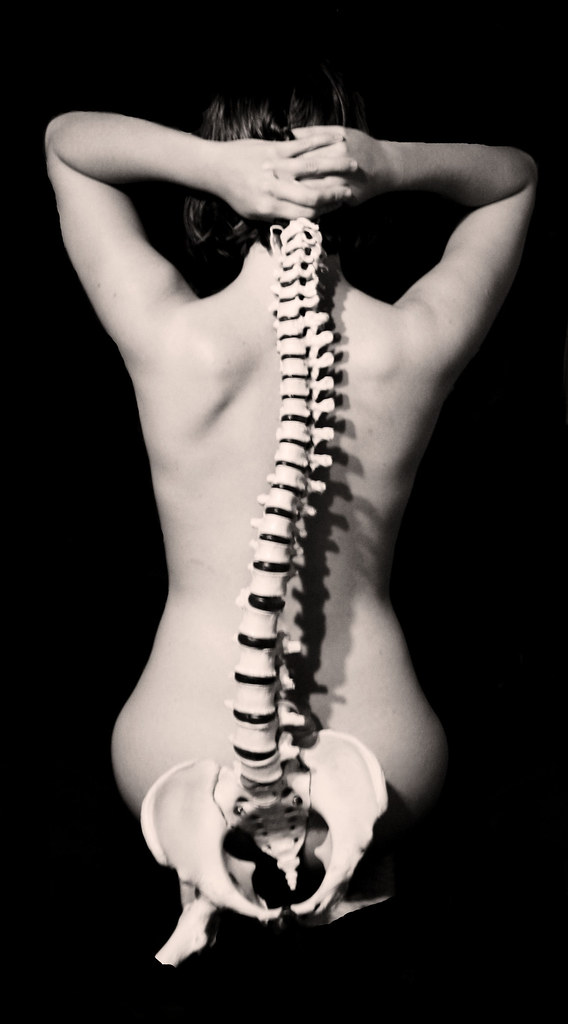
spine(Image by Katie Cowden used under CC license via)

Fifty-five year-old Terry Ragland of Tennessee recently sought medical attention for lower back pain at her local orthopedic center. She was introduced to Dr. Timothy Sweo, who ordered x-rays. After analyzing the results, Sweo concluded that the pain was caused by a curve in the spine called lumbar lordosis. He delivered the diagnosis to the patient by saying plainly, “You have ghetto booty.”

Lumbar lordosis is a severe curvature of the lower spine most visible from the side and it can be caused by a variety of a factors. “Ghetto booty” is, according to the most popular Urban dictionary definition, “a term used when you see a girl with a firm, big, tight packed ass. {Most black girls have ghetto booties}.” In other words, it’s slang for simply having a big butt.

For a medical professional to use the term is fantastically patronizing at best. For a white male medical professional to use racially-charged sex slang with a black female patient he has only met once before is jaw-droppingly gauche. His attempted apology to Ragland via letter does not help his case: “I was trying to take a technical conversation regarding your lower back and make it less technical.”

Presuming orthopedic patients are unable to comprehend medical terms like “lumbar lordosis” is ludicrous. After a month into my first limb-lengthening procedure at age 11, I could explain the difference between lordosis and scoliosis, a corticotomy and an osteotomy, and I could name every bone in the human body. I wasn’t exceptional – I just wanted to understand the world I was living in, like every one of my fellow pediatric patients. Priscilla Alderson’s excellent book Children’s Consent to Surgery presents overwhelming evidence that child patients are far more aware than adults tend to give them credit for. And Ragland is not a child.

“It says to me that he doubts what type of intellect I have, how intelligent I am to be able to understand what he conveys to me in a medical term,” Ragland told reporters.

While Sweo’s condescension comprises a particularly stunning mix of nasty prejudices, he is hardly the first doctor to speak disrespectfully to a patient. Medical specialists are renowned for being scientifically brilliant but socially inept. After making you sit in the waiting room, sometimes for several hours, they swoop in, keep their eyes on your body or the floor, bark a few questions at you, rattle off some orders for the nurse to take down, and swoop out again.  The patient is supposed take solace in the fact that it is all a sign of how important the doctor is.

Since this stereotype has become so pervasive, some medical professionals do make earnest attempts to shatter it, but their success varies. Some try through their body language and demeanor to give you the sense that they are genuinely listening and care about your all-around well-being. Others try by jamming a few blunt jokes into your narrow time slot. It gives you the sense that they’ve just watched Patch Adams and decided that being a clown is the perfect defense against being accused of coldness, so let ’er rip! Your body, your condition and your diseases are hilarious!

Indeed, the most exasperating aspect of the Dr. Sweo case is that he appears to genuinely believe that his comments might have been helpful. Usually it is easier to engage in productive discourse with someone whose intentions are good than with someone who aims to hurt. But in light of his oblivious apology, it seems Ragland has a better chance of getting through to other, more perceptive doctors via the media than to Sweo via complaint.

I have lumbar lordosis.  It’s one of the primary symptoms of achondroplasia and it’s why I had to undergo spinal surgery last year.  I could have crashed this site with a list of all the off-putting doctors and healers I encountered, as well as the sarcastic jokes my closest friends came up with to keep me sane.  As Ragland files a formal complaint with the Tennessee Department of Health, there will inevitably be some backlash about PC culture gone mad and minorities being too sensitive and humorless.  But more power to her for sticking up for herself, and for patients everywhere.

Sex with Circus Midgets or Uncomfortable Silence

7 Jul

(Via)


“Pregnant mothers should avoid thinking of ugly people, or those marked by any deformity or disease; avoid injury, fright and disease of any kind.”  So advised doctors in the 1920 parenting manual Searchlights on Health.  Eugenics was all the rage back then, but it had hardly come out of nowhere.  The ugly laws of the 19th and early 20th centuries prohibited, for example in Chicago, “Any person who is diseased, maimed, mutilated, or in any way deformed, so as to be an unsightly or disgusting object, or an improper person to be allowed in or on the streets, highways, thoroughfares, or public places. 

Under these laws, poor and homeless people with disabilities suffered the most.  The class system gave those from affluent families, like Helen Keller, a better shot at being exempted.  But before the disability rights movements of the 1970s, countless disabled children were abandoned by their families in orphanages and asylums, and were thus condemned to grow up to either join the circus or become the vagrants these laws targeted.  Abandonment, rejection and the resulting invisibility in society is an ableist tradition of astounding resilience.  Because just how far have we come in the past hundred years since doctors and municipalities advised not talking about or looking at disabled people?

This week Slate magazine features two articles by Barry Friedman and Dahlia Lithwick, asking readers to consider “what is left for the progressive movement after the gay rights victory at the Supreme Court.”  Arguing that liberal activists have developed tunnel vision, focusing almost exclusively on gay marriage and nothing else, they trumpet issues that deserve attention along with marriage equality.  Their list spans two articles, covering all sorts of social causes, from ending the death penalty to protecting the environment to improving child-care funding and education to marijuana legalization.  Nowhere in either article do they mention disability rights.

This very same week Slate also kicked off a blog about Florida by Craig Pittman with an opening article called, “True Facts About the Weirdest, Wildest, Most Fascinating State.”  Among the facts that apparently render the Sunshine State weird are the python-fighting alligators and “a town founded by a troupe of Russian circus midgets whose bus broke down.”  On the day of its release, Slate ran the article as its headline and emblazoned “A Town Founded By Russian Circus Midgets” across its front page as a teaser.

Face-palm. 

Friedman and Lithwick have nothing in common with Pittman except that they also write for Slate, a news site written by and for young liberals.  And that their articles remind me of what I’ve come to know and call Young Liberal Ableism. 

 That is, there are two ableist mentalities not uncommon among young liberals:

 1)      Uncomfortable Silence: the tendency to skirt issues of disability, especially compared to other social issues, because disability threatens two things young liberals unabashedly embrace – being independent and attractive.  (“Independent” and “attractive” rigidly defined, of course.)

 2)      Sex with Circus Midgets: the sick fascination with physical oddities that objectifies and/or fetishizes people with atypical bodies or conditions.  (I’ve discussed this in detail here.)

Both mentalities see any disabled people they hurt as acceptable collateral damage

Here’s the thing about dealing with all this.  You get used to it, but not forever and always.  Sometimes it rolls off your back, sometimes it hits a nerve.  This time, seeing a magazine as progressive as Slate brandish RUSSIAN CIRCUS MIDGETS on its front page while leaving disability rights out of its social justice discussion brought me right back to college, where friends of friends called me “Dwarf Emily” behind my back and someone else defended them to my face.  Where classmates cackled about the film Even Dwarfs Started Off Small—“because it’s just so awesome to see the midgets going all ape-shit!”—but declined my offer to screen the documentary Dwarfs: Not A Fairy Tale.  Where a gay professor was utterly outraged that her students didn’t seem to care about immigration rights or trans rights, but she never once mentioned disability rights.  Where an acquaintance asked to borrow my copy of The Curious Lives of Human Cadavers, but awkwardly turned down my offer to lend her Surgically Shaping Children.  Where roommates argued vociferously that they would rather be euthanized than lose the ability to walk.  Where jokes about dwarf-tossing were printed in the student paper. 

I won’t go into certain crude comments that involved me personally, but I will say that when a friend recently, carefully tried to tell me about how shocked he was to find a certain video of dwarfs in a grocery store, I cut him off and said, “Lemme guess, it was a dwarf woman porn video?  That’s one of the top search terms that bring people to my blog.”

For a little more than a decade, I’ve lived on one of America’s most liberal college campuses and then in one of the world’s most progressive cities.  I have never met so many liberal people at any other time in my life and I have never met so many ableist people at any other time in my life.   

This is not to ignore all those I’ve met who, despite their lack of experience with disability, ask carefully constructed questions and consistently make me feel not like a curious object but like a friend who is free to speak her mind about any part of her life experience.  And some young liberals are doing awesome work for disability rights and awareness.  But when a journalist and mother of a disabled twentysomething recently said, “No one wants to talk about disability rights – it’s not seen as sexy enough,” I knew exactly what she was talking about.

In 2009, when the pretty darn liberal Huffington Post reported on Little People of America’s call on the FCC to ban the word “midget,” the majority of commenters snidely remarked, “At least they can get married.”  There was truth to this, but I found it telling that not a single commenter on the left-wing blog considered that the word “midget” could be hurtful.  Everyone instead decided to play Oppression Olympics

Understand that I will never say that among liberals disabled people are worse off than other minorities or that ableism is the “last frontier” in human rights.  It’s not.  Even if I believed it to be true, it would be impossible to prove and fighting for the crown of Superlative Suffering doesn’t do anything but imply that there are those against whom you wish to compete.  I don’t want to compete with anyone. 

Nor do I assume that anyone who uses the word “midget” is bigoted.  Many who use antiquated terms are honestly unaware of their potential to hurt.  (It wasn’t until two years ago that I learned that referring to the Sami-speaking regions as “Lapland” can be very offensive to those who live there.)  And there is no minority on earth whose members agree unanimously on a name.  “Little people” makes me cringe almost as much as “midgets,” while my husband winces whenever I use the German word for “dwarf.”  Labels are only half as important as the intentions behind them.

But when young liberals insist that no one can be expected to know that “midget” is hurtful, there is something particularly perverse about hearing dehumanizing beliefs and ideas come from the mouths of those who pride themselves on their open-mindedness and diversity awareness.  Or whose own experience of marginalization would logically render them a better candidate for empathy.  In the words of Charles Negy, bigotry is an unwillingness to question our prejudices. 

Why do I call it Young Liberal Ableism and not just Young Ableism?  Because certain liberals could learn a thing or two from certain conservatives about facing disability and illness. Consider the stereotype of the small-town conservative who proselytizes about etiquette and tradition, and goes into a tizzy over the idea of two men kissing or a woman not taking her husband’s name or her neighbors speaking another language or a singer using swear words.  But for all the types of people she does not want to accept in her community, she is fiercely dedicated to her community.  She spends a good deal of her time going to church and checking in on her neighbors, and stays in contact with those who are physically dependent, sick or disabled.  As patronizing as charity can be, many young conservatives have been raised to send get-well cards, bake pies, and call on neighbors and relatives who are stuck at home or in the hospital.  They’ve been raised to believe that it’s the right thing to do. 

Many young liberals, meanwhile, have been raised to analyze their problems and personalities to the point of vanity, question moral traditions to the point of moral relativism, and feel free to do what they want to the point of only doing what they want.  They believe that anyone is welcome to live in their town, but they’ll only socialize with those they deem interesting.

I’m stereotyping of course.  But it’s a fact, not a stereotype, that in the U.S. liberals are less likely to donate to charity, less likely to do volunteer work, and less likely to donate blood than conservatives. 

Ultimately, it does not matter whether you call yourself “liberal” or “conservative,” left-wing or right-wing.  There are Ayn Rand conservatives who insist that compassion is “evil,” and there are liberals who work tirelessly in low-paying jobs at non-profits and social agencies that do as much good as any charity.  There are those of all political stripes who make large charitable donations but also want everyone to know about it, and there are those who don’t know the first thing about politics but know everything about empathy.  We are far more complex than our politics give us credit for.

The goal should be to never become too self-congratulatory about our politics or morals,  as Friedman and Lithwick warn.  But in response to their call for issues progressives specifically need to pay to attention to, I do have a wish list going:

How about young liberals fighting to make sure dwarf-tossing is banned around the world?

How about facts instead of factoids when it comes to communities founded by dwarf entertainers who have been socially isolated by ableism and fear life-long unemployment?

How about young liberals continuing to fight for the U.S. to ratify the U.N. Convention on the Rights of Persons with Disabilities?

How about young liberals debating the Supreme Court’s 9-0 ruling last year that religious organizations are exempt from the Americans with Disabilities Act?

How about young liberals talking more about the astronomical rates of violence against intellectually disabled people, rather than just sneering at Sarah Palin’s complaints about the word “retard”?

How about young liberal bloggers trying to understand physical disability and illness as often as they try to understand depression and social anxiety?

How about our seeing a lot more women with dwarfism starring in romantic comedies than in porn movies? 

How about more young liberal discussions about real dwarfs than Tolkien Dwarves?

In issuing these demands, I’m of course terrified of appearing too self-interested.  Politics is all about trying to square the selfishness of What about ME?! with the fairness of Everybody matters.  Sometimes sticking up for your own rights is easier than sticking up for someone else’s.  Sometimes it’s the other way around.  All of us, liberals and conservatives, should value trying to do what is right rather than what is easy.


Liberty and Justice For All

30 Jun

(Via)


The Defense of Marriage Act and Proposition 8 are dead. Less than nine years ago on Election Night 2004, when eleven states banned gay marriage in one fell swoop, I would never, ever have dared to think that change could come so rapidly. Of course, marriage equality does not yet exist in thirty-seven of the fifty United States, but with young people around the world overwhelmingly and increasingly showing their support, it is coming. Thank goodness, in the best sense of the word.

There are those—gay, straight, bi and queer—who are saying, “I can’t be happy about this after what happened to the Voting Rights Act this week.”

And, “I can’t be happy about this until full equality is granted to trans citizens.”

And, “I can’t be happy about this until the AIDS crisis gets more attention.”

And, “I can’t be happy about this until we realize that single people deserve federal benefits, too.”

And every one of these people has a valid point. It’s a common political strategy in such triumphant moments to grab the opportunity to shed light on other civil rights abuses while you have everyone’s attention. Drawing attention to other injustices—especially the attention of those whose privileges put them at risk for remaining oblivious to such issues—is crucial because no one is free when others are oppressed. This is why I am always willing to discuss the latter half of any of the above statements.

But I do take issue with the first half: the too-cynical-to-celebrate attitude that is begging to be called out for its hipster glass house. Because marriage equality is a victory for everyone.

Anyone familiar with the history of minority rights in the U.S. knows that granting civil rights for one group has had an undeniable domino effect on other groups. Not long after debates about slavery, segregation, and voting rights culminated with the nation’s belief that all men are indeed created equal, women asked, “Why just men?” And not long after so many women proved that straight relationships can be egalitarian, gay and lesbian citizens asked, “Why just straight ones?” And somewhere amid gays and lesbians proving that the way they were born hurts no one, trans people asked, “What about how we were born?”  And somewhere in between all the discussions about genitals and bodies and skin color and size, disabled people asked, “What about our bodies and brains?” Because no one is free when others are oppressed.

Likewise, when one kind of inhumane prejudice gets knocked down, all the others are under threat.

This is not to take attention away from the people most directly affected by this week’s momentous legal decision. Friends of mine in Massachusetts can suddenly enjoy concrete federal benefits now while my husband and I have always enjoyed these benefits simply because we’re in a straight relationship. I am so happy for them, and so sad one of my dearest friends never lived to see this day.

But the victory is truly for everyone – even those marriage equality opponents who fail to see how they will benefit from a society that is a little bit freer, a little less fearful, and lot less lop-sided. Because this is a victory for anyone who has been bullied for traits they never had any choice about. This is a victory for anyone with something that has made them stand out in their family. This is a victory for all the couples who have choked back tears when someone said that marriage is all about a man and a woman being able to procreate. This is a victory for all the parents who have tried to teach their children to never grow up thinking they are more important than anyone else.

Congratulations to all of you out there.


What To Do When I Go FWOMP!

23 Jun

(Image by Stephen Alcorn © 2003 http://www.alcorngallery.com)


“HEEEEEY!” Friends were at the door, back fresh from a vacation that had seemed far too long for me to endure. At the sound of their dulcet voices calling me in unison, I jumped from my chair, rounded the corner, darted down the hallway toward their open arms, and FWOMP! Iwassuddenlyhorizontal.

My friends gasped, “OMIGOD, ARE YOU OKAY?!” Apparently this time I was, from what I could tell of the pain, and I bounced up before they finished asking, throwing my arms around them both at once and laughing, “How’s that for a dramatic hello?”

“You’ve been drinking again, haven’t you?” one of them smiled.

“Yes!” I beamed. “You know exactly what to say! How was your vacation?”

We chatted for about five minutes, made plans for the next day, and said hasty goodbyes because their toddler was itching to get home. As I shut the door, I rubbed my knee, looked at my partner, and shook my head. “I’m gonna have a new bruise on the left to match the right.”

Two weeks before I’d gone flying down the same hallway, but that time it had really knocked the wind out of me and left a cut needing a bandage. I had reacted a little less wryly – diaphragm spasms are never pleasant and they forced me to let out a yell that sent my partner running from the kitchen. But after my initial roar, I switched to hollering, “I’M FINE! I’M FINE! DON’T PANIC! I’M FINE!” Our guests came peeking out of different rooms, everyone asking me how I was.

I was fine, but I was mad. Mad at gravity, mad at the pain, mad at my useless tendons and weak muscles that cause me to stumble on average about every ten days. But I wasn’t that mad. I’ve gotten used to it, after all.

Because my anterior tibilias tendons on both legs were severed some time during my first limb-lengthening procedure, I use different tendons to lift my feet when I walk. They compensate relatively well, but since they cause my feet to point slightly outwards rather than straight ahead, I’m a walking accident waiting to happen. It’s compounded by the fact that my muscles fatigue more quickly than others’ due to my dwarfism. It’s been this way since I was twelve and changes only in that the bigger I get, the harder I fall.

Since I was my surgeon’s only known case of tendons severing during limb-lengthening, most people with dwarfism do not face this problem. Some do, however, when their greater susceptibility to fatigue combines with their having to carry an average-sized trunk around on exceptionally short legs. In other words, had my tendons not severed, I may or may not have had this habit of losing my balance. It’s exasperating and inconvenient, but what can I do about it?

Laugh, for one thing. Over the years, I’ve decided a woman falling down is both hilarious and revolutionary—what with the delicate ballerinas we’re supposed to be—and drinking too much is just one of many lovely excuses to offer for it. Years ago I fell while carrying an armload of water glasses and promptly ended up in the emergency room with stitches and a black eye. From the physician named Dr. Goebbels to the nurses insisting my partner leave the room so that I could be free to explain what had happened, the opportunity for sick jokes was everywhere.

Friends have kept records of my losses in the battle against gravity. Some are critical, sighing, “EMILY, that’s the second time today!” while others are cheerleaders: “It doesn’t count this time because the ground is uneven.” (And can I just point out that the German word for gravity—Schwerkraft—literally translates as “heavy force”? I love German.)

Of course, I’m not always at my best when it happens. Often I fall because I’m particularly tired and this results in my being particularly bad-tempered about it. That I kvetch the most to those I know and love the best is logical, but not entirely fair.

When my peers witness me falling for the first time, many of them don’t know what to do. I’m trying to get better at telling them. If I’m not badly hurt, but still somewhat hurt, I try to shout that I’m okay to curtail their apprehension. Taking a minute to help me up and, depending how close we are, offering me an arm until I’m steady on my feet is almost always appreciated. Breaking into a panic and giving me the sense that it’s my job to calm them down is less helpful.

Most people who have to deal with pain caused by disabilities don’t want any more sympathy or attention beyond what we would give someone with a light headache. (In fact, many of us want a tad less sympathy than what some with mundane headaches go fishing for.) If I’m not hurt, anything you say to keep the mood light as a Screw-you! to my heavy fall will be invaluable. If I am hurt, any offers to help before I have to ask will be worth even more. And if your gentle-yet-practical manner demonstrates particularly good caregiving skills, I’m going to tell you so. Experience has made me a particularly good judge.

And I’m not embarrassed when I fall, so please don’t be embarrassed for me. At best, it’s as disruptive as a mighty sneeze. At worst, it’s a mood-killer.

The one fall that still makes me cringe to this day happened as I was stepping off a stage after delivering a poem to thunderous applause. I spent the summer before my senior year of high school at a young writers’ workshop in the Berkshires, where I found all the beauty, intellect and acceptance I been dreaming of ever since I first put pen to paper. Reciting one of my pieces to giggles and cheers made me feel as great as anyone on any podium has ever felt. The moment had been just perfect. And then, I slipped. The handsome emcee looked sincerely concerned: “Are you okay? Are you okay?” He had to keep asking because I was mumbling my answer, mortified to even acknowledge what had just happened. In my head I was begging everyone in that room, Please remember my poem and not my fall. Please.

Then again, “And Emily came tumbling after” is a poem in itself. It doesn’t work as well in Germany, what with no one having grown up with Mother Goose, so I’ll have to settle for the joke about being drunk. That one’s an international success.


Define “Active”

16 Jun

(Via)


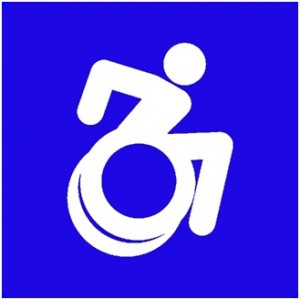
New York City has begun using a new design of the international symbol for disabilities this week. (See above.) Featuring a forward-moving, self-propelling wheelchair user, the new symbol has garnered praise from the mayor’s office and Professor Lisa Wade of Occidental College for portraying disabled people as “active and independent,” instead of “passive and helpless.”

I support the move 99% because it signifies the changing perceptions of what it means to be disabled. Altering our default descriptions of non-ambulatory people from “wheelchair-bound” to “using a wheelchair” sheds much-needed light on the fact that many disabled people are indeed differently abled. Wheelchairs, sign language, and Braille are not just substitute ways of moving and communicating but means of moving and communicating that require skill. If you’ve ever witnessed someone try to use a wheelchair for the first time, you know it’s like watching Bambi on ice.

That said, I am hesitant to embrace any idea that insists that physically “active” is preferable to “passive” at the risk of impugning those who cannot help but be dependent. Just as Little People of America’s motto “Think Big!” inadvertently suggests something undesirable about being small, an over-emphasis on being active—and defining “active” as the ability to physically move yourself forward—inadvertently suggests something humiliating about the thousands of medical conditions that preclude physical independence. All people have agency, and this absolutely bears repeating when we talk about human rights and portrayals of disability. But not all of us are independent.

Disability reminds us, perhaps like nothing else, that we can never hold every member of the human race to the same standard. This does not mean we cannot demand everyone strive for excellence, try their hardest, or be their own toughest critic. But it does mean we should be wary of promulgating rigid definitions of excellence.

As a friend with lupus once said, “What’s wrong with being weak?  What’s wrong with trying to do something and doing it badly?”  

Competitive cultures wince at weakness and I must say that America can be a very competitive place.  Even the most progressive human rights movements have embraced competitive, grandiose language when talking about empowerment.  Two years ago on Love Your Body Day, Chloe Angyal of Feministing wrote an article wherein she wanted to “ take a moment to appreciate the things my body can do.” She went on to list her favorite things:

My body can stitch itself back together when it gets cut. This never ceases to amaze me.

My body has an organ in it that can stretch to accommodate a small human being. I don’t want it to do any stretching or accommodating any time soon, but the capacity is there, and that blows my mind.

More than a decade after it was cool (was it really ever cool?) my body still has the muscle memory to do the Macarena. That one is kind of embarrassing, but still kind of great. Mostly embarrassing.

My body can orgasm. Enough said.

My body can do [a flip], and for that, I love it.

What can your body do?

I had been, and still am, a huge fan of Angyal’s writing. As a feminist, an athlete and someone who has struggled with disordered eating, her contributions to the discourse on body image have been invaluable. But this time around, I wasn’t inspired to join in her Love Your Body Day exercise. I hesitated to say so because I understood the noble intentions behind her article, and what kind of person wants to rain on a Love Your Body Day parade?

Apparently someone like me, because I ultimately couldn’t help but write this response:

I realize the very good intentions of your post: celebrating our bodies as they are. But the emphasis on what you can “do” (= ability) still made me quite uncomfortable as someone with disabilities.

Usually when one writes a piece meant to buck oppressive, judgmental thinking and celebrate the way we are, the author writes about a quality that is ostracized – a skin color, sexuality, a body size, physical features considered to be deformities, etc. It’s the honesty of the author in spite of adversity that inspires. You instead decided to celebrate things about your body that mainstream society does not ostracize at all, but in fact agrees with you are wonderful. So for those of us who cannot dance, have children, heal cuts, or do gymnastics, this post simply reminds us of this and it’s hard not to take it as bragging. (I know that wasn’t your intention.) You did invite us to list our own things we love about our bodies, but I don’t think there’s anything my body can do that yours can’t…

Angyal wrote back to me personally and apologized. From there we started a dialogue that resulted in my writing guest posts for Feministing and our exchanging lots of praise for each other’s work. I had been frustrated by the lack of disability awareness on leftist forums and simultaneoulsy self-conscious of appearing too negative or narcissistic. This made her response to my critique all the more inspiring.  She has both privileges and experiences of marginalization that I do not, just as I have privileges and experiences of marginalization that she does not. The same goes for those who can move their own wheelchairs and those who cannot.

Overlooking our privileges and inadvertently denigrating others happens all too easily, as all 7 billion of us strive for excellence and recognition of our various capacities for excellence. Trying to include everyone in the conversation, all the time, can be exhausting.  But admitting the danger of these missteps is imperative to the idea of truly universal human rights because that idea insists, over and over again, no matter what the circumstances, that everybody matters.  There is no way around it if we want to move forward.


Does GoldieBlox Break the Box?

9 Jun


After its Kickstarter fundraising campaign (see above) proved to be a success, GoldieBlox is here and available for retail.  Designed by an engineer appalled at the 1 to 10 ratio of female to male professionals in her field, the toy is the latest in a series of efforts across the West to combat the gender gap and get girls excited about scientific concepts from the earliest possible age.  Questioning the stereotype of women as “naturally” less competent in math, science and visual-spatial thinking is always admirable.  But does GoldieBlox really amount to anything more than simply painting science pink?    

Parents who want to conscientiously ensure their daughters feel every option is available to them will probably already have bought them Legos and Erector Sets.  But parents and relatives and neighbors who rely more on tradition when picking out presents may be swayed by the color-coding GoldieBlox employs.  As in: “I need a present for a cute girl.  Look, this is pink and cute.  I’ll take it.”  Having worked in early childhood education as well as social justice, I wish every adult responsible for stocking a child’s toy box would be conscientious enough to consider the value and purpose of their every purchase—or at least read the picture book all the way through—before heading to the cash register.  But plenty of adults who want to make kids happy don’t share my interest in kids’ things.  They truly appreciate age recommendations on the boxes, and the pink and blue color-coding.  It is these adults and their beloved little girls who will benefit tremendously from the GoldieBlox expansion of the world of pink into the realm of engineering. 

But why do we need to color code anything to let people know which gender it’s for?  Do we need to rename it GoldieNASA to get more women to work there?  Last year, when Bic introduced pens for women (“Easy glide – feel the smoothness!”), its Amazon page almost crashed under the weight of sarcastic reviews:


No Good For Man Hands


And then there were the appropriate reactions in November to the Honda She’s, a car marketed to women in Japan with special light and air-conditioning features to prevent wrinkles.  Feminists asked:


26


Indeed, the most offensive aspect of the pink-is-for-girls mentality is the antiquated belief that women need a softer, daintier, less intimidating variation of the standard, which was built for men by men.  Any woman who stops posing for a portrait and approaches that standard is an accident waiting to happen!  Right?

Pink cars and laptops and cell phones and building blocks trigger my gag reflex because they seem to be so obviously marketed as the deviation from the more serious male standard.  But is it fair of me to assume this?  Would GoldieNASA really be so bad?  A friend who works as a software engineer and buys so many Hello Kitty products I suspect he accounts for half of Sanrio’s market share would say no.  He agrees with me that Barbie and the Disney Princesses inappropriately introduce pre-schoolers to sexual self-objectification and viciously narrow beauty standards.  He is both irritated and concerned about those of any gender identity who think they should use their vulnerability to get what they want.  But his kitchen cupboards are brimming with cups emblazoned with pink hearts and daisies and butterflies.  He would love to work at GoldieNASA.

There is nothing inherently wrong with the color pink or with girls and boys, and men and women, being cute.  In fact, trashing the color pink and all things marketed at girlie-girls is often motivated by a powerful misogynistic tradition: the belief that things for girls are dumb and frivolous because girls are dumb and frivolous.  This is usually why boys and girls watch films and read books marketed to boys—like Harry Potter or Star Wars or every Pixar film but Brave—while only girls watch films and read books marketed to girls.  Some misogynists and feminists uphold this disparity by uniting in their belief that twirling around in ball-gowns is silly because it’s not a skill needed by the average adult in modern life.  Indeed, it is not.  But then neither is sword-fighting.    

For this reason, it is imperative to teach kids that the value of a toy or story derives from its content, not its color.  Within this lesson lies the truth that there is more to being a girl than dressing up and being cute, just as there is more to being a boy than being stoic and winning every competition.  Every child should feel every option is available to them because the most innovative minds approach the world with the least reliance on tradition.

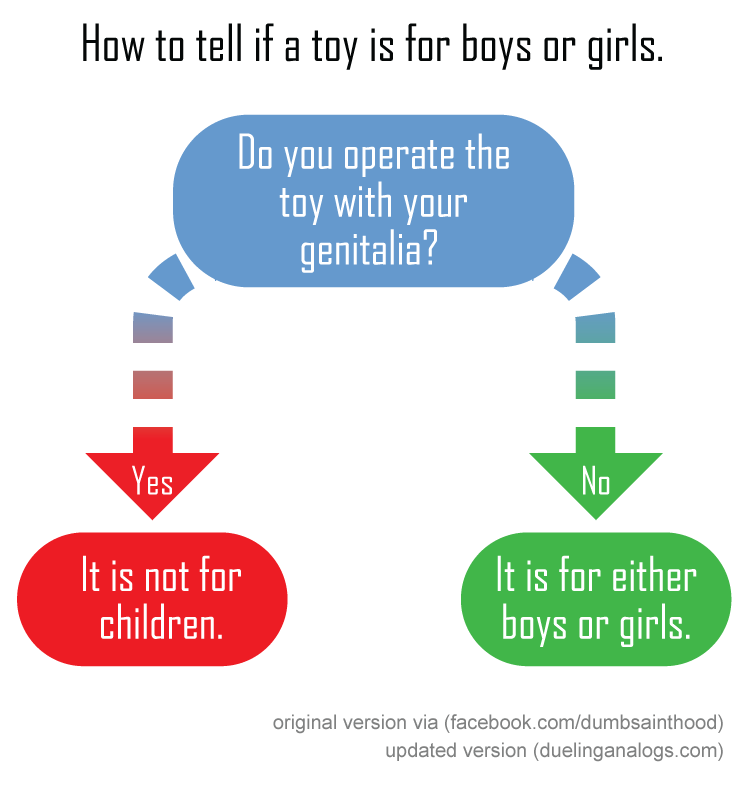
GoldieBlox will have succeeded when it is ubiquitous in any child’s room because it will signify that adults are picking their purchases based not on color but on this simple rubric:


PINK!

19 May

(Image by Monika Tugcu used under CC license via)


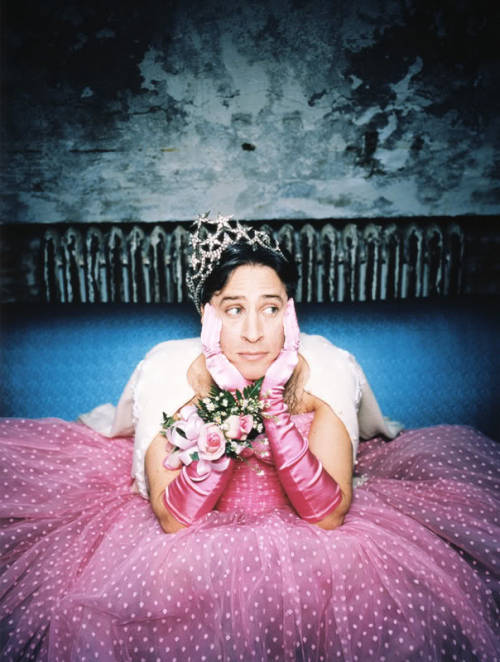
This holiday weekend I’m sparing you my deep and profound thoughts about the Barbie Dreamhouse exhibit that opened this week in downtown Berlin and the protest that accompanied it.  Instead, I’ll let the issues and problems of beauty standards and femininity and sexuality and body image and fashion and pink and sparkles be summed up by a little story I discovered this year:

In 1999, Jon Stewart was invited to be featured in People magazine’s annual list of 50 Most Beautiful People.  (I’ve written about the List before in The Body Image Series, highlighting Michael Chabon’s excellent reaction to it.)  Stewart agreed to be featured but insisted on wearing a pink prom dress and a tiara for the photo shoot.  Why? 

I feel pretty!


Who Should Have To Expose Themselves?

5 May

(Via)


If you live anywhere in the West, you know this transphobic joke.  Girl and guy go to bed.  Guy wakes up and finds out somehow that his lover was not born a woman.  The moment of realization is sketched out across his face in excruciating slow-motion, and then he runs away in horror/vomits his brains out/gets very, very, very angry.  The message? 

1)      A trans woman isn’t a “real” woman, she’s a freak.

2)      His being attracted to her somehow makes him less of a man.

3)      Most importantly, he’s been duped.

Feeling duped is the bedrock of transphobia.  Those who feel indiscriminately upset at the very idea of transsexual and/or transgender people usually say something along the lines of, “They’re deceiving people!  I’d be pretty pissed if I found out my girlfriend/boyfriend had had a sex change.”  This feeling is usually enshrouded in the myth that transitioning into the opposite sex is done capriciously, just for laughs and the thrill of going undercover.  This mentality never ever acknowledges the fact that many transsexual and transgender people feel as uncomfortable in the body they were born in as cis people would feel in a body they were not born in.  And it fosters the view of cis people as victims of trans villains, ignoring that trans people in the United States have a suicide rate 26 times higher than the nationl average and that worldwide one trans person is murdered every three days.

This all too common belief that trans people are deceptive, and maliciously so, has now reached new heights as two trans men in the U.K. have been charged with and convicted of sexual assault.  Their accusers claimed that the men’s failure to disclose their gender at birth before they slept with them was a form of fraud and thus the consent the women gave to sex was under false pretenses.  I am in no position to make a final judgment about these two specific cases.  Perhaps they involved many other factors revealing coercion and predatory behavior.  I cannot speak for the defendants or the accusers.  But I can and will speak out against the widespread belief that the freaks of the world are obliged to warn everyone they know about their atypical features and histories before they dare try to get close to someone.

My husband thought I must have been in a car accident years ago when we met for the first time at a birthday party.  I was wearing a sleeveless top exposing the lavender scars that traverse my upper arms.  I know I told him soon after, on our first date, about my long medical history, but that was because we were having an intellectual debate about the role of the media and I decided to use my childhood experiences as an example.  I decided to do so because I liked him and trusted him in a very special way.  It was not because I felt that anyone I was interested in romantically “deserved” to know.

What do potential sex partners deserve to know?  Do they deserve to know I had my calf bones removed?  Do they deserve to know I had my tonsils out?  What if I had been born deaf and had a cochlear implant?  What if I used to weigh twice as much, or half as much, as I do now?  What about veterans or cancer patients who have lost body parts normally only seen by sex partners?  Is it fraudulent of a cancer survivor to wear a prosthesis that would suggest she still has both breasts?  

Indeed, the moment I read about the British cases, I was immediately reminded of a poem by Robert Hass about a woman who is abandoned at her doorstep by a young admirer after she tells him she has had a double mastectomy.  “I’m sorry.  I don’t think I could,” he mumbles before he turns his tail and runs.  I do not know what it is like to be a cancer survivor or transsexual, but surely many of us know what it is like to fear being rejected for something we never had much of a choice about.

In reponse to the British accusations of sexual assault, law professor Alex Sharpe has asked, What if a potential sex partner appears white but is in fact of mixed race – is a failure to map out your entire family tree grounds for prosecution?  Of course not.  He points out that individuals are not legally obliged to reveal to sex partners that they are bisexual, married, divorced, have a past criminal record…  The list is endless, and thus he argues: “Given that we all have gender histories but only some of us (transgender people) are required to disclose them, there appears to be a good basis for arguing that a legal requirement to disclose gender history constitutes discrimination contrary to Article 14 of the European Convention on Human Rights.”

Of course, any counselor or psychologist will tell you that trust, openness, and honesty are necessary for a healthy relationship and true intimacy, but the right to privacy and personal dignity are also necessary for any community founded on justice.  And there can be no genuine trust when certain people reveal personal information only because society’s hang-ups about gender, sexuality, or atypical bodies demand they do. 

Everyone is entitled to their sexuality.  No one should ever be pressured into a heterosexual, homosexual or pansexual relationship.  Open and honest dialogue about this is essential.  But the more we blame minorities for upsetting our delusions of normalcy just by being who they are, the more we tell jokes implying that any normal person would be disgusted by their physiology, the more we insist that their identities are a perversion of ours, the more difficult we make it for them to be open and honest with us.


Who You Telling To Wear Makeup?

28 Apr

fashion show(Image by Alex Craig used under CC license via)


While chatting with colleagues over coffee this week, I ended up “outing” myself as a dwarf who’s had limb-lengthening.  (Experience has taught me some people notice right away when they meet me that something is up, while others go a long time without the slightest idea, especially in the wintertime when my scars are hidden under sleeves and pants.)  We arrived at this topic by discussing fashion—and the recent scandal in Sweden that’s left me almost speechless—and then beauty and self-confidence.  Several of my colleagues pointed out that every person they know who’s undergone cosmetic surgery never struck them as unattractive before the fact.  Only an idiot would think that there’s only one kind of beautiful nose or mouth or whathaveyou.  And only a jerk would tell someone to have cosmetic surgery.

As you may have guessed, I agreed wholeheartedly.  But what about telling someone to wear makeup?

This week, a man writing to Slate’s Dear Prudence advice column confessed he feels simultaneously guilty and helpless about the fact that some of his female friends are unlucky in love because “their looks are probably the only thing holding them back.”  Prudence tends give good, progressive advice, but this time, instead of telling him the ladies should move in less superficial circles, she suggested he pair them up with some similarly “average-looking” male buddies.  She then added, “If the problem with your female friends is not their intrinsic looks but the fact that they dress like schlubs or never wear makeup, then a guy’s perspective that they aren’t doing everything with what they’ve got could spur them into action.”

Ugh.  Say what you want about clothes, but the makeup debate is as messy and gunky as makeup itself, which is why I’ve avoided it up until now.  But am I the only one who thinks telling someone to start using makeup is entirely different from giving them your opinion about the way they dress?

Everyone, from my partner to my grandmother, rolls their eyes at certain fashion choices and, as I’ve said before, anyone who denies they ever do it is lying.  It betrays a pathetic insecurity to trash others’ dress for the sake of your own self-aggrandizement—e.g. “I wouldn’t be caught dead in that!”—but it is fair to say what just isn’t your cup of tea.  We can snark a little about someone’s clothes, hairstyles, accessories, headgear or makeup style (if they have one) without too much malice because someone is probably snarking about ours.  No one on earth dresses in a way that is universally attractive because there is no such thing as a universal beauty standard.  And as the saying goes, there is no arguing taste.  Someone thinks this is kick-ass, and someone else thinks it’s sloppy:

Captain Jack Sparrow

Someone thinks this is dreamy and someone else thinks it’s one big yawn:

Jason Straatmann Actor Japan Suit Tie Cufflinks Model

Someone thinks this is sexy and someone else thinks it’s garish: 

Untitled

People find beauty in this:

Traditional Korean dance

Or this:

Ethiopia, Mursi woman

Or this:

Bollenhut-Gutach

Or this:

4601942293_27f40e0122_o

Or this:

Namibië, oktober 2008

Or this:

 
And that’s just a tiny sample from around the world. There is even more variation across time because, as Oscar Wilde said, “Fashion is a form of ugliness so intolerable that we have to alter it every six months.”  I think some of my friends, like some of the subjects above, have a great sense of style, while others do not.  They in turn probably think the same about me.  But if any of them thought I should wear makeup more often than I do—which is almost never—and told me so, they wouldn’t be my friends.  But what if they’re my supervisors?      

In January, a study featured in The New York Times revealed that (American) women who wear makeup are considered more competent and more likable in the workplace.  A panel of stylists and professors made various points about this that basically all boiled down to, “It’s a choice.  If it makes women feel more confident, they should go for it.”  But if the study indicates that their confidence would result from garnering more positive attention for their looks, then their lack of confidence without makeup would result from a fear of not getting attention for their looks. 

Many modern women, especially lipstick feminists, repeat, “Empowerment is all about being free to choose!”  There is truth in this.  I know guys who were bullied in school for wearing concealer or plucking their eyebrows.  Women meanwhile are often forced into a nearly impossible balancing act wherein no makeup = plain Jane, but too much = slut, and kudos to anyone who refuses to play that game.  Good girl culture, as well as the results from the study, assert that “less makeup is more – you should look like you’re not wearing any.”  This rule seems potentially problematic to me because it is insidious.  If someone gets used to just slightly “improving” their face every day, it is more likely they’ll feel insecure without these improvements.  I occasionally enjoy wearing heavy makeup bordering on the outrageous (like glitter), but it feels like a mask and everyone knows it’s a mask.  When it’s so obviously part of a costume, there’s not much danger that I’ll start considering it an inalienable component of myself.  But the subtle makeup seems to be a lot harder for people to let go of.  I know women who refuse to be photographed without their makeup on—and you probably do, too—and if that doesn’t sound like an unhealthy insecurity, I don’t know what does.

In any case, it doesn’t sound like they are “free to choose,” as lipstick feminists advocate.  As I’ve written before in explaining my choice to have my limbs lengthened, we should be free to make complex decisions about our bodies without others making snap judgments about our motivations.  Anyone who does is a coward.  But it is also cowardly of us to voice hatred for our natural faces and simultaneously deny that this has any impact on others.  In the words of philosopher Arthur W. Frank, “When we make a choice, we confront others with that choice.”  The freedom to choose diminishes when a strong majority bends in one direction, because majorities create social pressure.  In a society that literally rewards women who wear makeup—i.e., with higher salaries—it is undeniable that many do so in order to win these rewards, ultimately playing by the rules under the guise of empowerment.  The cosmetics industry, like any industry, always aims to make their customers feel that they cannot live without their product and so they too have embraced the slogan of “Empowerment!”  Leading The Onion to smirk, “Women Now Empowered By Everything A Woman Does!” 

It would be obnoxious of me to assume that every woman with a compact in her purse does it to acquiesce.  I know and admire selfconfident women who love putting on bright red lipstick and self-confident men who wish they could, too, without being gawked at.  Primping can be fun.  Painting your skin certain colors can make you feel fine and refreshed, like slipping into a brand-new top or getting a new haircut.  Or brushing your teeth after a hangover. 

But it’s not quite the same thing, is it?  Once again, it’s a mask.  A friend of mine who loves dressing up but hates wearing makeup recently said, “I guess, ultimately, it’s weird looking in the mirror and seeing something that doesn’t look like me.  I don’t really like makeup on other people either though, so perhaps it’s a general class of trying to hide oneself that bugs me.”   

Indeed, that is one of my many reasons for rarely ever using cosmetics, why I graciously declined friends’ offers to do me up on my wedding day, why I cringe at the idea of anyone pressuring women into it.  I also like being able to rub my face without having to worry about smudging.  I’d rather spend the money on a million other things.  My partner hates the taste of cream, gloss or powder—“Kissing someone wearing foundation is like kissing a sandbox!”—and I must say I don’t blame him.  Most importantly perhaps, I don’t understand why our culture believes that women’s faces require some paint in order to be attractive but men’s faces don’t.  If I can’t compensate for the plainness of my natural face with my charisma, then no one should be able to.

Of course, almost all of us conform to our culture’s beauty standards to some degree.  I’ve worn concealer for blemishes and plucked my eyebrows to make them even, but I feel a strong attachment to my scars and so I’ve kept them.  I don’t always like my face—don’t we all have those days when we look in the mirror and just feel yucky and dissatisfied?—but even if I thought putting on some modern Western style of makeup would make me look “better,” it wouldn’t look like me.  Experience has also taught me that a dissatisfaction with one’s looks is almost always rooted in something more substantial: feeling not very fit, feeling overtired and stressed, feeling lazy because there’s been too much or too little to do.  And even if it’s not, I often feel very satisfied with my face, so on a bad day why not simply walk away from the mirror, focus on something a little more profound than my appearance, and have confidence that the feeling of self-satisfaction will return?

As psychologist Nancy Etcoff wrote in The Times:

Women who feel that makeup use is obligatory but unwanted, that it requires a forced confrontation with the mirror when they’d rather put their attention elsewhere, do not feel more confident after using it.  Research suggests that women can feel objectified by makeup, and for such women, any potential advantage may be offset by the emotional labor of wearing it.

And, in an excellent article on weddings, Ariel Meadow Stallings of Offbeatbride.com writes:

I’ve been thinking a lot lately about the pursuit of authenticity versus the pursuit of attention.  The first feels very internal, like you really have to look with-in yourself with a lot of introspection and thought to determine what’s important … while the other feels very external, like you’re hunting for other people’s eyeballs.  And why does one seem like so much fun, while the other seems like so much work? …

I guess it comes down to this: Attention gives you the cheap high of other people’s energy focused at you … but authenticity gives you that deep, long-lasting satisfaction of knowing that you’re on the right path and you’re doing the right thing.  While the quick high is more fun in the short run, the deep satisfaction is ultimately more filling.

This is why it is fine to wear makeup but wrong to tell someone else to.  Not only is it a ludicrously presumptuous, boundary-crossing thing to say—like telling someone to switch careers or leave their spouse—but it’s vacuous because it has nothing to do with matters of justice or morality.  It is sheerly a matter of beauty standards.  The worst thing about beauty standards is that they create peer pressure based merely on taste.  The best thing about them is that, as seen above, there are millions of them, and they are constantly changing.  If humans are capable of thinking the lip-plate is attractive, then surely we are capable of thinking a woman without makeup is attractive. 

Women and men should feel free to smear their faces with whatever they wish or go without, to pluck their eyebrows or leave them be, to shave any body part or refrain.  (Bearing in mind doctors have recently explained the cringeworthy risks of shaving certain parts.)  But the moment they say that someone should do the same in order to feel better or lure lovers or advance their career, we have a problem.  And it’s not physical.


Picking & Choosing Our Tragedies

21 Apr

World travel and communications recorded on Twitter

(Image by Eric Fischer used under CC license via)


What a week.  A suicide bomber in Pakistan killed four people.  A fertilizer plant explosion in Texas killed at least fourteen people.  Sixteen people died in a goldmine collapse in Ghana.  President Obama and members of the U.S. Senate were sent letters laced with poison.  A journalist in Mexico was assassinated, presumably by agents of the drug wars.  At least 65 people died in terrorist attacks in Iraq.  More than 150 people just died in an earthquake in Szechuan.  And after two young women and a little boy were murdered by bombs at the Boston Marathon, it felt surreal if not uncomfortable to see my last post about America’s inexperience with bombs at home emblazoned across the blog.  But what to say? 

For most of the week, we had no trace of a motive for the Boston bombing.  And now that one suspect of Chechen origin is dead and his brother is in custody, we still don’t have anything we could officially call a reason.  Polemicists on the right and left are using the event as “evidence” for the necessity of their own political agendas, arguing that we should have used drones, or that Dzhokhar Tsarnaev should face a military trial, or that we need more surveillance cameras everywhere, or that the two suspects seem more like the psychotic teens of Columbine than terrorist operatives.  As John Dickerson observed in Slate yesterday:

We need more restraint and less wild guessing. Free-flowing debate in the search for meaning is a part of these moments and a part of the human condition, but … In these fast-moving times when the only thing that is certain is that the first piece of news has repeatedly been wrong, perhaps those lawmakers and pundits who want to be part of the final conversation should (paraphrasing Mike Monteiro) follow the Quaker rule: Be meaningful or be quiet. 

Of course, we all like to think ourselves meaningful.  But so far, with no official motive, the only irrefutable point any politician has made thusfar came from the Ambassador from the Czech Republic, who urged the media to note that Czechs and Chechens belong to two different countries located over a thousand miles apart.

Distance and borders matter, obviously, since none of us are equally horrified by every single one of this week’s tragedies.  But why?  I had friends in the Boston area who were stuck at home during Friday’s lockdown.  (Two were hoping to be allowed out in time for them to make it to the annual birthday celebration of their late brother Bill, whom I wrote about at this time last year in a post on grief.)  But I’ll hazard to guess that most of those glued to the news updates from Boston did not have loved ones there.  The story dominated the headlines across the ocean in Germany, in France, in the U.K.  Everyone seemed to be watching. 

The simplest reason for this is that people are naturally empathic, upset to see others upset and, in the words of the Czech ambassador, “It was a stark reminder of the fact that any of us could be a victim of senseless violence anywhere at any moment.”  But dead people in Pakistan and Iraq no longer serve as reminders of that fact.  They instead represent our ability to compartmentalize, to exile certain tragedies to a semi-numb region of the mind, either because they seem too frequent for us to commit to or because we want to believe there is some crucial difference between Us and Them, protecting us from their fate.  It’s not malicious of us to compartmentalize in this way—to tear up upon sight of the beautiful little boy in Boston while not even checking to see if any of the victims in Iraq were children—but it’s not fair either. 

And so I stared down my last post about World War II bombs, feeling inexplicably uncomfortable, wondering whether it was callous of me to not say anything about the tragedies going on in my old home country, yet knowing World War II would never have happened had my new home country not embraced a dangerous idea of what makes a country “home.”  Borders are always bizarre.  In a digital age, distance is all in the mind.  I’ll never be able to rationally explain why some things feel “close to home” and others don’t.   I’ll always care more about the safety of those I know personally than those I don’t, but I’ll never be completely comfortable with this fact because ignoring our common humanity is what builds borders and facilitates cruelty.  I’ll always tear up if you show me a picture of an innocent victim.  I’ll always try to remember to ask why we are shown pictures of some victims, and not others. 

Or, as a friend in Boston observed during the lockdown, “It is so hard to be inside on this gorgeous, beautiful spring day.  Minor problem, but reminds me how lucky we are most of the time to feel safe outside our homes.”


This Is What War Looks Like, 70 Years After the Fact

7 Apr


This past Wednesday, Berlin’s Central Station—the largest train station in Europe—was closed after a 220-pound Soviet bomb from World War II was discovered by construction workers.  840 residents were evacuated from the area before the bomb was successfully defused.

Not all such bombs can be defused.  This past August, an American bomb discovered in Munich had to be detonated by experts, as you can see in the video above.  Approximately fifteen unexploded World War II bombs are discovered in Germany every dayThis does not happen where I come from.

To live in Berlin, my favorite place on earth, is to live in a city of scars.


Who Gets Stuck in the Friend Zone

24 Mar

Love for all!(Image by Matthias Ripp used under CC license via)

Well, I finally sat down and saw The Phantom of the Opera a quarter of a century after everyone else.  (If you don’t know the story, this parody sums it up pretty well.)  I won’t say what I thought of all the songs songs songs because I’m bound to alienate half my readers either way, but by the second to last scene, I was hollering at the screen: “Girl, you’d better not go for that swaggering bully in the mask!”  But then she ripped the mask off and he couldn’t stop crying and I was up to my eyelids in Kleenex, wailing: “If only he hadn’t killed so many people!  (And talked to her instead of stalked her… )  Now he’s just another disfigured guy stuck in the Friend Zone!  But his pain is reeeeeeeeal!”

This week, the word “Friend Zone” has been entered into the Oxford English Dictionary.  Many of my favorite feminists are not pleased.  Because the term is generally thought to be something only straight, bitter men complain about (see these Urban Dictionary definitions), many argue that it’s a misogynistic trope.  Lamenting the Friend Zone sends the message, however subliminally, that spending time with a female is pointless unless you gain access to her naughty bits.  Because who would want to be friends with a woman?! 

Such a bleak view of women is certainly a problem among many men.  In the words of John Mix Meyer, “Girls are not machines you put kindness coins into until sex falls out.”  Nice for the sake of nice is respect.  Nice only for the sake of getting laid is not.  As I’ve said before, cross-gender friendship could use a lot more support in books, film, and mainstream society.

But I’ve also used the word “Friend Zone” before because I don’t believe it refers only to this one chauvinistic idea.  Unrequited love isn’t fun for anyone.  Lots of women have been stuck in the Friend Zone, too.  Many people are expected by pop culture to always end up there, because society deems them asexual, and it could be helpful to examine why.  Almost every adult on earth craves love and sex, and we are all trying to figure out what attracts those we deem attractive. 

Men who sigh, “Girls don’t like nice guys,” need to get over their narcissism.  But there are others who wonder in earnest why the Friend Zone seems so jam-packed with quiet guys who genuinely respect women.  In stories of every genre, from classic literature (Madame Bovary) to modern literature (Freedom) to dime-a-dozen bodice-rippers (The Bridges of Madison County), bored heroines look past their straight-laced suitors to the tall dark stranger who’s not exactly famous for his fidelity or his feminism.  Love triangles always make for good drama, but when the heroine more often than not decides that the devoted sweetheart belongs in the Friend Zone and the unpredictable bad boy belongs in bed, many scratch their heads and repeat, “Why do girls always go for jerks?”  Or, as The Mr. T Experience sings, “I have some problems… but even Hitler had a girlfriend, so why can’t I?”

The answer often depends on the situation, but there are two fundamental, heteronormative traditions that prop it up:

The Macho Stereotype – Any guy who isn’t strong and independent to the point of being daring isn’t a “real man.”  Obeying the rules, doting on your wife, and being mediocre is emasculating.  Hence the double standard men are held to in real life: they are always expected to focus more on their success and autonomy than their emotional fulfillment.  Sociologist Stephanie Coontz has pointed out that the inordinate importance of independence to male worth is why homeless men arouse so much more disgust than homeless women.

The Gentler Sex Stereotype – A nice girl can see the diamond in the rough.  A man with a nasty wife is hen-pecked and pathetic, but a woman with a bad boy just might be the only one who understands him.  From a conservative standpoint, it’s virtuous of a woman to be so selfless and forgiving.  From a liberal standpoint, it’s the thrill of conquest and her extraordinarily open mind that keeps her trying.  

A man’s worth is defined by his success, albeit many women accept broad definitions of success.  Western romances across the ages assert that special girls who search for the softer side of the bully or the bad boy will find it: Beauty and the Beast, Wuthering Heights, My Fair Lady, The Sound of Music, The Music Man, Guys and Dolls, Bonnie and Clyde, right up to Fifty Shades of Grey.  Pop culture reiterates ad nauseam how much men love the chase, but this trope shows that scores of women do, too.  For the starry-eyed heroine, it’s a challenge to stray from the disapproving masses—or her parents—and become the One Special Woman who can tame the beast and bring joy to his lonely life.  The higher the risk, the greater the reward.  The reward is knowing that she is deeper, different from those other girls who swoon over bland perfection.  Hence even America’s most famous feminist, Lisa Simpson, has looked past loyal, bespectacled Milhouse for Nelson, the schoolyard bully from a broken home.  

By far the most horrific result of this romantic tradition is the fact that too many women in real life endure abuse, or worse. Pop culture sometimes concedes this and still has the audacity to romanticize it.  My high school did a production of Rodgers & Hammerstein’s Carousel the same year Time magazine declared it the Best Musical of All Time.  After wife-beater Billy Bigelow dies in an armed robbery, his widow tells their daughter, “It is possible, dear, for someone to hit you, hit you hard, and it not hurt at all.”  You see, truly devoted wives know that offering yourself up as his punching bag is a way to show your love and nurture him as he struggles with his demons. Only a selfish bitch would leave him when he needs her most.

Carousel was written in 1956, but the trope is still going strong. The final film of the Twilight series lead NPR’s Linda Holmes to observe:

When a saga popular with pre-adolescent girls peaks romantically on a night that leaves the heroine to wake up covered with bruises in the shape of her husband’s hands — and when that heroine then spends the morning explaining to her husband that she’s incredibly happy even though he injured her, and that it’s not his fault because she understands he couldn’t help it in light of the depth of his passion — that’s profoundly irresponsible.

Yes, we’re all having a good yuk over the unhinged quality of it all.  And yes, it’s a movie with a monster baby… But romanticizing an intimate relationship that leaves bruises and scars is a particularly terrible idea in a film aimed at girls. Talking about this is tiresome, but then so is putting it in the movie.

Indeed.

But attraction to the forbidden is not always dangerous.  Sometimes the bad boy is just misunderstood.  There is a powerful romantic tradition of fine ladies risking wealth and status for true love.  (See Aladdin, Titanic, Robin Hood, Moulin Rouge, Lady and the Tramp, Lady Chatterley’s Lover, The Pirates of Penzance, The Pirates of the Caribbean.)  There are also classic tales of heroines opening the gates to social progress by debunking their families’ horrid prejudices when they fall for men outside their race/nationality/religion/species.  (See Pocahontas, South Pacific, Fiddler on the Roof, The Little Mermaid.)  The heroines of Guess Who’s Coming to Dinner and Angst essen Seelen auf stare down the racial tensions of the era in which the films were released.  Meanwhile, Cyrano DeBergerac and the Phantom of the Opera both find out—albeit too late—that their beloveds would have looked past their disfigurement and loved them back. 

Since then, we’ve seen heroines end up with men with disabling injuries (often from war), while a handful go for guys who are congenitally disabled or disfigured.  As noted recently, Peter Dinklage’s romantic roles are possibly, finally breaking dwarf men out of the Friend Zone.  Great art obsesses over the blurry border between right and wrong, friend and lover, beauty and banality.  These compassionate heroines who try to understand the “bad” boys and the rejects help us deepen our perceptions of attractiveness.

It’s worth noting that the Phantom and Cyrano compensate for the supposed repulsiveness of their disfigurement with the sexiness of their genius.  They are supercrips.  Granted Gothic tales love to examine the complexity of blinding light draped in darkness.  I like a study of conflicting traits as much as the next starving liberal arts grad.  But it’s a ludicrously ableist tradition that only gives disabled superheroes a shot at intimacy, restricting ordinary disabled men like Quasimodo or the Seven Dwarfs to the Friend Zone.  And it’s an absurdly lookist tradition that restricts almost all of our disfigured and disabled women there.

Can you name a famous heroine who’s disfigured or physically disabled?  (Can you name a famous actress who’s visibly disabled, for that matter?  I might be able to, but I’d have to check Wikipedia to be sure.)  In the old days, disabled and disfigured girls might arouse sympathy (see Helen Keller), but the women were hags.  Period.  If women who were merely not conventionally attractive ever dared to step out of the Friend Zone and into the dating game, they were annoyingReally annoying.  And they were swatted away like flies.

Nowadays, love stories try to speak to women’s insecurities about their looks with quirky retellings of the Ugly Duckling or Cinderella.  The heroine perceives herself as unattractive, moaning, “Is it because of my [thighs/eyes/nose]?!”  (Rather than cursing, “That shallow jerk stuck me in the Friend Zone!”)  But we eventually see that she truly is a knock-out and it’s just a matter of finding the right man who will wipe the soot off her face, pay for a makeover, or simply remove her glasses.  Children’s films are getting a little better: Shrek and The Princess and the Frog feature heroines who are green-skinned for part of the courtship, though their Otherness is not quite as realistic as the Phantom’s or Quasimodo’s.  We’ve yet to see a heroine reveal a real-life physical disability and see her hot lover swoon.

And why not?  Francis Bacon said, “There is no exquisite beauty without some strangeness in the proportion.”  I’ve overheard countless guys say, “Chicks dig scars.”  Which is true.  Lots of chicks got scars, too.

The popularity of a story is by no means an empirical examination of our values.  Most people I know are so much deeper than pop culture gives us credit for.  And there is a lot more to many of these stories than the tropes I just reduced them to.  But it would be daft to pretend that they have nothing to do with our collective psyche.  Every one of us treasures those romantic moments we experienced that were “just like in a movie.”  Our most popular books and films simultaneously reflect and influence what we tend to think is hot.  And when it comes to opening our minds, fiction is often the best messenger.  We look to entertainment for escape and to art for enlightenment.  The most powerful stories provide both. 

When I attended a lecture at the Network of Disabled Women in Berlin two weeks ago, there was a debate as to whether reality TV shows and documentaries help or harm perceptions of disabled women.  Good documentaries smash stereotypes by providing facts and figures, but the over-representation of disabled women in such reports combined with their invisibility in love stories, detective stories, and silly sitcoms suggests that they exist solely as objects of study.  They are there to satisfy our curiosity, but we’re rarely asked to root for them the way we root for Rapunzel or Bridget Jones.  We never follow them on a journey dripping with passion.  We should. 

The Oxford English Dictionary’s newborn definition of “Friend Zone” reads: “a situation in which a platonic relationship exists between two people, one of whom has an undeclared romantic or sexual interest in the other.”  It doesn’t say it’s exclusively a problem for men.  And good for them.  To me, the term will always evoke the potentially destructive idea that certain “types” of people don’t ever need or deserve intimacy.  And we’ve got to keep questioning it.  Children, animals, and self-proclaimed asexuals automatically belong in the Friend Zone, along with your clients, patients, and students.  The disabled, the disfigured, the elderly, the ordinary, and the unsuccessful do not automatically belong there.  I’m counting on all of us, the storytellers and the lovers, to recognize the word so that we can recognize the problem.

Happy St. Patrick’s Day

17 Mar


The great Dara Ó Briain in a clip from QI that is well worth the poor visuals.  Happy holiday greetings from Berlin!