Archive | Scars & Physical Ability RSS feed for this section

The Best Picture Books for Preventing Prejudice

30 Nov

Book sculpture (Image by Ellen Forsyth used under CC 2.0 via)

Perhaps you are looking for gifts for little ones this holiday season. Or perhaps, like me, you simply know a staggering number of kids who will all have birthdays in the coming year. For either scenario, here is a sample of excellent—i.e., not boring or ugly—picture books that help raise diversity awareness through reading. All of these books have been featured in my workshops for pre-school teachers about helping minority children feel represented and teaching all students to see minority kids as their equals. They are divided into five categories based on objective.

***

Books That Know Not Every Family Is Upper/Middle Class with a White, Straight, Biological, Married Mom and Dad… The most delightful thing about pre-schoolers is that they have almost no idea what “normal” means. Of course they are surprised by the extraordinary, but they don’t place value judgments on it until someone older teaches it to them. Critically analyzing the media images and stories kids consume is crucial because the media not only educates them about the world beyond their doorstep, but it instills them with subconscious ideas about what kinds of people society believes deserve to appear in books, film, and television. Kids are of course individuals and some may be temperamentally predisposed toward narrow-mindedness, but a preemptive strike against prejudice never hurt anyone.


Tell Me Again About the Night I Was Born by Jamie Lee Curtis (available in German & Spanish) – A story of adoption as told from the point of view of the child. “Tell me again how the phone rang in the middle of the night and they told you I was born. Tell me again how you screamed. Tell me again how you called Grandma and Grandpa, but they didn’t hear the phone ’cause they sleep like logs…”


A Chair For My Mother by Vera B. Williams – A story that portrays poverty without uttering the word. The daughter of a single working mom tells of the day they lost everything they owned in a house fire. They’ve been saving up every spare cent they have to buy a big comfy armchair for their new home ever since. In the end, Mom finally has a place to lie back and rest her sore feet when she comes home from work at the diner, and her daughter can curl up to sleep in her lap.


Two Homes by Claire Masurel (available in French & German) – A boy proudly shows off his two homes. “I have two favorite chairs. A rocking chair at Daddy’s. A soft chair at Mommy’s.” The parents are portrayed as having nothing to do with each other, while always beaming at their son. “We love you wherever we are, and we love you wherever you are.”


The Snowy Day by Ezra Jack Keats (available in Spanish) – Ezra Jack Keats was one of the first American illustrators to feature everyday black children in his stories. All of his books portray kids growing up in inner city neighborhoods. This is a brilliantly illustrated, very simple story about a boy enjoying freshly fallen snow in every way possible.


Susan Laughs by Jeanne Willis – Written in verse, Susan swings, makes faces, sings songs, plays tricks, splashes in the water, rides on her dad’s shoulders, races in the back of a go-cart. Susan also happens to use a wheelchair.


What Makes A Baby by Cory Silverberg (available in German & Spanish) – A book about reproduction (sperm, egg, uterus) that leaves out gender (mom, dad, man, woman). No matter how many people want to ignore it, plenty of kids have been born via IVF, surrogacy, and to LGBTQ and intersex parents. This book allows those kids to have a conversation about where they came from, while emphasizing that your family is the people who were waiting for you to come into the world.

***

Books For Extraordinary Situations That Have To Be ExplainedThese stories get into the specifics of certain disabilities, conditions and diverse backgrounds, but there is no reason they should not be read to every child.
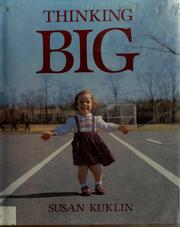


Thinking Big by Susan Kuklin – This book is out of print, but well worth the search, portraying a day in the life of an 8-year-old girl with achondroplastic dwarfism. She is great at painting, but needs stools to reach things at home and school. She has friends who hold her hand so she won’t get left behind on hikes, but she talks openly about the kindergartners who call her “baby.” She loves going to Little People of America meetings, but she loves being at home with her mom, dad and younger brother best of all. This book accompanied me from pre-school to fifth grade, read aloud by my new teacher to the class at the beginning of the school year in order to explain why I looked different from the others and to encourage my classmates to be upfront with their questions.


I Have A Sister My Sister Is Deaf by Jeanne Whitehouse Peterson– A day in the life of a hearing girl and her deaf sister. They play, argue, and help each other out, while explaining deafness as a mere difference in terms young kids can understand. The story has a gentle, poetic rhythm. On a deer hunt, the narrator explains, “I am the one who listens for small sounds. She is the one who watches for quick movements in the grass.”


The Black Book of Colors by Rosana Faría (available in French, German & Spanish) – Like the illustrations, everything is black for Thomas, so when it comes to colors, he smells, hears, and feels them. “Red is as sweet as a strawberry, as juicy as a watermelon, and it hurts when it seeps out of a cut on his knee.” The images are embossed for the reader to touch. The Braille alphabet is provided at the back of the book.


People by Peter Spier (available in French & German) – A superbly illustrated celebration of human beings and cultures all around the world. We have different skin colors, noses, hair styles, holidays, favorite foods, alphabets, hobbies, and homes, but we’re all people. It should be noted that this might be a bit of an information overload for children under 4.

***

Books About Moments When Diversity Is Considered Disruptive… These books empower kids who have been teased or interrogated for standing out. They can also be used to teach a bully or a clique how to understand and accept harmless differences. Some teachers rightly express concern over introducing the problems of sexism or racism to a child who has never seen a boy in a dress or a black girl before. Doing so could foster the notion that we should always associate minorities with controversy. Save them for when conflict does arise, or when the child is old enough to start learning about history and intolerance.


Amazing Grace by Mary Hoffman (available in Arabic, German, Panjabi, & Urdu) – Grace is a master at playing pretend. When her class decides to put on the play Peter Pan, she’s told by some know-it-all classmates that she can’t because she’s a girl and she’s black. She shows ’em all right.


And Tango Makes Three by Justin Richardson and Peter Parnell (available in German) – Penguins Silo and Roy live in a New York zoo and are utterly inseparable. The zookeepers encourage them to take an interest in the lady penguins so that they can soon have baby penguins, but to no avail. Silo and Roy build a nest together and end up adopting an egg. When Baby Tango is born, the three of them couldn’t be happier.


You Be Me – I’ll Be You by Pili Mandelbaum (available in French) – A biracial girl tells her white dad she wishes she looked like he does. Dad explains that he is milk and Mom is coffee, and she is café au lait. He says she is beautiful and sometimes he wishes he looked like her. Soon they’re dressing up in each other’s clothes, she’s braiding his hair, and he’s powdering her face. She wants to go into town and show Mom. On the way, they pass by a beauty shop and Dad points out how many white women are curling their hair and tanning their skin, while so many black women strive for the opposite.


“Sick of Pink” by Nathalie Hense (currently available only in German, French, Japanese, Norwegian & Portuguese) – The proud musings of a girl who likes witches, cranes, tractors, bugs, and barrettes with rhinestones in them. She knows boys who sew pretty clothes for their action figures and who paint daisies on their race cars. When grown-ups shake their heads and tell them, “That’s for girls!” or “That’s for boys!” she asks them why. “That’s just the way things are,” they tell her. “That’s not a real answer,” she deadpans.

***

Fairy Tales Beyond White Knights and Helpless Princesses… Even the most iconoclastic of people have their fantasies of love and heroism shaped by folklore. Yet the idea of revising Western fairy tales to make them less stereotypical has been met with a strong backlash. Whether or not you think it’s appropriate for kids to read Sleeping Beauty, Little Black Sambo or The Five Chinese Brothers, there is no harm in providing them with additional legends about love, valor and wisdom to make our cultural heritage more inclusive.
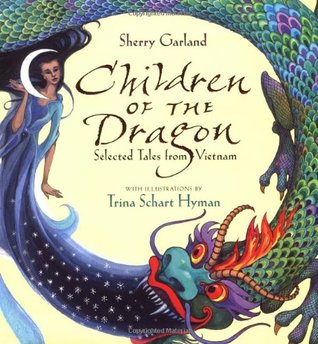


Children of the Dragon by Sherry Garland – Selected tales from Vietnam that rival any of the Grimm’s fairy tales in adventure, imagination and vibrancy. Many of the stories are supplemented by explanations of Vietnamese history that provide context.


Sense Pass King by Katrin Tchana – A girl in Cameroon outsmarts the king every time. Besides being one of the greatest illustrators of the 20th century, Trina Schart Hyman was a master of ethnic and socio-economic diversity in her many, many picture books.


Tam Lin by Jane Yolen – A Scottish ballad wherein a young maiden rescues her true love from the clutches of the evil faerie queen. In the end, she wins both his freedom and her clan’s great stone castle back. Not suitable for easily frightened children.


Liza Lou and the Yeller Belly Swamp by Mercer Mayer – A fearless girl triumphs over a ghost, a witch, a troll and a devil on her way to Grandma’s house in the bayous of Arkansas. Some of the best illustration there is. Think Little Red Riding Hood had she managed to outwit the wolf on her own.


The Talking Eggs by Robert D. San Souci – A Cinderella story of sorts set in the backwoods of the South. An elderly wise woman uses magic to help a kind, obedient girl escape her cruel mother and spoiled sister. In the end, she rides off to the big city in a carriage. (With no prince involved, this one passes the Bechdel test.)


King and King by Linda de Haan (available in Czech, Dutch & German) – It’s time for the prince to hurry up and get married before he has to rule the kingdom, but every princess who comes to call bores him to tears. The very last one, however, brings her utterly gorgeous brother, and the king and king live happily ever after.


The Paperbag Princess by Robert Munsch – After outwitting the dragon, Princess Elizabeth rescues the prince only to be told that her scorched hair and lousy clothes are a major turn-off. She tells him he is a bum. “They didn’t get married after all.” She runs off into the sunset as happy as can be. I have yet to meet a child who does not love the humor in this story.

***

The Best Book on Diversity To Date…


Horton Hatches The Egg by Dr. Seuss – A bird is sick of sitting around on her egg all day, so she asks Horton if he would mind stepping in for just a minute. He is happy to help, but the bird jets off to Palm Beach the minute she is free. Horton continues to sit on the egg while awaiting her return. He withstands the wind, the rain, a terrible cold, and three hunters who insist on selling him and the egg off to the circus as a freak show. Throughout it all he reminds himself, “I meant what I said and I said what I meant. An elephant’s faithful, one hundred percent.” After he becomes a media sensation, the bird comes back to claim her prize.

Whenever I used this one in the classroom, I would ask the kids whom the egg belongs to. The 3-year-olds, with their preliminary grasp on logic, would always give the black-and-white answer: “The egg belongs to the bird because eggs go with birds.” The 4- to 5-year-olds would invariably go the other way, plunging into righteous indignation over the injustice of the bird’s demands: “The elephant! The egg belongs to the elephant because he worked so hard and he loved it so much and she just can’t come back and take it!” In the end, the egg cracks open and out flies a baby elephant bird, who wraps his wings around Horton. This is Seuss at his best, showing that loyalty makes a family.
Could FDR Be Elected Today?

26 Oct

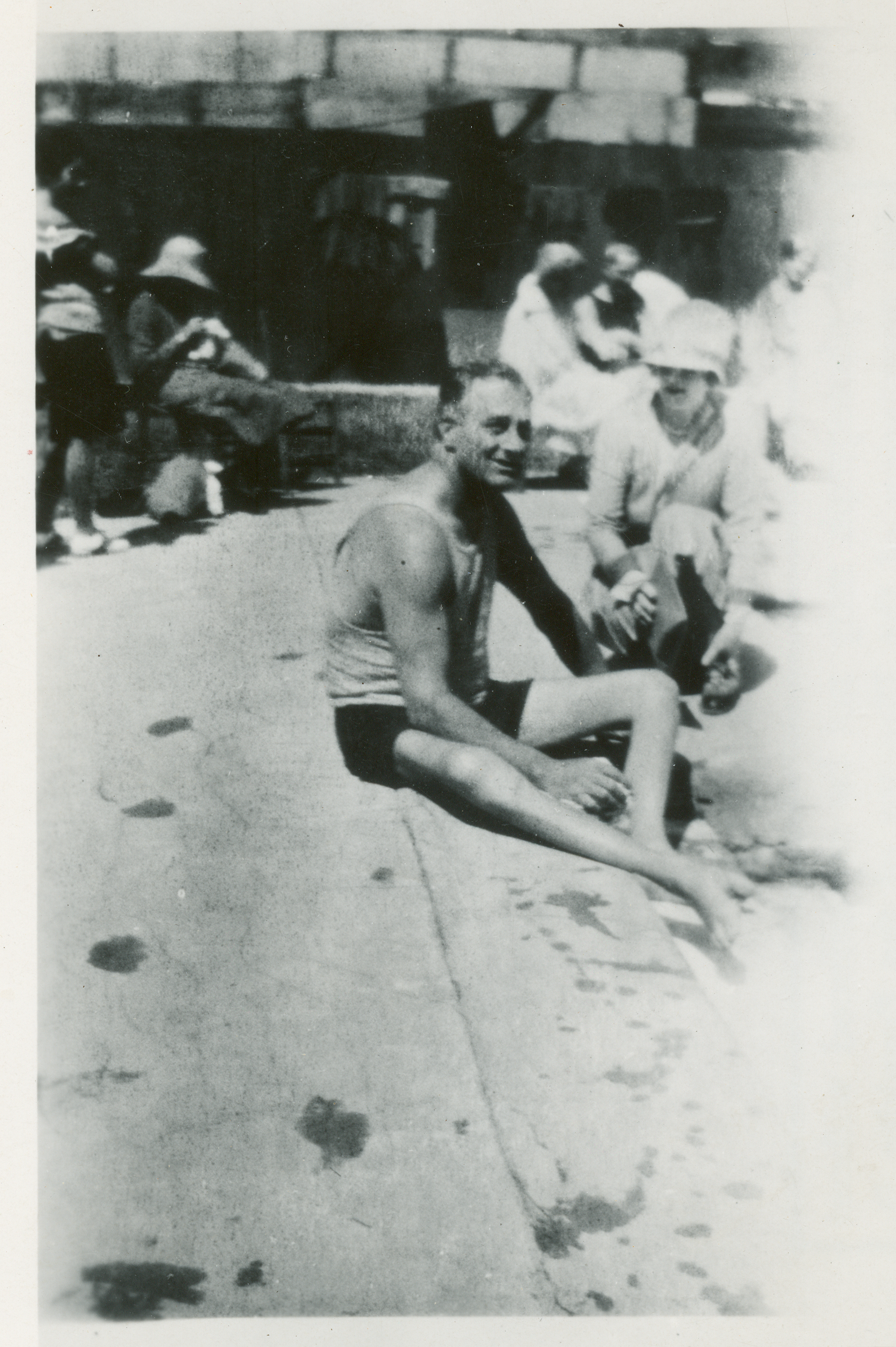
47-96 2331(Public domain image used under CC 2.0 via)


If you’ve happened to set aside 14 hours in the last month for Ken Burns’ The Roosevelts: An Intimate History, which aired on public television in the U.S., you know it affords considerable attention to FDR’s disability. Most touching is a 10-minute feature about Warm Springs, the Georgia health spa and rehabilitation center for polio patients, which Roosevelt founded and which soon became his primary vacation destination throughout his political career. Former employees and patients tell of him shaking the hands and asking the names of every patient, swimming alongside them and dunking whoever got within arm’s reach.

His biographer Geoffrey C. Ward explains:

It allowed him to be unself-conscious about polio… I don’t care how magnetic or self-confident you are, or you think you are… At Warm Springs, he could: not wear his braces, and go to the swimming pool, and have everybody see how small his legs were and it didn’t bother him at all because there were people there with worse problems…

He loved being one of them and the number one of them at the same time… To see someone so famous, who suffered from exactly the same problems that you suffered from, meant an enormous amount to all of the people who went there. Most of the people who went there went there mostly out of despair, at least at first. There wasn’t any other place to go. And here was this laughing giant who would kid them, and who would make the kind of awful sick jokes about being handicapped that other handicapped people love, but that you can’t share with anybody else. He loved doing that.

FDR told the staff that all at Warm Springs were equals, and many interviewees point to this as the beginning of his dedication to humanitarian, egalitarian projects. “It is tempting and probably true to say that polio gave FDR the gift of empathy,” says George F. Will. “There was no suffering that he could not in some sense relate to. And also, just as soon as the iron [brace]s were clapped onto his legs, the steel entered his soul. By having to fight through the constant pain of therapy that was unforgiving in its demands and not very fulfilling in its success.”

FDR had intended to market Warm Springs as both a vacation resort and a health spa, hoping the profits from the hotel would fund the rehabilitation center. The hotel ultimately failed, according to Burns’s documentary, “because prospective guests were scared off by the presence of polio patients.” Outside Warm Springs, attitudes toward disabled people were hardly tolerant. When voters elected a disabled president in 1932, 1936, 1940 and 1944, they did so in spite of his disability, not in acceptance of it.

Doctors attested to his physical and mental fitness in newspaper articles that asked, “Is he healthy enough to be president?” When Teddy Roosevelt’s family publicly opposed FDR’s candidacy, his daughter Alice took an ableist tack. Her famously hyperactive father had had the strength and will power to overcome his affliction, she argued, referring to TR’s childhood bout with asthma, while FDR’s paralysis from polio was a sign of his weakness and the reason why he embraced such wimpy social policies.

And here I thought Ann Coulter was a modern phenomenon.

Both Ken Burns and Geoffrey C. Ward contend that FDR could not be elected today. Ableism was pervasive in the 1930s and 40s, and it was well understood that publishing photographic evidence of his disability—his braces hidden by the podium, his difficulty getting in and out of cars, his regular falls—would be too detrimental to his image. But the press obliged. Photos like this one remained out of the public eye. Today neither the media nor bystanders with cell phone cameras afford anyone such privacy.

Appearance is as important as ever to politicians, if not more so since images in film, in print, on television, and online are countless times more prevalent now than they were in FDR’s time. This ubiquity is both the cause and the result of our expecting to see celebrities up close and from every angle. While Germany distanced itself from the idea of demanding charm and showmanship from their political leaders in the post-war era, America became ever more preoccupied with it, giving more credence to the photogenic Kennedys than any other presidential family.

The power of representation cannot be underestimated. We all like to be able to identify with famous and successful people because it imbues us with optimism about our own chances for success. We watch documentaries about celebrities’ lives in the hopes of discovering that they are the kind of person we would like, and who therefore would like us, if they ever had the chance to get to know us. Such idol worship, whether severe or mild, is of course ultimately irrational. But it satisfies the emotional need for recognition. If we cannot go on to be president for whatever reason, we can enjoy living vicariously through someone who does.

Ward is right when he speaks of how meaningful it was for ordinary patients with polio to see a sitting president with polio. But it is discouraging to consider that only those who could make the trek to Warm Springs were able to have the experience. And it is discouraging to consider Ward and Burns’ contention with its implication that disabled people today cannot have the experience of seeing a visibly disabled president because the American people will not elect one. Are they right?

In our age of a million media images, we commonly see senators, singers, elite athletes and film stars visiting disabled and ill children to boost their morale. But none of these celebrities are simultaneously as enormously powerful and as visibly disabled as Franklin Roosevelt was. Indeed, no one since his time ever has been.

Ghost + Dwarf = Double The Horror

12 Oct

ghost(Image by Jon Feinstein used under Creative Commons license via)


If ghosts are scary, and dwarfs are creepy, then ghost dwarfs must be an even better bet for thrill-seekers.

This seems to be the logic behind the DREAMLAND haunted house in Cambodia, where customers pay to be terrified by extraordinary-looking people like 30 year-old Horm Sivon, whose photo is gaining international attention. She is one of 10 dwarfs employed at the house alongside other disabled people.

The owner, Hien Rensei, defends his business as one of the few opportunities disabled people in Cambodia have for employment. “Some people may consider it immoral, especially in western countries. But in Cambodia we have the situation that people with disabilities just don’t get hired,” he told The Phnom Penh Post. He spoke of his own experience with discrimination as a Cambodian living and traveling in Japan, the U.K. and Germany. “For two years I couldn’t find a job because I didn’t speak the language and at airports my passport was checked much longer than the ones of my Japanese friends.”

Emilie Arfeuil, the photographer who captured Horm, denounces this industry as “a terrible step backwards in terms of human rights, a degrading exploitation of people’s disabilities.” She has entered the photo in National Geographic’s Photo of the Year contest.

If she wins, will the proceeds go toward furthering employment opportunities for disabled people in Asia?


White Woman Sues Spermbank for Accidentally Giving Her Black Donor’s Sperm

5 Oct

Unity in Diversity(Image by Fady Habib used under CC 2.0 via)


Man, we can’t go two months without some couple making headlines over a baby they didn’t plan for. An Ohio woman named Jennifer Cramblett is suing a spermbank for impregnating her with the contents of a vial different from the one she selected. The mix-up resulted when a clerk misread Vial 330 as “380.” Her lawsuit reads:

On August 21, 2012, Jennifer gave birth to Payton, a beautiful, obviously mixed race, baby girl. Jennifer bonded with Payton easily, and she and [her partner] Amanda love her very much. Even so, Jennifer lives each day with fears, anxieties and uncertainty about her future and Payton’s future. Jennifer admits that she was raised around stereotypical attitudes about people other than those in her all-white environment. Family members, one uncle in particular, speaks openly and derisively about persons of color. She did not know African Americans until her college days at the University of Akron.

Because of this background and upbringing, Jennifer acknowledges her limited cultural competency relative to African Americans, and steep learning curve, particularly in small, homogeneous, Uniontown, which she regards as too racially intolerant.

As just one example, getting a young daughter’s hair cut is not particularly stressful for most mothers, but to Jennifer it is not a routine matter, because Payton has hair typical of an African American girl. To get a decent cut, Jennifer must travel to a black neighborhood, far from where she lives, where she is obviously different in appearance, and not overtly welcome.

One of Jennifer’s biggest fears is the life experiences Payton will undergo, not only in her all-white community, but in her all-white, and often unconsciously insensitive, family. Despite her family’s attempts to accept her homosexuality, they have not been capable of truly embracing Jennifer for who she is. They do not converse with her about her gender preference, and encourage her not to “look different,” signaling their disapproval of her lesbianism.

Though compelled to repress her individuality amongst family members, Payton’s differences are irrepressible, and Jennifer does not want Payton to feel stigmatized or unrecognized due simply to the circumstances of her birth. Jennifer’s stress and anxiety intensify when she envisions Payton entering an all-white school. Ironically, Jennifer and Amanda moved to Uniontown from racially diverse Akron, because the schools were better and to be closer to family. Jennifer is well aware of the child psychology research and literature correlating intolerance and racism with reduced academic and psychological well-being of biracial children.

Family planning is so endlessly complicated that any law-abiding individual seeking privacy deserves it. But Cramblett is going public with her pursuit of compensation for emotional distress and therein invites judgment. John Culhane writes at Slate that this sort of blunder is bound to happen in the free market of assisted reproductive technology. Julie Bindel at The Guardian warns of a creeping let’s-get-a-designer-baby approach to parenting among those using IVF. “Just remember,” she writes. “If the child you end up with does not exactly fit your ideal requirements, you can’t give it back – and nor should you even suggest that something bad has happened to you.”

Do parents have the right to be guaranteed certain kinds of children? Those pursuing parenthood via sperm donors, egg donors, or adoption have much more freedom to decide against certain kinds of children than those using nothing but their own biology. The application for becoming an egg donor in New York contains over one hundred invasive questions about family and medical history, as well as education, favorite sports, artistic talents and “additional characteristics” such as “cleft chin, full lips, big eyes, or high cheekbones.” Applicants are required to submit three photos “that shows [sic] your face and/or body type clearly.”

I understand why such questions are asked. Many if not most parents already know such things about those involved in producing their child, so why shouldn’t the IVF parents be allowed to know? If my partner and I were to join their ranks, what sort of donor profile would seem most appealing to us? Deciding upon something inherently entails deciding against something else. Nevertheless, it is hard not to see this tick-the-box approach to baby-making as eugenic. How many parents would accept my eggs, with their 50% chance of passing on achondroplasia? How many would sue if someone accidentally got them without asking for them?

Parents seeking to adopt children here in Germany are asked what kind of children they would and would not like to have before they look at profiles. For example, do you mind if your children look extremely different from you? What about physical disabilities? Mental disabilities? Drug addiction? In an interview with a family whose two children were adopted, I was told that the agencies encourage prospective parents to be utterly frank about their fears and prejudices – that an insistence along the lines of, “We can handle anything!” will sound suspiciously naïve.

Such brutal honesty strikes me as reassuringly well-informed, perhaps the result of infamously ideological parents like Josephine Baker or Jim Jones, who flaunted their rainbow families at the expense of the children’s individuality. Reading Cramblett’s descriptions of her relatives’ hurtful reactions to her sexuality, I can sympathize with the feeling that battling one kind of bigotry can be hard enough. Everyone deserves to live free from the unnecessary pain of bigotry. But if we’re going to be suing someone, wouldn’t it be more logical to file complaints against those who make her daughter feel stigmatized and unrecognized? Surely they’re the ones causing “emotional distress.”

While the spermbank does appear to have erred out of negligence and may be at fault, would awarding Cramblett for “emotional distress” not set a precedent and open the door for endless lawsuits over the births of minority children parents did not explicitly wish for? My parents had a 1 in 40,000 chance of producing a child with achondroplasia, as does anyone reading this. (That is, unless you already have achondroplasia.) Should doctors warn every prospective parent of those odds? Should they warn us of the chance for racial atavism? If homosexuality proves to be genetically determined, will parents have a right to sue doctors who fail to remind them of the risk? The very idea of being financially “compensated” for emotional distress is often silly to those of us who know from firsthand experience how vastly unreliable life can be.

Legal decisions aside, my primary hope is that Cramblett and her partner will explain the lawsuit to her daughter in a way that does not cause her to feel any more conflicted about her extraordinary appearance than her relatives’ racist views already do.


Would You Rather Be Born Disabled or Become Disabled? (Part Two)

28 Sep

Dead body(Image by Stéphane Lavoie used under CC 2.0 via)


Most of them were not born with dwarfism. This is what I observed from a history of eminent dwarfs who enjoyed some degree of success outside of freak shows before the minority rights movements of the late 20th century. Most of them, such as Toulouse-Lautrec, experienced stunted growth as the result of an accident or an illness well after birth. Well after it would have been socially acceptable for their parents to give them up or hide them away. Such cases account for a very small minority of people with dwarfism, yet they dominated the scene of non-marginalized dwarfs for most of Western history. This got me thinking.

I conducted a crowd-sourcing experiment on Facebook, asking friends to name very famous people with severe physical disabilities. They had to be household names, nothing along the lines of “that little guy on Game of Thrones” or “that comic on that show from the Eighties who had a muscle problem.” The list of responses bore no surprises: Helen Keller, FDR, Beethoven, Frida Kahlo, Ray Charles, Christopher Reeve, Stephen Hawking, Michael J. Fox. All but two of them—Stevie Wonder and Oscar Pistorius—incurred their disability after infancy. Was this another sign of congenitally disabled people being hidden away? The vast majority (85%) of disabled people become disabled after birth. But the 15% whose conditions are congenital appear to be underrepresented in public.

Does society more readily accommodate those who lose certain abilities than those who never had them to begin with? Anthropologists know that for most of human history any injury or illness without a visible cause was presumed to be the result of black magic or a vengeful deity. From the European mythology of the changeling right up to the Nazi condemnation of genetic “monsters,” congenitally disabled people have been traditionally viewed as non-human and segregated accordingly. Vestiges of this remain in our general tendency to simply not consider congenitally disabled people as potential friends or partners or even peers, in contrast to the conviction that we should stick by our loved ones no matter what befalls them. Pop icon Dick Clark was warmly welcomed back to television as a co-host after his debilitating stroke, but I’ve yet to find a TV presenter in America who was born with a speech impairment like the one Clark developed. I don’t have the funding to empirically test my hypothesis, but you don’t have to delve too far into mainstream media to come up with stories, articles and interviews spotlighting someone who seemed to have it all until one fateful day when tragedy struck. And notice the comparable paucity of such resources on people who have always lived that way.

I squirm as I write this for fear of implying that those who become disabled have an easy time of it. Far from it. It would be utterly callous to ignore the often indescribable strain illness and injury can inflict on relationships, and the horrific social isolation that too many patients face. There’s a reason that “fair-weather friend” is a well-known term. And the human fascination with suffering can be more voyeuristic than empathic.

But no matter the motive, it is always accompanied by the unspoken understanding that no one would ever want to become disabled. This is, in essence, the most universal view of disability: Who on earth would want to lose an ability of any kind?

Even as a congenitally disabled person I understand this. I would never choose to erase my dwarfism from my life experience. But I do not like becoming more disabled than I already am. After tendon injuries and surgery to combat stenosis, I miss being able to ride a bike, to walk barefoot, to cook and type and sit on benches for long periods without pain. And if tomorrow I were to lose my ability to hear, see, or walk, I would be distraught, to put it mildly.

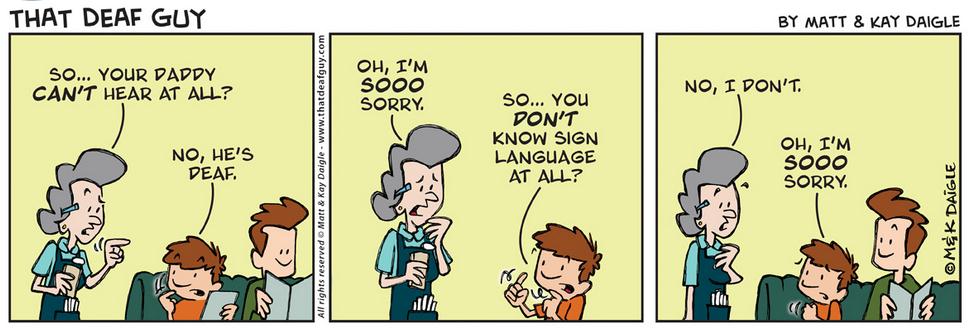
But in voicing this, it is crucial for me—and everyone listening to me—to recognize that my becoming deaf would be a profoundly different experience from that of my friend who has been Deaf since he can remember. Many Deaf people with cochlear implants have told of how overwhelmingly unpleasant hearing sound for the first time can be: One man has “discovered that, far from being adorable, the voices of his grandchildren were rather shrill and often best experienced with the implant turned off.” That Deaf Guy comic strip tells of the authors’ son pitying people who don’t know how to sign.

Similarly, those who have always needed a wheelchair to get around tend to see it as no worse than needing shoes to get around. Yes, it’s inconvenient in a world where ramps are all too rare, just as it would be inconvenient for those of us who are ambulatory if most public facilities didn’t accommodate the shoes on our feet. But that difficulty is imposed by a society that fails to accommodate certain minorities, not by the disability itself. Congenitally disabled bodies do not notice what they lack. As so many have said before me, How can you miss something you never had to begin with?

Researching all of this has brought me to the following conclusion: As individual humans, it is harder for us to deal with becoming disabled than with being born disabled. But as a society, the reverse is true – it is harder for us to accept someone who is born disabled than someone who has become disabled.

As a result, those who were born disabled and those who have become disabled often find themselves on opposite ends of the argument. A woman like Stella Young, who has never been able to walk, is rightly insulted when people tell her she is brave and inspiring just for getting up every morning. (Her TED Talk below is worth every minute.) But a woman like Christine Miserandino, who is slowly losing the ability to walk, is rightly seeking others’ encouragement and support as she struggles to do something she once took for granted. (Her oh-so-quotable Spoon Theory has already been linked on this blog before.)


Because the majority of disabled people are like Miserandino, not Young, the discourse on disability is dominated by sympathy, fear and lamentation. It is hard for us to remember that we shouldn’t pity a woman with cerebral palsy for her spasticity when so many people with multiple sclerosis openly mourn their loss of agility. Those who become injured or ill are entitled to their grief and no one should ever attempt to silence them. But everyone should think beyond their own experience before they publicly decry their condition as unbearable. Especially when it ends up joining the chorus of ableism led by non-disabled people.

One of the most read articles at The Atlantic this month is a piece by bioethicist Ezekiel Emanuel who explains why he hopes to die before age 76:

[Living too long] renders many of us, if not disabled, then faltering and declining, a state that may not be worse than death but is nonetheless deprived. It robs us of our creativity and ability to contribute to work, society, the world. It transforms how people experience us, relate to us, and, most important, remember us. We are no longer remembered as vibrant and engaged but as feeble, ineffectual, even pathetic.

Emanuel is an amateur mountain-climber and a professional writer. He is entitled to feel upset at the idea of losing the abilities he currently holds most dear. And his other arguments about the drawbacks to longevity are as thought-provoking as physicians’ personal opinions on life-saving interventions. But his decision to openly denounce dependence and weakness as unproductive and undignified increases the lifespan of our culture’s ableism. How can we ever stop marginalizing disabled people if we continue to openly voice our fear of becoming like them?

The experiences of those who are born disabled and the experiences of those who become disabled are profoundly different and equally valid. Simply remembering that would change a lot.


Would You Rather Be Born Disabled Or Become Disabled? (Part One)

21 Sep

Abstract Body(Image by srslyguys used under CC 2.0 via)


Imagine your body just as it is, in a world that looks exactly like the one we live in, but for one crucial difference:

You’re at a dinner party with some friends and some new faces, and you excuse yourself before heading to the bathroom. When you return to the table, you notice a few people exchanging looks. You wonder if your friends explained your absence to those who don’t know you well. You’re not sure if you should explain it yourself. Do you owe it to them? You’re not embarrassed, but they look a bit embarrassed for you. Then again, maybe you’re just being paranoid? You’re not really in the mood to get into it, and maybe these people would find it inappropriate dinner conversation. Maybe they’re the kind of people who would cringe, and you’d rather not discover that about them just now because the evening has been going pretty well and they seem nice so far.

Just when you decide not to say anything, the woman next to you asks, “Is everything okay?”

You reply, “Um, yeah.”

“Why did you get up and leave? Do you smoke?”

“Oh, no. No, I had to use the bathroom.”

“Oh… Wait, you mean like… you’re one of those… um… what’s the word for it?”

“Yeah. I’ve got frequent excretion syndrome. I have to use the bathroom a couple times a day.”

“Like, more than once a week?”

“Yeah, a couple times a day.”

“Like, every few minutes?”

“No, not that often. Just every few hours or so.”

“So you can’t hold it in?”

“Well, I’m—we’re—not supposed to. Not for too long. The doctors say it’s not healthy.”

“Wow. That must be so hard! How do you it?”

If 99% of humankind evolved in a way that they only needed to excrete once a week—as ball pythons do, for example—then modern society would look pretty different. The number of toilets available in public facilities would decrease significantly. A home with a bathroom would not be unheard of, but it would be a bit of a luxury, like an apartment building with an elevator. No one would assume that dinner at a restaurant or a friend’s house would guarantee access to such facilities. And the 1% of people who still needed a bathroom a few times a day would be considered disabled.

Eventually debates would crop up as to whether needing to excrete so often is “defective” or “just different.” There would be arguments as to who should accommodate whom: Should society provide more bathrooms, or should the minority wear diapers? Would you date someone who did? It must be so hard for parents and partners to deal with someone like that! I read on the Internet that those freaks do it in the shower! I would never get in a pool with one. You shouldn’t let your kids near them!

If you lived in this world, where most people’s bodies did not need to excrete more than once a week but yours did, you would undoubtedly experience frustration, as most disabled people do. But the source of your frustration would depend upon how you got to be the way you are.

If, after an accident, you suddenly belonged to a small minority of people who needed a bathroom more than once a week, you would experience a good deal of stress adjusting to your new schedule. Losing an ability you had taken for granted would feel unfair. Life was so much easier before this happened! Why me?! Some would be arguing that they would rather die than live like that. Depending on your support network and self-image, you might join that argument. But no matter how accepting your friends and family were, you would probably struggle with some internal shame about being less independent.

But if your body had always functioned that way for as long as you could remember—as it presumably does in the real world—most of your problems would stem from how alien the majority would make you feel. In the real world, we can all admit that needing a bathroom a few times a day can be inconvenient, especially on car trips, but it doesn’t feel “wrong,” “sick,” “crippling,” “freakish,” or “sad.” In a world where you’re the minority, you might accept the idea of wearing diapers rather than demand more bathrooms be built for you, or you might be deeply insulted by it. You might decide to combat the stigma of diapers. You would likely be upset hearing people say they would rather die than live like you.

That’s the difference between people who are born disabled and those who become disabled. The latter understandably experience stress, sometimes trauma, adjusting to a new condition. The former rarely feel the need to miss what they never had to begin with. Society likes to offer both groups pity. But they often respond to this pity with different answers because they have many different experiences. As we’ll see next week, conflict can only be avoided if everyone involved—those who were born disabled, those who became disabled, and those who are non-disabled—tries to understand the others’ point of view.


Everyone’s Sexuality. Everyone’s.

7 Sep

mjaxmi1inge5ntm3ymu4ngnkytg5


Don’t read the comments. Don’t read the comments. Don’t read the comments. 

That’s what raced through my mind as I read “The Challenges of Having Sex As A Little Person” at The Atlantic. Of course I read the comments anyway. 

And I was only slightly startled to find nothing but solipsistic snickering and overdone puns. The Atlantic doesn’t win any points for ending the article on a pun, either. But praise is due for addressing the topic at all. Based on an extensive interview with Dr. Marylou Naccarato, who has Kniest dysplasia, the article takes a wonderfully sex-positive approach to the experiences of people with dwarfism and the physical obstacles they can face in bed.

As per nearly every feature on dwarfism in the mainstream media, there are some factual errors. For example, one dwarf couple is quoted claiming that people with achondroplasia require “no medication, surgeries, special needs, nothing.” (See here for a list of the many complications we are at risk for.) But Naccarato is doing great work that is revolutionary in light of the fact that Little People of America, and probably most disability advocate organizations, repeatedly shy away from the topic of sexuality.

A simple reason for their silence is that almost all disability organizations comprise just as many parents and relatives of disabled people as disabled people themselves. And who wants to debate the best way to masturbate with Mom or Dad sitting next you? A more sinister reason for the silence is one of the building blocks of modern prejudice against disabled people: that is, the presumption that they are innocent, and therefore asexual. Most positive portrayals of disabled people are cute and cuddly. Is it the only way society can accept us? Refusing to see a minority as anything but asexual is to deny them their full humanity, on par with slut-shaming, prude-shaming, queer bullying, and objectification.

Before I go any further, let me say this: I do not want to talk publicly about what I do in the bedroom and I do not want to know what you do in the bedroom. My firm belief in sex-positive feminism and equality does not mean I think that you are sexy or exciting or impressive. Unless we’re close confidantes or I’ve indicated otherwise, please assume I don’t want any mental images of you and your naughty bits, no matter what they look like.

That said, I fully support anyone’s right to desire any sort of consensual sex imaginable. Without double-standards. Without the pressure of competition. Without the nuisance of others turning their personal preferences into rigid rules.

Take, for example, the way virginity is so frequently turned into not just a game but a high-stakes tournament. When and how did you lose it is an idea all of us are expected to base much of our identity on, even as adults. This is despite the fact that, according to medicine, virginity doesn’t exist. After all, what kind of sex does a guy have to engage in to officially “lose” it? And what about girls born without hymens? When exactly do lesbians lose their virginity?

Like race, virginity is a social construct and, in the words of a very wise person on Tumblr, what can be socially constructed can be socially changed. Last year the great Tracy Clark-Flory interviewed acquaintances about the sexual experience they considered to be their “first time.” The glorious thing about her inclusive project was that it revealed human sexuality to be just as diverse as everything else about us. Some defined their first time by their first orgasm, others by a particular first touch or experience of being touched. The problem with her stretching the definition of “losing your virginity” so broadly is that it robs competitive, insecure people of their ability to set standards with which they can gloat and put others down. Wait, no. That’s another glorious thing about it. There really is no problem with recognizing everyone’s experience as equally valid.

Failing to include everyone not only causes unnecessary humiliation, but it causes us to miss out on opportunities for true enlightenment. To quote the authors of You Can Tell Just By Looking: “Sexual minorities—people whose sexual desires, identities, and practices differ from the norm—do a better job talking about sex, precisely because they are constantly asked to explain and justify their love and their lust to a wider culture and, even, to themselves.”  The more you examine harmful traditions, the less necessary they become.

This does not mean that minorities have better sex. Indeed, too many activists in the sexual revolution end up repulsing readers and listeners when they allow pride in their sexuality to devolve into arrogance, insisting their sex life is better than yours, rather than merely different. For a year, the BDSM club at my alma mater ran the slogan: “I do what you’re scared to fantasize about.” Not helpful. And kinda pathetic the more you think about it.

I will never judge someone for liking any particular kind of consensual sex, but I will judge anyone who tries to turn sex into a competition to calm their own self-doubts. Whether you’re a wise-cracking online commenter or a sex-positive pioneer, true sexual liberation is about moving beyond the middle school clique mentality, not indulging in it. It’s pretty much the least attractive thing there is.

Would You Give Up A Disabled Baby, And If So, Why?

10 Aug

Youri(Image by Naoya Fujii used under CC 2.0 via)


Tonight 60 Minutes will feature the very first interview with the Australian couple that has attracted international scorn ever since the Thai woman they hired to be their surrogate mother publicly accused them of adopting one of the twins she gave birth to while refusing Baby Gammy, the one with Down Syndrome. Hiring a surrogate mother who lives abroad is both legal and unregulated in Australia, with none of the criminal background checks or counseling that are required for domestic surrogacy arrangements.

The Digital Age has seen the rise of prospective parents independently seeking out surrogate mothers online without any oversight, as well as a rise in “re-homing,” wherein adoptive parents join Facebook or Yahoo groups to seek out new parents for a child they’ve decided is harder to handle than they had thought. A disturbing Reuters report last fall profiled a couple who handed over a girl with medical problems they had adopted from Liberia to a new family they had found online, only to later discover that the new parents were known sex offenders.

Yet while black market adoption may be on the rise thanks to the Internet, the history of people rejecting only certain kinds of children is depressingly long. Only 2% of all babies born are disabled, yet half of the children up for adoption in the United States are disabled. Half of them are also black. Chad Goller-Sojourner told NPR this year that prior to his adoption by a white family, he was passed over by more than one black couple for being “too dark.”

I am deeply grateful that my parents did not put me up for adoption, like so many parents of dwarfs before them. Being rejected by your own parents simply for your body feels like a rejection of your very life. But I will not start chanting that parents should never ever make adoption plans for their children until we admit that not everyone is capable of being the sort of parent certain children need. The skills required for accepting your child’s skin color or body shape are not the same skills required for accepting a lifetime of waiver agreements about the deadly risks of invasive surgery. In the real world, some marriages do break down and some parents do become abusive and some parents do murder their half-grown children when they try and fail to cope with their child’s disability. I know a good number of people who are great at working independently but terrible at caregiving. In Far From the Tree, Andrew Solomon profiles a British woman who eventually relinquished custody of her severely disabled daughter to a foster mother, telling the NHS, “I’m not the right mother for this child.” Such honest humility requires some degree of bravery and, as Solomon points out, honors the skills of the foster mother and all parents who keep their commitments to disabled children.

Do some parents give up too easily? Absolutely. But are some children better off far away from their parents? Evidently. Because no two parents are alike, what is best for the child is best decided on a case-by-case basis. The Australian case sounds dreadful, but I’m withholding judgment until the parents have had their say. And as long as there is reproduction, there will always be parents who put their children up for adoption or terminate pregnancies, and society must thus ensure that the means for doing so are absolutely safe and heavily regulated.

But we cannot deny that too many parents end up failing to support certain kinds of children because the society they live in fails to support such kinds of people. Parents can usually see through the B.S. of those who urge them to stand by their kids no matter what and who also regularly make disparaging remarks about scars, fat, or dark skin, and openly wince at the idea of looking like a freak, a wimp, or a pussy. We won’t ever lower the disturbing number of prospective parents who would reject a child with an extra finger or toe until we as a society confront what would cause a parent to think that having an extra finger or toe is too horrific to endure.

During a discussion in college about the individual’s right to make their own medical decisions, I was shocked to hear a bunch of my friends insist that they would rather die than lose the ability to walk. Is it possible to attach such extreme shame to a hypothetical situation for yourself without attaching shame to the situation of others who live that way every day?

When I told one of my fiftysomething mentors about how upset I was by the incident, she smiled and said, “Well, that’s something young people are certainly more likely to say than anyone else.”

A fortysomething friend piped up, “Yeah, that is a very young person thing to say. I swore when I was young that I’d shoot myself if I ever went bald and yet here we are!”

Indeed, while the strains of physical pain and special accommodations and repeated doctor’s appointments are very real, perfection is not. And no matter how far technology advances, the belief that we can guarantee ourselves “normal” children is delusional. After all, unlike Baby Gammy and I, 85% of all disabled people were not born disabled. That’s something to bear in mind when heading to the obstetrician’s or the adoption agency.  


CPS: The Sticky Business of Not Minding Your Own Business

20 Jul

(Via)


A South Carolina woman was arrested earlier this month for allegedly letting her 9 year-old daughter play alone in the park while she went to work at McDonald’s. The mother had given her daughter a cell phone for safety’s sake, but a concerned stranger’s call to Child Protective Services led to the mother’s incarceration and loss of custody. Bloggers on both sides of the political spectrum are outraged over what they are calling a case of helicopter parenting gone mad. On Twitter, stories of “When I was a kid…” abound.

I wholeheartedly share their shock and dismay. (Seriously, couldn’t CPS have merely talked to the mother and helped her find a friend or a caregiver whose home could be a base for the girl during mom’s eight-hour shift?) But I am concerned about the mounting vitriol aimed at those whose job it is to protect the child. I grew up among social workers. And these bloggers, while rightfully critical, are failing to acknowledge that the mind-your-own-damn-business mentality they advocate is exactly what prevails in societies where everyone looks the other way when a child is neglected or abused.

Of course there are terrible social workers out there, just as there are those to be found in any profession who should really be working elsewhere. More importantly, it is dangerous to pretend that institutionalized xenophobia does not exist. A 2012 report revealed ableism appears to be a tremendous problem at CPS, with many disabled parents living in fear of being declared incompetent by social workers with a poor understanding of their abilities. In the South Carolina case, it seems reasonable to postulate that two of the American South’s most infamous cultural institutions—classism and authoritarianism—are what led to a cruel and unusual punishment doled out for what was, at best, a misdemeanor by a working mother.

But while attention to this case is warranted, news outlets tell real-life tales of wrongly accused parents to such an extent that one would assume most actions by CPS are unjustified. The media bias tends toward parents because parents are legally allowed to talk publicly about their children. Were a social worker to attempt to tell his side of story, he would be breaking the law. And children and families grateful to CPS for repairing broken homes rarely head to their local news station to rehash their past personal struggles.

We must acknowledge and condemn every instance of misconduct by social workers, just as we must acknowledge and condemn every case of medical malpractice, and of police brutality. But unlike doctors or police officers, social workers do not enjoy a wealth of Hollywood blockbusters and TV shows glamorizing what they do. Most portrayals in film and on television are fiercely unflattering: from the soulless bureaucrat too obsessed with rules to know love when she sees it, to the more sinister instrument of a government conspiracy to threaten political dissidents by taking away what they hold most dear. These stereotypes invariably evoke sympathy for the devastated parents and children, who wish those heartless busy-bodies would just learn to stay out of other people’s business. Rarely are social workers featured fighting the good fight.

And yet, that’s what they are there to do. Not to get a thrill from ripping crying kids away from their distraught parents, but to listen to every member of the family until they understand the source and extent of the problem. While pop culture promotes individual therapy as a path to wellness on par with yoga or meditation, the idea of family therapy tends to be seen as an outrageous invasion of privacy imposed by some glaring ice queen who is just waiting for the parents to slip up. Yet adept social workers know that the parents of neglected children sometimes have significant learning disabilities or were the victims of abuse themselves. When funding allows, parenting courses are available for those who have a hard time remembering how often diapers need to be changed, or that there are often alternatives to screaming and spanking. Adept social workers also know that neglected children are often overly forgiving of an abusive loved one, just as victims of domestic violence often are. And adept social workers know that children are far more likely to be abused, molested, or kidnapped by a member of their family than by a stranger. As with women, the most dangerous place for a child is their own home.

When I was an 11 year-old on Long Island, there was a report that a girl my age named Katie Beers had been kidnapped from a local arcade where I’d attended birthday parties. The perpetrator turned out to be a friend of the family, who kept her locked in his basement for 17 days. When he broke down and confessed to police, Beers was not returned to her mother, but placed in a foster home. I clearly remember the mother’s tearful face plastered across the headlines: “I just got her back and now they’re taking her away from me!” CPS investigators had discovered that, prior to the kidnapping, Beers’s mother had left her for years in the care of her godparents, where she was treated “like a slave” and repeatedly raped by her godfather. Beers writes today that she was ultimately relieved to be placed in foster care and that, had she not been taken out of her home, she never would have graduated high school, let alone college.

When it comes to the legal rights of the child versus the rights of the parent, the court of public opinion will always be fueled by vitriol. Family court, of course, should transcend this, putting reason and research first and foremost. CPS is undoubtedly rife with problems, many due to its miserable lack of funding. But we as a society will never put forth a sincere effort to endow social workers with enough funding to do their job well until we truly value what they do in the first place.


* Please note that while my sympathy for the social worker’s perspective is inspired by what I’ve learned from those I know, the views and conclusions expressed here are mine and mine alone.


What Do We Want? Visibility!

8 Jun


Leaving you this holiday weekend with the brilliant Maysoon Zayid whose TED Talk above includes myriad revelations well worth your time, among them:

One fun fact I learned while on the air with Keith Olbermann was that humans on the Internet are scumbags. People say children are cruel, but I was never made fun of as a child or an adult. Suddenly, my disability on the world wide web is fair game. I would look at clips online and see comments like, “Yo, why’s she tweakin?” “Yo, is she retarded?” And my favorite, “Poor Gumby-mouth terrorist. What does she suffer from? We should really pray for her.” One commenter even suggested that I add my disability to my credits: screenwriter, comedian, palsy…

Disability is as visual as race. If a wheelchair user can’t play Beyoncé, then Beyoncé can’t play a wheelchair user. People with disabilities are the largest minority in the world and we are the most underrepresented in entertainment.

Indeed.


Segregation Loses In German Court

25 May

Untitled(Image by Angela Schlafmütze used under CC 2.0 via)


People must learn to accept their disabled neighbors, a Rhineland court ruled this week in a case that—thankfully—has attracted controversy. A woman in the town of Kaltenengers, near Koblenz, filed suit against the construction of a home for severely disabled citizens near her apartment block. According to the Rhein-Zeitung, the woman and several other residents had expressed outrage at the supposed imposition upon their community, while their court arguments sparked outrage among the public. The plaintiff claimed that, “The vocalizations and noises made by the disabled will injure our own psychological well-being.” Talk about not-in-my-backyard.

All of us have sympathy for the NIMBY mindset to some extent. I’m fine with my neighbors playing music as long as it’s the right kind of music. (ZZ Top, yes. Opera, no. I can attest that nothing pierces through paper-thin walls at 2 am like a soprano aria.) When it’s the night before the most important exam in your academic career, you want everyone within a five-mile radius of you to shut up. When it’s the night after you’ve passed that exam with flying colors, you wish those prissy neighbors interrupting the celebrations to tell you to pipe down would let go and live a little. Such moments serve as reminders that Everybody matters is easier said than done.

There will always be debates about pristine parks, where the grass is there to be looked at, versus people’s parks, where the grass has been picnicked to the brink of death. (Berlin votes today on that very issue in deciding the fate of Tempelhof Park and, for many, the definition of Berlin itself.) But NIMBY descends into a segregationist mentality the moment we reject the idea of certain types of people outright. And in this court case, pitting disabled residents against their huffy neighbors, it makes you wonder who is really the most challenged in becoming a well-adjusted member of society.


Should You Be Allowed To Hide From Google?

18 May

Big Google brother ?(Image by Alain Bachellier used under CC 2.0 via)


The European Court of Justice ruled against Google this week in upholding an individual’s legal right to be forgotten. That is, while newspapers and most online sites will retain the right to publish information about me (and anyone else living in the European Union), I can now petition Google to remove its links to such sites so that they will no longer appear in search results for my name. The ruling has a good deal of support here in Europe, but Google, Wikipedia and newspapers across the Atlantic are crying censorship.

I personally don’t plan on making such a request any time soon, but I am disappointed that both the ruling and Google’s opposition to it fail to distinguish between public figures and private citizens. Under U.S. law, public figures are defined as those involved in public affairs (politicians, officials, etc.); those who actively seek public attention in order to influence the discourse of one or more issues (activists, pundits, outspoken celebrities or entrepreneurs); and those involved in issues of public interest whether or not they seek attention (criminals, all celebrities ever, spouses and relatives of politicians and celebrities). Public discourse benefits from search engines being able to produce a comprehensive collection of resources about public figures. Yes, this will always result in a plethora of worthless vitriol, but as unfortunate as this is, public figures must respect everyone’s right to hold and express free opinions about them, whether someone thinks that George W. Bush is a fascist or that Jeff Bezos is a fascist. But I believe private citizens deserve greater protection.

While we can all control what we publish about ourselves on the Internet, we cannot control what other people publish about us. Photos often require our permission, outright lies can be punished by slander laws, and children are also heavily protected from exposure by anyone other than their parents.  But private citizens usually have fewer resources for combating defamation and slander. And there are no laws against a friend of a friend outing you as gay on their blog or blabbing about your medical history on Tumblr. 

While it may be crucial for certain people – for example, weapons retailers or nursery school employers – to know if you have a history of mental illness, such information is otherwise considered strictly confidential by law. The Health Insurance Portability and Accountability Act (HIPAA) of 1996 imposed heavy punishments for any medical professional who breached doctor-patient confidentiality at the height of the AIDS crisis. But in the Age of Google, any tangential acquaintance of yours with a blog and a tendency toward loudmouthery can tell the world about any diseases you may have. Google is fighting for their right to include such gossip in the piecemeal biography that is their search results for your name, available to pretty much everyone on earth.

Particularly in the case of medical minorities, even those bloggers with the best intentions can be atrociously revealing.  Most of us know the embarrassment of our parents posting our baby pictures to Facebook, but in my research for issues of disability, I’ve come across countless parents posting public confessionals like:

My daughter was heart-broken to learn today that she’s the infertile one!  

My husband wanted me to put her up for adoption because he was just too ashamed.

I wonder if anyone could ever love him looking the way he does.

Any parent facing terrifying conditions or social adversity with their child deserves a place to vent their deepest fears. But there’s a difference between opening up in a counseling session and turning the Internet into your therapy couch. Discussing such fears in books and documentaries can contribute to the greater debate on disability, especially when it leads to examining what exactly instills such fears in parents. And too much parental openness is certainly preferable to the widespread shame of previous centuries that led so many to abandon their disabled children. But disabled children will grow up someday and may not want their parents interviews following them wherever they go. What young adult wants their friends or employers or potential lovers accessing statements like those above by merely entering their name into the search field of the world’s most popular website?

And while parents may readily take down such comments at upon request, what about acquaintances who gossip about you online? (Remember the Mark Zuckerberg character blogging about his ex’s bra size in The Social Network?) I’ve dealt with friends of friends trashing my medical experiences online by writing my own blog entries about the incident and the issues it raised, but I don’t believe everyone should be required to. Responding to a breach of privacy not by defending yourself but by simply removing yourself from the grid should be the right of any private citizen who’s ever been humiliated for personal information that truly affects no one but their closest friends and family. One of the very foundations of bigotry is the widespread belief that freaky people owe it to the world to answer any question we have about their lives.   

My favorite aspect of the Court ruling is the very thing Jimmy Wales bemoans: “A very strict reading of the law leads to this very bizarre conclusion that a newspaper can publish information and yet Google can’t link to it – it makes no sense at all,” said the Wikipedia founder. It makes sense in that, by untangling your company’s website from your high school’s website, the new ruling endows us with the ability to compartmentalize. This ability—to separate your work life from your social life, or your medical condition from your love life when you have no intention of becoming a public figure—seems like a right well worth protecting.

Sherri G. Morris writes of the time, back in the Internet 1.0, when she had met a great guy through her local chapter of Mensa. After a few dates, he googled her name and immediately discovered she belonged to a support group for people with intersex conditions. He and Morris eventually married, but there are undoubtedly many members of minority support groups who would prefer to restrict the fact of their membership to visitors of the group’s homepage. And, when it comes to private citizens, I’m not convinced such a restriction would qualify as censorship.

To compartmentalize, to reveal certain information about yourself at your own pace, is something which we all value in our lives, and which Google has been eroding with its every update. Until now.


Does Pride In Being Different Lead to Narcissism?

11 May

Being different(Image by Niccolò Caranti used under CC 2.0 via)


Long before there was Buzzfeed, there were online personality quizzes. (Back in the Analog Age, they featured in teen magazines like Sassy and YM.) Today they’re the rabbits of the Internet, every new one that pops up signifying ten more in gestation. “Which Mad Men Character Are You?” “Which Star Wars Character Are You?” “What City Are You?” Leading columnist Emma Roller to wisely observe, “No one cares.

Just for once, I’d love to see a quiz-taker being told: You’re Werda, Germany! Or You’re Selden, New York: You’ve got some nice areas and some sketchy areas, and a lot of perfectly fine but nondescript highways and sidestreets. A famous person passed through once, though that was ages ago. Some people like you, some people don’t. Most people haven’t heard of you except the couple thousand people who live there, plus the people who visit them or send them mail.

Or how about a quiz that announces, You’re one of the soldiers in Star Wars who gets killed in the first three minutes. Without you, and a bunch of other characters like you, there would be no shoot-out scene, and without the shoot-out scene, the audience wouldn’t know soon enough that they should fear the Empire. You are certainly useful—that’s why the actor who played you got paid after all—but no one will be looking for your name in the credits.

If such a result on a personality quiz sounds unthinkably cruel, then maybe we really do have a narcissism epidemic on our hands. Narcissism, after all, is the tendency to put your own needs ahead of others’ because, deep down inside, you believe you are more deserving of praise and sympathy. Because you’re different and special. (“Maybe there are a lot of Werdas and Seldens out there, but not me!”)

Every single one of us needs to feel special to someone, but the severity of this need can determine the difference between being self-confident and being self-involved. And when minorities embrace our exceptionality and take pride in being special, are we part of the problem?

It is easy to understand why minorities celebrate diversity with pride parades and slogans. Anyone who has been beaten up, harassed, or excluded for qualities they have no control over is understandably in need of a salve, whether that means spilling their hearts out in group therapy or singing along with the Columbus Gay Men’s Chorus, “I am beautiful, no matter what they say.” When I mentioned to my mother that I’d been asked at school at least ten times in one month, “Why is your head so big?” she replied, “Just tell them you have an extra package of brains, honey!”

It was a sweet, wonderful piece of advice. With one hitch. My ten year-old self took her explanation literally, thrilled by the news that dwarfs are neurologically advantaged! And even when I later found out that she meant it figuratively, I continued to believe for a period that I was truly smarter than any ignoramus who had questions about my body. Society does have many hang-ups about difference that fuel rude questions and comments, and this is indisputably problematic. But it is also problematic to counteract these hang-ups with the conviction that your difference makes you essentially better than everyday people.

It is no coincidence that the minority rights movements of the 1970s and 80s peaked right before the height of the self-esteem movement. With self-determination seen as the key to obliterating prejudice and fear of the Other, millions of children in my generation grew up chanting, “I’m special!”  I remember singing along with Piglet and Tigger:

If everybody were like everybody else,

How boring it would be.

The things that make me different,

Are the things that make me, Me!

Stand tall.

You’re in a class by yourself.

Be proud.

You’re not like anyone else.

No doubt about it.

You’re second to none,

’Cause you’re the one and only,

Genuine, original,

You’re the one and only one!

This approach was very well-intentioned, but half-baked.  Everyone is special insofar as everyone is unique. But we so often use “special” interchangeably with “extraordinary,” as in: not merely unique, but better than the rest. It is statistically impossible for everyone to be second to none. We can simultaneously be unique and ordinary, yet it’s a fact that is hard for us to wrap our heads around and even harder for our egos to accept. It is unsurprising that raising a generation of individuals to celebrate their exceptional qualities has unleashed millions of adults who are now struggling to deal with the countless moments in which they are reminded that they are not all that different from anyone else. And who wince at the thought of being called “average.”

This doesn’t have to yield narcissism, but it can. Narcissism causes people to repeatedly bring up their differences not in order to feel comfortable with them, but in order to prove their exceptionality. It causes them to talk more than they listen, to abandon relationships after the initial shine wears off, to justify hurting their partner or bailing out on their families. Narcissism causes non-famous people to pity themselves as underappreciated, undiscovered geniuses lost in a sea of lowly idiots, and it causes famous people to fanatically envy those who are more famous. Narcissism can cause someone to not merely believe in changing the law in the pursuit of justice but to see herself as being above the law. And while it may help her keep her head held high when someone criticizes her unfairly, narcissism leaves her bitter and spiteful when the criticism is on the mark. 

And where there is narcissism, there is the savior complex – the desire to help people not because you would want someone to do the same for you in the same situation, but because you recognize an opportunity to be seen as special. This attitude betrays a very bleak view of minorities and those in need – the self-appointed savior believes they should be grateful to him because he is exceptionally open-minded, unlike normal people, who would be repulsed by them.

This is why the minority rights movement is inherently opposed to narcissism. Narcissism upholds hierarchies and depletes empathy, and there can be no human rights without empathy.

In fact, being seen as ordinary is the ultimate goal of any minority rights movement. After counteracting fear and hatred with enough celebration of diversity to preserve everyone’s well-being, most minorities hope to one day garner about as much recognition as left-handed people. In the West today, no one tries to nervously change the subject or get ready for attacks when someone brings up their left-handedness, nor do they gush about how great it is to know someone so different! The idea of putting left-handed people on display in a theme park is unthinkable. Not only would that be spectacularly inhumane, but who on earth would go? Left-handedness is interesting, but it’s not that interesting.

Narcissism fosters an addiction to the idea of being recognized as interesting. Encouraging a wallflower ostracized for her looks to question mainstream beauty standards can help boost her self-satisfaction and all-around happiness.  Encouraging her to disregard anyone who doesn’t explicitly praise how she looks can trigger anti-social behavior. So how do we avoid this?

Superb articles at Slate and The New York Times have been exploring better methods for teaching children modesty and emotional intelligence, while recent novels like this and articles like this have been making self-proclaimed progressives examine our sometimes monstrously selfish habits. And how did I come to stop thinking that my dwarfism made me superior?

A few months after our discussion about my exceptionally sized skull, I was bragging to my mother about being the only kid at my elementary school with dwarfism. Although I don’t remember exactly what I was bragging about, I vividly remember my mother’s concerned look before she said, “I hope you don’t think you’re special.”

W-w-hat? Wait, I’m not special? Her words stuck with me like a stone in my shoe, as most good pieces of advice are wont to do.

My parents are the most supportive people any child could wish for. They also called me out whenever they sensed I was taking up too much space.   

My dad beamed upon hearing that I had passed all of my exams after having struggled to find time to study during a year of two surgeries and lots of physical therapy. But he laughed in my face the next summer when I tried to boast about working TWENTY hours a week.

At the end of one of my limb-lengthening procedures, when six metal rods were unscrewed from my thigh bone without local anesthesia, I screamed until I couldn’t hear myself anymore because the femur is the biggest bone in the body and the pain matched its size. The last coherent thing I remember shrieking was directed at my surgeon: “I HATE YOU!” My mom later told me he apologized to me with every turn of the screw, but I was too hysterical to notice. What I do remember is lying on the table with no one left in the room but my mother and her friend who had come along to help, my eyes stinging with the salt of the tears, hyperventilating and moaning until the friend interrupted me: “Emily, stop it! You’ve cried enough. It hurt, you were upset, but now IT’S OVER.”

That’s what friends are for. To be proud of your achievements, sympathetic to your pain, and to also tell you when you’re being ridiculous.


Who Needs To Look At Dwarfs In A Theme Park?

5 May

Caged Beauty #1

(Image by Howard Ignatius used under CC 2.0 via)


Belgian photographer Sanne De Wilde’s journey into the Kingdom of the Little People in Kunming, China is featured this week at Slate’s photo blog. “For me, it’s about how this kind of place can exist,” she told Slate. “What does it tell you about a person who starts this and creates it? What are his intentions?”

She goes on to explain that one of the hardest things to capture on film was the overwhelming boredom among the performers. “A lot of time the people are just hanging around in their room or on their beds lying around,” she said. 

That circus freaks get bored should not be too surprising, but it is still often radical today to consider that people categorized as freaks can in fact be boring. (More on that next week.)

A theme park funneling in people who pay to look at dwarfs and the state of disability rights in China are worth a zillion words each. But for now, De Wilde’s photos alone have plenty to say on the matter. The feature is definitely worth your time, and to those who do check it out, I leave one question open to you:

Does Slate’s reporting on the exploitation of dwarfs in freak shows now make up for its past SNAFUs?


A Challenge for Supporters of “Traditional Marriage”

13 Apr

(Via)


I’m all for toning down the emotion in politics and avoiding vitriol. But sometimes a silly idea reprinted for the umpteenth time just gets to you.

In an attempt to bridge the gap between proponents of marriage equality and the opposition, columnists Will Saletan and Connor Friedsdorf have been arguing that the former shouldn’t dismiss the latter as bigoted. Not all same-sex marriage opponents are homophobic, they declare, and comparing them to interracial marriage opponents is a false equivalency because plenty of traditionalists think gay people are perfectly okay. “Opposition to gay marriage can be rooted in the insidious belief that gays are inferior,” Friedsdorf writes, “but it’s also commonly rooted in the much-less-problematic belief that marriage is a procreative institution, not one meant to join couples for love and companionship alone.”

Childfree couples will take umbrage at this, and who can blame them? If we decide that the word “marriage” should only be awarded to those ready and willing to make babies, how about raising the bar a bit higher while we’re at it? How about limiting it to couples who have known each other for at least five years, have both completed their education, and are financially independent enough to pay for their own wedding? How about requiring premarital cohabitation for a period of at least 18 months—the infatuation phase lasts 9 to 18 months, after all—and of course requiring engaged couples to have sex a bunch of times, in order to make sure they know what they’re getting into? And why not reserve marriage for those who have never been previously married, never had a brush with so much as a traffic cop, and have passed an emotional intelligence test? In any case, conservatives who dare to argue that only baby-minded couples qualify for the marriage moniker shouldn’t be one bit surprised when this unleashes a barrage of opinions about which sorts of couples truly “deserve” it.

But while we all privately hold firm opinions about the best recipe for a partnership, and we all tend to voice these opinions here and there in public, there is something particularly revolting about those earnest attempts to argue that the ideal family is founded in a man and a woman’s physical capacity to make children. Five justices already decided last year that this argument doesn’t hold up in court. But Saletan and Friedsdorf’s insistence that the argument is nevertheless “rational” and “much-less-problematic” than other forms of bigotry is solipsistic and insensitive to the point of seeming cruel.

My extended family includes foster children and adopted children. There are scores of wonderful reasons for couples to adopt: they can’t physically have kids, they don’t want to physically have kids, their medical situation is complicated, they don’t want to increase the global population, they desperately want to do something about the crisis of unwanted children in the world. They recognize the indisputable truth of which most are aware but not all of us like to acknowledge – that family is what you make of it.

Some adopted children, like the subjects of the 2011 documentary Somewhere Between, feel compelled to make contact with their birth parents or culture of origin, and that is their right. Others, like Scott Fujita and Philipp Rösler and Steve Jobs, have felt no connection whatsoever and are at best amused by others’ fixation with their origins, and that is their right. When facing the myriad complexity of what makes a person who she is, guaranteeing everyone the right to self-determination is by far the fairest solution.

Some people admirably bend over backwards to honor their family ties, no matter how hard it may be, while others wisely save themselves a lot of grief by avoiding toxic individuals who share their DNA. For outsiders to implicitly value that DNA over genuine love and unwavering devotion is a pretty brazen putdown. Those who voluntarily commit and honor their commitment to be someone’s family deserve so much more respect than all of the deadbeat and emotionally abusive parents I’ve had the misfortune of knowing.

Because Ive said it once and Ill say it again. Caregiving isn’t just about having a big heart and finding joy in knowing you helped someone. It’s about sacrifice. It’s about reading a book for the fourth time no matter how much you want to throw it out the window. Or rubbing someone’s feet to distract them from the pain no matter how little sleep you’re running on. Or missing out on parties and events no matter how badly you want to go. Or suppressing your gag reflex as the one you love spits up something absolutely gross. Or mustering the strength to decide whether you should endure the anger being vented at you because everyone needs to vent, or whether you should call your loved one out on their self-pity lest their anger become an abusive habit. Caregiving is about testing your patience until it inevitably wears thin and you make a mistake or lash out, ensuring you’ll be up the next several nights wondering whether you just scarred someone for life. Caregiving is work and, regardless of whether it is paid work, it is one of the most psychologically taxing kinds of work there is.

Yet blood is still thought to be thicker than sweat, as the stigma of non-biological families persists. This traditional obsession with genealogy on a grand scale has led to classism and racism and aristocratic inbreeding and the sterilization of disabled people. On a smaller scale, it’s led to parents and children pushed to the brink of tears as they endure, again and again, some loudmouth’s opinion about “real” families.

Which is why I propose a challenge for all those well-intentioned supporters of “traditional marriage.” I won’t ever call you a bigot—if anything because name-calling has a pretty low success rate when it comes to changing society for the better—but do me a favor. Walk up to a childless couple planning to adopt and tell them that you’d like to see their marriage invalidated. Say it to their face. Tell them that their marriage is “wrong” or “not right” or less than or whatever it is you’ve been lead to believe is “real” because they didn’t use their own genes to make their children. Then visit them again after they’ve adopted and tell their kids about your wish to replace their parents’ marriage with a separate-but-equal civil union. And then tell me with a straight face that what you’ve said to them about their family is “much-less-problematic” than what Jim Crowe said about our president’s family.

Speaking of the president, he may have said it best: “What makes you a man isn’t the ability to make a child, but having the courage to raise one.”


How to Help Your Doctor Get the Job Done

23 Mar

(Via)


If you’ve ever had to undergo strings of medical tests or lengthy procedures, you know that there are plenty of doctors, nurses and technicians out there who could do with a few lessons in etiquette and bedside manner. I could spend years on this blog documenting every moment I was snapped at, interrupted, or made to feel like a nuisance while I was fretting about test results or mounting pain. It would take me a decade to do justice to all the horror stories I’ve heard from friends and fellow patients.

But the poor manners of all those (probably overworked) professionals who made a tough situation worse render the kindness of others all the more dazzling. (I love you, Nurse Wilson!) And it’s crucial to bear in mind that the patient’s version of things is only one side of the story. Medical professionals rarely get to see people at their best – their job is to witness and inflict pain all day. They must remain objective while navigating a sea of misery and fear, where not everyone claiming to be severely sick really is.

In order for doctor and patient to have the best possible experience, both have to be aware of what the other requires. Which is why I’m handing over the mic to Dr. Leana Wen, who’s penned an excellent article called “The 10 Types of ER Patients” this week. Her pieces of sound advice include:

No. 3: The Googler. The Internet can be a powerful tool for empowering patients, but please use it responsibly. Looking up your symptoms yourself might turn up that you have a brain tumor when you have food poisoning or that you are pregnant when you have belly pain (and you’re a man). Use the Internet to help you understand your diagnosis and treatment and to come up with questions—not to diagnose yourself.

No. 4: The “Pain All Over” Patient. We call it the “positive review of systems” when you say yes to everything we ask. Headache? Chest pain? Shortness of breath? Fatigue? Muscle aches? Yes, yes, of course, yes. Some illnesses really affect many parts of the your body, but more often than not, patients will say yes to convince us they are ill. We know you aren’t well, so tell us the truth. (If you don’t, you run the risk of undergoing unnecessary testing.) If everything hurts, try to tell us your story. When did you last feel normal and well? What happened then? And please don’t exaggerate. If you say that your pain is 15 out of 10, but you’re eating lunch and texting on your iPhone, it’s hard for us to calibrate your symptoms.

Head over to Slate to read the whole thing.


It’s Probably Every Dwarf’s Dream to Be a Prop for Miley Cyrus

2 Mar

Freaks(Image by Mariana Rojas used under CC license via)


Miley Cyrus loves diversity. Just not, you know, discussing diversity and the complex history behind it. Since her performance at the Video Music Awards last September, she has drawn tremendous criticism for her treatment of the black backup dancers in her shows – cartoonishly imitating their dance moves, spanking them, simulating sex with them. Some, including Cyrus, have argued the portrayal is affectionate or even celebratory, while others perceive it as exploitative and reductive. Articles at Vulture and The Guardian likened it to a minstrel show.

Cyrus also uses dwarf dancers in a similar way. One of these dancers, Hollis Jane, has come forward to voice her regret:

Most of the time, getting a job purely because you’re a little person (in my opinion) is not a good thing. It is further fulfilling society’s idea that we are something to laugh at; that our value is simply to shock. We can all agree that right now all Miley Cyrus wants to do is make society’s jaw drop. So what’s more “weird” or “freaky” than having little people parading around in your show?

As someone who is trying to make it as a serious actress in this industry, not just trying to “be famous” or make money, there is nothing more frustrating than this stigma. The longer little people agree to be used as shock value, the longer it is going to take for us to be taken seriously.

I was a bear in Miley Cyrus’s VMA performance and it was my first time doing anything like that…anything where I was being used because of my height, not because of my talent. And I will be the first one to tell you that standing on that stage, in that costume was one of the most degrading things I felt like I could ever do. I realize not everyone shares my opinion and I might just be young and naive, but I feel like the acceptance of this kind of treatment has got to stop.

In an interview on Ronan Farrow Daily this week, Jane admirably pointed out that the problem lies in the broader culture, not just Miley Cyrus’s individual decisions.  Powerful stars, aspiring dwarf actors, the media, and media consumers all bear a responsibility to quell the demand for dwarfs in freak shows.

To which Cyrus said in her W interview with Farrow:

I don’t give a shit. I’m not Disney, where they have, like, an Asian girl, a black girl, and a white girl, to be politically correct, and, like, everyone has bright-colored T-shirts. You know, it’s like, I’m not making any kind of statement. Anyone that hates on you is always below you, because they’re just jealous of what you have.

To which I say, we really don’t need another Amanda Palmer out there, another millionaire whose ego is so very fragile we can’t ever expect her to buck up the courage to engage with people “below” her, or to admit when she’s been wrong. Every entertainer accused of perpetuating stupid stereotypes has the opportunity to prove whether they are a respectable artist or a pathetic narcissist. An artist is trying to communicate something, and therefore cares first and foremost about what they are communicating. A narcissist defaults to seeing themselves as the victim in every conflict.

Hopefully those who love Cyrus’s music don’t love the way she deals with minorities.


What Makes A Cast Look Cool?

23 Feb

LegsOrthopedic casts haven’t changed much in 50 years, until now. Engineering student Jake Evill of New Zealand has designed the Cortex cast, a brace made from 3-D printing. While all casts could effectively be described as exoskeletons, the Cortex looks like one. Its lattice structure allows for ventilation, which Evill advertises as its greatest asset. The Cortex is still at its conceptual stage, but, as with almost all new technology, reviews in the media have been pulsing with excitement.

The problems of plaster and fiberglass casts are well known to anyone who’s had to wear one. They’re fairly heavy and very bulky. Worst of all, they make your skin itch like the dickens and you are forbidden from using any implements to scratch because the smallest cut can become badly infected in the dark, suffocating conditions damp with sweat and dead skin. I had to wear casts on both legs after two tendon surgeries and once after having Ilizarov fixators removed. The itching alone was bad enough to make me wish I had the fixators back on.

Anything that claims to be lighter and breathable is a very attractive proposition. But while the Cortex website boasts that the cast is waterproof and therefore perfect for bathing and swimming, this probably means that there is no cloth involved. The cloth lining between a traditional cast and your skin contributes to the itching, but it’s there to prevent abrasion. Watchmakers, jewelers and BDSM professionals all know that any material other than cloth or leather can pose serious risks to human skin.

And the claims that the innovative appearance of the new cast is stylish? What exactly makes a cast stylish? While I could see goths maybe being partial to the Cortex if they could order it in black, reviewers seem to be fawning over the look of it simply because it’s new. And the promotional photo for the Cortex features a well-toned, scarless, unbruised arm that looks a bit too healthy to contain a broken bone.  (I half-expect the owner of the model’s fist to be shouting, “BY THE POWER OF CORTEX!”) 

Style is all about what you do with what you’ve got.  Fiberglass casts come in assorted colors. I had hot pink ones while performing in a school play and ended up enhancing one dream-like scene lit only by ultra-violet light. When I had neon green casts, friends painted my toenails to match. And the good old tradition of letting your loved ones cover your limbs in graffiti is worth mentioning. A friend who is a professional painter adorned the bottoms of my feet with elaborate sunflowers.

Then again, some casts do not conceal only injuries. A young friend of mine once stuck a chunk of steak down her cast in order to get out of having to eat it before dessert. She managed to retrieve only part of it after dinner – the rest tore away and remained lodged deep in the plaster caverns enveloping her arm. Her parents remained unaware for days until the entire house began to reek of rancid meat. With the new cast design, families with deceptive children need not fear such hazards.  The Cortex offers not only porousness but transparency!


Does It Matter If It’s Genetic?

16 Feb

Photo 02-07-14 12 29 21(Image by Eduardo Unda-Sanzana used under Creative Commons license via)


There is an argument gradually gaining momentum in the LGBT movement: “So what if being gay is a choice?” Rather than lecturing social conservatives that homosexuality is an inborn trait and not a chosen lifestyle, we should ask them what’s so bad about two consenting adults loving each other. With bisexual, pansexual, and genderfluid identities becoming more visible, and all sorts of people becoming more open to experimenting, who really cares if any of it is a choice?

It’s an important question in the broader debate about sex and gender. And it forces me to question the parameters of this blog.

Painting On Scars is founded on the rights of people who are viewed as minorities based on qualities they have no choice about: gender identity, sexuality, ethnicity, nationality, class background, physical traits, and mental abilities. This foundation is built on my own minority status being indisputably determined by factors beyond my control. There is no doubt whatsoever that I was, as Lady Gaga hollers, born this way.

And when it comes to confronting bigotry, there is something particularly painful about being belittled for something you have no choice about. All of us can feel insecure about the decisions we make, but being told that you’re seeking work in the wrong field or that you talk too loud on the phone is still far less harrowing than being told that your natural appearance is universally repulsive or that your gender makes you intellectually or emotionally inferior. Every one of us wants to be accepted for the way we were born because a rejection of it feels like a rejection of our very lives. As autism activist Jim Sinclair explains:

When parents say, “I wish my child did not have autism,” what they’re really saying is, “I wish the child I have did not exist and that I had a different, non-autistic child instead.” Read that again. This is what we hear when you mourn over our existence. This is what we hear when you pray for a cure. That your fondest wish for us is that someday we will cease to be, and strangers you can love will move in behind our faces.

For this reason, Painting On Scars examines the existence of minorities who are born this way and the myriad reasons why any of us still struggle to accept them. (More on the complexities of parenting disabled children here.)

However, the born-this-way rubric is not always helpful. What about the explicit decision to not conform? What about the human right to the pursuit of happiness? It seems only natural—for lack of a better word—to defend alternative traits and behaviors that are very much a choice but do no harm. Women who don’t wear makeup. Filmmakers who dare to feature minority accents. People who want to preserve their parents’ cultural traditions rather than assimilate for assimilations sake.  Men who don’t identify as transgender but still very much like wearing dresses. Objection to these choices usually stems from a rigid belief in homogeneity or simply a difference in taste. Such objections make it clear to me as a blogger that as long as a difference doesn’t cause real harm, it is worth protecting from harm.

And conversely, I tend to defer to others when it comes to minority traits that people have little choice about but that do cause a good deal of harm: personality disorders, psychosis, sexual attraction to children, paranoia, trauma, suicide, or anything that precipitates emotionally abusive tendencies. I research these issues voraciously, not only because I have personal experience with many of them, but because they raise questions about human rights and individual freedom, as well as the greater good and personal safety. (The pro-mia and pro-ana movements, for example, argue that any attempt to treat or cure people with eating disorders qualifies as oppression rooted in narrow-mindedness.) Yet I refrain from opining about these issues publicly because my knowledge of them is as simplistic as they are complex.

Whether to change society or change oneself is a persistent predicament that accompanies every stage of life. When exploring the answer as it applies to minority issues, I keep coming back to the same question: Who suffers more in the change?  Humans have repeatedly proven to cause less suffering when we accept body diversity, intellectual disabilities, LGBT identities, and gender equality than when we oppress them.

Of course, what constitutes oppression and what constitutes acceptance is sometimes disputable. Alex Andreou argues this week in The Guardian that the current search for the gene for homosexuality is quite harmful. While LGBT activists have traditionally opposed the idea of homosexuality as a choice to combat those who argue for a cure through therapy, LGBT critics of the genetic research fear that discovery of a gene for homosexuality will lead to its elimination. Those of us whose conditions are genetically determined and socially marginalized have been acutely aware of this problem not just since the advent of the Human Genome Project 30 years ago, but since eugenicists began sterilizing all sorts of peoples over 100 years ago. In democratic societies where governments no longer dare to be too vocal about medical decisions regarding minorities, everyone still fears the coming of the day when insurance companies inform expecting parents that they will not cover children who will cost more. Because the existence of minorities precludes the efficiency of a one-size-fits-all system, we will always cost more.

In the spring of 1994, I was headed into the operating room to have my Ilizarov fixators removed. While prepping for surgery, one of the members of the surgical team excitedly told my mother, “Have you heard the news about achondroplasia? They found the gene! We can test Emily for it!”

My mother signed a release allowing for them to perform the test during the operation. Several weeks later I received a letter confirming that my fibroblast growth receptor gene 3 had the achondroplasia mutation. My first reaction was, “No shit. Who cares?”

I had been officially diagnosed with achondroplasia on my third day after birth, though admittedly, such an early diagnosis back in the 1980s was a stroke of luck. A girl with achondroplasia who later became my best friend had been born at the same hospital six months earlier, so the doctors recognized our similarities and ordered x-rays on my limbs. My achondroplasia was obviously a result of nature, not nurture.

Then again, in olden days dwarfism was often thought to be caused by mothers with loose morals. I myself had once asked my mother if perhaps I got achondroplasia because of the decisions she had made about the birthing process. (I had just watched Look Who’s Talking and had learned a lot about the pop culture understanding of what goes into having a baby.) The gene for achondroplasia explained how I got it, how I could pass it on, and lay rest to any modern blame-it-on the-mother mindset that might suspect it was because of aspirin or salami or cinnamon. Such information can—but does not have to—affect your sense of self.

A few years ago a woman living in the U.S. contacted me because her two-year-old daughter had been diagnosed with achondroplasia. The girl’s grandparents lived in another country and had steadfastly dismissed the diagnosis. “Americans are famous for over-diagnosing every little thing,” they shrugged. “She’ll grow out of it!” (Pun intended?)

A friend from the same country explained to me that disabled people there generally have few support networks and even fewer opportunities for independence. Perhaps the grandparents’ refusal to believe in achondroplasia stemmed from their fierce desire to remain hopeful about her future.

Would running a genetic test finally convince them to accept reality? When I was born, my parents and I benefited greatly from the dwarf rights movement of the 1970s and 80s, which had emerged due to the egalitarian spirit of the times that indulged in civil rights and celebrating diversity. As with the gay rights movement, millions of supporters showed that they did not need to see the results of genetic testing in order to justify and defend a minority’s right to exist and be accepted. If they could do it, so can we.


Trying To Understand Mini-Me

2 Feb

170739265KI00117_The_World_(Image by Ricky Brigante used under Creative Commons license via)


This month actor Verne Troyer (above) is featured in a National Geographic documentary series, Incredibly Small World, about the experience of living with dwarfism.  (Incredibly creative title, by the way.) Examining everything from the average-sized family of Amish origin he grew up in to his burgeoning career, Troyer hopes to spread awareness about dwarfs.  “Don’t look at us like we’re circus people!” he recently told The Daily Mail. Right on. 

But wait.  If you don’t want the world to see you as a circus freak, what was going on with Mini-Me?

While one of his most recent stints was in The Imaginarium of Dr. Parnassus, Troyer is by far known best as Mini-Me in the Austin Powers films.  According to his profile in The Lives of Dwarfs, he had been in the acting business for years and was grateful to finally land a role in which he portrayed an adult human.  All of his previous work had mirrored Kenny Baker—the actor inside R2D2— moving about in robot, baby, alien, and animal costumes.  But to call Mini-Me “human” is debatable.   

While the Austin Powers plotline claims he is a clone (one-eighth the size) of Dr. Evil and therefore in training to step in for the villain at any time, Mini-Me has little to no agency.  He doesn’t even speak.  Other characters refer to him as “like a dog” or “that Chihuahua thing.”  Slapstick has its rightful place in film, and all the characters in Austin Powers are blunt stereotypes meant to parody the James Bond genre, but it’s hard to watch Mini-Me portrayed pretty much the way dwarfs were handled by the aristocracy in Early Modern Europe – like a pet.  (And when fully-grown adults are handled as nothing but pets, it’s called slavery.) 

Austin Powers could have used Mini-Me to skewer the James Bond character Nick-Nack, but instead it merely perpetuated the gag.  Most minorities can name a famous character/caricature that makes their skin crawl—Tonto, Aunt Jemima, Mrs. Danvers—and Mini-Me is certainly up there for the dwarf community.

It makes me uncomfortable, but not enough to keep me from watching the films.  A lot of the scenes are as dull as the back-pages of an eighth grader’s notebook, but the jokes satirizing the Bond films are lovely: 


And Mini-Me is a funny name.  Just not the third time, or the fourth time, or the fortieth time that any given person with dwarfism hears it hollered at them on the street.

Today Troyer remains friends with Austin Powers creator Mike Meyers.  Cynics might say that networking is networking, and what dwarf actor wouldn’t remain loyal to someone who’d lifted him into the spotlight, no matter how dehumanizing the role?  Beggars can’t be choosers or bite the hand that feeds them. The tradition of the groveling dwarf actor grateful for anything he can get is so pervasive that Peter Dinklage has spoken out about the importance of dwarf actors turning down such roles for the sake of self-respect.  But when I see photos of Troyer schmoozing with Meyers, it reminds me of something other than begging or groveling.

Back when I was in elementary school, one of my classmates liked to lay his elbow on my head because I “made a great armrest.”  He would also regularly ask me, “How’s the weather down there, shorty?” to which my response was always, “Clouds of your bad breath.”  Not exactly Abbott and Costello caliber, but then again, we were eight.  I didn’t mind being the target of his jokes.  I almost liked it.  He wasn’t a close friend who’d helped me through any of my medical ordeals, but we knew each other, he talked to me and not only to laugh at my expense.  For this reason, I took his teasing as openness. 

That year was not an easy one in the schoolyard.  To be ostracized there means that those who don’t know you at all will hurl insults at your minority status from a safe distance, while those who do know you will stay eerily silent on the subject. This is why when someone talks both to you and about your difference, they seem to be demonstrating a delightful lack of fear. 

The millions of people who have giggled at Mini-Me, whether they are his viewers or his creators, aren’t necessarily harboring nasty views of dwarfs.  The difference comes down to who can not only laugh at him but talk to him, and who’s afraid to.