Tag Archives: Dwarfism

Art That Explores Dwarfism with Uniforms & Anti-Selfies

20 Mar

Laura Swanson(Image ©Laura Swanson, used with permission)
 
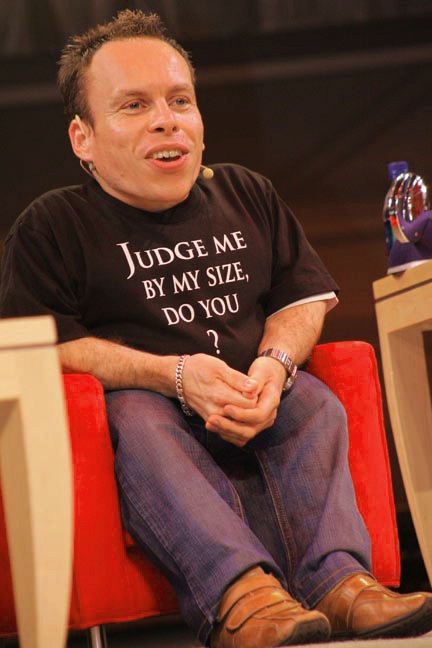
Laura Swanson is a rising artist on the New York scene. Born with achondroplasia, her work zeroes in on bodily difference and human perception. Her latest show, “Resistance,” opened recently at the JCC in Manhattan. The first part of the exhibit features uniforms and cultural apparel—that of a beekeeper, a welder, a plague doctor—altered to her size.

“I started thinking about if you see a person of average adult height wearing a uniform they wouldn’t judge or question…,” she told DNAinfo.  “[However,] when something is made smaller in scale, does it change the meaning?”

The second part of the exhibit features what Swanson calls “anti-selfies”: portraits in which her face is obscured. Does this draw attention to her extraordinary body? Or would the average viewer’s attention already be distracted by it?

In an interview at the Center for Art and Thought, she explained:

Anti-Self-Portraits examines longing for agency and privacy. I wanted to depict a naïve, comic desperation: that this person is so tired of being looked at, she is grabbing whatever is close to camouflage her body, but not doing a very good job at it, kind of like an ostrich sticking its head in the sand. At the same time, I wanted the photos to have a paradoxical feel. With the frontal, theatrical staging of the body, I wanted to convey that this person might not be such a desperate person, but actually a knowing person who is in control of how she is seen. 

A previous show, titled “Display,” featured an average-sized coat next to one that would fit the body of someone with achondroplasia. Here again Swanson invited her viewers to consider what exactly they were staring at. And why. Is an average-sized coat utilitarian, but a dwarf’s coat something you would pay to look at? Freak show attendees certainly did—and continue to do—throughout time and around the world.

Another planned project would explore notions of privacy. She described it in an interview at Haverford College in 2013:

My acute awareness of this desire stems not only from personal experience, but also from the history of photography, which is riddled with images of the Other…

I am working on a multi-part project that deals with an issue that is becoming increasingly unavoidable – the experience of having unwanted photographs taken of me and other people with physical differences while we go about our lives in public. It is funny because there is a lot of coverage and creative projects being made about government surveillance due to the recent PRISM/NSA spying controversy, but my project is actually looking at the ways ‘citizens’ use their phones to document others (ranging from people with physical differences and disabilities to depictions of homelessness) and share those photos on social media to amuse their friends. One part of the project will be … to design and fabricate devices for those who want to avoid having their image taken in public without consent. So not only am I getting further away from the camera, I am trying to prevent its usage!

As a professional photographer and sculptor, Swanson is thrusting tough questions upon the art world – a community renowned for having both broad and narrow definitions of beauty. As a person with dwarfism in the public eye, she is elevating the social issues of disability and physical difference to a more contemplative plane. That these issues tend to come in packaging that is either simplistically cute-and-cuddly or outright freak-show voyeuristic makes Swanson’s approach all the more refreshing.


Can We Understand What It Is Like To Hear Sound for the First Time?

17 Jan

listen(Image by Jay Morrison used under CC license via)
 
In the 1990s, Cristina Hartmann was one of the first of a few hundred deaf and hearing impaired children in the United States to undergo surgery for a cochlear implant. She has written extensively about the experience of hearing sound for the first time after the implant in her right ear was activated, most recently this month on Quora.com:

My mother was the one who told me, “Raise your hand when you hear something.” That statement left me baffled. What was I looking for? It was a bit like searching for Waldo when you didn’t know what he looked like.

In that tiny, windowless room deep in the large Manhattan hospital, the audiologist began tapping away at her keyboard. Everyone stared at me, even a woman standing in the doorway whom I had never seen before. I felt the heavy weight of expectations on my shoulders. I had to do something. I concentrated very hard, searching for the mysterious, indefinite Waldo. Whenever I felt anything, an itch or a breeze, I raised my hand slowly, searching everyone’s expressions for whether I had gotten it right or wrong. Nobody gave me any confirmation, so I went on guessing. Twenty-five years later, I realize the whole thing was a show that I performed. I knew this was a momentous event, and I didn’t want to disappoint….

As a congenitally deaf child (who was a bit long in the tooth at 6), I had never formed the neural pathways for my brain to even begin processing auditory stimulation. In the fashion of the ostrich, my brain ignored the strange stuff, and I remained as deaf as I had been an hour prior…

It took months and plenty of therapy for her brain to adapt. Thirteen years later, the activation of a second implant, this time in her left ear, proved a more harrowing experience than the first:

As the audiologist began the beep sequence, I burst into tears and involuntarily clenched the left side of my face. She looked up, puzzled. “Why are you crying? You’ve had this before!” she said. The pain was like sparklers going off on the left side of my head. The stimulation, as little as it was, completely overwhelmed me.

Even though I had already laid the neural pathways for auditory stimuli for my right ear, my brain was unprepared for the stimuli coming from the left side. Since my brain had already experienced this type of stimuli, it could process it, but it was still sensory overload. That stuff hurts. It took me months to acclimate myself to the new implant, but in the meantime, I cringed every time I turned it on. As I said, laying new neural pathways takes work.

Hartmann was later told by the mother of another patient, “Once they started with the beeps, [my daughter] screamed and cried.”

Such narratives exist in stark contrast to the YouTube videos of newly activated implant users laughing and smiling—and, in one case, crying for joy—that have been bouncing around the Internet with far greater frequency. While both narratives provide important information for those considering cochlear implants for themselves or their children, they are also an important contribution for the greater public in our understanding of what it means to be deaf.

It makes sense that crossing out of the world of silence into the world of sound is just as disorienting as its opposite. A hearing person with a middle ear infection strains to perceive the sound of speech, and a deaf person with a new cochlear implant strains to tune out noise pollution: the knocks of a radiator in another room, car doors slamming on the street, wind, footsteps, not to mention the countless background beeps and clicks of the Digital Age. After all, when a baby leaves the womb, she does not instantly adapt to her new home. She comes out crying. There’s too much light and not enough warmth. And, if she is not deaf, there is too much sound.

Speech is no less difficult to learn than Sign language, just as English is no less difficult than Chinese. The ease with which we learn one form of communication or the other depends entirely upon our personal experience and place in the world. For those of us who have grown up hearing speech, the viral videos communicate something very different than for those who grew up in Deaf culture.

While the experiences of utter delight portrayed in the videos are valid, their popularity contributes to an oversimplification of the issue. Watching a toddler smile upon finally hearing his mother’s voice for the first time sends a very strong subliminal message: Being deaf must be worse than not being deaf, and therefore anyone would want to join the world of the hearing. But the general public as an audience is already biased toward the hearing world’s standards of happiness. We are moved by the sound of loved ones uttering our names but not at the image of them signing our names because our culture does not rely on—and therefore does not highly value—Sign language.

This what inspired Lalit Marcus, the daughter of deaf parents and an active promoter of Deaf culture, to pen an article for The Wire titled, “Why You Shouldn’t Share Those Emotional ‘Deaf Person Hears for the First Time’ Videos”:

I want to make it clear that I don’t have a problem with people who choose to get cochlear implants. Medical decisions are painfully personal… I’m all for people making the health choices they think are best for them. What bothers me are the maudlin videos produced out of someone’s intense, private moment that are then taken out of context and broadcast around the world. What bothers me is how the viewer never learns how the individual came to the decision about their implant, which factors they took into account, whether their medical insurance covered it. Sometimes we don’t even learn their names.

This gives me pause. I consider the clip of me removing my casts to look at my newly lengthened legs, which featured 15 years ago in the HBO documentary Dwarfs: Not A Fairy Tale and last year on Berlin’s public station. The moment was simply joyous—as was the moment I stood up, let go of my friend’s hands and took my first steps—but the story behind it was abundantly complex. Which hopefully both documentaries portray.

I have endeavored to communicate that through this blog and all the media work I have done for the past 20 years.

Limb-lengthening and cochlear implant procedures are markedly different in several ways. Limb-lengthening, for example, does not threaten to endanger another language. But it does threaten to break ranks in the dwarf community through the controversy of altering versus accepting extraordinary bodies. Both procedures have proven to evoke vitriol among their proponents and detractors.

Hartmann reveals:

Most of my deaf friends were good about my CI. They didn’t mind it, except for the fact that my speech therapy cut into play time. That being said, people in the Deaf community felt free to make pointed and derisive comments about my CI. I still get these comments, even almost 24 years after my surgery. To some, I’ll always be a CI-wearer and a turncoat.

The CI advocates aren’t any better, if not worse.

I have very pleasant relationships with many parents of implanted children and CI users. I, however, have also been called a failure because I still use [American Sign Language] and don’t speak perfectly. I’ve also seen a mother run across a room to prevent her child from signing to another deaf child. I’ve been scolded for making gestures and looking too “deaf.”

The debate, of course, is ongoing.

But for those of us not faced with opting for or against a cochlear implant, we are faced with the challenge of overcoming our bias and remembering that Deaf culture is no less valid than the hearing culture we inhabit. Especially when those admittedly tantalizing videos wind up in our Facebook feeds.


Curiosity Kills the Rat

19 Oct

From the Archives


“All the freaky people make the beauty of the world.”

— Michael Franti

Fourteen years ago, I made a trip to Hot Topic—that quintessential 90s chain store for all things goth—in search of some fishnet stockings for a friend.  It was my first visit to the store since I was back in a wheelchair for my third and final limb-lengthening procedure and the narrow aisles prevented me from venturing beyond the entrance.  My first time in a wheelchair, from ages 11 to 12, had been a completely humbling experience as I was forced to see how very inaccessible the world is for the non-ambulatory.  This time around I was battling the hot-cheeked self-consciousness that adolescence attaches to any signs of dependency. 

As I tried to look casual while flipping through black gloves, black stockings, and black dog collars, a guy approached me sporting crimson hair, eyebrow rings, an employee badge and a smile.  “This is store is easily adjustable,” he grinned, and with that he began shoving aside the display cases and clothes racks—which were, like me, on wheels—clearing a path for me right through to the back and taking little notice of the other shoppers, some of  whom took one to the shoulder.  It was one of those crushes that disappear as quickly as they develop but leave a lasting memory: my knight in shining jewelry.

Thanks to experiences like this, I have a special place in my heart for the acceptance of physical differences that can often be found in the subcultures of punks, hippies, and goths.  From the imagining of monsters to the examination of anything taboo, counter-culture is often unfazed by physical qualities that fall outside of mainstream beauty standards.  The first kid in my high school who chose not to stare at the external fixators on my arms but instead held the door for me had green and purple hair.  About a month after my trip to Hot Topic, I showed a death-metal-loving friend my right fixator (shown above) for the first time, with the six titanium pins protruding from open wounds in my thigh.  He grinned, “That is the ultimate piercing, man!”  He hardly could have come up with a more pleasing reaction.  That my wounds were cool instead of “icky” or “pitiful” was a refreshing attitude found almost exclusively outside mainstream culture.  This attitude more readily understands my belief that my scars are merit badges I earned, not deformities to erase. 

However, this tendency toward decency over discomfort is just one side of the alternative coin.  Every subculture has its strengths and its weaknesses, and for all the freaky heroes I’ve encountered, I’ve also met plenty whose celebration of difference devolves into a sick fascination with the grotesque.  “Weird for the sake of weird” is progressive when it asserts that weird is inescapable, that it is in fact as much a part of the natural order as any of our conventions, and when it serves as therapy for the marginalized.  But it is problematic when it involves self-proclaimed artists using others’ reality as their own personal toys.     

In a previous post, I referred to a friend of friend including me in an Internet discussion about limb-lengthening.  His comments were in reaction to a photo of a leg wearing an Ilizarov fixator that had been posted on a Tumblr page focused on the “wonders of the world.”  There are countless sites like it, where photos of conjoined twins, heterochromatic eyes, intersexual bodies, and medical procedures are posted alongside images of animals, vampires, robots, cosplay, self-harm, manga and bad poetry.  I get it.  The world is “crazy” and it’s all art.  But if that’s not a freak show, what is? 

Disabled people are no longer put behind glass or in the circus—at least not in the U.S., Canada or Western Europe—but many people still believe they reserve the right to stare, both in public and on the Internet.  Whether under the guise of promoting diversity or admiring triumph in the face of adversity, they suppress any realization they may have that no one likes being stared atUnless it’s on our terms.  

I see endless art in my medical experiences and it can be so therapeutic.  During my first limb-lengthening procedure I also had braces on my teeth, leading my dad to observe, “She’s now 95% metal.”  Kinda cool.  During my third procedure, I had Botox injected into my hips twice to paralyze my muscles lest they resist the lengthening.  At the time, when I along with most people had no idea what it was, it was described to me as “basically the most deadly poison known to man.”  Whoa, hardcore.  When I happened upon photos of my anterior tibialis tendon graft surgery, I was enthralled: “I’m so red inside!”  And when a fellow patient recently alerted me to the fact that a high-end jeweler designed a bracelet strongly resembling the Ilizarov frame, I laughed my head off.  Almost all of us like looking at our bodies, and perhaps this is especially so for those of us who have had real scares over our health.  It’s a matter of facing our fears and owning it.  But no one likes the idea of others owning it.  This subtle but severe preference, this desire for dignity determines the difference between human rights and property rights. 

Two years ago, NPR featured a piece by Ben Mattlin, who is non-ambulatory and who said he used to be uncomfortable with the idea of Halloween and its objectification of the grotesque.  From my very first costume as a mouse to my most recent stint as the Wicked Witch of the West, my love of Halloween has not so much as once flickered, but his point is worth discussing.  Costume play, Halloween and any celebration of “weird” that is primarily attention-seeking inherently assumes there is a “natural” basis to be disrupted.  (And all too often Halloween devolves into offensive imitations of all sorts of minority identities.) 

I have my own collection of artsy photos stolen off the Internet that I use as screensavers and montages for parties, but they do not include photos of bodies taken outside the context of consensual artistic expression.  Re-appropriating a photo in a medical journal for a site about all things bizarre is protected under freedom of speech, but it can feel like disregard for consent.  And in any case, such xenocentrism will always be just as superficial as the status quo it seeks to disrupt.

When conjoined twins Abigail and Brittany Hensel agreed to be interviewed once—and only once—for a documentary about their lives (which I highly recommend), they explained that they don’t mind answering strangers’ questions at all.  (Ben Mattlin has said the same, as do I.)  What they hate more than anything is being photographed or filmed without permission.  While attending a baseball game outside their hometown, a sports film crew quickly directed their attention to the girls.  Even though they were already being filmed by their own documentary team, the stranger camera’s invasive, presumptuous stare ruined the day for them. 

Sensitivity toward others’ experience with medicine and death should never kill the discussion.  These discussions are imperative and art is the most glorious way we relate to one another.  But just as there’s more to good manners than simply saying “Please,” there’s more to genuine learning and artistic expression than poking at anything we can get our hands on.  Nuance, deference and respect are prerequisites for anyone with artistic or scientific integrity not only because they are the building-blocks of common decency, but because history has shown that curiosity will more likely harm the rat than the cat.


Originally posted May 19, 2012

Berlin Fashion Week Features Pieces Made for and Modeled by Dwarfs

1 Oct

stuff 01 used C Me

(Image © Emily Sullivan Sanford)

It’s been a good week in the media for dwarfs. Not only did Peter Dinklage’s Emmy win allow for him to speak out once again against bullying, but Fashion Week just ended in the city I call home and I couldn’t help but squeal a little “OMG!” at seeing history being made.

With her collection “At Eye Level,” Berlin-based designer Sema Gedik presented clothes made for and modeled by Laura Christ, Mick Mehnert, Eva Ehrmann and others with dwarfism. Gedik was inspired to do so after observing the difficulty of finding clothes that fit—not to mention stylish ones—faced by her cousin Funda, who has achondroplasia. That the fashion industry has never seemed interested in offering dwarfs clothing made for their bodies imbued Gedik with “an intense feeling of injustice.” She tells Berlin’s Tageszeitung, “Fashion should not be restricted by social conventions.”

But those restrictions are there, which is why she reports being surprised that she even managed to get the project off the ground and into Fashion Week. Indeed, a feature in The Washington Post earlier this year about the work of American designer Kathy D. Woods did little to help her kickstarter campaign to fund her line of clothes for fellow dwarfs. The campaign ended up falling far short of its goal.

El Mundo has declared Gedik’s debut “a revolution,” but the revolution is arguably the easiest step for any social justice movement. The trick is getting the new ideas to stick. Distributors argue that dwarf clientele wield too little purchase power to be worth investing in due to their small numbers. Gedik rebuffs this claim, pointing out that the number of women with typical catwalk-like measurements also constitutes a minority of consumers.

Ever since New York Fashion Week featured a handful of disabled models, some cultural critics have wondered whether the ulterior motive of the world of haute couture is to exploit those who stand out for shock value. After all, Francis Bacon’s truism that “there is no exquisite beauty without some strangeness in the proportion” both honors diversity and draws inordinate attention to an individual’s Otherness at the expense of anything else they may offer or need. Which is perhaps why my excitement and pride at Gedik’s breakthrough is tempered by a slightly more cynical It’s about time.

Gedik is adamant that her goal is to finally and fiercely open up the fashion market to dwarf consumers. “This is only the first step,” she insists. But there is a risk that the opening will close as soon as the novelty wears off. The final step in the path to justice will be to see work like Gedik’s so often that all that’s worthy of note is the choice of colors.

The Problem of Dwarfs on Reality TV

30 Aug

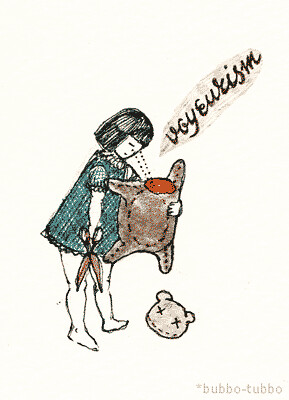
voyeurism(Image by Natasha Mileshina used under CC license via)

The new television schedule has kicked off both in the U.S. and the U.K. with the usual plethora of reality TV shows and the usual high number of shows zeroing in on people living with dwarfism: The Little Couple; Seven Little Johnstons; Our Little Family; Little Women of L.A.; and the grandfather of them all, Little People, Big World. Besides the patronizing titles and taglines, the shows feature factoids about dwarfing conditions and lots of melodrama thrown in with some social critique lite.

Having handed my life story over to a journalist for the umpteenth time this past spring, my husband and I recently discussed how important it is to be able to trust that your storyteller will not exploit you for entertainment value. It takes a perceptive mind and an agile hand to elucidate dwarf-related topics like bio-ethics, self-image, political correctness, beauty standards, harassment, adoption, job discrimination, pain management, and reproductive freedom—all of which could and have filled scholarly journals and books—via mere sound bites. At one point in the conversation my husband paused and said, “Just to make sure we’re on the same page, honey – we’re never appearing on reality TV. Right?”

I laughed and nodded reassuringly.

He was not unwise to worry.

Reality TV offers their subjects fame at the expense of their dignity. Documentaries and news features also carry a risk for this, but one element that distinguishes reality TV from journalism is the rock-solid guarantee of fights, tears, and bad-mouthing. For some participants there may be gratification in the knowledge that millions of viewers are interested in you enough to want to watch how you live every waking minute of your life, but it comes with the unspoken fact that they’re also waiting for you to slip up so that they have a good story to hash out among their friends and in gossip columns.

We are all vulnerable to voyeuristic temptation and the media knows this. It’s why it offers us up-close shots of survivors’ tears as soon as possible, and it’s why we click on them, despite recent and compelling arguments that this is socially irresponsible. The message of reality TV seems to be that no one really ever moves beyond middle school jealousy and superficiality, so we might as well let it all hang out. The better angels of our nature be damned.

Years ago, Cathy Alter mused via a glib article in The Atlantic about her rather bizarre obsession with dwarf reality shows. The greatest revelation came from her therapist, who explained, “I think regular size people feel more secure as people when they can observe midgets… I think that contrast is validating because we tell ourselves that at least there are people who have it worse, because they are small… We need the midgets to feel normal.”

This confirms what I have always suspected and, admittedly, feared. That millions of people are watching under the guise of wanting to understand difference while ultimately enjoying getting to look at lots of juicy pictures of freaks.  This is why these sensationalist shows do so well, while earnest, in-depth documentaries like Little People: The Movie remain out of print. Before the birth of reality TV in the late 90s, dwarfs were most often featured on daytime talkshows, alongside episodes featuring people caught in affairs and people who believed they were the reincarnation of Elvis.

As often the only dwarf in a given person’s circle of acquaintances, I have been told by many how touching they find these shows. How wonderful it is to see that “dwarfs are just like everyone else!” I can accept that there will probably always be a market for shallow entertainment that twists tragedy into soap opera and reduces the complexities of life into easy-to-swallow sentimentality, no matter how far society progresses. Tabloids will continue to exist because millions of people—including kind, intelligent people I know—will continue to buy them. In this regard, the individual shows are not so much problematic as is the fact that they are where TV viewers are most likely to see people with dwarfism.

Actress Hollis Jane, who called out Miley Cyrus last year for exploiting performers with dwarfism as sideshow acts, explained this summer why she turned down a contract to appear on Little Women of L.A.:

Other than Peter Dinklage, Tony Cox (Bad Santa) and Danny Woodburn (who played Mickey Abbott on Seinfeld), it’s nearly impossible to name successful actors and actresses who also happen to be little people. People get upset about the Kardashians representing women in America but for every Kardashian there is a Meryl Streep, a Natalie Portman, or a Zoe Saldana. Little people don’t have that. I have wanted to be an actress since I was in first grade and I played the angel, Gabriel, in a nativity play. I held firm to this dream until sixth grade when a parasitic thought crawled into my head and told me that I would never be an actress because I was a little person. I realized that since there was no one on television who looked like me, it meant that there would never be… When Game of Thrones premiered, my world was rocked. Peter Dinklage was doing the impossible. He was being taken seriously as an actor without exploiting his height for shock value or a joke. The night he won his Emmy, I cried for an hour.

She adds, “I have nothing against the women on these reality shows. There is a part of me that thinks it’s great we have little people on TV in any capacity…but I also think we deserve more than that.”

If the general public truly believed this, if reality TV viewers truly saw their dwarf subjects as their equals rather than curiosities, then we would see a lot more dwarfs as newsreaders and game show hosts, starring in sitcoms and dramas, playing the lead detective and the lovely heroine and the hero facing impossible odds to save the day. Perhaps that day will come, but for now few people can name a single dwarf actress and many dwarfs get told that they look like “that guy on the show about the little people.” That’s our reality.

And the Name of the Drug That Might End Dwarfism Is Vosoritide

28 Jun

Medicine 3(Image by Marosh used under CC license via)


Pharmaceuticals company BioMarin announced last week the first results of their clinical trials for the drug BMN-111, now named vosoritide by the World Health Organization. Researchers have been developing vosoritide in hopes of one day curing achondroplasia, the most common type of dwarfism. Vice-President Dr. Wolfgang Dummer reported:

In children receiving the highest dose of 15 micrograms per kilogram daily, we observed a 50% increase in mean annualized growth velocity compared to their own natural history control growth velocity. This increase in growth velocity, if maintained, could allow children with achondroplasia to resume a normalized growth rate. More importantly, vosoritide was well tolerated in all dose cohorts and we have observed no major safety concerns to date.

Whether or not vosoritide could reduce an achondroplastic person’s increased risk for chronic joint pain, bowed legs, spinal stenosis, sleep apnea, or hydrocephalus remains to be seen.

Since many of my readers are new to the blog, I’m re-posting my article “Will We Live to See the End of Dwarfism?” about how some of us with achondroplasia feel about all of this.

* * *

Medicine has been transforming the fate of human society since the first moment someone bandaged a wound. Bearing this in mind, along with the more recent advances in genetics, I have realized for the past decade or so that there is a future, however near or distant, that promises a world without dwarfism. But what if this world arrives as soon as the next generation?

Pharmaceuticals company BioMarin reported earlier this year the start of clinical trials for a drug called BMN-111. If it ends up doing what it promises, repeated injections could transform the bone and cartilage growth of children born with achondroplasia, essentially curing them of the condition. Could this mean that I might someday belong to the last of the dwarfs?

To be clear, BMN-111 could cure only achondroplasia, the most common type of dwarfism, not the other 200+ types. (So the attention-grabbing name of this article is a tad misleading.) Dwarfism caused by growth hormone deficiency—which affected circus performer General Tom Thumb and most of the actors playing the Munchkins in The Wizard of Oz—has already been cured by hormone injections invented at the end of the last century. But 70% of all dwarfs have achondroplasia. Without us, the small number of people identifiable as dwarfs would become much smaller.

Because I’m a fully grown adult, I can’t ever cure my achondroplasia. But would I have chosen to do so if I could? Were my doctor to offer me a pill that would transform my joints and my muscle tone, allowing me to walk and stand around for longer than an hour without my feet swelling with pain, I would take it in an instant. The same goes for a pill that would endow me with more normal fine motor strength, so that I could open jars and push down sticky buttons and do all those tasks that leave me swearing and/or asking someone else for help. I would gladly have taken a pill that would broaden my Eustachian tubes so that I would stop getting ear infections every year. And I would have embraced any sort of medicine that would have widened my spinal column so that I would never have had to have a laminectomy, and so that I could cook and clean my house without back pain. All of the discomfort and inconvenience I just listed are part and parcel of achondroplasia – parts that limb-lengthening could never alter.  

But when I consider a pill that, in ridding me of all that pain, would also rid me of every physical marker of achondroplasia, I suddenly hesitate. My wrists, my feet, my skull, my face would look significantly different from the one I have. The idea of never having had to learn how best to react to being the most physically remarkable person in school, of never having undergone limb-lengthening, of never having lived in an institution with children with all sorts of serious conditions, of never having had to explain my unique history to others – it makes me have a hard time imagining an Emily Sullivan Sanford that is anything like the one I know today. My dwarfism is only part of who I am, but it has been a significant part of who I am. This is why I understand the Little People of America members who balk at BMN-111, put their fingers in their ears and chant, “Go away, go away, go away!”

We must approach the future rationally because our emotional attachment to life as we know it can lead us to delude ourselves with an unrealistic sense of control. History after all demonstrates that future generations will never know all kinds of things we treasure today. Give or take a few centuries, people in our part of the world will most certainly not face the same illnesses, speak the same language, wear the same clothes, eat the same foods, or observe the same traditions we do. Whether we’re debating the politics of Hawaiian Pidgin or that punk’s not dead, we do not get the final say on what future generations will know and what will be lost to the ages.

Identity is a construct, but a construct that is as powerful as any other. As Andrew Solomon writes, “I don’t wish for anyone in particular to be gay, but the idea of no one’s being gay makes me miss myself already.”

Granted achondroplasia is not merely a difference like a dialect or homosexuality. It is a medical condition that causes very real physical pain and health risks. Like diabetes. I can write with certainty that the vast majority of people with diabetes, while rightfully proud of the obstacles they’ve overcome, would happily rid themselves of the disease. They would celebrate never having to check their blood sugar, inject themselves with insulin, or worry about developing dangerous complications. We can safely make the same assumption for people who have to deal with migraine headaches or deep-vein thrombosis.

But let’s consider a condition that, like achondroplasia, has as many social ramifications as medical ones. I bet most people who wear glasses would gladly take a pill that guaranteed perfect vision. No more headaches, no more pressure sores on the bridge of your nose, no more wondering where you set them down, no more worrying if they break, no more bills! But would they so easily let go of their bespectacled appearance? Although he no longer needs glasses since his laser surgery, comedian Drew Carey wears non-prescription glasses to maintain his look.

I surveyed a handful of friends in Europe and the U.S., and most answered that they would indeed take a pill guaranteed to improve their vision, and also that they would never wear anything but sunglasses again. If this scenario ever becomes reality, the movement of the past 100 years to broaden beauty standards to include the bespectacled will begin to fade. The 20% of my respondents that answered, “I would wear non-prescription glasses because it’s a part of my identity,” will belong to a shrinking minority left to fend for itself. They will likely start counting the minutes until they hear something marginalizing like: “Isn’t it great you won’t have to look like a nerd anymore?”    

Once again, people with achondroplasia must admit that our distinguishing condition involves far more innate physical complications than simply needing glasses or being gay. Activist Harry Wieder bemoaned the reticence among people with dwarfism to even admit that we are disabled, and he was right to be so critical. Downplaying the pain and surgical risks everyone with achondroplasia faces is a matter of denial. But such denial is often rooted in the worry that others will overemphasize our pain, distancing themselves from us in a way all too similar to the fear and pity that fuels ableism. Such distance imposed by other minorities can break solidarity and lead to hierarchical thinking along the lines of, “At least I’m not like that!

Anyone who reacts to the idea of BMN-111 ridding humanity of the achondroplastic appearance with a sigh of relief has a problem. It’s a problem we can never afford to ignore. The lessons of diversity awareness and inclusion are priceless. If dermatologists some day offer a cure for vitiligo, Winnie Harlow’s recent successes in the world of modeling will still have only been a good thing.

My attachment to my starfish hands, my achondroplastic nose, and my scars is not rational. But the human experience is never purely rational. And self-acceptance is an achievement like no other. Almost every person with achondroplasia has a jarring moment when they see themselves in photos or on film and are reminded that their hands are not at all slender, like most of the hands they see in photos or on film. Or that their hips sway when they walk. Or that their skulls are larger. Learning to live with the shock is a difficult but worthwhile experience. When a mother of a girl with achondroplasia wrote to me, asking about her four-year-old daughter’s future, my family awwwwwed at the photos she sent us. “I remember having an adorable little girl with a forehead like that!” my dad grinned.

I was not nearly so moved by the recently published images of celebrities photoshopped to “reimagine them with dwarfism” next to an image of Peter Dinklage photoshopped to “reimagine him without” because only their legs were modified.

The project itself is thought-provoking, but Daniel Radcliffe simply wouldn’t get into the achondroplasia club with those ridiculously long arms. And Peter Dinklage—whom GQ declared a “stud” in its 2011 Men of the Year list—would have a dramatically different forehead, cheekbones, jaw, and nose.

One of the respondents to my survey who said he would keep his glasses explained, “Not really for aesthetic reasons, exactly, though that’s part of it (and it is fun to buy glasses). But because they’re a part of my face! I’ve never considered contacts, either, come to think of it. They serve some other function, beyond utility and style, I guess.”

Similar feelings have been expressed by people who underwent surgery to remove the sixth finger on their right hand for convenience, while opting against the removal of the sixth finger on their left: “Why would I cut it off? It’s a part of me.”

Syndactyly runs in two sides of my family. One relative remarked about her child, “I was so happy when she was born to see she didn’t have those fused toes!”

To which another relative with fused toes later said, “Why? It hurts a bit more when you stub them, but otherwise, what’s the big deal?”

Replace the word “fused toes” with red hair or monolids or pale skin or dark skin or freckles or whatever intrinsic part of you might somewhere be considered unfashionable and you’ll know a little how dwarfs feel about BMN-111. As with limb-lengthening, BMN-111 threatens to out the uglier feelings some people have about our appearance. We must remember that it’s the feelings that are ugly, not the body.    

Talking out my endlessly complex thoughts about a world without dwarfism feels like moving through a labyrinth that is partly my own making. During one such recent talk, a close friend said to me, “If we could look at a version of you that never had achondroplasia, I understand that you would miss yourself and I would miss you, too.  But you would be awesome in a different way that would still be your own way, and it would be without all the pain and complications and danger.”

This is what people with achondroplasia need to hear from those who truly accept them.


Interview on Berlin Television

6 Jun

©Ines Barwig(Image ©Ines Barwig)


Berlin’s public broadcasting station rbb has just aired a report on Painting On Scars, which you can read about and watch here.

For those of you not fluent in German, I advise you against using GoogleTranslate. As a professional translator, I’ve always considered the service a bit of a rival, but now we’re talking full-blown war. Because while any half-educated human Germanist could tell you that the rbb report translates into English as “Short-Statured – Getting Taller Through Operations,” Google says:


GoogleTranslate


Ireland Votes on Marriage Equality – While Snarking about Midgets

17 May


Ireland votes on same-sex marriage on Friday, and comedians Brian O’Carroll and Lenny Abrahamson from the sitcom Mrs. Brown’s Boys have teamed up to urge voters to support equality with the above video. If you can’t view it, here’s a summary:

***

Reading from a speech, a frumpy-looking senior citizen, Mrs. Brown [played by Brian O’Carroll], looks at the camera and says, “Hello. I’d like to talk to you today about midget equality.”

“Marriage, Mammy!” interrupts her son Rory, who is standing next to the cameraman.

“What, love?” she asks, confused.

“It says ‘marriage equality,’ ” he corrects.

“What you got against midgets?” she demands.

“Nothing, Mammy, I’ve got nothing against anybody! It’s just that this is about marriage equality.”

“What about it?” she shrugs. “Any two people who feel in love enough should be allowed to get married! What’s the feckin’ fuss?”

“Well, some people believe that if you allow gays and lesbians to get married, it might change the meaning of marriage and family,” he explains.

She laughs. “I’ve heard that one before! When I was a young girl, there was a big hoo-haa about mixed marriages – y’know, Catholics marrying Protestants and black people marrying white people. But you know what? They still went ahead and got married. And the world didn’t end. No. And we all grew up a little bit.”

She turns to the camera. “And you know, we all have to grow up a little bit now. Marriage isn’t easy. Changing the law isn’t easy. Changing attitudes is even harder. But we can do it. We’ve done it before. And the world didn’t end.”

“Oh, I know that some of you think it’s not right. Well, all I can tell you from my experience is that I can’t describe the joy I feel to see my son Rory having the same opportunity for happiness as everybody’s else’s son.”

“So go out and vote. That’s the important thing. Go out and vote.” She turns to Rory. “Do you know, Rory, there was a time when women weren’t allowed to vote?”

He smiles, rolls his eyes and nods knowingly.

They both start to laugh.

“You see, that’s the thing!” she says, looking at the camera again. “Every generation gets a chance to make a big change. And you’re going to get your chance on May the 22nd. So go out and do it. Go out and vote.” She giggles. “And keep in mind, support midgets!”

Rory rolls his eyes and shakes his head.

She thinks for a moment. “Oh, right. They asked me to make it funny.” She prepares to tell a joke. “These two queers were—” ”

“Mammy!” Rory scolds.

***

The video is touching in its call for equal rights for same-sex partners in the spirit of equality for so many minorities. And yet the attempt to inject some humor amid the pathos comes via a slur at the expense of another minority. After I showed the video to a close friend, his face shifted back and forth between a soft smile and a furrowed brow. “Most of it is pretty sweet, but – the midgets part? I mean, why was that necessary?”

As the mother of a boy with achondroplasia told The Irish Independent:

I know Brendan O’Carroll probably didn’t mean anything malicious in his use of the word, but it’s just to educate people that it’s not an acceptable term to use…

Brendan didn’t use the N-word to describe black people, as this is thankfully totally unacceptable in most of today’s society…

I didn’t see what people with short stature, call them ‘midgets’ as he called them, has got to do with marriage equality. I just saw it as a source of ridicule. It was a cheap shot. It was just a gag…

[When my son was born], the obstetrician tried to explain the condition to me by using the term, “Do you know a clown in a circus? He’d be one of those.” That’s the attitude that’s out there. It’s just comments that people think it’s okay to refer to these people in a derogatory fashion and it’s not okay.

She is hardly the first mother of a child with dwarfism to hear this. Parents of children with achondroplasia born in the 1950s recounted in the documentary Little People: The Movie how they were routinely told the same thing by obstetric nurses.

I personally do not find Carroll’s use of the word “midget” deeply offensive. I find it cheap, and unfortunately symbolic of the way dwarfs are predominantly marginalized by comedians and pop culture – the same way gays and lesbians up until only recently were predominantly marginalized by comedians and pop culture. As Bob Hope wise-cracked in 1970:

You know, a new movement – a new movement has appeared on the American scene. First women’s liberation demanded the rights of women. Then the hardhats demanded the rights of men. And now gay liberation is demanding the rights of – whatever they are.

Many in the dwarf community have tried to emphasize the offensiveness of the word “midget” by comparing it to the offensiveness of the N-word for the black community. This comparison is not entirely apt because a word’s power to offend relies greatly on the intentions of those who primarily use it. Most of the time that I hear the M-word, the utterer is displaying more blunt ignorance than outright malice. In that way, “midget” is perhaps more comparable to “Oriental” or “gypsy” or “Siamese twin.” Some people use these words pejoratively, many people take them as pejoratives, but most people use them because they are unaware of the human rights conversations about these groups that have been going on for the past several decades.

Indeed, my first reaction was that, obviously Mrs. Brown is played up as a caricature of batty, outspoken matriarchs whose speech is expected to be embarrassingly outdated. But she did not refer to black people as “coloreds.”  And surely, Mrs. Brown, you had Seinfeld in Ireland back in the day?


Will We Live To See The End of Dwarfism?

29 Mar

Hands


Prologue: My three-month long hiatus from blogging was due to tendon surgery I underwent in January and rare complications that arose from it. I am now gradually returning to work from sick leave and thrilled to be back.

* * *

Medicine has been transforming the fate of human society since the first moment someone bandaged a wound. Bearing this in mind, along with the more recent advances in genetics, I have realized for the past decade or so that there is a future, however near or distant, that promises a world without dwarfism. But what if this world arrives as soon as the next generation?

Pharmaceuticals company BioMarin reported earlier this year the start of clinical trials for a drug called BMN-111. If it ends up doing what it promises, repeated injections could transform the bone and cartilage growth of children born with achondroplasia, essentially curing them of the condition. Could this mean that I might someday belong to the last of the dwarfs?

To be clear, BMN-111 could cure only achondroplasia, the most common type of dwarfism, not the other 200+ types. (So the attention-grabbing name of this article is a tad misleading.) Dwarfism caused by growth hormone deficiency—which affected circus performer General Tom Thumb and most of the actors playing the Munchkins in The Wizard of Oz—has already been cured by hormone injections invented at the end of the last century. But 70% of all dwarfs have achondroplasia. Without us, the small number of people identifiable as dwarfs would become much smaller.

Because I’m a fully grown adult, I can’t ever cure my achondroplasia. But would I have chosen to do so if I could? Were my doctor to offer me a pill that would transform my joints and my muscle tone, allowing me to walk and stand around for longer than an hour without my feet swelling with pain, I would take it in an instant. The same goes for a pill that would endow me with more normal fine motor strength, so that I could open jars and push down sticky buttons and do all those tasks that leave me swearing and/or asking someone else for help. I would gladly have taken a pill that would broaden my Eustachian tubes so that I would stop getting ear infections every year. And I would have embraced any sort of medicine that would have widened my spinal column so that I would never have had to have a laminectomy, and so that I could cook and clean my house without back pain. All of the discomfort and inconvenience I just listed are part and parcel of achondroplasia – parts that limb-lengthening could never alter.  

But when I consider a pill that, in ridding me of all that pain, would also rid me of every physical marker of achondroplasia, I suddenly hesitate. My wrists, my feet, my skull, my face would look significantly different from the one I have. The idea of never having had to learn how best to react to being the most physically remarkable person in school, of never having undergone limb-lengthening, of never having lived in an institution with children with all sorts of serious conditions, of never having had to explain my unique history to others – it makes me have a hard time imagining an Emily Sullivan Sanford that is anything like the one I know today. My dwarfism is only part of who I am, but it has been a significant part of who I am. This is why I understand the Little People of America members who balk at BMN-111, put their fingers in their ears and chant, “Go away, go away, go away!”

We must approach the future rationally because our emotional attachment to life as we know it can lead us to delude ourselves with an unrealistic sense of control. History after all demonstrates that future generations will never know all kinds of things we treasure today. Give or take a few centuries, people in our part of the world will most certainly not face the same illnesses, speak the same language, wear the same clothes, eat the same foods, or observe the same traditions we do. Whether we’re debating the politics of Hawaiian Pidgin or that punk’s not dead, we do not get the final say on what future generations will know and what will be lost to the ages.

Identity is a construct, but a construct that is as powerful as any other. As Andrew Solomon writes, “I don’t wish for anyone in particular to be gay, but the idea of no one’s being gay makes me miss myself already.”

Granted achondroplasia is not merely a difference like a dialect or homosexuality. It is a medical condition that causes very real physical pain and health risks. Like diabetes. I can write with certainty that the vast majority of people with diabetes, while rightfully proud of the obstacles they’ve overcome, would happily rid themselves of the disease. They would celebrate never having to check their blood sugar, inject themselves with insulin, or worry about developing dangerous complications. We can safely make the same assumption for people who have to deal with migraine headaches or deep-vein thrombosis.

But let’s consider a condition that, like achondroplasia, has as many social ramifications as medical ones. I bet most people who wear glasses would gladly take a pill that guaranteed perfect vision. No more headaches, no more pressure sores on the bridge of your nose, no more wondering where you set them down, no more worrying if they break, no more bills! But would they so easily let go of their bespectacled appearance? Although he no longer needs glasses since his laser surgery, comedian Drew Carey wears non-prescription glasses to maintain his look.

I surveyed a handful of friends in Europe and the U.S., and most answered that they would indeed take a pill guaranteed to improve their vision, and also that they would never wear anything but sunglasses again. If this scenario ever becomes reality, the movement of the past 100 years to broaden beauty standards to include the bespectacled will begin to fade. The 20% of my respondents that answered, “I would wear non-prescription glasses because it’s a part of my identity,” will belong to a shrinking minority left to fend for itself. They will likely start counting the minutes until they hear something marginalizing like: “Isn’t it great you won’t have to look like a nerd anymore?”    

Once again, people with achondroplasia must admit that our distinguishing condition involves far more innate physical complications than simply needing glasses or being gay. Activist Harry Wieder bemoaned the reticence among people with dwarfism to even admit that we are disabled, and he was right to be so critical. Downplaying the pain and surgical risks everyone with achondroplasia faces is a matter of denial. But such denial is often rooted in the worry that others will overemphasize our pain, distancing themselves from us in a way all too similar to the fear and pity that fuels ableism. Such distance imposed by other minorities can break solidarity and lead to hierarchical thinking along the lines of, “At least I’m not like that!

Anyone who reacts to the idea of BMN-111 ridding humanity of the achondroplastic appearance with a sigh of relief has a problem. It’s a problem we can never afford to ignore. The lessons of diversity awareness and inclusion are priceless. If dermatologists some day offer a cure for vitiligo, Winnie Harlow’s recent successes in the world of modeling will still have only been a good thing.

My attachment to my starfish hands, my achondroplastic nose, and my scars is not rational. But the human experience is never purely rational. And self-acceptance is an achievement like no other. Almost every person with achondroplasia has a jarring moment when they see themselves in photos or on film and are reminded that their hands are not at all slender, like most of the hands they see in photos or on film. Or that their hips sway when they walk. Or that their skulls are larger. Learning to live with the shock is a difficult but worthwhile experience. When a mother of a girl with achondroplasia wrote to me, asking about her four-year-old daughter’s future, my family awwwwwed at the photos she sent us. “I remember having an adorable little girl with a forehead like that!” my dad grinned.

I was not nearly so moved by the recently published images of celebrities photoshopped to “reimagine them with dwarfism” next to an image of Peter Dinklage photoshopped to “reimagine him without” because only their legs were modified.

The project itself is thought-provoking, but Daniel Radcliffe simply wouldn’t get into the achondroplasia club with those ridiculously long arms. And Peter Dinklage—whom GQ declared a “stud” in its 2011 Men of the Year list—would have a dramatically different forehead, cheekbones, jaw, and nose.

One of the respondents to my survey who said he would keep his glasses explained, “Not really for aesthetic reasons, exactly, though that’s part of it (and it is fun to buy glasses). But because they’re a part of my face! I’ve never considered contacts, either, come to think of it. They serve some other function, beyond utility and style, I guess.”

Similar feelings have been expressed by people who underwent surgery to remove the sixth finger on their right hand for convenience, while opting against the removal of the sixth finger on their left: “Why would I cut it off? It’s a part of me.”

Syndactyly runs in two sides of my family. One relative remarked about her child, “I was so happy when she was born to see she didn’t have those fused toes!”

To which another relative with fused toes later said, “Why? It hurts a bit more when you stub them, but otherwise, what’s the big deal?”

Replace the word “fused toes” with red hair or monolids or pale skin or dark skin or freckles or whatever intrinsic part of you might somewhere be considered unfashionable and you’ll know a little how dwarfs feel about BMN-111. As with limb-lengthening, BMN-111 threatens to out the uglier feelings some people have about our appearance. We must remember that it’s the feelings that are ugly, not the body.    

Talking out my endlessly complex thoughts about a world without dwarfism feels like moving through a labyrinth that is partly my own making. During one such recent talk, a close friend said to me, “If we could look at a version of you that never had achondroplasia, I understand that you would miss yourself and I would miss you, too.  But you would be awesome in a different way that would still be your own way, and it would be without all the pain and complications and danger.”

This is what people with achondroplasia need to hear from those who truly accept them.  


Would You Rather Be Born Disabled or Become Disabled? (Part Two)

28 Sep

Dead body(Image by Stéphane Lavoie used under CC 2.0 via)


Most of them were not born with dwarfism. This is what I observed from a history of eminent dwarfs who enjoyed some degree of success outside of freak shows before the minority rights movements of the late 20th century. Most of them, such as Toulouse-Lautrec, experienced stunted growth as the result of an accident or an illness well after birth. Well after it would have been socially acceptable for their parents to give them up or hide them away. Such cases account for a very small minority of people with dwarfism, yet they dominated the scene of non-marginalized dwarfs for most of Western history. This got me thinking.

I conducted a crowd-sourcing experiment on Facebook, asking friends to name very famous people with severe physical disabilities. They had to be household names, nothing along the lines of “that little guy on Game of Thrones” or “that comic on that show from the Eighties who had a muscle problem.” The list of responses bore no surprises: Helen Keller, FDR, Beethoven, Frida Kahlo, Ray Charles, Christopher Reeve, Stephen Hawking, Michael J. Fox. All but two of them—Stevie Wonder and Oscar Pistorius—incurred their disability after infancy. Was this another sign of congenitally disabled people being hidden away? The vast majority (85%) of disabled people become disabled after birth. But the 15% whose conditions are congenital appear to be underrepresented in public.

Does society more readily accommodate those who lose certain abilities than those who never had them to begin with? Anthropologists know that for most of human history any injury or illness without a visible cause was presumed to be the result of black magic or a vengeful deity. From the European mythology of the changeling right up to the Nazi condemnation of genetic “monsters,” congenitally disabled people have been traditionally viewed as non-human and segregated accordingly. Vestiges of this remain in our general tendency to simply not consider congenitally disabled people as potential friends or partners or even peers, in contrast to the conviction that we should stick by our loved ones no matter what befalls them. Pop icon Dick Clark was warmly welcomed back to television as a co-host after his debilitating stroke, but I’ve yet to find a TV presenter in America who was born with a speech impairment like the one Clark developed. I don’t have the funding to empirically test my hypothesis, but you don’t have to delve too far into mainstream media to come up with stories, articles and interviews spotlighting someone who seemed to have it all until one fateful day when tragedy struck. And notice the comparable paucity of such resources on people who have always lived that way.

I squirm as I write this for fear of implying that those who become disabled have an easy time of it. Far from it. It would be utterly callous to ignore the often indescribable strain illness and injury can inflict on relationships, and the horrific social isolation that too many patients face. There’s a reason that “fair-weather friend” is a well-known term. And the human fascination with suffering can be more voyeuristic than empathic.

But no matter the motive, it is always accompanied by the unspoken understanding that no one would ever want to become disabled. This is, in essence, the most universal view of disability: Who on earth would want to lose an ability of any kind?

Even as a congenitally disabled person I understand this. I would never choose to erase my dwarfism from my life experience. But I do not like becoming more disabled than I already am. After tendon injuries and surgery to combat stenosis, I miss being able to ride a bike, to walk barefoot, to cook and type and sit on benches for long periods without pain. And if tomorrow I were to lose my ability to hear, see, or walk, I would be distraught, to put it mildly.

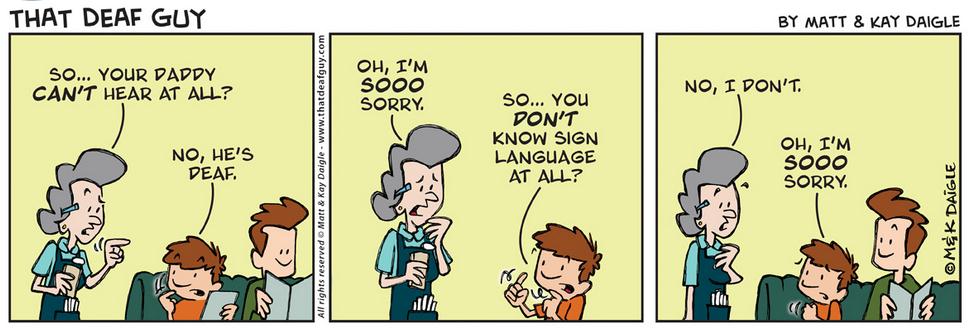
But in voicing this, it is crucial for me—and everyone listening to me—to recognize that my becoming deaf would be a profoundly different experience from that of my friend who has been Deaf since he can remember. Many Deaf people with cochlear implants have told of how overwhelmingly unpleasant hearing sound for the first time can be: One man has “discovered that, far from being adorable, the voices of his grandchildren were rather shrill and often best experienced with the implant turned off.” That Deaf Guy comic strip tells of the authors’ son pitying people who don’t know how to sign.

Similarly, those who have always needed a wheelchair to get around tend to see it as no worse than needing shoes to get around. Yes, it’s inconvenient in a world where ramps are all too rare, just as it would be inconvenient for those of us who are ambulatory if most public facilities didn’t accommodate the shoes on our feet. But that difficulty is imposed by a society that fails to accommodate certain minorities, not by the disability itself. Congenitally disabled bodies do not notice what they lack. As so many have said before me, How can you miss something you never had to begin with?

Researching all of this has brought me to the following conclusion: As individual humans, it is harder for us to deal with becoming disabled than with being born disabled. But as a society, the reverse is true – it is harder for us to accept someone who is born disabled than someone who has become disabled.

As a result, those who were born disabled and those who have become disabled often find themselves on opposite ends of the argument. A woman like Stella Young, who has never been able to walk, is rightly insulted when people tell her she is brave and inspiring just for getting up every morning. (Her TED Talk below is worth every minute.) But a woman like Christine Miserandino, who is slowly losing the ability to walk, is rightly seeking others’ encouragement and support as she struggles to do something she once took for granted. (Her oh-so-quotable Spoon Theory has already been linked on this blog before.)


Because the majority of disabled people are like Miserandino, not Young, the discourse on disability is dominated by sympathy, fear and lamentation. It is hard for us to remember that we shouldn’t pity a woman with cerebral palsy for her spasticity when so many people with multiple sclerosis openly mourn their loss of agility. Those who become injured or ill are entitled to their grief and no one should ever attempt to silence them. But everyone should think beyond their own experience before they publicly decry their condition as unbearable. Especially when it ends up joining the chorus of ableism led by non-disabled people.

One of the most read articles at The Atlantic this month is a piece by bioethicist Ezekiel Emanuel who explains why he hopes to die before age 76:

[Living too long] renders many of us, if not disabled, then faltering and declining, a state that may not be worse than death but is nonetheless deprived. It robs us of our creativity and ability to contribute to work, society, the world. It transforms how people experience us, relate to us, and, most important, remember us. We are no longer remembered as vibrant and engaged but as feeble, ineffectual, even pathetic.

Emanuel is an amateur mountain-climber and a professional writer. He is entitled to feel upset at the idea of losing the abilities he currently holds most dear. And his other arguments about the drawbacks to longevity are as thought-provoking as physicians’ personal opinions on life-saving interventions. But his decision to openly denounce dependence and weakness as unproductive and undignified increases the lifespan of our culture’s ableism. How can we ever stop marginalizing disabled people if we continue to openly voice our fear of becoming like them?

The experiences of those who are born disabled and the experiences of those who become disabled are profoundly different and equally valid. Simply remembering that would change a lot.


Street Harassment of Dwarfs: What You Can Do

14 Sep

http://www.youtube.com/watch?v=mD_PWU6K514


If you haven’t caught it already, Jonathan Novick’s video documenting his experiences in public as a person with achondroplasia is worth your time. Having grown up in a small town where almost everyone knew his backstory, Novick’s move to New York City was a rude awakening to the problem of street harassment. A day out and about, recorded by a hidden camera, features strangers shouting at him from afar, “Hey, short stuff!” “What is he?” “Little midget! Big man, big penis!” A few ask him, “Have you ever been on TV?” “Are you on that show with the little people?” “Can I take your picture?” Two people walk by while photographing him, without asking for permission.

Although I did not undergo limb-lengthening to blend in (more on that here), it has undeniably spared me a lot of this unpleasant commentary which so many dwarfs endure, and which I used to endure as a child. Writing from the U.K., Eugene Grant’s blog demonstrated last year that Novick’s tales of being incessantly photographed and called “Big man!” are far from rare. On Tumblr a college student reported this incident last September:

Walking home from coffee, a random car driving by yelled, “Slut” out their window. I’m not sure who it was directed toward. I was technically showing more skin than the other two in our party, but I also am the height of a 9 year-old and from a distance in the dark it’s hard to determine my age.

Either way assholes are assholes.

This is what sociologist Lisa Wade has called the burden of not being able to assume it’s not about you. This is a burden most people who are visible minorities carry with them. In a review of a street photography project by an artist regularly harassed for being fat, Wade explains:

The truth is that [she] often does not know what’s going on in the minds of her subjects. Yet, because she carries a body that she knows is disdained by many, it is perfectly reasonable for her to feel like every grimace, look of disgust, laugh, shared whisper, and instance of teasing is a negative reaction to her body. In fact, this is how many fat people experience being in public; whether they’re right about the intent 100% of the time is irrelevant to their lived experience.

And this is how people of color, people who speak English as a second language, disabled people and others who are marginalized live, too. Was that person rude because I speak with an accent? Did that person say there was no vacancies in the apartment because I’m black? Was I not chosen for the job because I’m in a wheelchair? Privilege is being able to assume that the person laughing behind you is laughing at something or someone else, that the scowl on someone’s face is because they’re having a bad day, and that there must have been a better qualified candidate.

While I’ve had my fair share of strangers asking about my scars, hands, and gait, they usually have to be particularly nosy in order to take notice of these features in the first place. This happens to me a lot more often in certain rural areas than in the urban setting I call home.

This is why the small town vs. big city debate isn’t quite as simple as Novick presents in his film. I understand the idea that extraordinary-looking people can benefit from living in a close-knit community, where most are already aware of your condition and don’t need you to explain it to them. Conjoined twins Abby and Brittany Hensel’s parents have also claimed their daughters benefited from this. But plenty of people who belong to minorities can attest that small towns do not always embrace diversity in their community. And while there are tremendous advantages to an atmosphere where people are outgoing and unrepressed, there is a fine line between friendliness and nosiness: In places where everyone knows everyone’s business, the assumption that everyone has the right to find out what they don’t know about you can be pervasive. In the choice between small town gossip versus big city street harassment, I’d choose neither.

In my experience, what matters is not the size of the place but the culture. Cities do not have to be hostile environments of street harassment, and villages do not have to be breeding grounds for judgmental hearsay. As Novick says, “I’ll ask that the next time you see someone who is different from you, think about their day. Think about what their day might be like… And then think about what part of their day you want to be.”


Everyone’s Sexuality. Everyone’s.

7 Sep

mjaxmi1inge5ntm3ymu4ngnkytg5


Don’t read the comments. Don’t read the comments. Don’t read the comments. 

That’s what raced through my mind as I read “The Challenges of Having Sex As A Little Person” at The Atlantic. Of course I read the comments anyway. 

And I was only slightly startled to find nothing but solipsistic snickering and overdone puns. The Atlantic doesn’t win any points for ending the article on a pun, either. But praise is due for addressing the topic at all. Based on an extensive interview with Dr. Marylou Naccarato, who has Kniest dysplasia, the article takes a wonderfully sex-positive approach to the experiences of people with dwarfism and the physical obstacles they can face in bed.

As per nearly every feature on dwarfism in the mainstream media, there are some factual errors. For example, one dwarf couple is quoted claiming that people with achondroplasia require “no medication, surgeries, special needs, nothing.” (See here for a list of the many complications we are at risk for.) But Naccarato is doing great work that is revolutionary in light of the fact that Little People of America, and probably most disability advocate organizations, repeatedly shy away from the topic of sexuality.

A simple reason for their silence is that almost all disability organizations comprise just as many parents and relatives of disabled people as disabled people themselves. And who wants to debate the best way to masturbate with Mom or Dad sitting next you? A more sinister reason for the silence is one of the building blocks of modern prejudice against disabled people: that is, the presumption that they are innocent, and therefore asexual. Most positive portrayals of disabled people are cute and cuddly. Is it the only way society can accept us? Refusing to see a minority as anything but asexual is to deny them their full humanity, on par with slut-shaming, prude-shaming, queer bullying, and objectification.

Before I go any further, let me say this: I do not want to talk publicly about what I do in the bedroom and I do not want to know what you do in the bedroom. My firm belief in sex-positive feminism and equality does not mean I think that you are sexy or exciting or impressive. Unless we’re close confidantes or I’ve indicated otherwise, please assume I don’t want any mental images of you and your naughty bits, no matter what they look like.

That said, I fully support anyone’s right to desire any sort of consensual sex imaginable. Without double-standards. Without the pressure of competition. Without the nuisance of others turning their personal preferences into rigid rules.

Take, for example, the way virginity is so frequently turned into not just a game but a high-stakes tournament. When and how did you lose it is an idea all of us are expected to base much of our identity on, even as adults. This is despite the fact that, according to medicine, virginity doesn’t exist. After all, what kind of sex does a guy have to engage in to officially “lose” it? And what about girls born without hymens? When exactly do lesbians lose their virginity?

Like race, virginity is a social construct and, in the words of a very wise person on Tumblr, what can be socially constructed can be socially changed. Last year the great Tracy Clark-Flory interviewed acquaintances about the sexual experience they considered to be their “first time.” The glorious thing about her inclusive project was that it revealed human sexuality to be just as diverse as everything else about us. Some defined their first time by their first orgasm, others by a particular first touch or experience of being touched. The problem with her stretching the definition of “losing your virginity” so broadly is that it robs competitive, insecure people of their ability to set standards with which they can gloat and put others down. Wait, no. That’s another glorious thing about it. There really is no problem with recognizing everyone’s experience as equally valid.

Failing to include everyone not only causes unnecessary humiliation, but it causes us to miss out on opportunities for true enlightenment. To quote the authors of You Can Tell Just By Looking: “Sexual minorities—people whose sexual desires, identities, and practices differ from the norm—do a better job talking about sex, precisely because they are constantly asked to explain and justify their love and their lust to a wider culture and, even, to themselves.”  The more you examine harmful traditions, the less necessary they become.

This does not mean that minorities have better sex. Indeed, too many activists in the sexual revolution end up repulsing readers and listeners when they allow pride in their sexuality to devolve into arrogance, insisting their sex life is better than yours, rather than merely different. For a year, the BDSM club at my alma mater ran the slogan: “I do what you’re scared to fantasize about.” Not helpful. And kinda pathetic the more you think about it.

I will never judge someone for liking any particular kind of consensual sex, but I will judge anyone who tries to turn sex into a competition to calm their own self-doubts. Whether you’re a wise-cracking online commenter or a sex-positive pioneer, true sexual liberation is about moving beyond the middle school clique mentality, not indulging in it. It’s pretty much the least attractive thing there is.

Who Needs To Look At Dwarfs In A Theme Park?

5 May

Caged Beauty #1

(Image by Howard Ignatius used under CC 2.0 via)


Belgian photographer Sanne De Wilde’s journey into the Kingdom of the Little People in Kunming, China is featured this week at Slate’s photo blog. “For me, it’s about how this kind of place can exist,” she told Slate. “What does it tell you about a person who starts this and creates it? What are his intentions?”

She goes on to explain that one of the hardest things to capture on film was the overwhelming boredom among the performers. “A lot of time the people are just hanging around in their room or on their beds lying around,” she said. 

That circus freaks get bored should not be too surprising, but it is still often radical today to consider that people categorized as freaks can in fact be boring. (More on that next week.)

A theme park funneling in people who pay to look at dwarfs and the state of disability rights in China are worth a zillion words each. But for now, De Wilde’s photos alone have plenty to say on the matter. The feature is definitely worth your time, and to those who do check it out, I leave one question open to you:

Does Slate’s reporting on the exploitation of dwarfs in freak shows now make up for its past SNAFUs?


It’s Probably Every Dwarf’s Dream to Be a Prop for Miley Cyrus

2 Mar

Freaks(Image by Mariana Rojas used under CC license via)


Miley Cyrus loves diversity. Just not, you know, discussing diversity and the complex history behind it. Since her performance at the Video Music Awards last September, she has drawn tremendous criticism for her treatment of the black backup dancers in her shows – cartoonishly imitating their dance moves, spanking them, simulating sex with them. Some, including Cyrus, have argued the portrayal is affectionate or even celebratory, while others perceive it as exploitative and reductive. Articles at Vulture and The Guardian likened it to a minstrel show.

Cyrus also uses dwarf dancers in a similar way. One of these dancers, Hollis Jane, has come forward to voice her regret:

Most of the time, getting a job purely because you’re a little person (in my opinion) is not a good thing. It is further fulfilling society’s idea that we are something to laugh at; that our value is simply to shock. We can all agree that right now all Miley Cyrus wants to do is make society’s jaw drop. So what’s more “weird” or “freaky” than having little people parading around in your show?

As someone who is trying to make it as a serious actress in this industry, not just trying to “be famous” or make money, there is nothing more frustrating than this stigma. The longer little people agree to be used as shock value, the longer it is going to take for us to be taken seriously.

I was a bear in Miley Cyrus’s VMA performance and it was my first time doing anything like that…anything where I was being used because of my height, not because of my talent. And I will be the first one to tell you that standing on that stage, in that costume was one of the most degrading things I felt like I could ever do. I realize not everyone shares my opinion and I might just be young and naive, but I feel like the acceptance of this kind of treatment has got to stop.

In an interview on Ronan Farrow Daily this week, Jane admirably pointed out that the problem lies in the broader culture, not just Miley Cyrus’s individual decisions.  Powerful stars, aspiring dwarf actors, the media, and media consumers all bear a responsibility to quell the demand for dwarfs in freak shows.

To which Cyrus said in her W interview with Farrow:

I don’t give a shit. I’m not Disney, where they have, like, an Asian girl, a black girl, and a white girl, to be politically correct, and, like, everyone has bright-colored T-shirts. You know, it’s like, I’m not making any kind of statement. Anyone that hates on you is always below you, because they’re just jealous of what you have.

To which I say, we really don’t need another Amanda Palmer out there, another millionaire whose ego is so very fragile we can’t ever expect her to buck up the courage to engage with people “below” her, or to admit when she’s been wrong. Every entertainer accused of perpetuating stupid stereotypes has the opportunity to prove whether they are a respectable artist or a pathetic narcissist. An artist is trying to communicate something, and therefore cares first and foremost about what they are communicating. A narcissist defaults to seeing themselves as the victim in every conflict.

Hopefully those who love Cyrus’s music don’t love the way she deals with minorities.


Does It Matter If It’s Genetic?

16 Feb

Photo 02-07-14 12 29 21(Image by Eduardo Unda-Sanzana used under Creative Commons license via)


There is an argument gradually gaining momentum in the LGBT movement: “So what if being gay is a choice?” Rather than lecturing social conservatives that homosexuality is an inborn trait and not a chosen lifestyle, we should ask them what’s so bad about two consenting adults loving each other. With bisexual, pansexual, and genderfluid identities becoming more visible, and all sorts of people becoming more open to experimenting, who really cares if any of it is a choice?

It’s an important question in the broader debate about sex and gender. And it forces me to question the parameters of this blog.

Painting On Scars is founded on the rights of people who are viewed as minorities based on qualities they have no choice about: gender identity, sexuality, ethnicity, nationality, class background, physical traits, and mental abilities. This foundation is built on my own minority status being indisputably determined by factors beyond my control. There is no doubt whatsoever that I was, as Lady Gaga hollers, born this way.

And when it comes to confronting bigotry, there is something particularly painful about being belittled for something you have no choice about. All of us can feel insecure about the decisions we make, but being told that you’re seeking work in the wrong field or that you talk too loud on the phone is still far less harrowing than being told that your natural appearance is universally repulsive or that your gender makes you intellectually or emotionally inferior. Every one of us wants to be accepted for the way we were born because a rejection of it feels like a rejection of our very lives. As autism activist Jim Sinclair explains:

When parents say, “I wish my child did not have autism,” what they’re really saying is, “I wish the child I have did not exist and that I had a different, non-autistic child instead.” Read that again. This is what we hear when you mourn over our existence. This is what we hear when you pray for a cure. That your fondest wish for us is that someday we will cease to be, and strangers you can love will move in behind our faces.

For this reason, Painting On Scars examines the existence of minorities who are born this way and the myriad reasons why any of us still struggle to accept them. (More on the complexities of parenting disabled children here.)

However, the born-this-way rubric is not always helpful. What about the explicit decision to not conform? What about the human right to the pursuit of happiness? It seems only natural—for lack of a better word—to defend alternative traits and behaviors that are very much a choice but do no harm. Women who don’t wear makeup. Filmmakers who dare to feature minority accents. People who want to preserve their parents’ cultural traditions rather than assimilate for assimilations sake.  Men who don’t identify as transgender but still very much like wearing dresses. Objection to these choices usually stems from a rigid belief in homogeneity or simply a difference in taste. Such objections make it clear to me as a blogger that as long as a difference doesn’t cause real harm, it is worth protecting from harm.

And conversely, I tend to defer to others when it comes to minority traits that people have little choice about but that do cause a good deal of harm: personality disorders, psychosis, sexual attraction to children, paranoia, trauma, suicide, or anything that precipitates emotionally abusive tendencies. I research these issues voraciously, not only because I have personal experience with many of them, but because they raise questions about human rights and individual freedom, as well as the greater good and personal safety. (The pro-mia and pro-ana movements, for example, argue that any attempt to treat or cure people with eating disorders qualifies as oppression rooted in narrow-mindedness.) Yet I refrain from opining about these issues publicly because my knowledge of them is as simplistic as they are complex.

Whether to change society or change oneself is a persistent predicament that accompanies every stage of life. When exploring the answer as it applies to minority issues, I keep coming back to the same question: Who suffers more in the change?  Humans have repeatedly proven to cause less suffering when we accept body diversity, intellectual disabilities, LGBT identities, and gender equality than when we oppress them.

Of course, what constitutes oppression and what constitutes acceptance is sometimes disputable. Alex Andreou argues this week in The Guardian that the current search for the gene for homosexuality is quite harmful. While LGBT activists have traditionally opposed the idea of homosexuality as a choice to combat those who argue for a cure through therapy, LGBT critics of the genetic research fear that discovery of a gene for homosexuality will lead to its elimination. Those of us whose conditions are genetically determined and socially marginalized have been acutely aware of this problem not just since the advent of the Human Genome Project 30 years ago, but since eugenicists began sterilizing all sorts of peoples over 100 years ago. In democratic societies where governments no longer dare to be too vocal about medical decisions regarding minorities, everyone still fears the coming of the day when insurance companies inform expecting parents that they will not cover children who will cost more. Because the existence of minorities precludes the efficiency of a one-size-fits-all system, we will always cost more.

In the spring of 1994, I was headed into the operating room to have my Ilizarov fixators removed. While prepping for surgery, one of the members of the surgical team excitedly told my mother, “Have you heard the news about achondroplasia? They found the gene! We can test Emily for it!”

My mother signed a release allowing for them to perform the test during the operation. Several weeks later I received a letter confirming that my fibroblast growth receptor gene 3 had the achondroplasia mutation. My first reaction was, “No shit. Who cares?”

I had been officially diagnosed with achondroplasia on my third day after birth, though admittedly, such an early diagnosis back in the 1980s was a stroke of luck. A girl with achondroplasia who later became my best friend had been born at the same hospital six months earlier, so the doctors recognized our similarities and ordered x-rays on my limbs. My achondroplasia was obviously a result of nature, not nurture.

Then again, in olden days dwarfism was often thought to be caused by mothers with loose morals. I myself had once asked my mother if perhaps I got achondroplasia because of the decisions she had made about the birthing process. (I had just watched Look Who’s Talking and had learned a lot about the pop culture understanding of what goes into having a baby.) The gene for achondroplasia explained how I got it, how I could pass it on, and lay rest to any modern blame-it-on the-mother mindset that might suspect it was because of aspirin or salami or cinnamon. Such information can—but does not have to—affect your sense of self.

A few years ago a woman living in the U.S. contacted me because her two-year-old daughter had been diagnosed with achondroplasia. The girl’s grandparents lived in another country and had steadfastly dismissed the diagnosis. “Americans are famous for over-diagnosing every little thing,” they shrugged. “She’ll grow out of it!” (Pun intended?)

A friend from the same country explained to me that disabled people there generally have few support networks and even fewer opportunities for independence. Perhaps the grandparents’ refusal to believe in achondroplasia stemmed from their fierce desire to remain hopeful about her future.

Would running a genetic test finally convince them to accept reality? When I was born, my parents and I benefited greatly from the dwarf rights movement of the 1970s and 80s, which had emerged due to the egalitarian spirit of the times that indulged in civil rights and celebrating diversity. As with the gay rights movement, millions of supporters showed that they did not need to see the results of genetic testing in order to justify and defend a minority’s right to exist and be accepted. If they could do it, so can we.


Trying To Understand Mini-Me

2 Feb

170739265KI00117_The_World_(Image by Ricky Brigante used under Creative Commons license via)


This month actor Verne Troyer (above) is featured in a National Geographic documentary series, Incredibly Small World, about the experience of living with dwarfism.  (Incredibly creative title, by the way.) Examining everything from the average-sized family of Amish origin he grew up in to his burgeoning career, Troyer hopes to spread awareness about dwarfs.  “Don’t look at us like we’re circus people!” he recently told The Daily Mail. Right on. 

But wait.  If you don’t want the world to see you as a circus freak, what was going on with Mini-Me?

While one of his most recent stints was in The Imaginarium of Dr. Parnassus, Troyer is by far known best as Mini-Me in the Austin Powers films.  According to his profile in The Lives of Dwarfs, he had been in the acting business for years and was grateful to finally land a role in which he portrayed an adult human.  All of his previous work had mirrored Kenny Baker—the actor inside R2D2— moving about in robot, baby, alien, and animal costumes.  But to call Mini-Me “human” is debatable.   

While the Austin Powers plotline claims he is a clone (one-eighth the size) of Dr. Evil and therefore in training to step in for the villain at any time, Mini-Me has little to no agency.  He doesn’t even speak.  Other characters refer to him as “like a dog” or “that Chihuahua thing.”  Slapstick has its rightful place in film, and all the characters in Austin Powers are blunt stereotypes meant to parody the James Bond genre, but it’s hard to watch Mini-Me portrayed pretty much the way dwarfs were handled by the aristocracy in Early Modern Europe – like a pet.  (And when fully-grown adults are handled as nothing but pets, it’s called slavery.) 

Austin Powers could have used Mini-Me to skewer the James Bond character Nick-Nack, but instead it merely perpetuated the gag.  Most minorities can name a famous character/caricature that makes their skin crawl—Tonto, Aunt Jemima, Mrs. Danvers—and Mini-Me is certainly up there for the dwarf community.

It makes me uncomfortable, but not enough to keep me from watching the films.  A lot of the scenes are as dull as the back-pages of an eighth grader’s notebook, but the jokes satirizing the Bond films are lovely: 


And Mini-Me is a funny name.  Just not the third time, or the fourth time, or the fortieth time that any given person with dwarfism hears it hollered at them on the street.

Today Troyer remains friends with Austin Powers creator Mike Meyers.  Cynics might say that networking is networking, and what dwarf actor wouldn’t remain loyal to someone who’d lifted him into the spotlight, no matter how dehumanizing the role?  Beggars can’t be choosers or bite the hand that feeds them. The tradition of the groveling dwarf actor grateful for anything he can get is so pervasive that Peter Dinklage has spoken out about the importance of dwarf actors turning down such roles for the sake of self-respect.  But when I see photos of Troyer schmoozing with Meyers, it reminds me of something other than begging or groveling.

Back when I was in elementary school, one of my classmates liked to lay his elbow on my head because I “made a great armrest.”  He would also regularly ask me, “How’s the weather down there, shorty?” to which my response was always, “Clouds of your bad breath.”  Not exactly Abbott and Costello caliber, but then again, we were eight.  I didn’t mind being the target of his jokes.  I almost liked it.  He wasn’t a close friend who’d helped me through any of my medical ordeals, but we knew each other, he talked to me and not only to laugh at my expense.  For this reason, I took his teasing as openness. 

That year was not an easy one in the schoolyard.  To be ostracized there means that those who don’t know you at all will hurl insults at your minority status from a safe distance, while those who do know you will stay eerily silent on the subject. This is why when someone talks both to you and about your difference, they seem to be demonstrating a delightful lack of fear. 

The millions of people who have giggled at Mini-Me, whether they are his viewers or his creators, aren’t necessarily harboring nasty views of dwarfs.  The difference comes down to who can not only laugh at him but talk to him, and who’s afraid to.


Is Dwarfism A Disability?

27 Oct

(Image by Ron Riccio used under Creative Commons license via)


A more sober ending to Dwarfism Awareness Month

I remember being around 10 years-old when I began taking care to never refer to my dwarfism as an “illness” or a “disease.” An illness is something that tries to destroy you. It demands you go into battle. Even if you end up grateful for its having made you stronger, you’re glad when it’s gone. My dwarfism has always been around and I’ve never tried to conquer it. It’s a condition, a word as neutral as it is fitting. But is it a disability?

Many in the dwarf community insist that it is not. The thinking goes that being extraordinarily short is no more serious than being left-handed. We don’t think of left-handedness as a disability. It’s merely a difference, one of many physical features that can shape someone’s identity, like hazel eyes or an outie belly button. Being left-handed is only an inconvenience insofar as the world is built for those who are right-handed, and populated by some who still cultivate fear and hatred of those who don’t conform to the majority. Needing left-handed scissors and mouse buttons is not really thought to be an issue of disabled access – it’s more akin to needing glasses or extra-moisturizing shampoo. Diversity awareness over the last 50 years has led the vast majority of Westerners to shrug at the idea of left-handedness.

And such a neutral shrug is what dwarf activists seem to be coveting when they insist that dwarfism is not a disability. In the words of Andrew Solomon, “Neutrality, which appears to lie halfway between shame and rejoicing, is in fact the endgame, reached only when activism becomes unnecessary.” But is dwarfism only an inconvenience insofar as the world is built for those who are taller? It’s a compelling thought experiment, but it ignores all the medical complications I’ve had to deal with. And it raises the question: What is dwarfism?

The official definition, which lumps hundreds of skeletal dysplasias and growth hormone deficiencies into one category, is in fact only concerned with height. Little People of America defines a dwarf as anyone who stands fully grown below 4’10” (1.47 m). But height is relative. Women in Indonesia and Guatemala are 4’10” on average, which means that the LPA definition is based on a certain culture, and cultures are always changing as we move through time and around the world. As a pre-teen, I always got a kick out of seeing my towering parents become the minority at LPA meetings, while as an adult, I got a kick out of seeing my German-Swedish partner tower over my parents.

Physically, Warwick Davis and Peter Dinklage have no more in common than a black-haired Korean does with a black-haired Irishman. But they share many experiences rooted in society’s reaction to their short stature. They were both cast as dwarfs in the second Chronicles of Narnia film because the fantasy tradition cares first and foremost about looks, making up its convoluted ideas about heritage and separate races as it goes along. Most forms of dwarfism are caused by genetic mutations, but others result from chromosomal abnormalities, malnutrition, or even child abuse. Thus, because it encompasses all sorts of conditions with a tremendous variety of causes and complications, dwarfism is a social construct. Can a social construct be a disability? What is a disability?

This blog recognizes disability as a medical condition that causes you to experience more pain and/or limitations than the average person in your peer group, and therein attracts inordinate attention from society. And the attention has traditionally been negative. Disabled people carry a burden most other minorities do not in that we must argue that our lives and identities are no less valuable than anyone else’s, while at the same time admitting that we will always experience a good deal of pain no matter how accepting or accommodating society is. (Poor people are the only other minority that shares this burden.) This idea of inherent pain is what causes many activists in the autistic community and the transgender community to buck the disabled classification.

But when pain is indisputably inherent to a condition, it is frequently relativized in the hopes that this will reduce ableist attitudes. When I was born, the doctor pointed out to my parents that “everyone has something different about their bodies. One person has bad knees, another has a chronic skin rash. Emily’s difference is just a lot more noticeable than other people’s.” But does this mean that bad knees and skin rashes and seasonal allergies are all disabilities? There’s more to it than that.

If a medical condition is only minimally limiting and can be treated with standard procedures, we don’t really consider it a disability and rightfully so. While there is value in relativizing everyone’s struggles in order to calm our fears of the Other, it carries the risk of our failing to recognize differences that have much to teach us. The regular migraines I inherited from my mother don’t make me disabled. The pain can be intense and it’s infuriatingly inconvenient to feel one coming on at a dinner party while also feeling the hollow echo of an empty pill box in my bag. But the migraines are treatable—and not exorbitantly expensive to treat—and easily understood by others because plenty of people get them. Having to explain to people what my back and joints can and cannot endure is a more complex task.  Alleviating or avoiding the pain is even harder.

I interviewed friends and acquaintances with achondroplasia about the physical difficulties they regularly face. Some described always needing to lie down for at least half an hour whenever they vacuum for 10 minutes or more, and needing to get up earlier than everyone else on weekdays in order to afford themselves more time for walking to work or class. Everyone has trouble finding comfortable shoes that fit—women’s business shoes and sandals pose the biggest challenge—and many need to wear orthotics. Camilla, a college student who has not undergone limb-lengthening, told me:

I definitely believe I feel fatigue more easily than people my age. I went out dancing with friends last night and I had to stop and just stand for a while because my legs were starting to hurt. Also, when I walk places with my average height friends, my joints start to hurt while they feel almost no effects of fatigue at all… I would say that the hardest physical aspect of having dwarfism would not be the height difference but the extreme muscle and joint pain that seems to be more and more easily triggered as I get older.

And by “older” she means approaching her mid-twenties. These physical limitations would sound less surprising coming from senior citizens, which is why, as an advisor explained to me, your eligibility for disability status decreases as you age and aching joints become more common to your peer group.

A friend who had limb-lengthening at the same time I did told me, “I know if I’ve been on my feet all day, my ankles get really stiff and I’m limping around at home at the end of the night… as compared to my friends who work all day and still manage to hit yoga class, the gym, or cycling class afterwards.” Those of us who have undergone limb-lengthening can test whether achondroplasia is a disability because we control for the socially-constructed advantages of height. Yet in my interviews, I noticed that many who have had limb-lengthening are often reticent to talk about their current physical hardships lest someone conclude that all that time spent breaking and healing and growing bones was for naught.

Indeed, pride complicates our perceptions of pain. While hypochondriacs rejoice when they qualify as “disabled,” those who have regularly been reminded by peers and institutions of the supposedly pitiful nature of their condition are often less willing to revel in it. Those who reject the idea of calling dwarfism a disability are often motivated by the desire to de-stigmatize dwarfism. I of course understand this desire, but I don’t see how we can make the argument without stigmatizing disability. And I am suspicious of any mindset that supports a hierarchy by essentially saying, “At least I’m not like them.”

Like people of color, people with dwarfism are united only by society’s reaction to them, not by any medical traits. This is why I do not believe dwarfism itself is a disability. However, most types of dwarfism are. The way in which the physical pain brought on by achondroplasia intersects with social limitations is explained very well by Spoon Theory, an idea invented by Christine Miserandino, who has lupus. It bears repeating that I can only begin to imagine what living with lupus is like.  In the presence of someone needing to vent about the pain, I hope to be as wonderfully deferential as so many non-disabled friends have been to me. But the fact that lupus is an illness while achondroplasia is a not is no reason to ignore the fact that Spoon Theory perfectly illustrates the broader concept of chronic pain and fatigue experienced by people with all kinds of disabilities. Emily Brand described it eloquently in The Guardian last year:

The basic idea is that you have a limited number of spoons available for the day and each action will cost a given number of them – the more demanding the task, the more spoons would be required. The phrase “running low on spoons” can be a useful way of communicating the need for rest to fellow “spoonies” who also use this system and to friends and family who are in the know. Reading up on this is one of the best things anyone could do to help with providing day-to-day support to someone with a chronic health condition, as it’s a powerful analogy that can help people to empathise with how much of an impact even an invisible symptom like chronic pain can make.

I love the idea of “running low on spoons.” I used it just last week in explaining to a friend that I couldn’t peer with her into a store window because my swollen feet were begging me to keep off the cobblestones. But at the risk of sounding, well, confused, I’m not entirely comfortable calling myself a “spoonie” because experiences in college have left me averse to glamorizing conditions with labels that sound like club memberships. And between dwarf and has dwarfism and midget and little person and LP and short-statured and disabled and physically challenged and differently-abled, I’ve got enough labels to sort through.


When Saying “I Don’t Judge” Is Judgmental

4 Aug

Beautiful and Softly(Image by Thomas Hawk used under Creative Commons license via)


“I’ve learned not to judge other people.” In the debate on marriage equality, many former opponents have softened their opinions with this all-too-common phrase. While a little progress and diplomacy in any debate is better than none, this should hardly be considered an acceptable assessment of same-sex marriage. Because whenever we say, “I don’t judge,” we’re implying that we think there is something morally ambiguous to judge about the situation.

We say “I don’t judge” when we observe pain or dishonesty and are hard pressed to think of a way it could have been prevented. We say it when we observe someone lose control and we know that everyone loses control sometimes. We say it when at least two sides are sparring and both have made major mistakes. It’s dishonest to pretend that we don’t have opinions about the decisions and actions we witness, because we all do. But ultimately saying, “I don’t judge” means my opinion is incomplete because I can’t say for sure what I would do in that situation. And when the act in question falls short of intentionally cruel behavior, it is often the appropriate thing to say.

It’s appropriate when we hear about a neighbor’s divorce (“I don’t know the details of the marriage, so I can’t judge”), when we hear that someone took a job that compromised their morals (“I can’t say what I would do if I were that strapped for cash”), when we see people with parenting methods that differ from our own (“That child isn’t my child, and I don’t know what I would do if she were”). We say it not to ignore the harm it may have wrought, but in order to remain humble, to avoid hypocrisy, and to remember that different circumstances prevent the human experience from being truly universal.

But we do not and should not say it regarding lifestyles that raise no moral questions. We don’t say, “She’s dating a foreigner, but I don’t judge,” or “They adopted a child, but I don’t judge.” If anyone said of my partner, “He married a woman with dwarfism, but I don’t judge,” that person would be implying there is something shameful or irresponsible about me and my condition.

A little over a hundred years ago, doctors were saying just that. A Virginia medical manual in 1878 advocated criminalizing marriages between average-sized men and women with dwarfism, insisting that such an act was on par with “murder.”

Modern readers hopefully find nothing morally ambiguous about two consenting adults falling in love and deciding to commit to one another. Regarding interracial or same-sex or international or medically “mixed” marriages, the only people who should invite our judgment are those who impugn these relationships with the statement, “I don’t judge.” It’s an oxymoron, not unlike a “Please” slathered sarcasm. And it would be swell to see it less and less in political discussions on civil rights.


Doctor Tries to Be Hip And Misses

21 Jul

spine(Image by Katie Cowden used under CC license via)

Fifty-five year-old Terry Ragland of Tennessee recently sought medical attention for lower back pain at her local orthopedic center. She was introduced to Dr. Timothy Sweo, who ordered x-rays. After analyzing the results, Sweo concluded that the pain was caused by a curve in the spine called lumbar lordosis. He delivered the diagnosis to the patient by saying plainly, “You have ghetto booty.”

Lumbar lordosis is a severe curvature of the lower spine most visible from the side and it can be caused by a variety of a factors. “Ghetto booty” is, according to the most popular Urban dictionary definition, “a term used when you see a girl with a firm, big, tight packed ass. {Most black girls have ghetto booties}.” In other words, it’s slang for simply having a big butt.

For a medical professional to use the term is fantastically patronizing at best. For a white male medical professional to use racially-charged sex slang with a black female patient he has only met once before is jaw-droppingly gauche. His attempted apology to Ragland via letter does not help his case: “I was trying to take a technical conversation regarding your lower back and make it less technical.”

Presuming orthopedic patients are unable to comprehend medical terms like “lumbar lordosis” is ludicrous. After a month into my first limb-lengthening procedure at age 11, I could explain the difference between lordosis and scoliosis, a corticotomy and an osteotomy, and I could name every bone in the human body. I wasn’t exceptional – I just wanted to understand the world I was living in, like every one of my fellow pediatric patients. Priscilla Alderson’s excellent book Children’s Consent to Surgery presents overwhelming evidence that child patients are far more aware than adults tend to give them credit for. And Ragland is not a child.

“It says to me that he doubts what type of intellect I have, how intelligent I am to be able to understand what he conveys to me in a medical term,” Ragland told reporters.

While Sweo’s condescension comprises a particularly stunning mix of nasty prejudices, he is hardly the first doctor to speak disrespectfully to a patient. Medical specialists are renowned for being scientifically brilliant but socially inept. After making you sit in the waiting room, sometimes for several hours, they swoop in, keep their eyes on your body or the floor, bark a few questions at you, rattle off some orders for the nurse to take down, and swoop out again.  The patient is supposed take solace in the fact that it is all a sign of how important the doctor is.

Since this stereotype has become so pervasive, some medical professionals do make earnest attempts to shatter it, but their success varies. Some try through their body language and demeanor to give you the sense that they are genuinely listening and care about your all-around well-being. Others try by jamming a few blunt jokes into your narrow time slot. It gives you the sense that they’ve just watched Patch Adams and decided that being a clown is the perfect defense against being accused of coldness, so let ’er rip! Your body, your condition and your diseases are hilarious!

Indeed, the most exasperating aspect of the Dr. Sweo case is that he appears to genuinely believe that his comments might have been helpful. Usually it is easier to engage in productive discourse with someone whose intentions are good than with someone who aims to hurt. But in light of his oblivious apology, it seems Ragland has a better chance of getting through to other, more perceptive doctors via the media than to Sweo via complaint.

I have lumbar lordosis.  It’s one of the primary symptoms of achondroplasia and it’s why I had to undergo spinal surgery last year.  I could have crashed this site with a list of all the off-putting doctors and healers I encountered, as well as the sarcastic jokes my closest friends came up with to keep me sane.  As Ragland files a formal complaint with the Tennessee Department of Health, there will inevitably be some backlash about PC culture gone mad and minorities being too sensitive and humorless.  But more power to her for sticking up for herself, and for patients everywhere.

Sex with Circus Midgets or Uncomfortable Silence

7 Jul

(Via)


“Pregnant mothers should avoid thinking of ugly people, or those marked by any deformity or disease; avoid injury, fright and disease of any kind.”  So advised doctors in the 1920 parenting manual Searchlights on Health.  Eugenics was all the rage back then, but it had hardly come out of nowhere.  The ugly laws of the 19th and early 20th centuries prohibited, for example in Chicago, “Any person who is diseased, maimed, mutilated, or in any way deformed, so as to be an unsightly or disgusting object, or an improper person to be allowed in or on the streets, highways, thoroughfares, or public places. 

Under these laws, poor and homeless people with disabilities suffered the most.  The class system gave those from affluent families, like Helen Keller, a better shot at being exempted.  But before the disability rights movements of the 1970s, countless disabled children were abandoned by their families in orphanages and asylums, and were thus condemned to grow up to either join the circus or become the vagrants these laws targeted.  Abandonment, rejection and the resulting invisibility in society is an ableist tradition of astounding resilience.  Because just how far have we come in the past hundred years since doctors and municipalities advised not talking about or looking at disabled people?

This week Slate magazine features two articles by Barry Friedman and Dahlia Lithwick, asking readers to consider “what is left for the progressive movement after the gay rights victory at the Supreme Court.”  Arguing that liberal activists have developed tunnel vision, focusing almost exclusively on gay marriage and nothing else, they trumpet issues that deserve attention along with marriage equality.  Their list spans two articles, covering all sorts of social causes, from ending the death penalty to protecting the environment to improving child-care funding and education to marijuana legalization.  Nowhere in either article do they mention disability rights.

This very same week Slate also kicked off a blog about Florida by Craig Pittman with an opening article called, “True Facts About the Weirdest, Wildest, Most Fascinating State.”  Among the facts that apparently render the Sunshine State weird are the python-fighting alligators and “a town founded by a troupe of Russian circus midgets whose bus broke down.”  On the day of its release, Slate ran the article as its headline and emblazoned “A Town Founded By Russian Circus Midgets” across its front page as a teaser.

Face-palm. 

Friedman and Lithwick have nothing in common with Pittman except that they also write for Slate, a news site written by and for young liberals.  And that their articles remind me of what I’ve come to know and call Young Liberal Ableism. 

 That is, there are two ableist mentalities not uncommon among young liberals:

 1)      Uncomfortable Silence: the tendency to skirt issues of disability, especially compared to other social issues, because disability threatens two things young liberals unabashedly embrace – being independent and attractive.  (“Independent” and “attractive” rigidly defined, of course.)

 2)      Sex with Circus Midgets: the sick fascination with physical oddities that objectifies and/or fetishizes people with atypical bodies or conditions.  (I’ve discussed this in detail here.)

Both mentalities see any disabled people they hurt as acceptable collateral damage

Here’s the thing about dealing with all this.  You get used to it, but not forever and always.  Sometimes it rolls off your back, sometimes it hits a nerve.  This time, seeing a magazine as progressive as Slate brandish RUSSIAN CIRCUS MIDGETS on its front page while leaving disability rights out of its social justice discussion brought me right back to college, where friends of friends called me “Dwarf Emily” behind my back and someone else defended them to my face.  Where classmates cackled about the film Even Dwarfs Started Off Small—“because it’s just so awesome to see the midgets going all ape-shit!”—but declined my offer to screen the documentary Dwarfs: Not A Fairy Tale.  Where a gay professor was utterly outraged that her students didn’t seem to care about immigration rights or trans rights, but she never once mentioned disability rights.  Where an acquaintance asked to borrow my copy of The Curious Lives of Human Cadavers, but awkwardly turned down my offer to lend her Surgically Shaping Children.  Where roommates argued vociferously that they would rather be euthanized than lose the ability to walk.  Where jokes about dwarf-tossing were printed in the student paper. 

I won’t go into certain crude comments that involved me personally, but I will say that when a friend recently, carefully tried to tell me about how shocked he was to find a certain video of dwarfs in a grocery store, I cut him off and said, “Lemme guess, it was a dwarf woman porn video?  That’s one of the top search terms that bring people to my blog.”

For a little more than a decade, I’ve lived on one of America’s most liberal college campuses and then in one of the world’s most progressive cities.  I have never met so many liberal people at any other time in my life and I have never met so many ableist people at any other time in my life.   

This is not to ignore all those I’ve met who, despite their lack of experience with disability, ask carefully constructed questions and consistently make me feel not like a curious object but like a friend who is free to speak her mind about any part of her life experience.  And some young liberals are doing awesome work for disability rights and awareness.  But when a journalist and mother of a disabled twentysomething recently said, “No one wants to talk about disability rights – it’s not seen as sexy enough,” I knew exactly what she was talking about.

In 2009, when the pretty darn liberal Huffington Post reported on Little People of America’s call on the FCC to ban the word “midget,” the majority of commenters snidely remarked, “At least they can get married.”  There was truth to this, but I found it telling that not a single commenter on the left-wing blog considered that the word “midget” could be hurtful.  Everyone instead decided to play Oppression Olympics

Understand that I will never say that among liberals disabled people are worse off than other minorities or that ableism is the “last frontier” in human rights.  It’s not.  Even if I believed it to be true, it would be impossible to prove and fighting for the crown of Superlative Suffering doesn’t do anything but imply that there are those against whom you wish to compete.  I don’t want to compete with anyone. 

Nor do I assume that anyone who uses the word “midget” is bigoted.  Many who use antiquated terms are honestly unaware of their potential to hurt.  (It wasn’t until two years ago that I learned that referring to the Sami-speaking regions as “Lapland” can be very offensive to those who live there.)  And there is no minority on earth whose members agree unanimously on a name.  “Little people” makes me cringe almost as much as “midgets,” while my husband winces whenever I use the German word for “dwarf.”  Labels are only half as important as the intentions behind them.

But when young liberals insist that no one can be expected to know that “midget” is hurtful, there is something particularly perverse about hearing dehumanizing beliefs and ideas come from the mouths of those who pride themselves on their open-mindedness and diversity awareness.  Or whose own experience of marginalization would logically render them a better candidate for empathy.  In the words of Charles Negy, bigotry is an unwillingness to question our prejudices. 

Why do I call it Young Liberal Ableism and not just Young Ableism?  Because certain liberals could learn a thing or two from certain conservatives about facing disability and illness. Consider the stereotype of the small-town conservative who proselytizes about etiquette and tradition, and goes into a tizzy over the idea of two men kissing or a woman not taking her husband’s name or her neighbors speaking another language or a singer using swear words.  But for all the types of people she does not want to accept in her community, she is fiercely dedicated to her community.  She spends a good deal of her time going to church and checking in on her neighbors, and stays in contact with those who are physically dependent, sick or disabled.  As patronizing as charity can be, many young conservatives have been raised to send get-well cards, bake pies, and call on neighbors and relatives who are stuck at home or in the hospital.  They’ve been raised to believe that it’s the right thing to do. 

Many young liberals, meanwhile, have been raised to analyze their problems and personalities to the point of vanity, question moral traditions to the point of moral relativism, and feel free to do what they want to the point of only doing what they want.  They believe that anyone is welcome to live in their town, but they’ll only socialize with those they deem interesting.

I’m stereotyping of course.  But it’s a fact, not a stereotype, that in the U.S. liberals are less likely to donate to charity, less likely to do volunteer work, and less likely to donate blood than conservatives. 

Ultimately, it does not matter whether you call yourself “liberal” or “conservative,” left-wing or right-wing.  There are Ayn Rand conservatives who insist that compassion is “evil,” and there are liberals who work tirelessly in low-paying jobs at non-profits and social agencies that do as much good as any charity.  There are those of all political stripes who make large charitable donations but also want everyone to know about it, and there are those who don’t know the first thing about politics but know everything about empathy.  We are far more complex than our politics give us credit for.

The goal should be to never become too self-congratulatory about our politics or morals,  as Friedman and Lithwick warn.  But in response to their call for issues progressives specifically need to pay to attention to, I do have a wish list going:

How about young liberals fighting to make sure dwarf-tossing is banned around the world?

How about facts instead of factoids when it comes to communities founded by dwarf entertainers who have been socially isolated by ableism and fear life-long unemployment?

How about young liberals continuing to fight for the U.S. to ratify the U.N. Convention on the Rights of Persons with Disabilities?

How about young liberals debating the Supreme Court’s 9-0 ruling last year that religious organizations are exempt from the Americans with Disabilities Act?

How about young liberals talking more about the astronomical rates of violence against intellectually disabled people, rather than just sneering at Sarah Palin’s complaints about the word “retard”?

How about young liberal bloggers trying to understand physical disability and illness as often as they try to understand depression and social anxiety?

How about our seeing a lot more women with dwarfism starring in romantic comedies than in porn movies? 

How about more young liberal discussions about real dwarfs than Tolkien Dwarves?

In issuing these demands, I’m of course terrified of appearing too self-interested.  Politics is all about trying to square the selfishness of What about ME?! with the fairness of Everybody matters.  Sometimes sticking up for your own rights is easier than sticking up for someone else’s.  Sometimes it’s the other way around.  All of us, liberals and conservatives, should value trying to do what is right rather than what is easy.