Archive | Scars & Psychology RSS feed for this section

Would You Rather Be Born Disabled or Become Disabled? (Part Two)

28 Sep

Dead body(Image by Stéphane Lavoie used under CC 2.0 via)


Most of them were not born with dwarfism. This is what I observed from a history of eminent dwarfs who enjoyed some degree of success outside of freak shows before the minority rights movements of the late 20th century. Most of them, such as Toulouse-Lautrec, experienced stunted growth as the result of an accident or an illness well after birth. Well after it would have been socially acceptable for their parents to give them up or hide them away. Such cases account for a very small minority of people with dwarfism, yet they dominated the scene of non-marginalized dwarfs for most of Western history. This got me thinking.

I conducted a crowd-sourcing experiment on Facebook, asking friends to name very famous people with severe physical disabilities. They had to be household names, nothing along the lines of “that little guy on Game of Thrones” or “that comic on that show from the Eighties who had a muscle problem.” The list of responses bore no surprises: Helen Keller, FDR, Beethoven, Frida Kahlo, Ray Charles, Christopher Reeve, Stephen Hawking, Michael J. Fox. All but two of them—Stevie Wonder and Oscar Pistorius—incurred their disability after infancy. Was this another sign of congenitally disabled people being hidden away? The vast majority (85%) of disabled people become disabled after birth. But the 15% whose conditions are congenital appear to be underrepresented in public.

Does society more readily accommodate those who lose certain abilities than those who never had them to begin with? Anthropologists know that for most of human history any injury or illness without a visible cause was presumed to be the result of black magic or a vengeful deity. From the European mythology of the changeling right up to the Nazi condemnation of genetic “monsters,” congenitally disabled people have been traditionally viewed as non-human and segregated accordingly. Vestiges of this remain in our general tendency to simply not consider congenitally disabled people as potential friends or partners or even peers, in contrast to the conviction that we should stick by our loved ones no matter what befalls them. Pop icon Dick Clark was warmly welcomed back to television as a co-host after his debilitating stroke, but I’ve yet to find a TV presenter in America who was born with a speech impairment like the one Clark developed. I don’t have the funding to empirically test my hypothesis, but you don’t have to delve too far into mainstream media to come up with stories, articles and interviews spotlighting someone who seemed to have it all until one fateful day when tragedy struck. And notice the comparable paucity of such resources on people who have always lived that way.

I squirm as I write this for fear of implying that those who become disabled have an easy time of it. Far from it. It would be utterly callous to ignore the often indescribable strain illness and injury can inflict on relationships, and the horrific social isolation that too many patients face. There’s a reason that “fair-weather friend” is a well-known term. And the human fascination with suffering can be more voyeuristic than empathic.

But no matter the motive, it is always accompanied by the unspoken understanding that no one would ever want to become disabled. This is, in essence, the most universal view of disability: Who on earth would want to lose an ability of any kind?

Even as a congenitally disabled person I understand this. I would never choose to erase my dwarfism from my life experience. But I do not like becoming more disabled than I already am. After tendon injuries and surgery to combat stenosis, I miss being able to ride a bike, to walk barefoot, to cook and type and sit on benches for long periods without pain. And if tomorrow I were to lose my ability to hear, see, or walk, I would be distraught, to put it mildly.

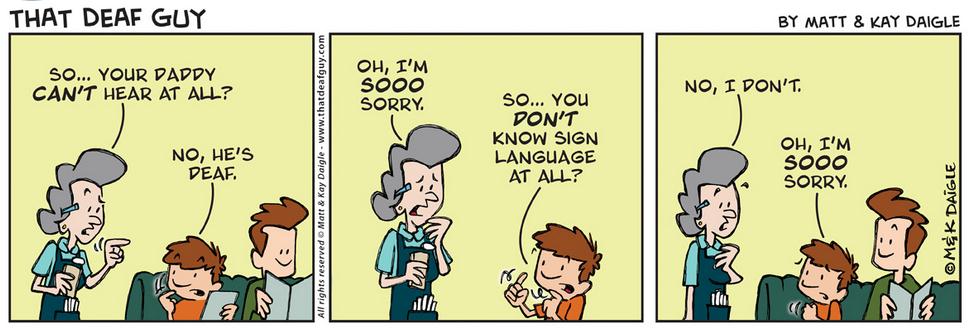
But in voicing this, it is crucial for me—and everyone listening to me—to recognize that my becoming deaf would be a profoundly different experience from that of my friend who has been Deaf since he can remember. Many Deaf people with cochlear implants have told of how overwhelmingly unpleasant hearing sound for the first time can be: One man has “discovered that, far from being adorable, the voices of his grandchildren were rather shrill and often best experienced with the implant turned off.” That Deaf Guy comic strip tells of the authors’ son pitying people who don’t know how to sign.

Similarly, those who have always needed a wheelchair to get around tend to see it as no worse than needing shoes to get around. Yes, it’s inconvenient in a world where ramps are all too rare, just as it would be inconvenient for those of us who are ambulatory if most public facilities didn’t accommodate the shoes on our feet. But that difficulty is imposed by a society that fails to accommodate certain minorities, not by the disability itself. Congenitally disabled bodies do not notice what they lack. As so many have said before me, How can you miss something you never had to begin with?

Researching all of this has brought me to the following conclusion: As individual humans, it is harder for us to deal with becoming disabled than with being born disabled. But as a society, the reverse is true – it is harder for us to accept someone who is born disabled than someone who has become disabled.

As a result, those who were born disabled and those who have become disabled often find themselves on opposite ends of the argument. A woman like Stella Young, who has never been able to walk, is rightly insulted when people tell her she is brave and inspiring just for getting up every morning. (Her TED Talk below is worth every minute.) But a woman like Christine Miserandino, who is slowly losing the ability to walk, is rightly seeking others’ encouragement and support as she struggles to do something she once took for granted. (Her oh-so-quotable Spoon Theory has already been linked on this blog before.)


Because the majority of disabled people are like Miserandino, not Young, the discourse on disability is dominated by sympathy, fear and lamentation. It is hard for us to remember that we shouldn’t pity a woman with cerebral palsy for her spasticity when so many people with multiple sclerosis openly mourn their loss of agility. Those who become injured or ill are entitled to their grief and no one should ever attempt to silence them. But everyone should think beyond their own experience before they publicly decry their condition as unbearable. Especially when it ends up joining the chorus of ableism led by non-disabled people.

One of the most read articles at The Atlantic this month is a piece by bioethicist Ezekiel Emanuel who explains why he hopes to die before age 76:

[Living too long] renders many of us, if not disabled, then faltering and declining, a state that may not be worse than death but is nonetheless deprived. It robs us of our creativity and ability to contribute to work, society, the world. It transforms how people experience us, relate to us, and, most important, remember us. We are no longer remembered as vibrant and engaged but as feeble, ineffectual, even pathetic.

Emanuel is an amateur mountain-climber and a professional writer. He is entitled to feel upset at the idea of losing the abilities he currently holds most dear. And his other arguments about the drawbacks to longevity are as thought-provoking as physicians’ personal opinions on life-saving interventions. But his decision to openly denounce dependence and weakness as unproductive and undignified increases the lifespan of our culture’s ableism. How can we ever stop marginalizing disabled people if we continue to openly voice our fear of becoming like them?

The experiences of those who are born disabled and the experiences of those who become disabled are profoundly different and equally valid. Simply remembering that would change a lot.



Everyone’s Sexuality. Everyone’s.

7 Sep

mjaxmi1inge5ntm3ymu4ngnkytg5


Don’t read the comments. Don’t read the comments. Don’t read the comments. 

That’s what raced through my mind as I read “The Challenges of Having Sex As A Little Person” at The Atlantic. Of course I read the comments anyway. 

And I was only slightly startled to find nothing but solipsistic snickering and overdone puns. The Atlantic doesn’t win any points for ending the article on a pun, either. But praise is due for addressing the topic at all. Based on an extensive interview with Dr. Marylou Naccarato, who has Kniest dysplasia, the article takes a wonderfully sex-positive approach to the experiences of people with dwarfism and the physical obstacles they can face in bed.

As per nearly every feature on dwarfism in the mainstream media, there are some factual errors. For example, one dwarf couple is quoted claiming that people with achondroplasia require “no medication, surgeries, special needs, nothing.” (See here for a list of the many complications we are at risk for.) But Naccarato is doing great work that is revolutionary in light of the fact that Little People of America, and probably most disability advocate organizations, repeatedly shy away from the topic of sexuality.

A simple reason for their silence is that almost all disability organizations comprise just as many parents and relatives of disabled people as disabled people themselves. And who wants to debate the best way to masturbate with Mom or Dad sitting next you? A more sinister reason for the silence is one of the building blocks of modern prejudice against disabled people: that is, the presumption that they are innocent, and therefore asexual. Most positive portrayals of disabled people are cute and cuddly. Is it the only way society can accept us? Refusing to see a minority as anything but asexual is to deny them their full humanity, on par with slut-shaming, prude-shaming, queer bullying, and objectification.

Before I go any further, let me say this: I do not want to talk publicly about what I do in the bedroom and I do not want to know what you do in the bedroom. My firm belief in sex-positive feminism and equality does not mean I think that you are sexy or exciting or impressive. Unless we’re close confidantes or I’ve indicated otherwise, please assume I don’t want any mental images of you and your naughty bits, no matter what they look like.

That said, I fully support anyone’s right to desire any sort of consensual sex imaginable. Without double-standards. Without the pressure of competition. Without the nuisance of others turning their personal preferences into rigid rules.

Take, for example, the way virginity is so frequently turned into not just a game but a high-stakes tournament. When and how did you lose it is an idea all of us are expected to base much of our identity on, even as adults. This is despite the fact that, according to medicine, virginity doesn’t exist. After all, what kind of sex does a guy have to engage in to officially “lose” it? And what about girls born without hymens? When exactly do lesbians lose their virginity?

Like race, virginity is a social construct and, in the words of a very wise person on Tumblr, what can be socially constructed can be socially changed. Last year the great Tracy Clark-Flory interviewed acquaintances about the sexual experience they considered to be their “first time.” The glorious thing about her inclusive project was that it revealed human sexuality to be just as diverse as everything else about us. Some defined their first time by their first orgasm, others by a particular first touch or experience of being touched. The problem with her stretching the definition of “losing your virginity” so broadly is that it robs competitive, insecure people of their ability to set standards with which they can gloat and put others down. Wait, no. That’s another glorious thing about it. There really is no problem with recognizing everyone’s experience as equally valid.

Failing to include everyone not only causes unnecessary humiliation, but it causes us to miss out on opportunities for true enlightenment. To quote the authors of You Can Tell Just By Looking: “Sexual minorities—people whose sexual desires, identities, and practices differ from the norm—do a better job talking about sex, precisely because they are constantly asked to explain and justify their love and their lust to a wider culture and, even, to themselves.”  The more you examine harmful traditions, the less necessary they become.

This does not mean that minorities have better sex. Indeed, too many activists in the sexual revolution end up repulsing readers and listeners when they allow pride in their sexuality to devolve into arrogance, insisting their sex life is better than yours, rather than merely different. For a year, the BDSM club at my alma mater ran the slogan: “I do what you’re scared to fantasize about.” Not helpful. And kinda pathetic the more you think about it.

I will never judge someone for liking any particular kind of consensual sex, but I will judge anyone who tries to turn sex into a competition to calm their own self-doubts. Whether you’re a wise-cracking online commenter or a sex-positive pioneer, true sexual liberation is about moving beyond the middle school clique mentality, not indulging in it. It’s pretty much the least attractive thing there is.

Would You Give Up A Disabled Baby, And If So, Why?

10 Aug

Youri(Image by Naoya Fujii used under CC 2.0 via)


Tonight 60 Minutes will feature the very first interview with the Australian couple that has attracted international scorn ever since the Thai woman they hired to be their surrogate mother publicly accused them of adopting one of the twins she gave birth to while refusing Baby Gammy, the one with Down Syndrome. Hiring a surrogate mother who lives abroad is both legal and unregulated in Australia, with none of the criminal background checks or counseling that are required for domestic surrogacy arrangements.

The Digital Age has seen the rise of prospective parents independently seeking out surrogate mothers online without any oversight, as well as a rise in “re-homing,” wherein adoptive parents join Facebook or Yahoo groups to seek out new parents for a child they’ve decided is harder to handle than they had thought. A disturbing Reuters report last fall profiled a couple who handed over a girl with medical problems they had adopted from Liberia to a new family they had found online, only to later discover that the new parents were known sex offenders.

Yet while black market adoption may be on the rise thanks to the Internet, the history of people rejecting only certain kinds of children is depressingly long. Only 2% of all babies born are disabled, yet half of the children up for adoption in the United States are disabled. Half of them are also black. Chad Goller-Sojourner told NPR this year that prior to his adoption by a white family, he was passed over by more than one black couple for being “too dark.”

I am deeply grateful that my parents did not put me up for adoption, like so many parents of dwarfs before them. Being rejected by your own parents simply for your body feels like a rejection of your very life. But I will not start chanting that parents should never ever make adoption plans for their children until we admit that not everyone is capable of being the sort of parent certain children need. The skills required for accepting your child’s skin color or body shape are not the same skills required for accepting a lifetime of waiver agreements about the deadly risks of invasive surgery. In the real world, some marriages do break down and some parents do become abusive and some parents do murder their half-grown children when they try and fail to cope with their child’s disability. I know a good number of people who are great at working independently but terrible at caregiving. In Far From the Tree, Andrew Solomon profiles a British woman who eventually relinquished custody of her severely disabled daughter to a foster mother, telling the NHS, “I’m not the right mother for this child.” Such honest humility requires some degree of bravery and, as Solomon points out, honors the skills of the foster mother and all parents who keep their commitments to disabled children.

Do some parents give up too easily? Absolutely. But are some children better off far away from their parents? Evidently. Because no two parents are alike, what is best for the child is best decided on a case-by-case basis. The Australian case sounds dreadful, but I’m withholding judgment until the parents have had their say. And as long as there is reproduction, there will always be parents who put their children up for adoption or terminate pregnancies, and society must thus ensure that the means for doing so are absolutely safe and heavily regulated.

But we cannot deny that too many parents end up failing to support certain kinds of children because the society they live in fails to support such kinds of people. Parents can usually see through the B.S. of those who urge them to stand by their kids no matter what and who also regularly make disparaging remarks about scars, fat, or dark skin, and openly wince at the idea of looking like a freak, a wimp, or a pussy. We won’t ever lower the disturbing number of prospective parents who would reject a child with an extra finger or toe until we as a society confront what would cause a parent to think that having an extra finger or toe is too horrific to endure.

During a discussion in college about the individual’s right to make their own medical decisions, I was shocked to hear a bunch of my friends insist that they would rather die than lose the ability to walk. Is it possible to attach such extreme shame to a hypothetical situation for yourself without attaching shame to the situation of others who live that way every day?

When I told one of my fiftysomething mentors about how upset I was by the incident, she smiled and said, “Well, that’s something young people are certainly more likely to say than anyone else.”

A fortysomething friend piped up, “Yeah, that is a very young person thing to say. I swore when I was young that I’d shoot myself if I ever went bald and yet here we are!”

Indeed, while the strains of physical pain and special accommodations and repeated doctor’s appointments are very real, perfection is not. And no matter how far technology advances, the belief that we can guarantee ourselves “normal” children is delusional. After all, unlike Baby Gammy and I, 85% of all disabled people were not born disabled. That’s something to bear in mind when heading to the obstetrician’s or the adoption agency.  


CPS: The Sticky Business of Not Minding Your Own Business

20 Jul

(Via)


A South Carolina woman was arrested earlier this month for allegedly letting her 9 year-old daughter play alone in the park while she went to work at McDonald’s. The mother had given her daughter a cell phone for safety’s sake, but a concerned stranger’s call to Child Protective Services led to the mother’s incarceration and loss of custody. Bloggers on both sides of the political spectrum are outraged over what they are calling a case of helicopter parenting gone mad. On Twitter, stories of “When I was a kid…” abound.

I wholeheartedly share their shock and dismay. (Seriously, couldn’t CPS have merely talked to the mother and helped her find a friend or a caregiver whose home could be a base for the girl during mom’s eight-hour shift?) But I am concerned about the mounting vitriol aimed at those whose job it is to protect the child. I grew up among social workers. And these bloggers, while rightfully critical, are failing to acknowledge that the mind-your-own-damn-business mentality they advocate is exactly what prevails in societies where everyone looks the other way when a child is neglected or abused.

Of course there are terrible social workers out there, just as there are those to be found in any profession who should really be working elsewhere. More importantly, it is dangerous to pretend that institutionalized xenophobia does not exist. A 2012 report revealed ableism appears to be a tremendous problem at CPS, with many disabled parents living in fear of being declared incompetent by social workers with a poor understanding of their abilities. In the South Carolina case, it seems reasonable to postulate that two of the American South’s most infamous cultural institutions—classism and authoritarianism—are what led to a cruel and unusual punishment doled out for what was, at best, a misdemeanor by a working mother.

But while attention to this case is warranted, news outlets tell real-life tales of wrongly accused parents to such an extent that one would assume most actions by CPS are unjustified. The media bias tends toward parents because parents are legally allowed to talk publicly about their children. Were a social worker to attempt to tell his side of story, he would be breaking the law. And children and families grateful to CPS for repairing broken homes rarely head to their local news station to rehash their past personal struggles.

We must acknowledge and condemn every instance of misconduct by social workers, just as we must acknowledge and condemn every case of medical malpractice, and of police brutality. But unlike doctors or police officers, social workers do not enjoy a wealth of Hollywood blockbusters and TV shows glamorizing what they do. Most portrayals in film and on television are fiercely unflattering: from the soulless bureaucrat too obsessed with rules to know love when she sees it, to the more sinister instrument of a government conspiracy to threaten political dissidents by taking away what they hold most dear. These stereotypes invariably evoke sympathy for the devastated parents and children, who wish those heartless busy-bodies would just learn to stay out of other people’s business. Rarely are social workers featured fighting the good fight.

And yet, that’s what they are there to do. Not to get a thrill from ripping crying kids away from their distraught parents, but to listen to every member of the family until they understand the source and extent of the problem. While pop culture promotes individual therapy as a path to wellness on par with yoga or meditation, the idea of family therapy tends to be seen as an outrageous invasion of privacy imposed by some glaring ice queen who is just waiting for the parents to slip up. Yet adept social workers know that the parents of neglected children sometimes have significant learning disabilities or were the victims of abuse themselves. When funding allows, parenting courses are available for those who have a hard time remembering how often diapers need to be changed, or that there are often alternatives to screaming and spanking. Adept social workers also know that neglected children are often overly forgiving of an abusive loved one, just as victims of domestic violence often are. And adept social workers know that children are far more likely to be abused, molested, or kidnapped by a member of their family than by a stranger. As with women, the most dangerous place for a child is their own home.

When I was an 11 year-old on Long Island, there was a report that a girl my age named Katie Beers had been kidnapped from a local arcade where I’d attended birthday parties. The perpetrator turned out to be a friend of the family, who kept her locked in his basement for 17 days. When he broke down and confessed to police, Beers was not returned to her mother, but placed in a foster home. I clearly remember the mother’s tearful face plastered across the headlines: “I just got her back and now they’re taking her away from me!” CPS investigators had discovered that, prior to the kidnapping, Beers’s mother had left her for years in the care of her godparents, where she was treated “like a slave” and repeatedly raped by her godfather. Beers writes today that she was ultimately relieved to be placed in foster care and that, had she not been taken out of her home, she never would have graduated high school, let alone college.

When it comes to the legal rights of the child versus the rights of the parent, the court of public opinion will always be fueled by vitriol. Family court, of course, should transcend this, putting reason and research first and foremost. CPS is undoubtedly rife with problems, many due to its miserable lack of funding. But we as a society will never put forth a sincere effort to endow social workers with enough funding to do their job well until we truly value what they do in the first place.


* Please note that while my sympathy for the social worker’s perspective is inspired by what I’ve learned from those I know, the views and conclusions expressed here are mine and mine alone.


Segregation Loses In German Court

25 May

Untitled(Image by Angela Schlafmütze used under CC 2.0 via)


People must learn to accept their disabled neighbors, a Rhineland court ruled this week in a case that—thankfully—has attracted controversy. A woman in the town of Kaltenengers, near Koblenz, filed suit against the construction of a home for severely disabled citizens near her apartment block. According to the Rhein-Zeitung, the woman and several other residents had expressed outrage at the supposed imposition upon their community, while their court arguments sparked outrage among the public. The plaintiff claimed that, “The vocalizations and noises made by the disabled will injure our own psychological well-being.” Talk about not-in-my-backyard.

All of us have sympathy for the NIMBY mindset to some extent. I’m fine with my neighbors playing music as long as it’s the right kind of music. (ZZ Top, yes. Opera, no. I can attest that nothing pierces through paper-thin walls at 2 am like a soprano aria.) When it’s the night before the most important exam in your academic career, you want everyone within a five-mile radius of you to shut up. When it’s the night after you’ve passed that exam with flying colors, you wish those prissy neighbors interrupting the celebrations to tell you to pipe down would let go and live a little. Such moments serve as reminders that Everybody matters is easier said than done.

There will always be debates about pristine parks, where the grass is there to be looked at, versus people’s parks, where the grass has been picnicked to the brink of death. (Berlin votes today on that very issue in deciding the fate of Tempelhof Park and, for many, the definition of Berlin itself.) But NIMBY descends into a segregationist mentality the moment we reject the idea of certain types of people outright. And in this court case, pitting disabled residents against their huffy neighbors, it makes you wonder who is really the most challenged in becoming a well-adjusted member of society.


Should You Be Allowed To Hide From Google?

18 May

Big Google brother ?(Image by Alain Bachellier used under CC 2.0 via)


The European Court of Justice ruled against Google this week in upholding an individual’s legal right to be forgotten. That is, while newspapers and most online sites will retain the right to publish information about me (and anyone else living in the European Union), I can now petition Google to remove its links to such sites so that they will no longer appear in search results for my name. The ruling has a good deal of support here in Europe, but Google, Wikipedia and newspapers across the Atlantic are crying censorship.

I personally don’t plan on making such a request any time soon, but I am disappointed that both the ruling and Google’s opposition to it fail to distinguish between public figures and private citizens. Under U.S. law, public figures are defined as those involved in public affairs (politicians, officials, etc.); those who actively seek public attention in order to influence the discourse of one or more issues (activists, pundits, outspoken celebrities or entrepreneurs); and those involved in issues of public interest whether or not they seek attention (criminals, all celebrities ever, spouses and relatives of politicians and celebrities). Public discourse benefits from search engines being able to produce a comprehensive collection of resources about public figures. Yes, this will always result in a plethora of worthless vitriol, but as unfortunate as this is, public figures must respect everyone’s right to hold and express free opinions about them, whether someone thinks that George W. Bush is a fascist or that Jeff Bezos is a fascist. But I believe private citizens deserve greater protection.

While we can all control what we publish about ourselves on the Internet, we cannot control what other people publish about us. Photos often require our permission, outright lies can be punished by slander laws, and children are also heavily protected from exposure by anyone other than their parents.  But private citizens usually have fewer resources for combating defamation and slander. And there are no laws against a friend of a friend outing you as gay on their blog or blabbing about your medical history on Tumblr. 

While it may be crucial for certain people – for example, weapons retailers or nursery school employers – to know if you have a history of mental illness, such information is otherwise considered strictly confidential by law. The Health Insurance Portability and Accountability Act (HIPAA) of 1996 imposed heavy punishments for any medical professional who breached doctor-patient confidentiality at the height of the AIDS crisis. But in the Age of Google, any tangential acquaintance of yours with a blog and a tendency toward loudmouthery can tell the world about any diseases you may have. Google is fighting for their right to include such gossip in the piecemeal biography that is their search results for your name, available to pretty much everyone on earth.

Particularly in the case of medical minorities, even those bloggers with the best intentions can be atrociously revealing.  Most of us know the embarrassment of our parents posting our baby pictures to Facebook, but in my research for issues of disability, I’ve come across countless parents posting public confessionals like:

My daughter was heart-broken to learn today that she’s the infertile one!  

My husband wanted me to put her up for adoption because he was just too ashamed.

I wonder if anyone could ever love him looking the way he does.

Any parent facing terrifying conditions or social adversity with their child deserves a place to vent their deepest fears. But there’s a difference between opening up in a counseling session and turning the Internet into your therapy couch. Discussing such fears in books and documentaries can contribute to the greater debate on disability, especially when it leads to examining what exactly instills such fears in parents. And too much parental openness is certainly preferable to the widespread shame of previous centuries that led so many to abandon their disabled children. But disabled children will grow up someday and may not want their parents interviews following them wherever they go. What young adult wants their friends or employers or potential lovers accessing statements like those above by merely entering their name into the search field of the world’s most popular website?

And while parents may readily take down such comments at upon request, what about acquaintances who gossip about you online? (Remember the Mark Zuckerberg character blogging about his ex’s bra size in The Social Network?) I’ve dealt with friends of friends trashing my medical experiences online by writing my own blog entries about the incident and the issues it raised, but I don’t believe everyone should be required to. Responding to a breach of privacy not by defending yourself but by simply removing yourself from the grid should be the right of any private citizen who’s ever been humiliated for personal information that truly affects no one but their closest friends and family. One of the very foundations of bigotry is the widespread belief that freaky people owe it to the world to answer any question we have about their lives.   

My favorite aspect of the Court ruling is the very thing Jimmy Wales bemoans: “A very strict reading of the law leads to this very bizarre conclusion that a newspaper can publish information and yet Google can’t link to it – it makes no sense at all,” said the Wikipedia founder. It makes sense in that, by untangling your company’s website from your high school’s website, the new ruling endows us with the ability to compartmentalize. This ability—to separate your work life from your social life, or your medical condition from your love life when you have no intention of becoming a public figure—seems like a right well worth protecting.

Sherri G. Morris writes of the time, back in the Internet 1.0, when she had met a great guy through her local chapter of Mensa. After a few dates, he googled her name and immediately discovered she belonged to a support group for people with intersex conditions. He and Morris eventually married, but there are undoubtedly many members of minority support groups who would prefer to restrict the fact of their membership to visitors of the group’s homepage. And, when it comes to private citizens, I’m not convinced such a restriction would qualify as censorship.

To compartmentalize, to reveal certain information about yourself at your own pace, is something which we all value in our lives, and which Google has been eroding with its every update. Until now.


Does Pride In Being Different Lead to Narcissism?

11 May

Being different(Image by Niccolò Caranti used under CC 2.0 via)


Long before there was Buzzfeed, there were online personality quizzes. (Back in the Analog Age, they featured in teen magazines like Sassy and YM.) Today they’re the rabbits of the Internet, every new one that pops up signifying ten more in gestation. “Which Mad Men Character Are You?” “Which Star Wars Character Are You?” “What City Are You?” Leading columnist Emma Roller to wisely observe, “No one cares.

Just for once, I’d love to see a quiz-taker being told: You’re Werda, Germany! Or You’re Selden, New York: You’ve got some nice areas and some sketchy areas, and a lot of perfectly fine but nondescript highways and sidestreets. A famous person passed through once, though that was ages ago. Some people like you, some people don’t. Most people haven’t heard of you except the couple thousand people who live there, plus the people who visit them or send them mail.

Or how about a quiz that announces, You’re one of the soldiers in Star Wars who gets killed in the first three minutes. Without you, and a bunch of other characters like you, there would be no shoot-out scene, and without the shoot-out scene, the audience wouldn’t know soon enough that they should fear the Empire. You are certainly useful—that’s why the actor who played you got paid after all—but no one will be looking for your name in the credits.

If such a result on a personality quiz sounds unthinkably cruel, then maybe we really do have a narcissism epidemic on our hands. Narcissism, after all, is the tendency to put your own needs ahead of others’ because, deep down inside, you believe you are more deserving of praise and sympathy. Because you’re different and special. (“Maybe there are a lot of Werdas and Seldens out there, but not me!”)

Every single one of us needs to feel special to someone, but the severity of this need can determine the difference between being self-confident and being self-involved. And when minorities embrace our exceptionality and take pride in being special, are we part of the problem?

It is easy to understand why minorities celebrate diversity with pride parades and slogans. Anyone who has been beaten up, harassed, or excluded for qualities they have no control over is understandably in need of a salve, whether that means spilling their hearts out in group therapy or singing along with the Columbus Gay Men’s Chorus, “I am beautiful, no matter what they say.” When I mentioned to my mother that I’d been asked at school at least ten times in one month, “Why is your head so big?” she replied, “Just tell them you have an extra package of brains, honey!”

It was a sweet, wonderful piece of advice. With one hitch. My ten year-old self took her explanation literally, thrilled by the news that dwarfs are neurologically advantaged! And even when I later found out that she meant it figuratively, I continued to believe for a period that I was truly smarter than any ignoramus who had questions about my body. Society does have many hang-ups about difference that fuel rude questions and comments, and this is indisputably problematic. But it is also problematic to counteract these hang-ups with the conviction that your difference makes you essentially better than everyday people.

It is no coincidence that the minority rights movements of the 1970s and 80s peaked right before the height of the self-esteem movement. With self-determination seen as the key to obliterating prejudice and fear of the Other, millions of children in my generation grew up chanting, “I’m special!”  I remember singing along with Piglet and Tigger:

If everybody were like everybody else,

How boring it would be.

The things that make me different,

Are the things that make me, Me!

Stand tall.

You’re in a class by yourself.

Be proud.

You’re not like anyone else.

No doubt about it.

You’re second to none,

’Cause you’re the one and only,

Genuine, original,

You’re the one and only one!

This approach was very well-intentioned, but half-baked.  Everyone is special insofar as everyone is unique. But we so often use “special” interchangeably with “extraordinary,” as in: not merely unique, but better than the rest. It is statistically impossible for everyone to be second to none. We can simultaneously be unique and ordinary, yet it’s a fact that is hard for us to wrap our heads around and even harder for our egos to accept. It is unsurprising that raising a generation of individuals to celebrate their exceptional qualities has unleashed millions of adults who are now struggling to deal with the countless moments in which they are reminded that they are not all that different from anyone else. And who wince at the thought of being called “average.”

This doesn’t have to yield narcissism, but it can. Narcissism causes people to repeatedly bring up their differences not in order to feel comfortable with them, but in order to prove their exceptionality. It causes them to talk more than they listen, to abandon relationships after the initial shine wears off, to justify hurting their partner or bailing out on their families. Narcissism causes non-famous people to pity themselves as underappreciated, undiscovered geniuses lost in a sea of lowly idiots, and it causes famous people to fanatically envy those who are more famous. Narcissism can cause someone to not merely believe in changing the law in the pursuit of justice but to see herself as being above the law. And while it may help her keep her head held high when someone criticizes her unfairly, narcissism leaves her bitter and spiteful when the criticism is on the mark. 

And where there is narcissism, there is the savior complex – the desire to help people not because you would want someone to do the same for you in the same situation, but because you recognize an opportunity to be seen as special. This attitude betrays a very bleak view of minorities and those in need – the self-appointed savior believes they should be grateful to him because he is exceptionally open-minded, unlike normal people, who would be repulsed by them.

This is why the minority rights movement is inherently opposed to narcissism. Narcissism upholds hierarchies and depletes empathy, and there can be no human rights without empathy.

In fact, being seen as ordinary is the ultimate goal of any minority rights movement. After counteracting fear and hatred with enough celebration of diversity to preserve everyone’s well-being, most minorities hope to one day garner about as much recognition as left-handed people. In the West today, no one tries to nervously change the subject or get ready for attacks when someone brings up their left-handedness, nor do they gush about how great it is to know someone so different! The idea of putting left-handed people on display in a theme park is unthinkable. Not only would that be spectacularly inhumane, but who on earth would go? Left-handedness is interesting, but it’s not that interesting.

Narcissism fosters an addiction to the idea of being recognized as interesting. Encouraging a wallflower ostracized for her looks to question mainstream beauty standards can help boost her self-satisfaction and all-around happiness.  Encouraging her to disregard anyone who doesn’t explicitly praise how she looks can trigger anti-social behavior. So how do we avoid this?

Superb articles at Slate and The New York Times have been exploring better methods for teaching children modesty and emotional intelligence, while recent novels like this and articles like this have been making self-proclaimed progressives examine our sometimes monstrously selfish habits. And how did I come to stop thinking that my dwarfism made me superior?

A few months after our discussion about my exceptionally sized skull, I was bragging to my mother about being the only kid at my elementary school with dwarfism. Although I don’t remember exactly what I was bragging about, I vividly remember my mother’s concerned look before she said, “I hope you don’t think you’re special.”

W-w-hat? Wait, I’m not special? Her words stuck with me like a stone in my shoe, as most good pieces of advice are wont to do.

My parents are the most supportive people any child could wish for. They also called me out whenever they sensed I was taking up too much space.   

My dad beamed upon hearing that I had passed all of my exams after having struggled to find time to study during a year of two surgeries and lots of physical therapy. But he laughed in my face the next summer when I tried to boast about working TWENTY hours a week.

At the end of one of my limb-lengthening procedures, when six metal rods were unscrewed from my thigh bone without local anesthesia, I screamed until I couldn’t hear myself anymore because the femur is the biggest bone in the body and the pain matched its size. The last coherent thing I remember shrieking was directed at my surgeon: “I HATE YOU!” My mom later told me he apologized to me with every turn of the screw, but I was too hysterical to notice. What I do remember is lying on the table with no one left in the room but my mother and her friend who had come along to help, my eyes stinging with the salt of the tears, hyperventilating and moaning until the friend interrupted me: “Emily, stop it! You’ve cried enough. It hurt, you were upset, but now IT’S OVER.”

That’s what friends are for. To be proud of your achievements, sympathetic to your pain, and to also tell you when you’re being ridiculous.


A Challenge for Supporters of “Traditional Marriage”

13 Apr

(Via)


I’m all for toning down the emotion in politics and avoiding vitriol. But sometimes a silly idea reprinted for the umpteenth time just gets to you.

In an attempt to bridge the gap between proponents of marriage equality and the opposition, columnists Will Saletan and Connor Friedsdorf have been arguing that the former shouldn’t dismiss the latter as bigoted. Not all same-sex marriage opponents are homophobic, they declare, and comparing them to interracial marriage opponents is a false equivalency because plenty of traditionalists think gay people are perfectly okay. “Opposition to gay marriage can be rooted in the insidious belief that gays are inferior,” Friedsdorf writes, “but it’s also commonly rooted in the much-less-problematic belief that marriage is a procreative institution, not one meant to join couples for love and companionship alone.”

Childfree couples will take umbrage at this, and who can blame them? If we decide that the word “marriage” should only be awarded to those ready and willing to make babies, how about raising the bar a bit higher while we’re at it? How about limiting it to couples who have known each other for at least five years, have both completed their education, and are financially independent enough to pay for their own wedding? How about requiring premarital cohabitation for a period of at least 18 months—the infatuation phase lasts 9 to 18 months, after all—and of course requiring engaged couples to have sex a bunch of times, in order to make sure they know what they’re getting into? And why not reserve marriage for those who have never been previously married, never had a brush with so much as a traffic cop, and have passed an emotional intelligence test? In any case, conservatives who dare to argue that only baby-minded couples qualify for the marriage moniker shouldn’t be one bit surprised when this unleashes a barrage of opinions about which sorts of couples truly “deserve” it.

But while we all privately hold firm opinions about the best recipe for a partnership, and we all tend to voice these opinions here and there in public, there is something particularly revolting about those earnest attempts to argue that the ideal family is founded in a man and a woman’s physical capacity to make children. Five justices already decided last year that this argument doesn’t hold up in court. But Saletan and Friedsdorf’s insistence that the argument is nevertheless “rational” and “much-less-problematic” than other forms of bigotry is solipsistic and insensitive to the point of seeming cruel.

My extended family includes foster children and adopted children. There are scores of wonderful reasons for couples to adopt: they can’t physically have kids, they don’t want to physically have kids, their medical situation is complicated, they don’t want to increase the global population, they desperately want to do something about the crisis of unwanted children in the world. They recognize the indisputable truth of which most are aware but not all of us like to acknowledge – that family is what you make of it.

Some adopted children, like the subjects of the 2011 documentary Somewhere Between, feel compelled to make contact with their birth parents or culture of origin, and that is their right. Others, like Scott Fujita and Philipp Rösler and Steve Jobs, have felt no connection whatsoever and are at best amused by others’ fixation with their origins, and that is their right. When facing the myriad complexity of what makes a person who she is, guaranteeing everyone the right to self-determination is by far the fairest solution.

Some people admirably bend over backwards to honor their family ties, no matter how hard it may be, while others wisely save themselves a lot of grief by avoiding toxic individuals who share their DNA. For outsiders to implicitly value that DNA over genuine love and unwavering devotion is a pretty brazen putdown. Those who voluntarily commit and honor their commitment to be someone’s family deserve so much more respect than all of the deadbeat and emotionally abusive parents I’ve had the misfortune of knowing.

Because Ive said it once and Ill say it again. Caregiving isn’t just about having a big heart and finding joy in knowing you helped someone. It’s about sacrifice. It’s about reading a book for the fourth time no matter how much you want to throw it out the window. Or rubbing someone’s feet to distract them from the pain no matter how little sleep you’re running on. Or missing out on parties and events no matter how badly you want to go. Or suppressing your gag reflex as the one you love spits up something absolutely gross. Or mustering the strength to decide whether you should endure the anger being vented at you because everyone needs to vent, or whether you should call your loved one out on their self-pity lest their anger become an abusive habit. Caregiving is about testing your patience until it inevitably wears thin and you make a mistake or lash out, ensuring you’ll be up the next several nights wondering whether you just scarred someone for life. Caregiving is work and, regardless of whether it is paid work, it is one of the most psychologically taxing kinds of work there is.

Yet blood is still thought to be thicker than sweat, as the stigma of non-biological families persists. This traditional obsession with genealogy on a grand scale has led to classism and racism and aristocratic inbreeding and the sterilization of disabled people. On a smaller scale, it’s led to parents and children pushed to the brink of tears as they endure, again and again, some loudmouth’s opinion about “real” families.

Which is why I propose a challenge for all those well-intentioned supporters of “traditional marriage.” I won’t ever call you a bigot—if anything because name-calling has a pretty low success rate when it comes to changing society for the better—but do me a favor. Walk up to a childless couple planning to adopt and tell them that you’d like to see their marriage invalidated. Say it to their face. Tell them that their marriage is “wrong” or “not right” or less than or whatever it is you’ve been lead to believe is “real” because they didn’t use their own genes to make their children. Then visit them again after they’ve adopted and tell their kids about your wish to replace their parents’ marriage with a separate-but-equal civil union. And then tell me with a straight face that what you’ve said to them about their family is “much-less-problematic” than what Jim Crowe said about our president’s family.

Speaking of the president, he may have said it best: “What makes you a man isn’t the ability to make a child, but having the courage to raise one.”


How to Help Your Doctor Get the Job Done

23 Mar

(Via)


If you’ve ever had to undergo strings of medical tests or lengthy procedures, you know that there are plenty of doctors, nurses and technicians out there who could do with a few lessons in etiquette and bedside manner. I could spend years on this blog documenting every moment I was snapped at, interrupted, or made to feel like a nuisance while I was fretting about test results or mounting pain. It would take me a decade to do justice to all the horror stories I’ve heard from friends and fellow patients.

But the poor manners of all those (probably overworked) professionals who made a tough situation worse render the kindness of others all the more dazzling. (I love you, Nurse Wilson!) And it’s crucial to bear in mind that the patient’s version of things is only one side of the story. Medical professionals rarely get to see people at their best – their job is to witness and inflict pain all day. They must remain objective while navigating a sea of misery and fear, where not everyone claiming to be severely sick really is.

In order for doctor and patient to have the best possible experience, both have to be aware of what the other requires. Which is why I’m handing over the mic to Dr. Leana Wen, who’s penned an excellent article called “The 10 Types of ER Patients” this week. Her pieces of sound advice include:

No. 3: The Googler. The Internet can be a powerful tool for empowering patients, but please use it responsibly. Looking up your symptoms yourself might turn up that you have a brain tumor when you have food poisoning or that you are pregnant when you have belly pain (and you’re a man). Use the Internet to help you understand your diagnosis and treatment and to come up with questions—not to diagnose yourself.

No. 4: The “Pain All Over” Patient. We call it the “positive review of systems” when you say yes to everything we ask. Headache? Chest pain? Shortness of breath? Fatigue? Muscle aches? Yes, yes, of course, yes. Some illnesses really affect many parts of the your body, but more often than not, patients will say yes to convince us they are ill. We know you aren’t well, so tell us the truth. (If you don’t, you run the risk of undergoing unnecessary testing.) If everything hurts, try to tell us your story. When did you last feel normal and well? What happened then? And please don’t exaggerate. If you say that your pain is 15 out of 10, but you’re eating lunch and texting on your iPhone, it’s hard for us to calibrate your symptoms.

Head over to Slate to read the whole thing.


Barbie vs. Lammily

9 Mar

Lammily is Barbie’s new contender(Image by Day Donaldson used under Creative Commons license via)

Barbie turns 55 today and her birthday risks being overshadowed by a rival. Designer Nickolay Lamm has kicked off a very successful crowdsourcing campaign to fund the production of Lammily, a doll whose body is modeled after the mean proportions (taken from the Centers for Disease Control) for an American 19 year-old because, as her slogan goes, “average is beautiful.” The center photo above shows Lammily at her earliest design stage in contrast to Barbie. The left and right photos show her updated, final form.

Despite that her name sounds like the way most toddlers mangle mine, Lammily does seem quite lovely. But mostly because the problems with her competitor are countless. Barbie represents—and was very much intended to represent—an idea born in the middle of the last century that little girls should play not just with baby dolls or girl dolls, but with a woman doll, a post-pubescent beauty they should aspire to. The very first Barbie was inspired by the German Lilli, a character featured in tabloid comics who worked as a secretary by day and an escort by night. While it’s disputed whether or not the Lilli doll was in fact a sex toy, the longer you look at Barbie, the more that explanation makes sense.

Barbie is all fantasy: too thin to menstruate, with breasts so big she’d have to crawl on all fours to get around. (Sporty Lammily could knock her to the floor with a light kick.)  Fantasies about beauty are fine as long as they remain a niche, not a standard. If her fame and influence were not so unparalleled, Barbie wouldn’t be a cause of much trouble. But she is the most famous doll in the world, and while she often changes jobs and outfits to bend to society’s trends, her body type never budges from the sex toy standard.

My mother swore I would never own a Barbie—how could it be healthy for a girl with dwarfism to idolize a lady who’s all legs?—but a neighbor bought me one for Christmas, and within the next 10 years I owned 12: Tropical Barbie, Superstar Barbie, Ice Capades Barbie, Gymnast Barbie, Fun-to-Dress Barbie, Loving You Barbie, Hollywood Hair Barbie, Cool Times Barbie, Dreamtime Barbie, Dream Glow Barbie, Dream Date Barbie, and my mother’s own, dragged-out-of-the-attic Barbie from the 1960s, whose earrings had turned her cheeks green. The funny thing is that every one of these Barbies had a slightly different face and slightly different blond hair with varying lengths and textures. But, just like the Disney Princesses, the bodies were all exactly the same. Barbie’s oh-so-80s Rocker friends Diva (brunette), DeeDee (black), and Dana (possibly Asian?) represented a broader range of hair and skin, but their bodies were all replicas of Barbie’s. This is what makes Lammily so radical.

But I don’t want an answer to Barbie. I want many answers to Barbie. Lammily correctly demonstrates that an average girl in the Western world is not blond. But blondes shouldn’t be any more excluded or celebrated than anyone else. Declaring “average” bodies and physical features a beauty standard continues to marginalize girls who deviate from the average. Another word for average is “normal” and it’s never fun for a young girl to hear that her body is “not normal.” Both Barbie and Disney have dared to dabble in the beauty of different ethnicities, but they haven’t been brave enough to try different body types – short, curvy, bony, disabled, with freckles or scars or glasses or birthmarks in the shape of Mexico.

In the words of artist Glenn Marla, there is no wrong way to have a body. If Mattel can invent over 50 varieties of blond hair for their preeminent princess, surely doll manufacturers can find a way to profit from providing a rainbow of body types. Maybe they will be brave enough by the next time International Women’s Day rolls around. That’s my fantasy, anyway.

Does It Matter If It’s Genetic?

16 Feb

Photo 02-07-14 12 29 21(Image by Eduardo Unda-Sanzana used under Creative Commons license via)


There is an argument gradually gaining momentum in the LGBT movement: “So what if being gay is a choice?” Rather than lecturing social conservatives that homosexuality is an inborn trait and not a chosen lifestyle, we should ask them what’s so bad about two consenting adults loving each other. With bisexual, pansexual, and genderfluid identities becoming more visible, and all sorts of people becoming more open to experimenting, who really cares if any of it is a choice?

It’s an important question in the broader debate about sex and gender. And it forces me to question the parameters of this blog.

Painting On Scars is founded on the rights of people who are viewed as minorities based on qualities they have no choice about: gender identity, sexuality, ethnicity, nationality, class background, physical traits, and mental abilities. This foundation is built on my own minority status being indisputably determined by factors beyond my control. There is no doubt whatsoever that I was, as Lady Gaga hollers, born this way.

And when it comes to confronting bigotry, there is something particularly painful about being belittled for something you have no choice about. All of us can feel insecure about the decisions we make, but being told that you’re seeking work in the wrong field or that you talk too loud on the phone is still far less harrowing than being told that your natural appearance is universally repulsive or that your gender makes you intellectually or emotionally inferior. Every one of us wants to be accepted for the way we were born because a rejection of it feels like a rejection of our very lives. As autism activist Jim Sinclair explains:

When parents say, “I wish my child did not have autism,” what they’re really saying is, “I wish the child I have did not exist and that I had a different, non-autistic child instead.” Read that again. This is what we hear when you mourn over our existence. This is what we hear when you pray for a cure. That your fondest wish for us is that someday we will cease to be, and strangers you can love will move in behind our faces.

For this reason, Painting On Scars examines the existence of minorities who are born this way and the myriad reasons why any of us still struggle to accept them. (More on the complexities of parenting disabled children here.)

However, the born-this-way rubric is not always helpful. What about the explicit decision to not conform? What about the human right to the pursuit of happiness? It seems only natural—for lack of a better word—to defend alternative traits and behaviors that are very much a choice but do no harm. Women who don’t wear makeup. Filmmakers who dare to feature minority accents. People who want to preserve their parents’ cultural traditions rather than assimilate for assimilations sake.  Men who don’t identify as transgender but still very much like wearing dresses. Objection to these choices usually stems from a rigid belief in homogeneity or simply a difference in taste. Such objections make it clear to me as a blogger that as long as a difference doesn’t cause real harm, it is worth protecting from harm.

And conversely, I tend to defer to others when it comes to minority traits that people have little choice about but that do cause a good deal of harm: personality disorders, psychosis, sexual attraction to children, paranoia, trauma, suicide, or anything that precipitates emotionally abusive tendencies. I research these issues voraciously, not only because I have personal experience with many of them, but because they raise questions about human rights and individual freedom, as well as the greater good and personal safety. (The pro-mia and pro-ana movements, for example, argue that any attempt to treat or cure people with eating disorders qualifies as oppression rooted in narrow-mindedness.) Yet I refrain from opining about these issues publicly because my knowledge of them is as simplistic as they are complex.

Whether to change society or change oneself is a persistent predicament that accompanies every stage of life. When exploring the answer as it applies to minority issues, I keep coming back to the same question: Who suffers more in the change?  Humans have repeatedly proven to cause less suffering when we accept body diversity, intellectual disabilities, LGBT identities, and gender equality than when we oppress them.

Of course, what constitutes oppression and what constitutes acceptance is sometimes disputable. Alex Andreou argues this week in The Guardian that the current search for the gene for homosexuality is quite harmful. While LGBT activists have traditionally opposed the idea of homosexuality as a choice to combat those who argue for a cure through therapy, LGBT critics of the genetic research fear that discovery of a gene for homosexuality will lead to its elimination. Those of us whose conditions are genetically determined and socially marginalized have been acutely aware of this problem not just since the advent of the Human Genome Project 30 years ago, but since eugenicists began sterilizing all sorts of peoples over 100 years ago. In democratic societies where governments no longer dare to be too vocal about medical decisions regarding minorities, everyone still fears the coming of the day when insurance companies inform expecting parents that they will not cover children who will cost more. Because the existence of minorities precludes the efficiency of a one-size-fits-all system, we will always cost more.

In the spring of 1994, I was headed into the operating room to have my Ilizarov fixators removed. While prepping for surgery, one of the members of the surgical team excitedly told my mother, “Have you heard the news about achondroplasia? They found the gene! We can test Emily for it!”

My mother signed a release allowing for them to perform the test during the operation. Several weeks later I received a letter confirming that my fibroblast growth receptor gene 3 had the achondroplasia mutation. My first reaction was, “No shit. Who cares?”

I had been officially diagnosed with achondroplasia on my third day after birth, though admittedly, such an early diagnosis back in the 1980s was a stroke of luck. A girl with achondroplasia who later became my best friend had been born at the same hospital six months earlier, so the doctors recognized our similarities and ordered x-rays on my limbs. My achondroplasia was obviously a result of nature, not nurture.

Then again, in olden days dwarfism was often thought to be caused by mothers with loose morals. I myself had once asked my mother if perhaps I got achondroplasia because of the decisions she had made about the birthing process. (I had just watched Look Who’s Talking and had learned a lot about the pop culture understanding of what goes into having a baby.) The gene for achondroplasia explained how I got it, how I could pass it on, and lay rest to any modern blame-it-on the-mother mindset that might suspect it was because of aspirin or salami or cinnamon. Such information can—but does not have to—affect your sense of self.

A few years ago a woman living in the U.S. contacted me because her two-year-old daughter had been diagnosed with achondroplasia. The girl’s grandparents lived in another country and had steadfastly dismissed the diagnosis. “Americans are famous for over-diagnosing every little thing,” they shrugged. “She’ll grow out of it!” (Pun intended?)

A friend from the same country explained to me that disabled people there generally have few support networks and even fewer opportunities for independence. Perhaps the grandparents’ refusal to believe in achondroplasia stemmed from their fierce desire to remain hopeful about her future.

Would running a genetic test finally convince them to accept reality? When I was born, my parents and I benefited greatly from the dwarf rights movement of the 1970s and 80s, which had emerged due to the egalitarian spirit of the times that indulged in civil rights and celebrating diversity. As with the gay rights movement, millions of supporters showed that they did not need to see the results of genetic testing in order to justify and defend a minority’s right to exist and be accepted. If they could do it, so can we.


Will Dove’s New “Selfie” Film Redefine Beauty?

26 Jan


In another installment of its positive body image campaign, Dove has released an 8-minute documentary called Selfie that premiered last week as the Sundance Film Festival.  For those of you who can’t watch it, the film can be summed up thusly:

***

Mothers with their teenage daughters talk about their insecurities about their own bodies.  One girl reveals that her mother’s urging her to wear cosmetics makes her uneasy. 

Cut to a high school gym, where a professional photographer addresses female students, telling them, “I’m here to talk to you about beauty.  You have the power to change and redefine what beauty is!  … The power is at our fingertips.  We can take selfies.”

Cut to her workshop about self-portraiture. “I’m going to ask you to take a risk that could change the way that people define beauty.  What if we find a way when you guys are taking your selfies to actually incorporate the things about us that we don’t like?” The girls list what they hate about themselves: braces, glasses, round faces, rosy cheeks. 

The photographer points out that mothers often pass on their own insecurities to their daughters, to which one girl vociferously agrees.  The girls then are given an assignment to teach their mothers how to take selfies, because “Your mom can redefine beauty just like you can.”

A touching montage of mothers and daughters learning to embrace their least favorite features plays, culminating in an exhibit of the selfies, where visitors leave Post-Its complimenting the girls on their looks.  The girls then smile at how good the compliments made them feel.  The mothers declare that social media is redefining beauty by putting the creativity in the girls’ hands.    

***

I absolutely love the way the film takes mothers to task, especially in light of this week’s report that parents are googling “Is my daughter ugly?” three times more often than they are posing the question about their sons.  We cannot teach our young women that they should not obsess over their looks if we don’t believe it ourselves.

I also like Dove’s idea of promoting the anti-duckface selfie, the least-favorite-traits selfie.  This film will do some good.  But does it truly redefine beauty for everyone?  Does it include everyone?

What about a girl with muscle spatisticity?  What about a girl with the physical markers of Down Syndrome?  What about a girl with scars, burns or chronic skin discoloration?  And, perhaps most importantly, what about that girl who is silently—obsessively—counting and comparing the compliments on her selfie to the compliments on others’ selfies?  Hierarchies survive through feelings of competitiveness.  What about the girl who ends up with the fewest or the least glowing compliments?  Does the project teach these girls how to deal with that, or does it leave them to their own devices?

This is not criticism for the sake of cynicism, but for the sake of empiricism.  The Love Your Body movement has been around for over 30 years, yet eating disorders are on the rise and our mainstream standards of “beauty” have not deviated from tradition at all.  (Go ahead and google “beauty” right now in an image search and see how diverse the results are.) 

As with so many Love Your Body projects, the girls in the video are not beautiful under the sociological definition of “super-normal” (strange and considered exotic), but they are far from the sociological definition of “abnormal” (strange and considered repulsive).  Everything they hate about their bodies—cheeks, glasses, eyebrows, braces—still falls smack in the middle of healthy human appearance.  It’s the equivalent of adults in the middle-middle class and lower-middle class discussing how “poor” they feel for not having made it into the top 1%.  Such insecurities are valid, but repeatedly restricting the discussion to those who only just barely challenge society’s definitions of “success” or “beauty” is safe to the point of almost seeming scared of rocking the boat too hard.

This is not to say that girls with more abnormal looks deserve more sympathy than those closer to average.  On the contrary, in my experience low self-esteem does not correlate to appearance.  I know many women who, being a few pounds overweight, are far less happy with themselves than other women with severe and rare deformities.  Perhaps parents are more dedicated to boosting self-esteem when their daughters more noticeably deviate from the norm. 

Or perhaps being excluded from the game from the get-go helps a girl to see how dumb the rules are to begin with.  Returning to the analogy of class, researchers have found that wealthier parents often have a harder time handling severely disabled children because they upset their need to be in control (“He breaks things!”), whereas parents living below the poverty line are more accepting of life’s unreliability (“Eh, there’s nothing in this house that wasn’t broken long ago!”)  Similarly, girls and the parents of girls whose looks could possibly near the standard of super-normal beauty may be more likely to spend time, money and anxiety trying to reach it than those who give up trying to wow the crowds and instead laugh at the delusional nature of it all.

Either way, I don’t think the Selfie project would be hurt one bit by a truly diverse sample of beauty.  (Let’s get some felfies in there, while we’re at it.)  Rather than monologuing about our own individual fears and demanding strangers allay them with compliments, we need a dialogue between the girl on the far end of the spectrum who’s been trashed for her looks and whoever it was who gave in to the temptation to trash her.  We need a dialogue between those who want to meet an elite standard of beauty and the type of people who support that standard.  We need a dialogue between the ugliest person you can imagine and your reasons for deciding they’re ugly.

That would redefine a lot.


If you enjoy this blog and want to support it, please like the Painting On Scars Facebook page.

The Best Book of 2013 (and the 21st Century)

30 Dec


“Though many of us take pride in how different we are from our parents, we are endlessly sad at how different our children are from us.”

So begins Andrew Solomon’s Far From the Tree: Parents, Children and the Search for Identity, a book that profiles families with children who are profoundly different from their parents – deaf, gay, autistic, short-statured, schizophrenic, transgender, intellectually disabled (Down Syndrome), multiply disabled, born out of rape, prodigious, and criminal. With every story, Solomon ends up returning to the same question: What is family? And in asking this, he demands, again and again, What is love?

He conjectures that true love is 30% knowledge of who someone is, 30% percent acceptance of who they are, and 30% projection of who they are. Projection is as indispensable as the other elements, but it is by far the most problematic. Love is threatened when it relies more on projection than anything else. When driven by a fear of being alone, projection can dangerously blind us to others’ faults: “You like the same bands I do?! You must be so deep!” When driven by a fear of being burdened, it can dangerously fuel our least empathic feelings: “I can’t handle taking care of a freak!” It would seem that our best hope for filling our lives with true love is to be better informed. If so, Solomon’s book is an ideal source of information.

He writes poignantly of his own mother’s difficulty accepting his homosexuality. In the West today, we are just as quick to judge parents who seem to hurt their children as we are to judge children who seem to hurt their parents. But in examining his mother, Solomon wisely observes that “she did, like most parents, genuinely believe that her way of being happy was the best way of being happy.” Who among us does not tend toward such self-righteousness?

I’ve never met anyone who doesn’t pride themselves on something they believe they do better than their parents did, an improvement they would like to pass on. Even my friends who take little interest in children tend to talk about their hypothetical progeny as projects: e.g. “My kids will never/always… ” And with projects come projection. The children in Solomon’s book, himself included, are dynamite to that projection.

While he is determined to understand his mother’s feelings that caused him so much pain, he is unwavering in his assertion that homophobia, ableism and all other irrational fears have no place in the future of a healthy society. He calls the forces that inspire current legislation limiting the rights of minorities a “crisis in empathy.” And he practices what he preaches – his determination to empathize with the United States’ most marginalized families is utterly humbling. He does it not only for the sake of compassion, but for the sake of practicality. We’ve already tried condemning and isolating the kinds of people who make us uneasy. On a grand scale, it hasn’t gotten us anywhere.

When I described the book to friends – many themselves minorities – several winced at the idea of rape victims and schizophrenic people. “Sounds like a fun book!” they sighed. Such reactions are hardly unknown to Solomon, who notes, “One’s own identity, replete with problems though it may be, usually looks more tenable than someone else’s identity.” Indeed, my own gut reaction is to glare at anyone who dares to compare the experience of having a child with dwarfism to the experience of having a child who grows up to murder students at Columbine High School. But gut reactions tend to be more hurtful than helpful. “At the mention of dwarfs,” Solomon writes, “[some of my] friends burst into laughter.” Fear always conquers by dividing us, and for this reason I adore  Solomon’s ferocious intersectionality. It is rare but contagious.

He profiles several different families in each chapter, which is admirable because it is comprehensive. However, at times it can feel like overkill. I might have preferred three families per chapter rather than seven or eight. The medium isn’t conducive to such a large cast because it’s difficult to keep the characters from blending together if you can’t physically see their faces or hear their voices. I thus found his videos series a source of clarification, not mere supplement.

But Solomon is an exquisite writer. Plenty of ink has already been spilled on the disabilities and social issues he examines, but it’s too often bogged down in language that comes off as dry or downright dreary. It’s not easy to push through 770 pages of the most marginalized lives imaginable, but Solomon’s writing is as poetic as it is sensitive. He is never too meek make assertions and yet, unlike countless journalists, he manages to do so without ever ignoring the agency of those he describes. True empathy never condescends because it transcends fear.

I am, of course, a biased critic. It was 32 years ago this month that my parents got the news that I had dwarfism. And they did everything right – the best any two human beings could when faced with a rare diagnosis that traditionally brought on social isolation. (As Solomon documents, mothers of dwarfs in olden days were often thought to have caused the condition by being lecherous.)

What my parents did perhaps best of all is something all the great parents of the world do – to make me feel so unconditionally loved that I always felt free to discuss with them what might have been done better. Sometimes my critiques are correct and sometimes they’re flat-out wrong. But the freedom to examine what you need to change about yourself in order to be a tolerable person and what you have the right to protect about yourself in order to be a happy person should be a freedom granted to every member of every family. On both sides of the parent/child relationship, or any relationship, “love is made more acute when it requires exertion.”

In a just world, no one should have to be any more grateful to their parents for accepting them than anyone else should have to be. As I’ve written before, caregiving is freakin’ hard, and our gratitude to those who raised us deepens when we consider that, as a whole, they have been more accommodating and respectful of their children than any of their historical predecessors. Solomon points out, “A hundred years ago, children were effectively property, and you could do almost anything to them short of killing them.”  But despite how far we have come since then, we have yet to reach an acceptable rate of justice for all. 

Solomon points out that 1 in 4 participants in a recent survey said they would choose abortion if their pregnancy tested positive for dwarfism.  At least half the children up for adoption in the United States have disabilities of some kind.  Crisis in empathy indeed.

Individuals who cannot parent a child profoundly different from themselves should not be forced to. Likewise, society’s hang-ups about difference should not encourage parents to flee from it.  Considering the current statistics, Solomon’s book is as necessary as it is beautiful.


Is Dwarfism A Disability?

27 Oct

(Image by Ron Riccio used under Creative Commons license via)


A more sober ending to Dwarfism Awareness Month

I remember being around 10 years-old when I began taking care to never refer to my dwarfism as an “illness” or a “disease.” An illness is something that tries to destroy you. It demands you go into battle. Even if you end up grateful for its having made you stronger, you’re glad when it’s gone. My dwarfism has always been around and I’ve never tried to conquer it. It’s a condition, a word as neutral as it is fitting. But is it a disability?

Many in the dwarf community insist that it is not. The thinking goes that being extraordinarily short is no more serious than being left-handed. We don’t think of left-handedness as a disability. It’s merely a difference, one of many physical features that can shape someone’s identity, like hazel eyes or an outie belly button. Being left-handed is only an inconvenience insofar as the world is built for those who are right-handed, and populated by some who still cultivate fear and hatred of those who don’t conform to the majority. Needing left-handed scissors and mouse buttons is not really thought to be an issue of disabled access – it’s more akin to needing glasses or extra-moisturizing shampoo. Diversity awareness over the last 50 years has led the vast majority of Westerners to shrug at the idea of left-handedness.

And such a neutral shrug is what dwarf activists seem to be coveting when they insist that dwarfism is not a disability. In the words of Andrew Solomon, “Neutrality, which appears to lie halfway between shame and rejoicing, is in fact the endgame, reached only when activism becomes unnecessary.” But is dwarfism only an inconvenience insofar as the world is built for those who are taller? It’s a compelling thought experiment, but it ignores all the medical complications I’ve had to deal with. And it raises the question: What is dwarfism?

The official definition, which lumps hundreds of skeletal dysplasias and growth hormone deficiencies into one category, is in fact only concerned with height. Little People of America defines a dwarf as anyone who stands fully grown below 4’10” (1.47 m). But height is relative. Women in Indonesia and Guatemala are 4’10” on average, which means that the LPA definition is based on a certain culture, and cultures are always changing as we move through time and around the world. As a pre-teen, I always got a kick out of seeing my towering parents become the minority at LPA meetings, while as an adult, I got a kick out of seeing my German-Swedish partner tower over my parents.

Physically, Warwick Davis and Peter Dinklage have no more in common than a black-haired Korean does with a black-haired Irishman. But they share many experiences rooted in society’s reaction to their short stature. They were both cast as dwarfs in the second Chronicles of Narnia film because the fantasy tradition cares first and foremost about looks, making up its convoluted ideas about heritage and separate races as it goes along. Most forms of dwarfism are caused by genetic mutations, but others result from chromosomal abnormalities, malnutrition, or even child abuse. Thus, because it encompasses all sorts of conditions with a tremendous variety of causes and complications, dwarfism is a social construct. Can a social construct be a disability? What is a disability?

This blog recognizes disability as a medical condition that causes you to experience more pain and/or limitations than the average person in your peer group, and therein attracts inordinate attention from society. And the attention has traditionally been negative. Disabled people carry a burden most other minorities do not in that we must argue that our lives and identities are no less valuable than anyone else’s, while at the same time admitting that we will always experience a good deal of pain no matter how accepting or accommodating society is. (Poor people are the only other minority that shares this burden.) This idea of inherent pain is what causes many activists in the autistic community and the transgender community to buck the disabled classification.

But when pain is indisputably inherent to a condition, it is frequently relativized in the hopes that this will reduce ableist attitudes. When I was born, the doctor pointed out to my parents that “everyone has something different about their bodies. One person has bad knees, another has a chronic skin rash. Emily’s difference is just a lot more noticeable than other people’s.” But does this mean that bad knees and skin rashes and seasonal allergies are all disabilities? There’s more to it than that.

If a medical condition is only minimally limiting and can be treated with standard procedures, we don’t really consider it a disability and rightfully so. While there is value in relativizing everyone’s struggles in order to calm our fears of the Other, it carries the risk of our failing to recognize differences that have much to teach us. The regular migraines I inherited from my mother don’t make me disabled. The pain can be intense and it’s infuriatingly inconvenient to feel one coming on at a dinner party while also feeling the hollow echo of an empty pill box in my bag. But the migraines are treatable—and not exorbitantly expensive to treat—and easily understood by others because plenty of people get them. Having to explain to people what my back and joints can and cannot endure is a more complex task.  Alleviating or avoiding the pain is even harder.

I interviewed friends and acquaintances with achondroplasia about the physical difficulties they regularly face. Some described always needing to lie down for at least half an hour whenever they vacuum for 10 minutes or more, and needing to get up earlier than everyone else on weekdays in order to afford themselves more time for walking to work or class. Everyone has trouble finding comfortable shoes that fit—women’s business shoes and sandals pose the biggest challenge—and many need to wear orthotics. Camilla, a college student who has not undergone limb-lengthening, told me:

I definitely believe I feel fatigue more easily than people my age. I went out dancing with friends last night and I had to stop and just stand for a while because my legs were starting to hurt. Also, when I walk places with my average height friends, my joints start to hurt while they feel almost no effects of fatigue at all… I would say that the hardest physical aspect of having dwarfism would not be the height difference but the extreme muscle and joint pain that seems to be more and more easily triggered as I get older.

And by “older” she means approaching her mid-twenties. These physical limitations would sound less surprising coming from senior citizens, which is why, as an advisor explained to me, your eligibility for disability status decreases as you age and aching joints become more common to your peer group.

A friend who had limb-lengthening at the same time I did told me, “I know if I’ve been on my feet all day, my ankles get really stiff and I’m limping around at home at the end of the night… as compared to my friends who work all day and still manage to hit yoga class, the gym, or cycling class afterwards.” Those of us who have undergone limb-lengthening can test whether achondroplasia is a disability because we control for the socially-constructed advantages of height. Yet in my interviews, I noticed that many who have had limb-lengthening are often reticent to talk about their current physical hardships lest someone conclude that all that time spent breaking and healing and growing bones was for naught.

Indeed, pride complicates our perceptions of pain. While hypochondriacs rejoice when they qualify as “disabled,” those who have regularly been reminded by peers and institutions of the supposedly pitiful nature of their condition are often less willing to revel in it. Those who reject the idea of calling dwarfism a disability are often motivated by the desire to de-stigmatize dwarfism. I of course understand this desire, but I don’t see how we can make the argument without stigmatizing disability. And I am suspicious of any mindset that supports a hierarchy by essentially saying, “At least I’m not like them.”

Like people of color, people with dwarfism are united only by society’s reaction to them, not by any medical traits. This is why I do not believe dwarfism itself is a disability. However, most types of dwarfism are. The way in which the physical pain brought on by achondroplasia intersects with social limitations is explained very well by Spoon Theory, an idea invented by Christine Miserandino, who has lupus. It bears repeating that I can only begin to imagine what living with lupus is like.  In the presence of someone needing to vent about the pain, I hope to be as wonderfully deferential as so many non-disabled friends have been to me. But the fact that lupus is an illness while achondroplasia is a not is no reason to ignore the fact that Spoon Theory perfectly illustrates the broader concept of chronic pain and fatigue experienced by people with all kinds of disabilities. Emily Brand described it eloquently in The Guardian last year:

The basic idea is that you have a limited number of spoons available for the day and each action will cost a given number of them – the more demanding the task, the more spoons would be required. The phrase “running low on spoons” can be a useful way of communicating the need for rest to fellow “spoonies” who also use this system and to friends and family who are in the know. Reading up on this is one of the best things anyone could do to help with providing day-to-day support to someone with a chronic health condition, as it’s a powerful analogy that can help people to empathise with how much of an impact even an invisible symptom like chronic pain can make.

I love the idea of “running low on spoons.” I used it just last week in explaining to a friend that I couldn’t peer with her into a store window because my swollen feet were begging me to keep off the cobblestones. But at the risk of sounding, well, confused, I’m not entirely comfortable calling myself a “spoonie” because experiences in college have left me averse to glamorizing conditions with labels that sound like club memberships. And between dwarf and has dwarfism and midget and little person and LP and short-statured and disabled and physically challenged and differently-abled, I’ve got enough labels to sort through.


They Don’t Care That We’re Angry

29 Sep

Capslock is NOT persuasiveHere’s a shocker: North Americans don’t like activists, especially feminists and environmentalists. Results from a study featured in The Pacific Standard show that these groups are associated with an abrasive, in-your-face approach to politics, and this repels more people than it attracts. Reporter Tom Jacobs urges these groups to change their tactics if they want to get anything done, while Alexandra Brodsky at Feministing has taken umbrage at any call for women to “hush up.” Jacobs has my attention. As someone who’s constantly clogging her Facebook friends’ Newsfeeds with social justice editorials, I’m happy to hear from anyone who can tell me how to entice more people to join the discussion.

Activism is recognizing injustice and inequality when you see it, and taking the time to ask, “Why?” It doesn’t have to be angry. But several of my friends echo the results of the study, saying they’re turned off by the way so many activists—feminists in particular—walk around like ticking time bombs, ready to explode at anyone who dares disagree with a woman ever. One of these friends cited a feminist who once told her, “The problem is people don’t like my writing because I’m just too controversial for them.”

I can see how that kind of self-righteousness would fail to impress, and I can also see where it comes from. Emotions run high whenever we try to talk about injustice and inequality because these are issues that threaten personal safety and pride. Debaters on both ends of the political spectrum all too often tend toward the obstreperous, topping off their arguments with the age-old threat: “You don’t want to make me angry.”

To which I must say, You’re right. I don’t. Because you can be rather boring when you’re angry. Speaking up requires some degree of bravery, but simply getting angry requires no talent whatsoever. A toddler can get angry. (Calling someone a Nazi requires even less skill.) Hollering until your opponent cowers may feel like you won the debate, but it usually means you’ve humiliated them, which will cause them and their supporters to hate you and your beliefs more than they did prior to the encounter. If you’re concerned with no one’s opinion but your own, then your activism isn’t about seeking justice. It’s about seeking attention. And anyone can play that game.

That said, it is unfair of anti-feminists to use a few belligerent narcissists as an excuse for dismissing an entire movement, for denying inequality and injustice exist, for refusing to listen to anyone who speaks up about it. In reaction to this year’s spate of female celebrities claiming “I’m not a feminist, but—”, the great Mary Elizabeth Williams wrote:

Ladies, it is OK to say that you’re a feminist, full stop. You don’t have to twirl your hair and stamp your toe delicately into the ground and sweet-talk that maybe you guess it’s OK that men and women be treated equally…

You can call yourself or not call yourself whatever you want, but consider this. Nobody enjoys it more when a woman says she’s not a feminist than a misogynist. Nobody gets more gloatingly self-congratulatory about it, or happier about what “real” women don’t need than someone who doesn’t like women very much…

A woman will usually strike me as rather petty if she trashes the entire feminist movement just for the sake of making sure no one thinks of her as unattractive or unlikable. And a man will usually strike me as rather creepy if he downplays the importance of women’s rights or refuses to see the ways in which feminism benefits men tremendously. Complacency is just as self-righteous as belligerence.

There are many people who opt out of activism for very good reasons. Some have had terrible experiences with prejudice and for them, avoiding political discussions means avoiding deep and harrowing pain. I myself have had days—sometimes years—when I just did not want to think about my dwarfism in any political way. Constantly reminding yourself of all the narrow-mindedness out there is not a lot of fun. To those on the receiving end of bigotry, it’s perfectly fair to want a break from the tough stuff.

It’s also fair to take a more nuanced approach to politics, to believe in an idea but not the execution, or to question the usefulness of labels like “feminist” or “environmentalist.”  But we would look cock-eyed at anyone who said, “I’m not into human rights, but—” And so I react with the same “WTF?” to anyone who goes out of their way to disassociate themselves with feminism, or any other social justice movement. In the words of my husband, “Why would anyone explicitly say they don’t like feminism? That’s like saying you don’t like democracy.”

And to those who still think feminism is inherently humorless and activism is overly serious, I direct them to a story featured in The New York Times in 1990, wherein feminist activists broke into toy stores and switched the computer chips of Talking Barbie and Talking G.I. Joe, which left the blonde roaring, “Vengeance is mine!” and the soldier musing, “Will we ever have enough clothes?”

(And for those of you who like your jokes a little bluer, there’s this and this.)

I very much want to reach those participants in the study, that majority of North Americans who associate activists with repugnant rage. This issue is of particular concern to me because, among my closest friends and family, no one has ever called me soft-spoken.

Toward the end of my senior year in high school, I got wind of a rumor that I was going to be voted “Most Argumentative” in the yearbook. As soon as I heard about this, I campaigned for it. “You’re not voting for me? Why the hell don’t you think I’m the most argumentative?!” In jest, of course.

But not without truth. I had published my first angry letter to the editor at 14, followed by a couple more over the years. I spoke at school board meetings and political rallies. When I heard a speech I gave described by a family friend as overflowing with “righteous indignation,” I could not have been more pleased. It felt in part like a revolution against old-fashioned gender roles—because everyone knows a woman who talks too much is castrating, while a guy who can command the room is powerful—but mostly it just felt like me. When I like something, I love it to pieces, and when I don’t, everyone braces themselves for a rant. Assertiveness over insecurity. Honesty over likability. I don’t care what you think, anyway. I am woman. Rar.

Years later, as I began writing for wider audiences, I began wondering if my Medea-like rage had ever changed a single mind. Righteous indignation sounds passionate to those who already agree with you, but what if my I-HAVE-NO-TOLERANCE-FOR-INTOLERANCE approach had actually scared off someone who may have been willing to hear my argument in lowercase letters? I refuse to back down, but I don’t want to threaten anyone, either.

Make no mistake, I still love to argue with righteous indignation at all hours of the day with anyone willing to engage me. (As I explained to my sleepy-eyed partner in the middle of a rant about cultural appropriation one morning before work, “Sorry, honey, but you married a walking manifesto.”)  But whenever it comes to public debate, I try to remember to put on the brakes and ask myself, Do I want to silence my opponents or convince them?

And if the answer is the latter, then Desmond Tutu certainly said it best: “Don’t raise your voice—improve your argument.”


New Rights for Intersex Newborns in Germany

25 Aug

Germany has become the first country in Europe to allow parents to check one of three boxes for gender on their child’s birth certificate: “male,” “female,” or “blank.” The new option is intended to accommodate the parents of intersex newborns; i.e., those whose reproductive or sexual anatomy does not appear to fit the traditional definitions of male or female. The children will be allowed to choose “male” or “female” later in life, but they will not be required to. This will all go into effect November 1st.

While the law says nothing about gender ID in passports, equality activists are celebrating it as a tremendous step forward. According to Silvan Agius of the International Lesbian, Gay, Bisexual, Trans and Intersex Association, the European Union has been slow to act on issues of gender identity. “Germany’s move will put more pressure on Brussels,” Agius told Der Spiegel. “That can only be a good thing.”

However, not everyone in the intersex community is celebrating the idea of a third gender box. Creating a new category, they argue, is to give in to the idea of narrowly defined categories. Instead of turning the gender binary into a triad, why not loosen the definitions of “male” and “female” to include those with all sorts of bodies? Many people with intersex conditions have a perfect sense of belonging when it comes to gender – they only feel alienated when others insist they don’t belong.

And while they often cooperate politically, intersex people should never be confused with transgender, transsexual, or genderqueer people. The Intersex Society of North America states, “Most people with intersex conditions come to medical attention because doctors or parents notice something unusual about their bodies. In contrast, people who are transgender have an internal experience of gender identity that is different from most people.” The ISNA’s history of intersex offers much information about the long medical tradition, and resulting problems, of conflating and confusing the two.

Professor Alice Dreger explains that cases wherein intersex individuals also qualify as transgender because they elect to transition from the gender assigned to them at birth—this is essentially the plot of the 2002 Pulitzer Prize-winning novel Middlesex—are quite rare. Dreger notes, “Far more often, the concerns of intersex and transgender people represent opposite sides of the same coin: intersex people get surgeries they don’t want, and transgender people can’t get the surgeries they do want.” The surgeries many intersex people regret having undergone in childhood are primarily cosmetic, removing or adding tissue only for the sake of “normalizing” the appearance of their genitals, and at the expense of sensation and function.

Another all too common problem is the concealment of the patient’s intersex condition by her parents and doctors, leaving her unaware for as long as possible and discouraged from asking the questions she might begin to have about her anatomy. In her essay “Twisted Lies,” Sherri G. Morris writes that not finding out until college that you are without a uterus can be rather upsetting, to say the least.

As for the well-known term “hermaphrodite,” it is inaccurate at best and defamatory at worst. The word represents the idea of one person being anatomically both male and female, and this idea is a purely mythological one. Because it is physiologically impossible. As Dreger points out:

…the only way you could be born with “both sets of genitals” is if you had two bottoms. The clitoris and the penis are homologues—they are the same organ developmentally—so you get one or the other, or one in-between organ. Similarly, the labia majora and the scrotum are homologues—so you get either a set of labia majora, a scrotum, or something in between. But you can’t have all the female parts (clitoris, labia majora, etc.) and all the male parts (penis, scrotum, etc.) on one person…

What people mean when they say a person “was born with both sets of genitals” is that a child may be born with a phallus that looks a lot like a penis plus a vagina (the tubular organ that goes from the outside of the body towards the uterus, if there is a uterus). This can happen because of hormones, in conditions like congenital adrenal hyperplasia and partial androgen insensitivity syndrome. But to say that gives you “both sets of genitals” is to pretend that somehow all that matters to males is their penises and all that matters to females in their vaginas. In fact, many of us women also care about our clitorises. (For that matter, many men care about their scrotums.)

Unfortunately, sick fascination with the hermaphrodite is utterly pervasive today. Comedians of all stripes, from South Park to Flight of the Conchords, have yuk-yukked over the idea of a person with both sets of genitals being able to have intercourse on their own, while artists have done their fair share of poking at and playing with the myth. (See here for an intersex woman’s take on Middlesex.)

On this issue the ISNA is emphatic: “The terms [‘hermaphrodite’ and ‘hermaphroditism’] attract people with sexual fetishes and fantasies that, frankly, we as a patient advocacy organization are not interested in hearing from.” They therefore advocate expunging any terms related to “hermaphrodite” from all medical literature:

We think it is much better for everyone involved when specific condition names are used in medical research and practice… While some intersex people seek to reclaim the word “hermaphrodite” with pride to reference themselves (much like the words “dyke” and “queer” have been reclaimed by LBGT people), we’ve learned over the years it is best generally avoided, since the political subtlety is lost on a lot of people.

Meanwhile, in an Op-Ed piece appearing yesterday in Spiegel International, Agius argued, “…real progress for intersex people is not measured through the number of available labels but through an end to the human rights breaches currently being inflicted.”

Indeed, the new German law is just the tip of the iceberg. Considering that one in every 2,000 infants is born with an intersex condition, shame-induced secrecy continues to be an abysmal problem. The rights and concerns of those with intersex conditions receive far too little attention. (I was completely uninformed until I met Dreger ten years ago at the conference Surgically Shaping Children.) Whatever the legal specifics, Germany’s new law will hopefully promote awareness above all else, and in more ways than one.


The Parents and the Childfree Are Ignoring A Very Important Group

11 Aug

Hay que reorganizar los cuidados

(Image by gaelx used under Creative Commons license via)


“Now I’m going to ask you something that you officially don’t have to answer, but I’m going to ask you anyway…”

I was in the middle of a job interview, and the résumé splayed out on the table betrayed my age. I knew exactly what was coming.

“Do you have kids?” the interviewer asked.

“No,” I smiled, remembering that German law protected me from having to tell him if and when I ever planned to.

“Good,” he smiled back, glancing to the side as if afraid of being overheard. “Because I hate to say it, but employees with kids will not be able to do this job.”

It was clear to me he wasn’t being sexist or anti-family – just honest. The job in question involved shifts at all hours of the day that would change from week to week. There wasn’t any room for developing a schedule of any regularity, or for excusing oneself repeatedly during flu season. And it wasn’t the only profession I’d heard of that demanded flexibility while offering none back. This year has seen study after study reveal that childless women are heavily favored in academia and the corporate world, while men in any field face miserable stigma if they dare prioritize paternal commitments over professional ones. Parents have it so hard.

But then again, so do childless employees. Yet another study out this year revealed that middle class childless women in the public service sector face stigma and sometimes even harassment in the work place for defying traditional gender expectations. In these jobs, working moms are sometimes accommodated more readily than single ladies, leading Amanda Marcotte to complain at Slate of “women missing dates, exercise classes, and social outings in order to cover for the mothers they work with.” In New York magazine, feminist Ann Friedman argued:

Many corporations now strive for a veneer of family friendliness, so it’s not likely a woman will get the stink-eye for leaving early to catch her kid’s soccer game. Which is a feminist victory. But if a childless employee cops to the fact that she’s ducking out for a yoga class? It’s seen as downright indulgent and may even show up on a performance review.

If you’ve ever waded into the debate between childfree adults and parents, online or off, you know they tend to be rather resentful of one another. I usually find myself playing devil’s advocate to both. At this time last year I wrote about the depths of the pain self-righteous parents can inflict on others. But for every supercilious mother I’ve witnessed flaunting her offspring like Olympic gold medals, I’ve also seen huffy child-freers rolling their eyes the moment a toddler enters their field of vision, having no qualms with letting everyone know that the mere existence of a child in their presence is an assault on their personal freedom. Which brings new meaning to the word “childish.”

It’s a shame because the childfree movement has many excellent points to make about society and gender bias. Summing it all up to the inherent undesirability of children is the worst possible political tactic because no one who believes in human rights can write off an entire group of people who have no choice about belonging to that group. Would we tolerate anyone saying, “I can’t stand the elderly”? Or “There is no way I am ever going to learn to like mentally disabled people”?  And anyone who trashes someone else’s reproductive decisions in order to justify their own will never, ever convince the skeptics they need on their side. They’ll just come off as intolerant and judgmental.

And while mothers hit a wall if they insist that theirs is the hardest job in the world, I don’t think we’re going to get very far arguing that employees should have just as much right to leave work early to make it to yoga class as they do to make it to their kid’s soccer game. In the choice between work versus yoga, nothing but my own happiness is riding on the decision. Because it’s me-time. In the choice between work versus my nephew’s soccer game, someone else’s happiness is also at stake. Because it’s caregiving.

This is not to say that single people have less important lives than those with children. Nor do I intend to suggest that parenting is the hardest job in the world. (As mother and feminist Jessica Valenti pointed out in Why Have Kids?, can anyone say with a straight face that being a parent is harder than being a firefighter or an oncologist?) But those who dedicate a large chunk of their time to others in need of care should always be accommodated more readily than those who don’t. Because helping others in need—whether it’s your kids, your parents, your friend’s kids, or anyone you know who is dependent due to age, disability or illness—is work in itself. It’s often a labor of love, but it’s labor nonetheless. And usually it increases your need for me-time, while leaving you with even less time for it.

As a childless woman, I have occasionally been an unpaid caregiver and frequently the one in need of care. I’ve taken time off from work to babysit my neighbors’ toddler, to bring my nephews to the pediatrician, to pick up a friend’s daughter from kindergarten, to help organize a funeral and sort through an estate. And my parents, relatives, husband and friends have taken time off from work in order to take me to physical therapy, to check-ups and procedures, to be at my bedside before and after surgery. The ideal family-friendly workplace would accommodate any employee’s need to help someone in regular need of assistance.

And maybe if we extend the value of good parenting to the value of good caregiving, we’ll be able to have more discussions about how freakin’ hard it can be. Caregiving isn’t just about having a big heart and finding joy in knowing you helped someone. It’s about sacrifice. It’s about reading a book for the fourth time no matter how much you want to throw it out the window. Or rubbing someone’s feet to distract them from the pain no matter how little sleep you’re running on. Or missing out on parties and events no matter how badly you want to go. Or suppressing your gag reflex as the one you love spits up something absolutely gross. Or mustering the strength to decide whether you should endure the anger being vented at you because everyone needs to vent, or whether you should call your loved one out on their self-pity lest their anger become an abusive habit. Caregiving is about testing your patience until it inevitably wears thin and you make a mistake or lash out, ensuring you’ll be up the next several nights wondering whether you just scarred someone for life. Caregiving is work and, regardless of whether it is paid work, it is one of the most psychologically taxing kinds of work there is.  And some are naturally better at caregiving than others, regardless of gender.

But why is taking time off for your child’s recital more generous than taking time off for a date with a friend? Isn’t a childless peer just as valuable as a family member? Of course, but let’s not fool ourselves. Sitting through an entire school recital is a lot less fun than fine dining. (Hence the rule at Springfield Elementary: “No leaving after your kid’s part is done.”) And helping a friend through a typical young adult “crisis” like a breakup will never require the same sort of patience, empathy and thick skin that you need for helping someone through serious illness, severe injury, death or divorce. Commiserating, while still noble in its intentions, is simply saying, “I’ve been there!” and swapping sob stories within the boundaries of our comfort zone. Empathizing is forcing ourselves to stretch our imaginations and open our hearts to someone whose experience frustrates us, or maybe even scares us, because it is essentially different from our own experience. Because empathizing is so much harder, it is undeniably more noble.

Young, childless, upper/middle class adults like me will probably always be seen as the most self-indulgent because our stage in life is the least likely to involve illness or dependency. But those who volunteer after work to play with underprivileged children or tutor illiterate adults or regularly call their lonely relatives demonstrate that social segregation is in part a choice.

This is not to guilt everyone into feeling that our lives are meaningless unless we start volunteering. But we should be honest, not touchy, if our lifestyles are in fact more self-centered than others’. This year, unlike years past, I find myself only occasionally dedicating my time to someone else. My husband has been the giver, exerting himself to maintain the work-life balance constantly threatened by the pressures of his job and my medical needs. And for that he deserves accommodation from his employers, and both gratitude and admiration from me.


When Saying “I Don’t Judge” Is Judgmental

4 Aug

Beautiful and Softly(Image by Thomas Hawk used under Creative Commons license via)


“I’ve learned not to judge other people.” In the debate on marriage equality, many former opponents have softened their opinions with this all-too-common phrase. While a little progress and diplomacy in any debate is better than none, this should hardly be considered an acceptable assessment of same-sex marriage. Because whenever we say, “I don’t judge,” we’re implying that we think there is something morally ambiguous to judge about the situation.

We say “I don’t judge” when we observe pain or dishonesty and are hard pressed to think of a way it could have been prevented. We say it when we observe someone lose control and we know that everyone loses control sometimes. We say it when at least two sides are sparring and both have made major mistakes. It’s dishonest to pretend that we don’t have opinions about the decisions and actions we witness, because we all do. But ultimately saying, “I don’t judge” means my opinion is incomplete because I can’t say for sure what I would do in that situation. And when the act in question falls short of intentionally cruel behavior, it is often the appropriate thing to say.

It’s appropriate when we hear about a neighbor’s divorce (“I don’t know the details of the marriage, so I can’t judge”), when we hear that someone took a job that compromised their morals (“I can’t say what I would do if I were that strapped for cash”), when we see people with parenting methods that differ from our own (“That child isn’t my child, and I don’t know what I would do if she were”). We say it not to ignore the harm it may have wrought, but in order to remain humble, to avoid hypocrisy, and to remember that different circumstances prevent the human experience from being truly universal.

But we do not and should not say it regarding lifestyles that raise no moral questions. We don’t say, “She’s dating a foreigner, but I don’t judge,” or “They adopted a child, but I don’t judge.” If anyone said of my partner, “He married a woman with dwarfism, but I don’t judge,” that person would be implying there is something shameful or irresponsible about me and my condition.

A little over a hundred years ago, doctors were saying just that. A Virginia medical manual in 1878 advocated criminalizing marriages between average-sized men and women with dwarfism, insisting that such an act was on par with “murder.”

Modern readers hopefully find nothing morally ambiguous about two consenting adults falling in love and deciding to commit to one another. Regarding interracial or same-sex or international or medically “mixed” marriages, the only people who should invite our judgment are those who impugn these relationships with the statement, “I don’t judge.” It’s an oxymoron, not unlike a “Please” slathered sarcasm. And it would be swell to see it less and less in political discussions on civil rights.


“Power for Good”

28 Jul

tumblr_mqm3ypKbXg1qz5q5lo1_500(Via)


Tropes are ideas we construct based on observing patterns in society and wanting to understand them. Stereotypes are ideas we construct based on hearing about patterns in society and accepting them at face value. Needless to say, stereotypes based on that which we have no choice about—our sex, gender identity, sexuality, ethnicity, nationality, physical traits, or mental abilities—usually do more harm than good.

Not only do they deny minorities equal rights and opportunities, but a recent study shows that embracing racial stereotypes leads to creative stagnation. So how do we combat them? 

In the wake of the Trayvon Martin verdict and President Obama’s call for a dialogue on race in America, Harvard researchers announced a competition to find the quickest, most effective method for getting people to let go of the prejudices they have about a certain group. The results? Calls for empathy and other try-to-put-yourself-in-their-shoes methods were largely ineffective.  What worked best was showing the participants counter-stereotypical images. World leaders with severe disabilities. Parents proudly painting their son’s toenails. Construction workers nursing their babies. Sons helping out with the housework.  Seeing is believing, apparently.

It is crucial to note that celebrating diversity can feel patronizing, especially to the subjects. The goal, after all, is to drive stereotypes to extinction so that observers find absolutely nothing extraordinary about any of the above images. Because the subjects do not feel extraordinary, at least not all the time – they feel normal.  No person who can qualify as a minority or counter-stereotype should feel pressured to spotlight their everyday life if they don’t want to.  But it is encouraging—if not unsurprising—to see that altering media portrayals of society alters a good deal of the prejudices plaguing too many corners of society.

As my friend Sarah Winawer-Wetzel recently said:

For me, it validates the importance of being out as a gay person. How else are people going to believe that a nice white Jewish girl who dresses femme and doesn’t look particularly counterculture can be queer if I’m not out like a friggin’ lightbulb everywhere I go? I’m not doing it just for me – I’m doing it so that when a little kid looks at the world and thinks about being gay, that kid sees the full spectrum of possibilities, not just a cultural stereotype. Those of us who control visuals and representations of people in the media need to remember to wield our power for good.

We often forget the power we wield when we have a stereotype in our hands, thinking it’s bigger than anything we can do about it. But it is not.  And that is wonderful.


Liberty and Justice For All

30 Jun

(Via)


The Defense of Marriage Act and Proposition 8 are dead. Less than nine years ago on Election Night 2004, when eleven states banned gay marriage in one fell swoop, I would never, ever have dared to think that change could come so rapidly. Of course, marriage equality does not yet exist in thirty-seven of the fifty United States, but with young people around the world overwhelmingly and increasingly showing their support, it is coming. Thank goodness, in the best sense of the word.

There are those—gay, straight, bi and queer—who are saying, “I can’t be happy about this after what happened to the Voting Rights Act this week.”

And, “I can’t be happy about this until full equality is granted to trans citizens.”

And, “I can’t be happy about this until the AIDS crisis gets more attention.”

And, “I can’t be happy about this until we realize that single people deserve federal benefits, too.”

And every one of these people has a valid point. It’s a common political strategy in such triumphant moments to grab the opportunity to shed light on other civil rights abuses while you have everyone’s attention. Drawing attention to other injustices—especially the attention of those whose privileges put them at risk for remaining oblivious to such issues—is crucial because no one is free when others are oppressed. This is why I am always willing to discuss the latter half of any of the above statements.

But I do take issue with the first half: the too-cynical-to-celebrate attitude that is begging to be called out for its hipster glass house. Because marriage equality is a victory for everyone.

Anyone familiar with the history of minority rights in the U.S. knows that granting civil rights for one group has had an undeniable domino effect on other groups. Not long after debates about slavery, segregation, and voting rights culminated with the nation’s belief that all men are indeed created equal, women asked, “Why just men?” And not long after so many women proved that straight relationships can be egalitarian, gay and lesbian citizens asked, “Why just straight ones?” And somewhere amid gays and lesbians proving that the way they were born hurts no one, trans people asked, “What about how we were born?”  And somewhere in between all the discussions about genitals and bodies and skin color and size, disabled people asked, “What about our bodies and brains?” Because no one is free when others are oppressed.

Likewise, when one kind of inhumane prejudice gets knocked down, all the others are under threat.

This is not to take attention away from the people most directly affected by this week’s momentous legal decision. Friends of mine in Massachusetts can suddenly enjoy concrete federal benefits now while my husband and I have always enjoyed these benefits simply because we’re in a straight relationship. I am so happy for them, and so sad one of my dearest friends never lived to see this day.

But the victory is truly for everyone – even those marriage equality opponents who fail to see how they will benefit from a society that is a little bit freer, a little less fearful, and lot less lop-sided. Because this is a victory for anyone who has been bullied for traits they never had any choice about. This is a victory for anyone with something that has made them stand out in their family. This is a victory for all the couples who have choked back tears when someone said that marriage is all about a man and a woman being able to procreate. This is a victory for all the parents who have tried to teach their children to never grow up thinking they are more important than anyone else.

Congratulations to all of you out there.