Archive | Scars & Cognitive Ability RSS feed for this section

Segregation Loses In German Court

25 May

Untitled(Image by Angela Schlafmütze used under CC 2.0 via)


People must learn to accept their disabled neighbors, a Rhineland court ruled this week in a case that—thankfully—has attracted controversy. A woman in the town of Kaltenengers, near Koblenz, filed suit against the construction of a home for severely disabled citizens near her apartment block. According to the Rhein-Zeitung, the woman and several other residents had expressed outrage at the supposed imposition upon their community, while their court arguments sparked outrage among the public. The plaintiff claimed that, “The vocalizations and noises made by the disabled will injure our own psychological well-being.” Talk about not-in-my-backyard.

All of us have sympathy for the NIMBY mindset to some extent. I’m fine with my neighbors playing music as long as it’s the right kind of music. (ZZ Top, yes. Opera, no. I can attest that nothing pierces through paper-thin walls at 2 am like a soprano aria.) When it’s the night before the most important exam in your academic career, you want everyone within a five-mile radius of you to shut up. When it’s the night after you’ve passed that exam with flying colors, you wish those prissy neighbors interrupting the celebrations to tell you to pipe down would let go and live a little. Such moments serve as reminders that Everybody matters is easier said than done.

There will always be debates about pristine parks, where the grass is there to be looked at, versus people’s parks, where the grass has been picnicked to the brink of death. (Berlin votes today on that very issue in deciding the fate of Tempelhof Park and, for many, the definition of Berlin itself.) But NIMBY descends into a segregationist mentality the moment we reject the idea of certain types of people outright. And in this court case, pitting disabled residents against their huffy neighbors, it makes you wonder who is really the most challenged in becoming a well-adjusted member of society.


The Real Reason You Should Learn A Foreign Language

27 Apr

Language Scramble (Image by Eric Andresen used under Creative Commons license via)


“Emily Sanford speaking, how may I help you?”

“Yeah, hi, I just got put through to you by one of your coworkers, and that guy can barely speak a damn word of German! Why do you hire foreigners? Because they’re so cheap?”

“I’d be happy to help you if you could tell me why you are calling, sir.”

“I need to ask about where to distribute some flyers your company mailed me, but I really want to know first why on earth you hire foreigners? I mean, seriously? Is it to save money?”

I pressed him for the details about the flyers, suppressing the urge to blurt out something in German to the effect of, “I American. I no understanded what you say me in Deutschy language.”

Contempt for immigrants who can’t speak the local language at the C1 Level or higher seems to pervade every country. I’ve witnessed an initiative to make English the official language of my parents’ tiny village in Upstate New York after some white farmers heard two words of Spanish on the street, and I’ve been yelled at here in Germany by surly locals for speaking English in public. These complaints are usually steeped in the explicit or implicit stance that if you can’t speak the language, you shouldn’t be here.

Yet speaking a second language is unlike any other skill. Plenty of fiercely intelligent people are terrible at foreign languages and, unlike being terrible at arithmetic or project management, this weakness will render any of their other talents virtually invisible if the job market does not operate in their mother tongue. Speaking the local language flawlessly and eloquently is the best bet to integration in any society. And if it doesn’t happen to be a language you grew up speaking, it’s a lot of work.

I speak German, French, Russian, Spanish, Swedish, and Dutch, but “speak” is a relative term. I can hold basic conversations in Russian and Spanish, but they’re always peppered with errors. (Im probably the American equivalent of the intelligible but amusing foreigner who says things like, I vant you to come sit on de table.) A few years of self-teaching have led me to understand almost anything written in Dutch, but I can’t understand the nightly news and I can’t say anything not in the present tense. My in-laws in Stockholm sweetly praise whatever I dare to say in their language, but I miss most of the details of whatever they say among themselves. After starting a book called Swedish In Three Months seven years ago, I’m still on chapter four.

I’m fluent in German and French, but “fluent” is too simplistic a word for the complexity of what it denotes. My German feels about as good as my English was back when I was in middle school. That is, I can say almost anything I want to say, but I sound a lot less diplomatic and nuanced than I would like to. I still learn new words every day. (Added to my vocabulary this week were “chisel,” “epic,” and “sexual exploitation.”) Explaining an intricate issue like a budget report to a superior at work can still make me falter. I occasionally hear myself using the wrong gender or preposition, an instant giveaway that I’m foreign.  And because double-digit numbers in German are said in reverse order (e.g. “twoandthirty” instead of “thirty-two”), I hate taking down numbers. Always have and always will.

This is why it would be deceptive of me to simply say, “I speak seven languages.” To Brits and Americans, it sounds like bragging, and to Europeans, it sounds suspicious. After all, it’s an unspoken but well-known fact that Brits and Americans who fancy themselves cosmopolitan love to exaggerate whatever knowledge of a foreign language they have, especially when they’re in the company of those who can’t possible test them on it. As British-Canadian satirist Christian Lander writes at Stuff White People Like:

… two years of college Italian does not confer fluency.  For the most part, these classes will only teach a white person how to order food in a restaurant, ask for a train schedule, and over pronounce words when they are mixed into English. Amazingly this small amount of proficiency is more than enough to warrant inclusion on a resume under “spoken languages.”

… When you hear a white person say that they speak your native language, you will probably think it’s a good idea to start talking to them in said language.  WRONG! Instead you should say something like “you speak (insert language)?” to which they will reply “a little” in your native tongue.  If you just leave it here, the white person will feel fantastic for the rest of the day.  If you push it any further and speak quickly, the white person will just look at you with a blank stare.  Within a minute you will notice that blank stare has shifted from confusion to contempt.  You have shamed them and your chance for friendship is ruined forever.

Finally, though they won’t admit it, white people do not believe that learning English is difficult. This is because if it were true, then that would mean that their housekeeper, gardener, mother-in-law … are smarter than them.  Needless to say, this realization would destroy their entire universe.

Indeed, my linguistic repertoire doesn’t sound at all impressive to the 216 million people around the world who speak four languages or more. Most of these people live in Africa and, unlike me, their range always encompasses completely unrelated languages like French and Bangangte, or English and Wolof. 45% of my Facebook friends speak two or more languages well enough to say or describe whatever they want to say. For them, and half of the people on earth, speaking more than one language is like knowing how to drive or swim. Sure it requires dedication and practice, but it’s not something you flaunt once you learn how to do it. You just do it.

Conventional wisdom says it’s best to be complimented on your language skills by a native speaker.  But if that native speaker is monolingual, they will only notice what you can’t do.  It takes a polyglot to appreciate how far along you are because they know just how much work goes into what you’re trying to accomplish. Anyone who’s lived 24 hours a day in another language knows about the headaches, the falling into bed exhausted at 8 pm, the horrors of meeting someone who talks fast.

Tech reviews across the Interwebs have been abuzz this year about a new language program called DuoLingo. The online program claims to be revolutionizing the way Anglophones learn other languages via the addictive nature of video games. That DuoLingo inspires passion and dedication is wonderful, and after checking out the advanced German program, I’m impressed with how authentically modern the dialogue is. (None of that old school drivel still found in too many online programs: “I am charmed to make your acquaintance. Which way to the discotheque?”) But I’m skeptical of the company’s insistence that you can learn a language without ever speaking to people.

Does the game teach you how to develop an intelligible accent? Does it teach you how to dive into a dinner conversation with sentences shooting at you from every direction? And, perhaps most importantly, does the game warn you about the crucial cultural connotations of certain words? To cite just a few examples, in German a “Pamphlet” isn’t just a pamphlet, it’s a manifesto. The word “deportieren” means what it sounds like except it’s only used to describe someone being sent away to a concentration camp. And you will come off as crass if you ever call a German woman “Fräulein.” As with all my knowledge of German slang, I learned these lessons from German people, not dictionaries. Language is culture and there are no cultures without people.

And just like every culture on earth, every language is a moving target. What sounds hip and what sounds sophisticated and what sounds rude and what sounds stuffy differs from generation to generation, from place to place, and from person to person. It’s exhausting, but it’s also pretty cool. In an increasingly homogeneous world, the most resilient differences are linguistic. American tourists are often disappointed to discover that businessmen in London dress more like Bill Gates than Winston Churchill, or that women in Barcelona don’t walk around with roses clenched between their teeth. But no matter the visual monotony, their ears are guaranteed to be confronted with new music.

Yet, despite its shortcomings, I suspect that DuoLingo’s personless approach to foreign language learning is exactly what many bilingual wannabes yearn for. In my experience, the number one reason adults will avoid or give up learning a foreign language is not that they dislike grammar or are overwhelmed by accents – it’s that whenever you try to speak a new language, you are bound to be laughed at.

Unlike learning to dance or sew or build a shed, you can only master a language by repeatedly practicing in the company of experts—i.e., native speakers—who are not paid to have the patience of teachers. No matter how good you are, the moment you venture out of the classroom to talk to others, someone will smirk at you and someone will correct you and someone else will get frustrated with how long it takes you to say the simplest thing. Someone is bound to make fun of you. And adults do not like being made fun of.  

They don’t like being corrected mid-sentence or being told they sound “cute.” It reminds them of being back in school, and they’ll do anything to avoid it. This is why trying to learn a foreign language from a romantic partner often puts strain on the relationship. Sure it’s fun to proudly whisper “I love you, my sweetness” to your boyfriend in another language. But it’s exasperating to try to discuss a film you just watched together and see a smirk creep across his face as you say, “I think that part not so good, but other part a little, little okay, but it hard understand why the… the… the… what’s the word?”

Adult pride can be so sensitive that there are debates as to whether or not it’s rude to correct a grown person’s linguistic mistakes outside of the classroom. I’m of the camp that insists on gulping down our pride because, as my French hostess told me my third day in Provence, “Do you want to learn French or don’t you?!” Her commitment to this credo was proven when she shouted grammatical corrections to me from another room while I was talking on the phone.

But there are other conflicts where the rules for etiquette are not so clear. My partner and I recently told a Danish-German couple about our latest trip to Stockholm. We had had a few tiffs about my being left out of the Swedish conversations and his relatives being left out of the English conversations. 

Our friends nodded knowingly. “The answer to that problem,” the Dane said with a grin, “is that it’s incredibly rude of them to leave you out of a conversation by speaking a language that’s hard for you, and it’s also incredibly rude of you to insist that everyone switch to a language that’s hard for them just for your sake.”

Indeed, being excluded from anything is a nasty feeling and nothing excludes like a foreign language. Then again, once a couple is fluent in more than one common language, the ability to speak in code is a pretty sweet reward. (Ex: “Do you mind if we change the subject, honey? I don’t want to hear him get going on this again… ”)

Many adults insist that they would have become fluent in a foreign language if only their parents had paid for early lessons because kids pick up languages better. There is truth to this argument children living abroad for a year or more are indeed more likely to become fluent than their parents are, but few understand why. I do not believe the pop science assumption that kids have an easier time learning languages because they are neurologically predisposed. Studies at Cambridge University—and my own experience as an English teacher in Berlin pre-schools—show that kids above the age of three start off a new language with the same bad accent and tendency to make mistakes as adults do. The three advantages children do have over adults are all social.

First of all, while they don’t exactly enjoy being laughed at, kids are far less self-conscious about making mistakes than teenagers and adults are. Secondly, immigrant and expat kids can easily be immersed in the local language simply by being enrolled in school, as opposed to their parents, who must first land a job in the language and therein already demonstrate some proficiency. Thirdly, and perhaps most importantly, kids have a lot less to learn to achieve fluency in their age group than adults do. A first grader’s mastery of a language involves being able to talk about Disney films and their favorite flavor of ice cream and all that other stuff found at the intermediate level of any language course. Fluency for an adult means being able to engage in debates about the next election or to write business letters or to make witty jokes with a killer punch-line, all skills for which we each need 12 years of schooling just to master in our first language, never mind a second one.

Learning a foreign language takes a lot of patience and a sturdy ego. In return, it endows you with empathy for students of your own language. And with this empathy it is not rude to smile at a non-native speaker’s mistakes or to poke fun at languages and accents. It’s hilarious to hear someone with a thick German accent try to say “weather vane” (usually comes out as “fezzerwane”), and it’s just as hilarious to hear Americans try to say, “Geschlechtergleichberechtigung” (“gender equality”).

When I was staying in Tokyo two years ago, my friend Kazumi would call me to dinner. “Em-i-liiii!”

Hai!” I’d reply with exorbitant enthusiasm.

This always made her and her fiancé burst into giggles. “So cute how you say, ‘Hai!’ ” she would smile.

“So cute how you say my name,” I’d smile back.

This exchange would not be so innocuous if one of us were portraying the other’s accent as a sign of stupidity, or complacently refusing to ever leave our own linguistic comfort zone.

When Brits complain about the invasion of other languages and dialects, they ignore that millions throughout Asia, Africa, Oceania, the Americas and the Caribbean gave up their first language for the King’s English lest they face punishment. When Americans insist that they shouldnt have to learn another language because immigrants and foreigners should learn theirs, they ignore that more than three-quarters of us are descended from ancestors who had to learn English as a second language. Many Americans seem to believe they did it so that we wouldn’t have to. But if they want to fully comprehend what exactly their ancestors achieved and what exactly they’re asking of immigrants today, then they will have to try to do it themselves. If I had wanted to be truly fair to my caller so angry about my coworkers German, I would have switched into my own language and waited to see how well he fared. 

Learning a foreign language is not about picking up enough exotic words to be able to show off at dinner parties.  Its about understanding why foreigners make mistakes in our language by exposing ourselves to the mistakes we are bound to make in theirs.  It’s about both the guest and the host, the tourist and the immigrant, not giving anyone attitude for failing to speak flawlessly to them in their own language. Its about forging a path to greater empathy, until it expands into your own backyard and all around the world.


A Challenge for Supporters of “Traditional Marriage”

13 Apr

(Via)


I’m all for toning down the emotion in politics and avoiding vitriol. But sometimes a silly idea reprinted for the umpteenth time just gets to you.

In an attempt to bridge the gap between proponents of marriage equality and the opposition, columnists Will Saletan and Connor Friedsdorf have been arguing that the former shouldn’t dismiss the latter as bigoted. Not all same-sex marriage opponents are homophobic, they declare, and comparing them to interracial marriage opponents is a false equivalency because plenty of traditionalists think gay people are perfectly okay. “Opposition to gay marriage can be rooted in the insidious belief that gays are inferior,” Friedsdorf writes, “but it’s also commonly rooted in the much-less-problematic belief that marriage is a procreative institution, not one meant to join couples for love and companionship alone.”

Childfree couples will take umbrage at this, and who can blame them? If we decide that the word “marriage” should only be awarded to those ready and willing to make babies, how about raising the bar a bit higher while we’re at it? How about limiting it to couples who have known each other for at least five years, have both completed their education, and are financially independent enough to pay for their own wedding? How about requiring premarital cohabitation for a period of at least 18 months—the infatuation phase lasts 9 to 18 months, after all—and of course requiring engaged couples to have sex a bunch of times, in order to make sure they know what they’re getting into? And why not reserve marriage for those who have never been previously married, never had a brush with so much as a traffic cop, and have passed an emotional intelligence test? In any case, conservatives who dare to argue that only baby-minded couples qualify for the marriage moniker shouldn’t be one bit surprised when this unleashes a barrage of opinions about which sorts of couples truly “deserve” it.

But while we all privately hold firm opinions about the best recipe for a partnership, and we all tend to voice these opinions here and there in public, there is something particularly revolting about those earnest attempts to argue that the ideal family is founded in a man and a woman’s physical capacity to make children. Five justices already decided last year that this argument doesn’t hold up in court. But Saletan and Friedsdorf’s insistence that the argument is nevertheless “rational” and “much-less-problematic” than other forms of bigotry is solipsistic and insensitive to the point of seeming cruel.

My extended family includes foster children and adopted children. There are scores of wonderful reasons for couples to adopt: they can’t physically have kids, they don’t want to physically have kids, their medical situation is complicated, they don’t want to increase the global population, they desperately want to do something about the crisis of unwanted children in the world. They recognize the indisputable truth of which most are aware but not all of us like to acknowledge – that family is what you make of it.

Some adopted children, like the subjects of the 2011 documentary Somewhere Between, feel compelled to make contact with their birth parents or culture of origin, and that is their right. Others, like Scott Fujita and Philipp Rösler and Steve Jobs, have felt no connection whatsoever and are at best amused by others’ fixation with their origins, and that is their right. When facing the myriad complexity of what makes a person who she is, guaranteeing everyone the right to self-determination is by far the fairest solution.

Some people admirably bend over backwards to honor their family ties, no matter how hard it may be, while others wisely save themselves a lot of grief by avoiding toxic individuals who share their DNA. For outsiders to implicitly value that DNA over genuine love and unwavering devotion is a pretty brazen putdown. Those who voluntarily commit and honor their commitment to be someone’s family deserve so much more respect than all of the deadbeat and emotionally abusive parents I’ve had the misfortune of knowing.

Because Ive said it once and Ill say it again. Caregiving isn’t just about having a big heart and finding joy in knowing you helped someone. It’s about sacrifice. It’s about reading a book for the fourth time no matter how much you want to throw it out the window. Or rubbing someone’s feet to distract them from the pain no matter how little sleep you’re running on. Or missing out on parties and events no matter how badly you want to go. Or suppressing your gag reflex as the one you love spits up something absolutely gross. Or mustering the strength to decide whether you should endure the anger being vented at you because everyone needs to vent, or whether you should call your loved one out on their self-pity lest their anger become an abusive habit. Caregiving is about testing your patience until it inevitably wears thin and you make a mistake or lash out, ensuring you’ll be up the next several nights wondering whether you just scarred someone for life. Caregiving is work and, regardless of whether it is paid work, it is one of the most psychologically taxing kinds of work there is.

Yet blood is still thought to be thicker than sweat, as the stigma of non-biological families persists. This traditional obsession with genealogy on a grand scale has led to classism and racism and aristocratic inbreeding and the sterilization of disabled people. On a smaller scale, it’s led to parents and children pushed to the brink of tears as they endure, again and again, some loudmouth’s opinion about “real” families.

Which is why I propose a challenge for all those well-intentioned supporters of “traditional marriage.” I won’t ever call you a bigot—if anything because name-calling has a pretty low success rate when it comes to changing society for the better—but do me a favor. Walk up to a childless couple planning to adopt and tell them that you’d like to see their marriage invalidated. Say it to their face. Tell them that their marriage is “wrong” or “not right” or less than or whatever it is you’ve been lead to believe is “real” because they didn’t use their own genes to make their children. Then visit them again after they’ve adopted and tell their kids about your wish to replace their parents’ marriage with a separate-but-equal civil union. And then tell me with a straight face that what you’ve said to them about their family is “much-less-problematic” than what Jim Crowe said about our president’s family.

Speaking of the president, he may have said it best: “What makes you a man isn’t the ability to make a child, but having the courage to raise one.”


How to Help Your Doctor Get the Job Done

23 Mar

(Via)


If you’ve ever had to undergo strings of medical tests or lengthy procedures, you know that there are plenty of doctors, nurses and technicians out there who could do with a few lessons in etiquette and bedside manner. I could spend years on this blog documenting every moment I was snapped at, interrupted, or made to feel like a nuisance while I was fretting about test results or mounting pain. It would take me a decade to do justice to all the horror stories I’ve heard from friends and fellow patients.

But the poor manners of all those (probably overworked) professionals who made a tough situation worse render the kindness of others all the more dazzling. (I love you, Nurse Wilson!) And it’s crucial to bear in mind that the patient’s version of things is only one side of the story. Medical professionals rarely get to see people at their best – their job is to witness and inflict pain all day. They must remain objective while navigating a sea of misery and fear, where not everyone claiming to be severely sick really is.

In order for doctor and patient to have the best possible experience, both have to be aware of what the other requires. Which is why I’m handing over the mic to Dr. Leana Wen, who’s penned an excellent article called “The 10 Types of ER Patients” this week. Her pieces of sound advice include:

No. 3: The Googler. The Internet can be a powerful tool for empowering patients, but please use it responsibly. Looking up your symptoms yourself might turn up that you have a brain tumor when you have food poisoning or that you are pregnant when you have belly pain (and you’re a man). Use the Internet to help you understand your diagnosis and treatment and to come up with questions—not to diagnose yourself.

No. 4: The “Pain All Over” Patient. We call it the “positive review of systems” when you say yes to everything we ask. Headache? Chest pain? Shortness of breath? Fatigue? Muscle aches? Yes, yes, of course, yes. Some illnesses really affect many parts of the your body, but more often than not, patients will say yes to convince us they are ill. We know you aren’t well, so tell us the truth. (If you don’t, you run the risk of undergoing unnecessary testing.) If everything hurts, try to tell us your story. When did you last feel normal and well? What happened then? And please don’t exaggerate. If you say that your pain is 15 out of 10, but you’re eating lunch and texting on your iPhone, it’s hard for us to calibrate your symptoms.

Head over to Slate to read the whole thing.


Does It Matter If It’s Genetic?

16 Feb

Photo 02-07-14 12 29 21(Image by Eduardo Unda-Sanzana used under Creative Commons license via)


There is an argument gradually gaining momentum in the LGBT movement: “So what if being gay is a choice?” Rather than lecturing social conservatives that homosexuality is an inborn trait and not a chosen lifestyle, we should ask them what’s so bad about two consenting adults loving each other. With bisexual, pansexual, and genderfluid identities becoming more visible, and all sorts of people becoming more open to experimenting, who really cares if any of it is a choice?

It’s an important question in the broader debate about sex and gender. And it forces me to question the parameters of this blog.

Painting On Scars is founded on the rights of people who are viewed as minorities based on qualities they have no choice about: gender identity, sexuality, ethnicity, nationality, class background, physical traits, and mental abilities. This foundation is built on my own minority status being indisputably determined by factors beyond my control. There is no doubt whatsoever that I was, as Lady Gaga hollers, born this way.

And when it comes to confronting bigotry, there is something particularly painful about being belittled for something you have no choice about. All of us can feel insecure about the decisions we make, but being told that you’re seeking work in the wrong field or that you talk too loud on the phone is still far less harrowing than being told that your natural appearance is universally repulsive or that your gender makes you intellectually or emotionally inferior. Every one of us wants to be accepted for the way we were born because a rejection of it feels like a rejection of our very lives. As autism activist Jim Sinclair explains:

When parents say, “I wish my child did not have autism,” what they’re really saying is, “I wish the child I have did not exist and that I had a different, non-autistic child instead.” Read that again. This is what we hear when you mourn over our existence. This is what we hear when you pray for a cure. That your fondest wish for us is that someday we will cease to be, and strangers you can love will move in behind our faces.

For this reason, Painting On Scars examines the existence of minorities who are born this way and the myriad reasons why any of us still struggle to accept them. (More on the complexities of parenting disabled children here.)

However, the born-this-way rubric is not always helpful. What about the explicit decision to not conform? What about the human right to the pursuit of happiness? It seems only natural—for lack of a better word—to defend alternative traits and behaviors that are very much a choice but do no harm. Women who don’t wear makeup. Filmmakers who dare to feature minority accents. People who want to preserve their parents’ cultural traditions rather than assimilate for assimilations sake.  Men who don’t identify as transgender but still very much like wearing dresses. Objection to these choices usually stems from a rigid belief in homogeneity or simply a difference in taste. Such objections make it clear to me as a blogger that as long as a difference doesn’t cause real harm, it is worth protecting from harm.

And conversely, I tend to defer to others when it comes to minority traits that people have little choice about but that do cause a good deal of harm: personality disorders, psychosis, sexual attraction to children, paranoia, trauma, suicide, or anything that precipitates emotionally abusive tendencies. I research these issues voraciously, not only because I have personal experience with many of them, but because they raise questions about human rights and individual freedom, as well as the greater good and personal safety. (The pro-mia and pro-ana movements, for example, argue that any attempt to treat or cure people with eating disorders qualifies as oppression rooted in narrow-mindedness.) Yet I refrain from opining about these issues publicly because my knowledge of them is as simplistic as they are complex.

Whether to change society or change oneself is a persistent predicament that accompanies every stage of life. When exploring the answer as it applies to minority issues, I keep coming back to the same question: Who suffers more in the change?  Humans have repeatedly proven to cause less suffering when we accept body diversity, intellectual disabilities, LGBT identities, and gender equality than when we oppress them.

Of course, what constitutes oppression and what constitutes acceptance is sometimes disputable. Alex Andreou argues this week in The Guardian that the current search for the gene for homosexuality is quite harmful. While LGBT activists have traditionally opposed the idea of homosexuality as a choice to combat those who argue for a cure through therapy, LGBT critics of the genetic research fear that discovery of a gene for homosexuality will lead to its elimination. Those of us whose conditions are genetically determined and socially marginalized have been acutely aware of this problem not just since the advent of the Human Genome Project 30 years ago, but since eugenicists began sterilizing all sorts of peoples over 100 years ago. In democratic societies where governments no longer dare to be too vocal about medical decisions regarding minorities, everyone still fears the coming of the day when insurance companies inform expecting parents that they will not cover children who will cost more. Because the existence of minorities precludes the efficiency of a one-size-fits-all system, we will always cost more.

In the spring of 1994, I was headed into the operating room to have my Ilizarov fixators removed. While prepping for surgery, one of the members of the surgical team excitedly told my mother, “Have you heard the news about achondroplasia? They found the gene! We can test Emily for it!”

My mother signed a release allowing for them to perform the test during the operation. Several weeks later I received a letter confirming that my fibroblast growth receptor gene 3 had the achondroplasia mutation. My first reaction was, “No shit. Who cares?”

I had been officially diagnosed with achondroplasia on my third day after birth, though admittedly, such an early diagnosis back in the 1980s was a stroke of luck. A girl with achondroplasia who later became my best friend had been born at the same hospital six months earlier, so the doctors recognized our similarities and ordered x-rays on my limbs. My achondroplasia was obviously a result of nature, not nurture.

Then again, in olden days dwarfism was often thought to be caused by mothers with loose morals. I myself had once asked my mother if perhaps I got achondroplasia because of the decisions she had made about the birthing process. (I had just watched Look Who’s Talking and had learned a lot about the pop culture understanding of what goes into having a baby.) The gene for achondroplasia explained how I got it, how I could pass it on, and lay rest to any modern blame-it-on the-mother mindset that might suspect it was because of aspirin or salami or cinnamon. Such information can—but does not have to—affect your sense of self.

A few years ago a woman living in the U.S. contacted me because her two-year-old daughter had been diagnosed with achondroplasia. The girl’s grandparents lived in another country and had steadfastly dismissed the diagnosis. “Americans are famous for over-diagnosing every little thing,” they shrugged. “She’ll grow out of it!” (Pun intended?)

A friend from the same country explained to me that disabled people there generally have few support networks and even fewer opportunities for independence. Perhaps the grandparents’ refusal to believe in achondroplasia stemmed from their fierce desire to remain hopeful about her future.

Would running a genetic test finally convince them to accept reality? When I was born, my parents and I benefited greatly from the dwarf rights movement of the 1970s and 80s, which had emerged due to the egalitarian spirit of the times that indulged in civil rights and celebrating diversity. As with the gay rights movement, millions of supporters showed that they did not need to see the results of genetic testing in order to justify and defend a minority’s right to exist and be accepted. If they could do it, so can we.


The Best Book of 2013 (and the 21st Century)

30 Dec


“Though many of us take pride in how different we are from our parents, we are endlessly sad at how different our children are from us.”

So begins Andrew Solomon’s Far From the Tree: Parents, Children and the Search for Identity, a book that profiles families with children who are profoundly different from their parents – deaf, gay, autistic, short-statured, schizophrenic, transgender, intellectually disabled (Down Syndrome), multiply disabled, born out of rape, prodigious, and criminal. With every story, Solomon ends up returning to the same question: What is family? And in asking this, he demands, again and again, What is love?

He conjectures that true love is 30% knowledge of who someone is, 30% percent acceptance of who they are, and 30% projection of who they are. Projection is as indispensable as the other elements, but it is by far the most problematic. Love is threatened when it relies more on projection than anything else. When driven by a fear of being alone, projection can dangerously blind us to others’ faults: “You like the same bands I do?! You must be so deep!” When driven by a fear of being burdened, it can dangerously fuel our least empathic feelings: “I can’t handle taking care of a freak!” It would seem that our best hope for filling our lives with true love is to be better informed. If so, Solomon’s book is an ideal source of information.

He writes poignantly of his own mother’s difficulty accepting his homosexuality. In the West today, we are just as quick to judge parents who seem to hurt their children as we are to judge children who seem to hurt their parents. But in examining his mother, Solomon wisely observes that “she did, like most parents, genuinely believe that her way of being happy was the best way of being happy.” Who among us does not tend toward such self-righteousness?

I’ve never met anyone who doesn’t pride themselves on something they believe they do better than their parents did, an improvement they would like to pass on. Even my friends who take little interest in children tend to talk about their hypothetical progeny as projects: e.g. “My kids will never/always… ” And with projects come projection. The children in Solomon’s book, himself included, are dynamite to that projection.

While he is determined to understand his mother’s feelings that caused him so much pain, he is unwavering in his assertion that homophobia, ableism and all other irrational fears have no place in the future of a healthy society. He calls the forces that inspire current legislation limiting the rights of minorities a “crisis in empathy.” And he practices what he preaches – his determination to empathize with the United States’ most marginalized families is utterly humbling. He does it not only for the sake of compassion, but for the sake of practicality. We’ve already tried condemning and isolating the kinds of people who make us uneasy. On a grand scale, it hasn’t gotten us anywhere.

When I described the book to friends – many themselves minorities – several winced at the idea of rape victims and schizophrenic people. “Sounds like a fun book!” they sighed. Such reactions are hardly unknown to Solomon, who notes, “One’s own identity, replete with problems though it may be, usually looks more tenable than someone else’s identity.” Indeed, my own gut reaction is to glare at anyone who dares to compare the experience of having a child with dwarfism to the experience of having a child who grows up to murder students at Columbine High School. But gut reactions tend to be more hurtful than helpful. “At the mention of dwarfs,” Solomon writes, “[some of my] friends burst into laughter.” Fear always conquers by dividing us, and for this reason I adore  Solomon’s ferocious intersectionality. It is rare but contagious.

He profiles several different families in each chapter, which is admirable because it is comprehensive. However, at times it can feel like overkill. I might have preferred three families per chapter rather than seven or eight. The medium isn’t conducive to such a large cast because it’s difficult to keep the characters from blending together if you can’t physically see their faces or hear their voices. I thus found his videos series a source of clarification, not mere supplement.

But Solomon is an exquisite writer. Plenty of ink has already been spilled on the disabilities and social issues he examines, but it’s too often bogged down in language that comes off as dry or downright dreary. It’s not easy to push through 770 pages of the most marginalized lives imaginable, but Solomon’s writing is as poetic as it is sensitive. He is never too meek make assertions and yet, unlike countless journalists, he manages to do so without ever ignoring the agency of those he describes. True empathy never condescends because it transcends fear.

I am, of course, a biased critic. It was 32 years ago this month that my parents got the news that I had dwarfism. And they did everything right – the best any two human beings could when faced with a rare diagnosis that traditionally brought on social isolation. (As Solomon documents, mothers of dwarfs in olden days were often thought to have caused the condition by being lecherous.)

What my parents did perhaps best of all is something all the great parents of the world do – to make me feel so unconditionally loved that I always felt free to discuss with them what might have been done better. Sometimes my critiques are correct and sometimes they’re flat-out wrong. But the freedom to examine what you need to change about yourself in order to be a tolerable person and what you have the right to protect about yourself in order to be a happy person should be a freedom granted to every member of every family. On both sides of the parent/child relationship, or any relationship, “love is made more acute when it requires exertion.”

In a just world, no one should have to be any more grateful to their parents for accepting them than anyone else should have to be. As I’ve written before, caregiving is freakin’ hard, and our gratitude to those who raised us deepens when we consider that, as a whole, they have been more accommodating and respectful of their children than any of their historical predecessors. Solomon points out, “A hundred years ago, children were effectively property, and you could do almost anything to them short of killing them.”  But despite how far we have come since then, we have yet to reach an acceptable rate of justice for all. 

Solomon points out that 1 in 4 participants in a recent survey said they would choose abortion if their pregnancy tested positive for dwarfism.  At least half the children up for adoption in the United States have disabilities of some kind.  Crisis in empathy indeed.

Individuals who cannot parent a child profoundly different from themselves should not be forced to. Likewise, society’s hang-ups about difference should not encourage parents to flee from it.  Considering the current statistics, Solomon’s book is as necessary as it is beautiful.


Simple Language & Democracy

22 Sep

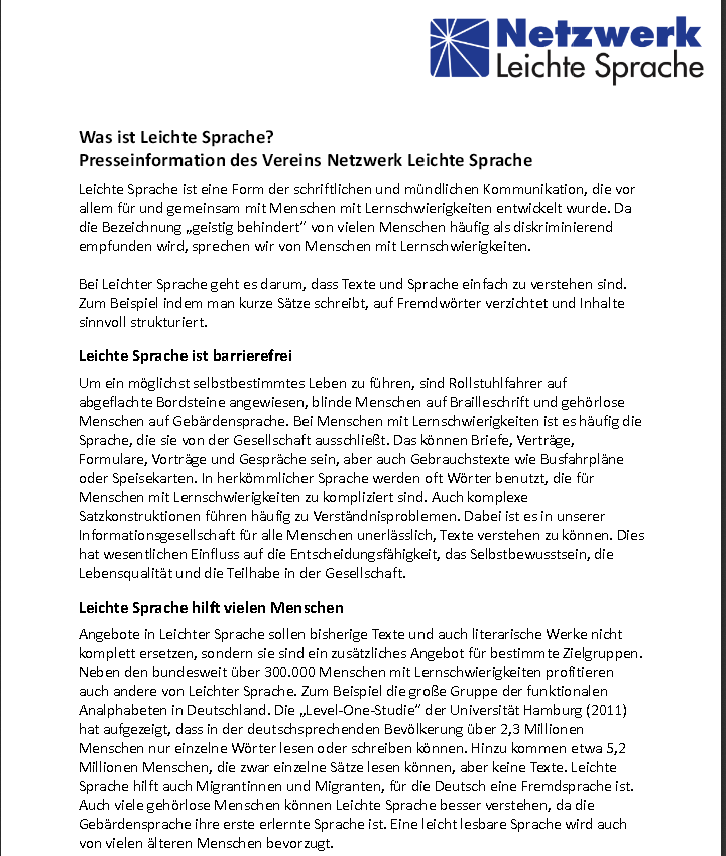
My country of residence votes today in what my partner has called “possibly the most boring German election in recent memory.”  Sure the new Euro-skeptic party may be prove to be a rising star while the Pirate Party sinks (no pun intended), but with voter non-participation at an all-time high, conventional wisdom anticipates pretty much more of the same.  There is, however, one new feature of this campaign season distinguishing it from years past – all of the major parties offer translations of their platform and websites in Leichte Sprache

Leichte Sprache (“Simple Language”) is a variant of German developed by professionals who work closely with citizens with intellectual disabilities.  It avoids long sentences, abbreviations and acronyms, jargon, foreign words, and Roman numerals.  The text is often accompanied by images that convey meaning.  Commonly used words supplant those used to signify sophistication; e.g. “allow” is preferred to “authorize.”  Instead of “public transportation,” Leichte Sprache translators use “buses and trains.”  Repeating the same word (“You should take these pills because these pills are the best”) is preferable to using synonyms (“You should take these pills because this medicine is the best”).  Adverbs signifying time (“Maybe tomorrow it will rain”) are used in lieu of verb tenses (“Tomorrow it could rain”), because complex verb tenses should be avoided altogether.  Figurative descriptions (“Rabeneltern” = “raven parents”) are replaced with literal ones (“bad parents”).  The German custom of smashing compound words together without dashes or spaces (as in “Eheunbedenklichkeitsbescheinigung”) is also discouraged.     

The closest English equivalent to Leichte Sprache is Simple English, which thusfar has only really gained traction on Wikipedia.  While the Leichte Sprache Netzwerk focuses on the needs of citizens with intellectual disabilities, most advocates of Simple English in the U.S. list immigrants and other non-native English speakers as their primary target group.  This is also a revolutionary idea.  If you think the contractual agreement at iTunes is hard to wade through, imagine trying to read it in whatever foreign language you studied in high school. 

Indeed, most expats I know who have only a basic knowledge of German tend to simply hand their contracts, tax forms, and newspapers over to a German friend for an explanation.  For such people, Leichte Sprache versions would be a much more surmountable hurdle. 

And anyone about to scoff at the idea of lazy immigrants trying to take the easy way out should try the following exercise.  If you’ve studied little to no German, see how long it takes you to understand the Leichte Sprache version of this text:
 

Leichte Sprache


Need a dictionary?  Now compare reading that to reading the original version:


Schwere Sprache


Which one would encourage you to at least give it a try?  Naturally plenty of immigrants and expats strive and pride themselves on reaching the level of language used in the second text.  But for those scientists and doctors and painters and cooks and economists who admit that foreign languages were never their strong point, something is far better than nothing.

Some have voiced concerns that this is a slippery slope toward an anti-intellectual populace; that all the poetry, intricacy, and subtlety of refined language will be thrown out with the bathwater if Leichte Sprache has its way.  As a writer, I’ll be the first one at the barricades whenever anyone proposes that all public discourse accommodate the lowest common denominator.  I’m the type to shudder at someone saying, “We’ve come 360 degrees” when they mean 180 degrees; at reporters saying “he’s a graceful person” when they mean “gracious”; at friends mistaking “literally” for “extremely.”  Because when our language becomes shallow and meaningless, our ideas become shallow and meaningless. 

But Leichte Sprache is no cause for worry because it is intended as an option, like Braille, not an imposed standard, like the Newspeak in Ninety-Eighty-Four.  Far from stigmatizing intellectuals, it is a means of empowering groups of people that are all too often excluded from the discussion.  And, perhaps most importantly, Leichte Sprache is a conscientious effort, a carefully constructed means of expression with many, many rules, whereas any shift toward linguistic parochialism among those of us without cognitive disabilities usually comes from an unwillingness to give much care or thought to what we say.

Indeed, it bears repeating that Leichte Sprache is not a matter of merely dumbing down the way we speak to certain people, with no concern for how patronizing we might sound.  For anyone who thinks people with intellectual disabilities don’t notice when we’re talking down to them, there’s this:


The role of Leichte Sprache in today’s election may not be big enough to produce any surprises, but its implementation does recognize the rights of several minorities to participate in the political process.  It also signifies Germany’s commitment to the U.N. Convention on the Rights of People with Disabilities. However, according to Leichte Sprache translator Andrea Tischner, the two parties currently in power are not doing all they could.  Chancellor Angela Merkel’s center-right Christian Democrats, and their Bavarian sister party the Christian Social Union, have failed to translate much of their platform into Leichte Sprache, while the libertarian Free Democrats use too many big words in their translations.  Interestingly, theirs has been the most diverse administration in the history of Germany—and possibly the world— with a female chancellor, a foreign-born vice-chancellor and an openly gay secretary of state.  But according to Tischner, the best translations are offered by three of the four major parties on the left: the Social Democrats, the Greens, and the Pirates.  She didn’t offer any assessment of how the anti-immigrant, Nazi-apologist Nationalists are handling things, but I think we can guess.


Equal Treatment Means Special Treatment, Right?

1 Sep

(Via)


Recently overheard in a library: “They just hired some incompetent disabled person. Equality is a nice idea and all, but I can’t turn my whole world upside down in order to always be thinking about what some other person needs. I have to think about my needs.”

To which this disabled person shrugs, “Ditto.”


The Parents and the Childfree Are Ignoring A Very Important Group

11 Aug

Hay que reorganizar los cuidados

(Image by gaelx used under Creative Commons license via)


“Now I’m going to ask you something that you officially don’t have to answer, but I’m going to ask you anyway…”

I was in the middle of a job interview, and the résumé splayed out on the table betrayed my age. I knew exactly what was coming.

“Do you have kids?” the interviewer asked.

“No,” I smiled, remembering that German law protected me from having to tell him if and when I ever planned to.

“Good,” he smiled back, glancing to the side as if afraid of being overheard. “Because I hate to say it, but employees with kids will not be able to do this job.”

It was clear to me he wasn’t being sexist or anti-family – just honest. The job in question involved shifts at all hours of the day that would change from week to week. There wasn’t any room for developing a schedule of any regularity, or for excusing oneself repeatedly during flu season. And it wasn’t the only profession I’d heard of that demanded flexibility while offering none back. This year has seen study after study reveal that childless women are heavily favored in academia and the corporate world, while men in any field face miserable stigma if they dare prioritize paternal commitments over professional ones. Parents have it so hard.

But then again, so do childless employees. Yet another study out this year revealed that middle class childless women in the public service sector face stigma and sometimes even harassment in the work place for defying traditional gender expectations. In these jobs, working moms are sometimes accommodated more readily than single ladies, leading Amanda Marcotte to complain at Slate of “women missing dates, exercise classes, and social outings in order to cover for the mothers they work with.” In New York magazine, feminist Ann Friedman argued:

Many corporations now strive for a veneer of family friendliness, so it’s not likely a woman will get the stink-eye for leaving early to catch her kid’s soccer game. Which is a feminist victory. But if a childless employee cops to the fact that she’s ducking out for a yoga class? It’s seen as downright indulgent and may even show up on a performance review.

If you’ve ever waded into the debate between childfree adults and parents, online or off, you know they tend to be rather resentful of one another. I usually find myself playing devil’s advocate to both. At this time last year I wrote about the depths of the pain self-righteous parents can inflict on others. But for every supercilious mother I’ve witnessed flaunting her offspring like Olympic gold medals, I’ve also seen huffy child-freers rolling their eyes the moment a toddler enters their field of vision, having no qualms with letting everyone know that the mere existence of a child in their presence is an assault on their personal freedom. Which brings new meaning to the word “childish.”

It’s a shame because the childfree movement has many excellent points to make about society and gender bias. Summing it all up to the inherent undesirability of children is the worst possible political tactic because no one who believes in human rights can write off an entire group of people who have no choice about belonging to that group. Would we tolerate anyone saying, “I can’t stand the elderly”? Or “There is no way I am ever going to learn to like mentally disabled people”?  And anyone who trashes someone else’s reproductive decisions in order to justify their own will never, ever convince the skeptics they need on their side. They’ll just come off as intolerant and judgmental.

And while mothers hit a wall if they insist that theirs is the hardest job in the world, I don’t think we’re going to get very far arguing that employees should have just as much right to leave work early to make it to yoga class as they do to make it to their kid’s soccer game. In the choice between work versus yoga, nothing but my own happiness is riding on the decision. Because it’s me-time. In the choice between work versus my nephew’s soccer game, someone else’s happiness is also at stake. Because it’s caregiving.

This is not to say that single people have less important lives than those with children. Nor do I intend to suggest that parenting is the hardest job in the world. (As mother and feminist Jessica Valenti pointed out in Why Have Kids?, can anyone say with a straight face that being a parent is harder than being a firefighter or an oncologist?) But those who dedicate a large chunk of their time to others in need of care should always be accommodated more readily than those who don’t. Because helping others in need—whether it’s your kids, your parents, your friend’s kids, or anyone you know who is dependent due to age, disability or illness—is work in itself. It’s often a labor of love, but it’s labor nonetheless. And usually it increases your need for me-time, while leaving you with even less time for it.

As a childless woman, I have occasionally been an unpaid caregiver and frequently the one in need of care. I’ve taken time off from work to babysit my neighbors’ toddler, to bring my nephews to the pediatrician, to pick up a friend’s daughter from kindergarten, to help organize a funeral and sort through an estate. And my parents, relatives, husband and friends have taken time off from work in order to take me to physical therapy, to check-ups and procedures, to be at my bedside before and after surgery. The ideal family-friendly workplace would accommodate any employee’s need to help someone in regular need of assistance.

And maybe if we extend the value of good parenting to the value of good caregiving, we’ll be able to have more discussions about how freakin’ hard it can be. Caregiving isn’t just about having a big heart and finding joy in knowing you helped someone. It’s about sacrifice. It’s about reading a book for the fourth time no matter how much you want to throw it out the window. Or rubbing someone’s feet to distract them from the pain no matter how little sleep you’re running on. Or missing out on parties and events no matter how badly you want to go. Or suppressing your gag reflex as the one you love spits up something absolutely gross. Or mustering the strength to decide whether you should endure the anger being vented at you because everyone needs to vent, or whether you should call your loved one out on their self-pity lest their anger become an abusive habit. Caregiving is about testing your patience until it inevitably wears thin and you make a mistake or lash out, ensuring you’ll be up the next several nights wondering whether you just scarred someone for life. Caregiving is work and, regardless of whether it is paid work, it is one of the most psychologically taxing kinds of work there is.  And some are naturally better at caregiving than others, regardless of gender.

But why is taking time off for your child’s recital more generous than taking time off for a date with a friend? Isn’t a childless peer just as valuable as a family member? Of course, but let’s not fool ourselves. Sitting through an entire school recital is a lot less fun than fine dining. (Hence the rule at Springfield Elementary: “No leaving after your kid’s part is done.”) And helping a friend through a typical young adult “crisis” like a breakup will never require the same sort of patience, empathy and thick skin that you need for helping someone through serious illness, severe injury, death or divorce. Commiserating, while still noble in its intentions, is simply saying, “I’ve been there!” and swapping sob stories within the boundaries of our comfort zone. Empathizing is forcing ourselves to stretch our imaginations and open our hearts to someone whose experience frustrates us, or maybe even scares us, because it is essentially different from our own experience. Because empathizing is so much harder, it is undeniably more noble.

Young, childless, upper/middle class adults like me will probably always be seen as the most self-indulgent because our stage in life is the least likely to involve illness or dependency. But those who volunteer after work to play with underprivileged children or tutor illiterate adults or regularly call their lonely relatives demonstrate that social segregation is in part a choice.

This is not to guilt everyone into feeling that our lives are meaningless unless we start volunteering. But we should be honest, not touchy, if our lifestyles are in fact more self-centered than others’. This year, unlike years past, I find myself only occasionally dedicating my time to someone else. My husband has been the giver, exerting himself to maintain the work-life balance constantly threatened by the pressures of his job and my medical needs. And for that he deserves accommodation from his employers, and both gratitude and admiration from me.


When Saying “I Don’t Judge” Is Judgmental

4 Aug

Beautiful and Softly(Image by Thomas Hawk used under Creative Commons license via)


“I’ve learned not to judge other people.” In the debate on marriage equality, many former opponents have softened their opinions with this all-too-common phrase. While a little progress and diplomacy in any debate is better than none, this should hardly be considered an acceptable assessment of same-sex marriage. Because whenever we say, “I don’t judge,” we’re implying that we think there is something morally ambiguous to judge about the situation.

We say “I don’t judge” when we observe pain or dishonesty and are hard pressed to think of a way it could have been prevented. We say it when we observe someone lose control and we know that everyone loses control sometimes. We say it when at least two sides are sparring and both have made major mistakes. It’s dishonest to pretend that we don’t have opinions about the decisions and actions we witness, because we all do. But ultimately saying, “I don’t judge” means my opinion is incomplete because I can’t say for sure what I would do in that situation. And when the act in question falls short of intentionally cruel behavior, it is often the appropriate thing to say.

It’s appropriate when we hear about a neighbor’s divorce (“I don’t know the details of the marriage, so I can’t judge”), when we hear that someone took a job that compromised their morals (“I can’t say what I would do if I were that strapped for cash”), when we see people with parenting methods that differ from our own (“That child isn’t my child, and I don’t know what I would do if she were”). We say it not to ignore the harm it may have wrought, but in order to remain humble, to avoid hypocrisy, and to remember that different circumstances prevent the human experience from being truly universal.

But we do not and should not say it regarding lifestyles that raise no moral questions. We don’t say, “She’s dating a foreigner, but I don’t judge,” or “They adopted a child, but I don’t judge.” If anyone said of my partner, “He married a woman with dwarfism, but I don’t judge,” that person would be implying there is something shameful or irresponsible about me and my condition.

A little over a hundred years ago, doctors were saying just that. A Virginia medical manual in 1878 advocated criminalizing marriages between average-sized men and women with dwarfism, insisting that such an act was on par with “murder.”

Modern readers hopefully find nothing morally ambiguous about two consenting adults falling in love and deciding to commit to one another. Regarding interracial or same-sex or international or medically “mixed” marriages, the only people who should invite our judgment are those who impugn these relationships with the statement, “I don’t judge.” It’s an oxymoron, not unlike a “Please” slathered sarcasm. And it would be swell to see it less and less in political discussions on civil rights.


“Power for Good”

28 Jul

tumblr_mqm3ypKbXg1qz5q5lo1_500(Via)


Tropes are ideas we construct based on observing patterns in society and wanting to understand them. Stereotypes are ideas we construct based on hearing about patterns in society and accepting them at face value. Needless to say, stereotypes based on that which we have no choice about—our sex, gender identity, sexuality, ethnicity, nationality, physical traits, or mental abilities—usually do more harm than good.

Not only do they deny minorities equal rights and opportunities, but a recent study shows that embracing racial stereotypes leads to creative stagnation. So how do we combat them? 

In the wake of the Trayvon Martin verdict and President Obama’s call for a dialogue on race in America, Harvard researchers announced a competition to find the quickest, most effective method for getting people to let go of the prejudices they have about a certain group. The results? Calls for empathy and other try-to-put-yourself-in-their-shoes methods were largely ineffective.  What worked best was showing the participants counter-stereotypical images. World leaders with severe disabilities. Parents proudly painting their son’s toenails. Construction workers nursing their babies. Sons helping out with the housework.  Seeing is believing, apparently.

It is crucial to note that celebrating diversity can feel patronizing, especially to the subjects. The goal, after all, is to drive stereotypes to extinction so that observers find absolutely nothing extraordinary about any of the above images. Because the subjects do not feel extraordinary, at least not all the time – they feel normal.  No person who can qualify as a minority or counter-stereotype should feel pressured to spotlight their everyday life if they don’t want to.  But it is encouraging—if not unsurprising—to see that altering media portrayals of society alters a good deal of the prejudices plaguing too many corners of society.

As my friend Sarah Winawer-Wetzel recently said:

For me, it validates the importance of being out as a gay person. How else are people going to believe that a nice white Jewish girl who dresses femme and doesn’t look particularly counterculture can be queer if I’m not out like a friggin’ lightbulb everywhere I go? I’m not doing it just for me – I’m doing it so that when a little kid looks at the world and thinks about being gay, that kid sees the full spectrum of possibilities, not just a cultural stereotype. Those of us who control visuals and representations of people in the media need to remember to wield our power for good.

We often forget the power we wield when we have a stereotype in our hands, thinking it’s bigger than anything we can do about it. But it is not.  And that is wonderful.


Doctor Tries to Be Hip And Misses

21 Jul

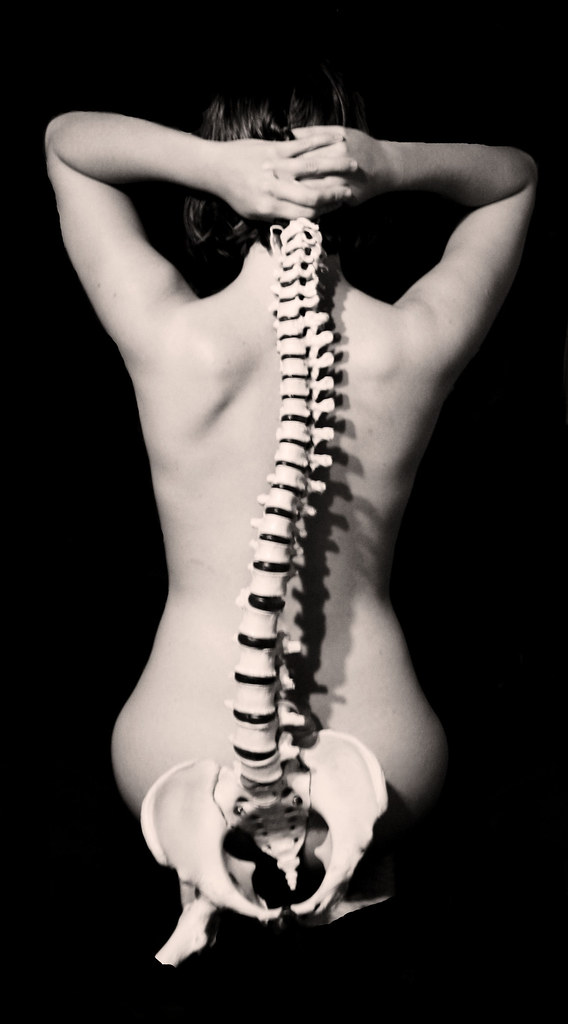
spine(Image by Katie Cowden used under CC license via)

Fifty-five year-old Terry Ragland of Tennessee recently sought medical attention for lower back pain at her local orthopedic center. She was introduced to Dr. Timothy Sweo, who ordered x-rays. After analyzing the results, Sweo concluded that the pain was caused by a curve in the spine called lumbar lordosis. He delivered the diagnosis to the patient by saying plainly, “You have ghetto booty.”

Lumbar lordosis is a severe curvature of the lower spine most visible from the side and it can be caused by a variety of a factors. “Ghetto booty” is, according to the most popular Urban dictionary definition, “a term used when you see a girl with a firm, big, tight packed ass. {Most black girls have ghetto booties}.” In other words, it’s slang for simply having a big butt.

For a medical professional to use the term is fantastically patronizing at best. For a white male medical professional to use racially-charged sex slang with a black female patient he has only met once before is jaw-droppingly gauche. His attempted apology to Ragland via letter does not help his case: “I was trying to take a technical conversation regarding your lower back and make it less technical.”

Presuming orthopedic patients are unable to comprehend medical terms like “lumbar lordosis” is ludicrous. After a month into my first limb-lengthening procedure at age 11, I could explain the difference between lordosis and scoliosis, a corticotomy and an osteotomy, and I could name every bone in the human body. I wasn’t exceptional – I just wanted to understand the world I was living in, like every one of my fellow pediatric patients. Priscilla Alderson’s excellent book Children’s Consent to Surgery presents overwhelming evidence that child patients are far more aware than adults tend to give them credit for. And Ragland is not a child.

“It says to me that he doubts what type of intellect I have, how intelligent I am to be able to understand what he conveys to me in a medical term,” Ragland told reporters.

While Sweo’s condescension comprises a particularly stunning mix of nasty prejudices, he is hardly the first doctor to speak disrespectfully to a patient. Medical specialists are renowned for being scientifically brilliant but socially inept. After making you sit in the waiting room, sometimes for several hours, they swoop in, keep their eyes on your body or the floor, bark a few questions at you, rattle off some orders for the nurse to take down, and swoop out again.  The patient is supposed take solace in the fact that it is all a sign of how important the doctor is.

Since this stereotype has become so pervasive, some medical professionals do make earnest attempts to shatter it, but their success varies. Some try through their body language and demeanor to give you the sense that they are genuinely listening and care about your all-around well-being. Others try by jamming a few blunt jokes into your narrow time slot. It gives you the sense that they’ve just watched Patch Adams and decided that being a clown is the perfect defense against being accused of coldness, so let ’er rip! Your body, your condition and your diseases are hilarious!

Indeed, the most exasperating aspect of the Dr. Sweo case is that he appears to genuinely believe that his comments might have been helpful. Usually it is easier to engage in productive discourse with someone whose intentions are good than with someone who aims to hurt. But in light of his oblivious apology, it seems Ragland has a better chance of getting through to other, more perceptive doctors via the media than to Sweo via complaint.

I have lumbar lordosis.  It’s one of the primary symptoms of achondroplasia and it’s why I had to undergo spinal surgery last year.  I could have crashed this site with a list of all the off-putting doctors and healers I encountered, as well as the sarcastic jokes my closest friends came up with to keep me sane.  As Ragland files a formal complaint with the Tennessee Department of Health, there will inevitably be some backlash about PC culture gone mad and minorities being too sensitive and humorless.  But more power to her for sticking up for herself, and for patients everywhere.

Sex with Circus Midgets or Uncomfortable Silence

7 Jul

(Via)


“Pregnant mothers should avoid thinking of ugly people, or those marked by any deformity or disease; avoid injury, fright and disease of any kind.”  So advised doctors in the 1920 parenting manual Searchlights on Health.  Eugenics was all the rage back then, but it had hardly come out of nowhere.  The ugly laws of the 19th and early 20th centuries prohibited, for example in Chicago, “Any person who is diseased, maimed, mutilated, or in any way deformed, so as to be an unsightly or disgusting object, or an improper person to be allowed in or on the streets, highways, thoroughfares, or public places. 

Under these laws, poor and homeless people with disabilities suffered the most.  The class system gave those from affluent families, like Helen Keller, a better shot at being exempted.  But before the disability rights movements of the 1970s, countless disabled children were abandoned by their families in orphanages and asylums, and were thus condemned to grow up to either join the circus or become the vagrants these laws targeted.  Abandonment, rejection and the resulting invisibility in society is an ableist tradition of astounding resilience.  Because just how far have we come in the past hundred years since doctors and municipalities advised not talking about or looking at disabled people?

This week Slate magazine features two articles by Barry Friedman and Dahlia Lithwick, asking readers to consider “what is left for the progressive movement after the gay rights victory at the Supreme Court.”  Arguing that liberal activists have developed tunnel vision, focusing almost exclusively on gay marriage and nothing else, they trumpet issues that deserve attention along with marriage equality.  Their list spans two articles, covering all sorts of social causes, from ending the death penalty to protecting the environment to improving child-care funding and education to marijuana legalization.  Nowhere in either article do they mention disability rights.

This very same week Slate also kicked off a blog about Florida by Craig Pittman with an opening article called, “True Facts About the Weirdest, Wildest, Most Fascinating State.”  Among the facts that apparently render the Sunshine State weird are the python-fighting alligators and “a town founded by a troupe of Russian circus midgets whose bus broke down.”  On the day of its release, Slate ran the article as its headline and emblazoned “A Town Founded By Russian Circus Midgets” across its front page as a teaser.

Face-palm. 

Friedman and Lithwick have nothing in common with Pittman except that they also write for Slate, a news site written by and for young liberals.  And that their articles remind me of what I’ve come to know and call Young Liberal Ableism. 

 That is, there are two ableist mentalities not uncommon among young liberals:

 1)      Uncomfortable Silence: the tendency to skirt issues of disability, especially compared to other social issues, because disability threatens two things young liberals unabashedly embrace – being independent and attractive.  (“Independent” and “attractive” rigidly defined, of course.)

 2)      Sex with Circus Midgets: the sick fascination with physical oddities that objectifies and/or fetishizes people with atypical bodies or conditions.  (I’ve discussed this in detail here.)

Both mentalities see any disabled people they hurt as acceptable collateral damage

Here’s the thing about dealing with all this.  You get used to it, but not forever and always.  Sometimes it rolls off your back, sometimes it hits a nerve.  This time, seeing a magazine as progressive as Slate brandish RUSSIAN CIRCUS MIDGETS on its front page while leaving disability rights out of its social justice discussion brought me right back to college, where friends of friends called me “Dwarf Emily” behind my back and someone else defended them to my face.  Where classmates cackled about the film Even Dwarfs Started Off Small—“because it’s just so awesome to see the midgets going all ape-shit!”—but declined my offer to screen the documentary Dwarfs: Not A Fairy Tale.  Where a gay professor was utterly outraged that her students didn’t seem to care about immigration rights or trans rights, but she never once mentioned disability rights.  Where an acquaintance asked to borrow my copy of The Curious Lives of Human Cadavers, but awkwardly turned down my offer to lend her Surgically Shaping Children.  Where roommates argued vociferously that they would rather be euthanized than lose the ability to walk.  Where jokes about dwarf-tossing were printed in the student paper. 

I won’t go into certain crude comments that involved me personally, but I will say that when a friend recently, carefully tried to tell me about how shocked he was to find a certain video of dwarfs in a grocery store, I cut him off and said, “Lemme guess, it was a dwarf woman porn video?  That’s one of the top search terms that bring people to my blog.”

For a little more than a decade, I’ve lived on one of America’s most liberal college campuses and then in one of the world’s most progressive cities.  I have never met so many liberal people at any other time in my life and I have never met so many ableist people at any other time in my life.   

This is not to ignore all those I’ve met who, despite their lack of experience with disability, ask carefully constructed questions and consistently make me feel not like a curious object but like a friend who is free to speak her mind about any part of her life experience.  And some young liberals are doing awesome work for disability rights and awareness.  But when a journalist and mother of a disabled twentysomething recently said, “No one wants to talk about disability rights – it’s not seen as sexy enough,” I knew exactly what she was talking about.

In 2009, when the pretty darn liberal Huffington Post reported on Little People of America’s call on the FCC to ban the word “midget,” the majority of commenters snidely remarked, “At least they can get married.”  There was truth to this, but I found it telling that not a single commenter on the left-wing blog considered that the word “midget” could be hurtful.  Everyone instead decided to play Oppression Olympics

Understand that I will never say that among liberals disabled people are worse off than other minorities or that ableism is the “last frontier” in human rights.  It’s not.  Even if I believed it to be true, it would be impossible to prove and fighting for the crown of Superlative Suffering doesn’t do anything but imply that there are those against whom you wish to compete.  I don’t want to compete with anyone. 

Nor do I assume that anyone who uses the word “midget” is bigoted.  Many who use antiquated terms are honestly unaware of their potential to hurt.  (It wasn’t until two years ago that I learned that referring to the Sami-speaking regions as “Lapland” can be very offensive to those who live there.)  And there is no minority on earth whose members agree unanimously on a name.  “Little people” makes me cringe almost as much as “midgets,” while my husband winces whenever I use the German word for “dwarf.”  Labels are only half as important as the intentions behind them.

But when young liberals insist that no one can be expected to know that “midget” is hurtful, there is something particularly perverse about hearing dehumanizing beliefs and ideas come from the mouths of those who pride themselves on their open-mindedness and diversity awareness.  Or whose own experience of marginalization would logically render them a better candidate for empathy.  In the words of Charles Negy, bigotry is an unwillingness to question our prejudices. 

Why do I call it Young Liberal Ableism and not just Young Ableism?  Because certain liberals could learn a thing or two from certain conservatives about facing disability and illness. Consider the stereotype of the small-town conservative who proselytizes about etiquette and tradition, and goes into a tizzy over the idea of two men kissing or a woman not taking her husband’s name or her neighbors speaking another language or a singer using swear words.  But for all the types of people she does not want to accept in her community, she is fiercely dedicated to her community.  She spends a good deal of her time going to church and checking in on her neighbors, and stays in contact with those who are physically dependent, sick or disabled.  As patronizing as charity can be, many young conservatives have been raised to send get-well cards, bake pies, and call on neighbors and relatives who are stuck at home or in the hospital.  They’ve been raised to believe that it’s the right thing to do. 

Many young liberals, meanwhile, have been raised to analyze their problems and personalities to the point of vanity, question moral traditions to the point of moral relativism, and feel free to do what they want to the point of only doing what they want.  They believe that anyone is welcome to live in their town, but they’ll only socialize with those they deem interesting.

I’m stereotyping of course.  But it’s a fact, not a stereotype, that in the U.S. liberals are less likely to donate to charity, less likely to do volunteer work, and less likely to donate blood than conservatives. 

Ultimately, it does not matter whether you call yourself “liberal” or “conservative,” left-wing or right-wing.  There are Ayn Rand conservatives who insist that compassion is “evil,” and there are liberals who work tirelessly in low-paying jobs at non-profits and social agencies that do as much good as any charity.  There are those of all political stripes who make large charitable donations but also want everyone to know about it, and there are those who don’t know the first thing about politics but know everything about empathy.  We are far more complex than our politics give us credit for.

The goal should be to never become too self-congratulatory about our politics or morals,  as Friedman and Lithwick warn.  But in response to their call for issues progressives specifically need to pay to attention to, I do have a wish list going:

How about young liberals fighting to make sure dwarf-tossing is banned around the world?

How about facts instead of factoids when it comes to communities founded by dwarf entertainers who have been socially isolated by ableism and fear life-long unemployment?

How about young liberals continuing to fight for the U.S. to ratify the U.N. Convention on the Rights of Persons with Disabilities?

How about young liberals debating the Supreme Court’s 9-0 ruling last year that religious organizations are exempt from the Americans with Disabilities Act?

How about young liberals talking more about the astronomical rates of violence against intellectually disabled people, rather than just sneering at Sarah Palin’s complaints about the word “retard”?

How about young liberal bloggers trying to understand physical disability and illness as often as they try to understand depression and social anxiety?

How about our seeing a lot more women with dwarfism starring in romantic comedies than in porn movies? 

How about more young liberal discussions about real dwarfs than Tolkien Dwarves?

In issuing these demands, I’m of course terrified of appearing too self-interested.  Politics is all about trying to square the selfishness of What about ME?! with the fairness of Everybody matters.  Sometimes sticking up for your own rights is easier than sticking up for someone else’s.  Sometimes it’s the other way around.  All of us, liberals and conservatives, should value trying to do what is right rather than what is easy.


Liberty and Justice For All

30 Jun

(Via)


The Defense of Marriage Act and Proposition 8 are dead. Less than nine years ago on Election Night 2004, when eleven states banned gay marriage in one fell swoop, I would never, ever have dared to think that change could come so rapidly. Of course, marriage equality does not yet exist in thirty-seven of the fifty United States, but with young people around the world overwhelmingly and increasingly showing their support, it is coming. Thank goodness, in the best sense of the word.

There are those—gay, straight, bi and queer—who are saying, “I can’t be happy about this after what happened to the Voting Rights Act this week.”

And, “I can’t be happy about this until full equality is granted to trans citizens.”

And, “I can’t be happy about this until the AIDS crisis gets more attention.”

And, “I can’t be happy about this until we realize that single people deserve federal benefits, too.”

And every one of these people has a valid point. It’s a common political strategy in such triumphant moments to grab the opportunity to shed light on other civil rights abuses while you have everyone’s attention. Drawing attention to other injustices—especially the attention of those whose privileges put them at risk for remaining oblivious to such issues—is crucial because no one is free when others are oppressed. This is why I am always willing to discuss the latter half of any of the above statements.

But I do take issue with the first half: the too-cynical-to-celebrate attitude that is begging to be called out for its hipster glass house. Because marriage equality is a victory for everyone.

Anyone familiar with the history of minority rights in the U.S. knows that granting civil rights for one group has had an undeniable domino effect on other groups. Not long after debates about slavery, segregation, and voting rights culminated with the nation’s belief that all men are indeed created equal, women asked, “Why just men?” And not long after so many women proved that straight relationships can be egalitarian, gay and lesbian citizens asked, “Why just straight ones?” And somewhere amid gays and lesbians proving that the way they were born hurts no one, trans people asked, “What about how we were born?”  And somewhere in between all the discussions about genitals and bodies and skin color and size, disabled people asked, “What about our bodies and brains?” Because no one is free when others are oppressed.

Likewise, when one kind of inhumane prejudice gets knocked down, all the others are under threat.

This is not to take attention away from the people most directly affected by this week’s momentous legal decision. Friends of mine in Massachusetts can suddenly enjoy concrete federal benefits now while my husband and I have always enjoyed these benefits simply because we’re in a straight relationship. I am so happy for them, and so sad one of my dearest friends never lived to see this day.

But the victory is truly for everyone – even those marriage equality opponents who fail to see how they will benefit from a society that is a little bit freer, a little less fearful, and lot less lop-sided. Because this is a victory for anyone who has been bullied for traits they never had any choice about. This is a victory for anyone with something that has made them stand out in their family. This is a victory for all the couples who have choked back tears when someone said that marriage is all about a man and a woman being able to procreate. This is a victory for all the parents who have tried to teach their children to never grow up thinking they are more important than anyone else.

Congratulations to all of you out there.


Does GoldieBlox Break the Box?

9 Jun


After its Kickstarter fundraising campaign (see above) proved to be a success, GoldieBlox is here and available for retail.  Designed by an engineer appalled at the 1 to 10 ratio of female to male professionals in her field, the toy is the latest in a series of efforts across the West to combat the gender gap and get girls excited about scientific concepts from the earliest possible age.  Questioning the stereotype of women as “naturally” less competent in math, science and visual-spatial thinking is always admirable.  But does GoldieBlox really amount to anything more than simply painting science pink?    

Parents who want to conscientiously ensure their daughters feel every option is available to them will probably already have bought them Legos and Erector Sets.  But parents and relatives and neighbors who rely more on tradition when picking out presents may be swayed by the color-coding GoldieBlox employs.  As in: “I need a present for a cute girl.  Look, this is pink and cute.  I’ll take it.”  Having worked in early childhood education as well as social justice, I wish every adult responsible for stocking a child’s toy box would be conscientious enough to consider the value and purpose of their every purchase—or at least read the picture book all the way through—before heading to the cash register.  But plenty of adults who want to make kids happy don’t share my interest in kids’ things.  They truly appreciate age recommendations on the boxes, and the pink and blue color-coding.  It is these adults and their beloved little girls who will benefit tremendously from the GoldieBlox expansion of the world of pink into the realm of engineering. 

But why do we need to color code anything to let people know which gender it’s for?  Do we need to rename it GoldieNASA to get more women to work there?  Last year, when Bic introduced pens for women (“Easy glide – feel the smoothness!”), its Amazon page almost crashed under the weight of sarcastic reviews:


No Good For Man Hands


And then there were the appropriate reactions in November to the Honda She’s, a car marketed to women in Japan with special light and air-conditioning features to prevent wrinkles.  Feminists asked:


26


Indeed, the most offensive aspect of the pink-is-for-girls mentality is the antiquated belief that women need a softer, daintier, less intimidating variation of the standard, which was built for men by men.  Any woman who stops posing for a portrait and approaches that standard is an accident waiting to happen!  Right?

Pink cars and laptops and cell phones and building blocks trigger my gag reflex because they seem to be so obviously marketed as the deviation from the more serious male standard.  But is it fair of me to assume this?  Would GoldieNASA really be so bad?  A friend who works as a software engineer and buys so many Hello Kitty products I suspect he accounts for half of Sanrio’s market share would say no.  He agrees with me that Barbie and the Disney Princesses inappropriately introduce pre-schoolers to sexual self-objectification and viciously narrow beauty standards.  He is both irritated and concerned about those of any gender identity who think they should use their vulnerability to get what they want.  But his kitchen cupboards are brimming with cups emblazoned with pink hearts and daisies and butterflies.  He would love to work at GoldieNASA.

There is nothing inherently wrong with the color pink or with girls and boys, and men and women, being cute.  In fact, trashing the color pink and all things marketed at girlie-girls is often motivated by a powerful misogynistic tradition: the belief that things for girls are dumb and frivolous because girls are dumb and frivolous.  This is usually why boys and girls watch films and read books marketed to boys—like Harry Potter or Star Wars or every Pixar film but Brave—while only girls watch films and read books marketed to girls.  Some misogynists and feminists uphold this disparity by uniting in their belief that twirling around in ball-gowns is silly because it’s not a skill needed by the average adult in modern life.  Indeed, it is not.  But then neither is sword-fighting.    

For this reason, it is imperative to teach kids that the value of a toy or story derives from its content, not its color.  Within this lesson lies the truth that there is more to being a girl than dressing up and being cute, just as there is more to being a boy than being stoic and winning every competition.  Every child should feel every option is available to them because the most innovative minds approach the world with the least reliance on tradition.

GoldieBlox will have succeeded when it is ubiquitous in any child’s room because it will signify that adults are picking their purchases based not on color but on this simple rubric:


Who Gets Stuck in the Friend Zone

24 Mar

Love for all!(Image by Matthias Ripp used under CC license via)

Well, I finally sat down and saw The Phantom of the Opera a quarter of a century after everyone else.  (If you don’t know the story, this parody sums it up pretty well.)  I won’t say what I thought of all the songs songs songs because I’m bound to alienate half my readers either way, but by the second to last scene, I was hollering at the screen: “Girl, you’d better not go for that swaggering bully in the mask!”  But then she ripped the mask off and he couldn’t stop crying and I was up to my eyelids in Kleenex, wailing: “If only he hadn’t killed so many people!  (And talked to her instead of stalked her… )  Now he’s just another disfigured guy stuck in the Friend Zone!  But his pain is reeeeeeeeal!”

This week, the word “Friend Zone” has been entered into the Oxford English Dictionary.  Many of my favorite feminists are not pleased.  Because the term is generally thought to be something only straight, bitter men complain about (see these Urban Dictionary definitions), many argue that it’s a misogynistic trope.  Lamenting the Friend Zone sends the message, however subliminally, that spending time with a female is pointless unless you gain access to her naughty bits.  Because who would want to be friends with a woman?! 

Such a bleak view of women is certainly a problem among many men.  In the words of John Mix Meyer, “Girls are not machines you put kindness coins into until sex falls out.”  Nice for the sake of nice is respect.  Nice only for the sake of getting laid is not.  As I’ve said before, cross-gender friendship could use a lot more support in books, film, and mainstream society.

But I’ve also used the word “Friend Zone” before because I don’t believe it refers only to this one chauvinistic idea.  Unrequited love isn’t fun for anyone.  Lots of women have been stuck in the Friend Zone, too.  Many people are expected by pop culture to always end up there, because society deems them asexual, and it could be helpful to examine why.  Almost every adult on earth craves love and sex, and we are all trying to figure out what attracts those we deem attractive. 

Men who sigh, “Girls don’t like nice guys,” need to get over their narcissism.  But there are others who wonder in earnest why the Friend Zone seems so jam-packed with quiet guys who genuinely respect women.  In stories of every genre, from classic literature (Madame Bovary) to modern literature (Freedom) to dime-a-dozen bodice-rippers (The Bridges of Madison County), bored heroines look past their straight-laced suitors to the tall dark stranger who’s not exactly famous for his fidelity or his feminism.  Love triangles always make for good drama, but when the heroine more often than not decides that the devoted sweetheart belongs in the Friend Zone and the unpredictable bad boy belongs in bed, many scratch their heads and repeat, “Why do girls always go for jerks?”  Or, as The Mr. T Experience sings, “I have some problems… but even Hitler had a girlfriend, so why can’t I?”

The answer often depends on the situation, but there are two fundamental, heteronormative traditions that prop it up:

The Macho Stereotype – Any guy who isn’t strong and independent to the point of being daring isn’t a “real man.”  Obeying the rules, doting on your wife, and being mediocre is emasculating.  Hence the double standard men are held to in real life: they are always expected to focus more on their success and autonomy than their emotional fulfillment.  Sociologist Stephanie Coontz has pointed out that the inordinate importance of independence to male worth is why homeless men arouse so much more disgust than homeless women.

The Gentler Sex Stereotype – A nice girl can see the diamond in the rough.  A man with a nasty wife is hen-pecked and pathetic, but a woman with a bad boy just might be the only one who understands him.  From a conservative standpoint, it’s virtuous of a woman to be so selfless and forgiving.  From a liberal standpoint, it’s the thrill of conquest and her extraordinarily open mind that keeps her trying.  

A man’s worth is defined by his success, albeit many women accept broad definitions of success.  Western romances across the ages assert that special girls who search for the softer side of the bully or the bad boy will find it: Beauty and the Beast, Wuthering Heights, My Fair Lady, The Sound of Music, The Music Man, Guys and Dolls, Bonnie and Clyde, right up to Fifty Shades of Grey.  Pop culture reiterates ad nauseam how much men love the chase, but this trope shows that scores of women do, too.  For the starry-eyed heroine, it’s a challenge to stray from the disapproving masses—or her parents—and become the One Special Woman who can tame the beast and bring joy to his lonely life.  The higher the risk, the greater the reward.  The reward is knowing that she is deeper, different from those other girls who swoon over bland perfection.  Hence even America’s most famous feminist, Lisa Simpson, has looked past loyal, bespectacled Milhouse for Nelson, the schoolyard bully from a broken home.  

By far the most horrific result of this romantic tradition is the fact that too many women in real life endure abuse, or worse. Pop culture sometimes concedes this and still has the audacity to romanticize it.  My high school did a production of Rodgers & Hammerstein’s Carousel the same year Time magazine declared it the Best Musical of All Time.  After wife-beater Billy Bigelow dies in an armed robbery, his widow tells their daughter, “It is possible, dear, for someone to hit you, hit you hard, and it not hurt at all.”  You see, truly devoted wives know that offering yourself up as his punching bag is a way to show your love and nurture him as he struggles with his demons. Only a selfish bitch would leave him when he needs her most.

Carousel was written in 1956, but the trope is still going strong. The final film of the Twilight series lead NPR’s Linda Holmes to observe:

When a saga popular with pre-adolescent girls peaks romantically on a night that leaves the heroine to wake up covered with bruises in the shape of her husband’s hands — and when that heroine then spends the morning explaining to her husband that she’s incredibly happy even though he injured her, and that it’s not his fault because she understands he couldn’t help it in light of the depth of his passion — that’s profoundly irresponsible.

Yes, we’re all having a good yuk over the unhinged quality of it all.  And yes, it’s a movie with a monster baby… But romanticizing an intimate relationship that leaves bruises and scars is a particularly terrible idea in a film aimed at girls. Talking about this is tiresome, but then so is putting it in the movie.

Indeed.

But attraction to the forbidden is not always dangerous.  Sometimes the bad boy is just misunderstood.  There is a powerful romantic tradition of fine ladies risking wealth and status for true love.  (See Aladdin, Titanic, Robin Hood, Moulin Rouge, Lady and the Tramp, Lady Chatterley’s Lover, The Pirates of Penzance, The Pirates of the Caribbean.)  There are also classic tales of heroines opening the gates to social progress by debunking their families’ horrid prejudices when they fall for men outside their race/nationality/religion/species.  (See Pocahontas, South Pacific, Fiddler on the Roof, The Little Mermaid.)  The heroines of Guess Who’s Coming to Dinner and Angst essen Seelen auf stare down the racial tensions of the era in which the films were released.  Meanwhile, Cyrano DeBergerac and the Phantom of the Opera both find out—albeit too late—that their beloveds would have looked past their disfigurement and loved them back. 

Since then, we’ve seen heroines end up with men with disabling injuries (often from war), while a handful go for guys who are congenitally disabled or disfigured.  As noted recently, Peter Dinklage’s romantic roles are possibly, finally breaking dwarf men out of the Friend Zone.  Great art obsesses over the blurry border between right and wrong, friend and lover, beauty and banality.  These compassionate heroines who try to understand the “bad” boys and the rejects help us deepen our perceptions of attractiveness.

It’s worth noting that the Phantom and Cyrano compensate for the supposed repulsiveness of their disfigurement with the sexiness of their genius.  They are supercrips.  Granted Gothic tales love to examine the complexity of blinding light draped in darkness.  I like a study of conflicting traits as much as the next starving liberal arts grad.  But it’s a ludicrously ableist tradition that only gives disabled superheroes a shot at intimacy, restricting ordinary disabled men like Quasimodo or the Seven Dwarfs to the Friend Zone.  And it’s an absurdly lookist tradition that restricts almost all of our disfigured and disabled women there.

Can you name a famous heroine who’s disfigured or physically disabled?  (Can you name a famous actress who’s visibly disabled, for that matter?  I might be able to, but I’d have to check Wikipedia to be sure.)  In the old days, disabled and disfigured girls might arouse sympathy (see Helen Keller), but the women were hags.  Period.  If women who were merely not conventionally attractive ever dared to step out of the Friend Zone and into the dating game, they were annoyingReally annoying.  And they were swatted away like flies.

Nowadays, love stories try to speak to women’s insecurities about their looks with quirky retellings of the Ugly Duckling or Cinderella.  The heroine perceives herself as unattractive, moaning, “Is it because of my [thighs/eyes/nose]?!”  (Rather than cursing, “That shallow jerk stuck me in the Friend Zone!”)  But we eventually see that she truly is a knock-out and it’s just a matter of finding the right man who will wipe the soot off her face, pay for a makeover, or simply remove her glasses.  Children’s films are getting a little better: Shrek and The Princess and the Frog feature heroines who are green-skinned for part of the courtship, though their Otherness is not quite as realistic as the Phantom’s or Quasimodo’s.  We’ve yet to see a heroine reveal a real-life physical disability and see her hot lover swoon.

And why not?  Francis Bacon said, “There is no exquisite beauty without some strangeness in the proportion.”  I’ve overheard countless guys say, “Chicks dig scars.”  Which is true.  Lots of chicks got scars, too.

The popularity of a story is by no means an empirical examination of our values.  Most people I know are so much deeper than pop culture gives us credit for.  And there is a lot more to many of these stories than the tropes I just reduced them to.  But it would be daft to pretend that they have nothing to do with our collective psyche.  Every one of us treasures those romantic moments we experienced that were “just like in a movie.”  Our most popular books and films simultaneously reflect and influence what we tend to think is hot.  And when it comes to opening our minds, fiction is often the best messenger.  We look to entertainment for escape and to art for enlightenment.  The most powerful stories provide both. 

When I attended a lecture at the Network of Disabled Women in Berlin two weeks ago, there was a debate as to whether reality TV shows and documentaries help or harm perceptions of disabled women.  Good documentaries smash stereotypes by providing facts and figures, but the over-representation of disabled women in such reports combined with their invisibility in love stories, detective stories, and silly sitcoms suggests that they exist solely as objects of study.  They are there to satisfy our curiosity, but we’re rarely asked to root for them the way we root for Rapunzel or Bridget Jones.  We never follow them on a journey dripping with passion.  We should. 

The Oxford English Dictionary’s newborn definition of “Friend Zone” reads: “a situation in which a platonic relationship exists between two people, one of whom has an undeclared romantic or sexual interest in the other.”  It doesn’t say it’s exclusively a problem for men.  And good for them.  To me, the term will always evoke the potentially destructive idea that certain “types” of people don’t ever need or deserve intimacy.  And we’ve got to keep questioning it.  Children, animals, and self-proclaimed asexuals automatically belong in the Friend Zone, along with your clients, patients, and students.  The disabled, the disfigured, the elderly, the ordinary, and the unsuccessful do not automatically belong there.  I’m counting on all of us, the storytellers and the lovers, to recognize the word so that we can recognize the problem.

The People You Meet When You Talk About Human Suffering

17 Feb

 plastic crowd

(Image by Boinink used under CC license via)


Not all disabled people are innocents.  I would hope this comes as no surprise.  But in the wake of Oscar Pistorius’s alleged murder of his girlfriend, some are going to the other extreme.  In a bizarre article titled “The Disability Pedestal,” Slate writer William Saletan lists various disabled people who have allegedly committed similarly heinous crimes.  He cites anger over their disability as a frequent motive.  Which evokes the stereotype of the evil freak who kills in order to compensate.  That stereotype is at least as old as wicked witches, and as modern as the albino villain of The DaVinci Code.  Do we really need to feed it? 

And if there is truth to the commonly held belief that disability renders people more likely to lash out at others, then shouldn’t we be investing in a solution?  Saletan doesn’t offer any statistics on how many disabled people commit crimes out of self-pity, but if it’s really so endemic, then we should do something about it.

But I don’t think that’s what he meant.  While never going so far as to declare disabled killers a social problem, Saletan does argue that some see their disability as “just another card they can play,” and that both they and we need to realize that it all comes down to individual responsibility:

Equality isn’t about being special.  It’s about being ordinary.  People with disabilities aren’t above sin or crime.  They’re just like the rest of us…  You run your own race.  You make your own decisions.  Most people with prosthetic legs don’t shoot their lovers.  Most guys who survive testicular cancer don’t run doping rings in the Tour de France.  Something about beating cancer or overcoming a birth defect tugs at our hearts. It paralyzes our judgment.  We don’t want to believe that people who have accomplished such things can do evil.  Most don’t.  But some do.

I know plenty of disabled people who are jerks and nothing about the Pistorius case compels me to think of him as anything but one.  The stereotype of the poor, innocent, helpless, asexual, naïve invalid needs to go.  Yet I’m not comfortable with Saletan’s rather Ayn Randian assertion that compassion impairs judgment.  What impairs judgment is an inability to see someone as more than just a disability.  We should all be smart enough, deep enough, big enough to be humbled by the extraordinary difficulties someone has endured and to simultaneously call out their faults—or crimes—for what they are. 

Having a disability does not automatically make you a brave person or a good person or someone who deserves to be liked.  But disabilities almost invariably cause pain, and equality should not aim to rid us of our impulses toward compassion.  Was my judgment “paralyzed” when I met a girl in the hospital whose body was hot-pink with third-degree burns and immediately thought, “Man, I shouldn’t whine so much”?  Lots of my fellow patients at the hospital turned out to be the sort of people I couldn’t stand.  But almost every one of them had had experiences I could only try to imagine.  Refusing to excuse a disabled person should not preclude trying to understand the privileges we enjoy that they do not.    

To be fair to Saletan, I must admit it’s strange to find myself arguing this way because I am often fed up with discussions of disability and psychiatric disorders that devolve into self-pity and melodrama.  (See Twitter, Tumblr, Facebook… )  But firing off judgment can lead to snap judgments, and focusing our political energy on ranting about the whiners can lead to a cynical, soulless view of humanity.    

It just goes to show that we still have a hard time as a society figuring out what exactly to do with human suffering.  In my experience, four personality types exacerbate this problem.  (I’ve assigned gender randomly):

Mr. Comfort Zone – “I’ve Suffered, But You Don’t See Me Complaining!”  That guy who only sees society through his own lens.  He refuses to recognize any privileges he may enjoy, insists that everything balances out in the end and/or that the system is really rigged against people like him thanks to our oppressive PC culture.  He has a point that self-pity is counterproductive, but his refusal to acknowledge that anyone could have it harder than he does is the epitome of selfishness.  His refusal to explore the possibility of institutionalized chauvinism is intellectually lazy.  And his campaign for self-reliance loses all credibility the moment he blames minorities for his hardships. 

Ms. No Time For It – “It’s Sad Others Suffer, But I Don’t Like to Think About It…”  That lady who avoids political or social issues like the plague.  She wants to “stay positive” and “talk about cheerful things,” like the weather and her favorite TV shows and recent purchases.  She has a point that complaining too much about the world’s problems can wear you down, but she often contradicts this by complaining about mundane problems, like those trashy people who live around the corner and that snobby celebrity who had affairs with three different men, all of them friends of her husband, can you imagine how nasty you’d have to be in order to do such a thing?  In refusing to discuss politics, she ignores how much of her world view is determined by politics; i.e., what is considered “beautiful,” what it is considered “normal,” what is “controversial.”  She doesn’t realize that her ability to avoid certain “political” issues is a privilege

Mr. Oppression Olympics – “My People Have Suffered the Most!”  The activist who thinks the only rights worth fighting for are his own.  He may have a point about the unique nature of the discrimination he’s faced, but he ludicrously believes the more you’ve suffered, the more justice you deserve.  He secretly harbors prejudices about other minorities and this might be revealed when he thinks one of them might be taking time, funding, or attention away from “his” group.  He also refuses to acknowledge any privileges he may have.

Ms. Cry Wolf – “Can I Get Attention for My Suffering?”  The whimpering waif who takes the phrase “Talk about your feelings” to the extreme, turning almost every political discussion into a personal therapy session.  She secretly, or perhaps subconsciously, thinks belonging to a minority is enviable because it grants you sympathy and excuses for why you can’t do something.  She has a point that repression can be dangerous, but she goes overboard by crying, “OPPRESSION!” at any call for modesty or good manners.  She lists her problems in order to attain solace and praise, rather than revelation. 

We’re all prone to feel like these people in certain situations.  As a teen, I often slipped into Ms. Cry Wolf around boys I liked, hoping my saying, “I’m having such a hard day I could just cry!” would get them to be exactly as kind to me as I desired.  During my limb-lengthening procedures, when girlfriends would moan about not being thin enough while I was struggling against my painkillers to keep food down, I felt like Mr. Comfort Zone, wanting to tell them to shut up and be grateful.  In college, I felt like Mr. Oppression Olympics when students would raise their fists for feminism and LGBT rights but squirm and change the subject if I brought up disability rights.  And when it comes to certain matters of injustice—like what’s been going on in the Congo for the past five, ten, fifteen years?—I continue to be Ms. No Time For It, clicking past the headlines to the latest news about Stephen Fry or Jack White. 

Most people I know have had these feelings at certain points.  But we should be wary of acting on any of them, especially in the political sphere, because they’re all counter-productive.  There’s no progress in self-pity.  There’s no progress without empathy.  As I blog about disability and disenfranchisement, I agree with Saletan that I should never, ever be comfortable with the idea of myself as a victim.  But I also never want to be so hardened that I can’t be moved by human suffering.  Because that’s not really the point of trying to get along with the rest of the world, is it?


Note: This post was inspired by Crommunist’s The People You Meet When You Write About Race


“ ‘I Am So Sorry’ Is A Start”

23 Dec

Last week 20 children and 7 women were murdered as I was celebrating my birthday.  Hearts leapt into throats and the urge to hug the little ones in our lives pushed the tears further down the cheeks.  As you absolutely undoubtedly know, the Internet has since been inundated with debates regarding gun control, violent video games, and even gender roles.  Amidst all the vitriol and special snowflake lecturing, it’s the lackluster discussions of psychiatric disorders that seem the least helpful.   

Too much of what has been said about mental illness has been too simplistic, too unscientific, too dismissive of the fact that accurately diagnosing a deceased individual often requires years of research.  Liza Long’s piece “I Am Adam Lanza’s Mother” is brazenly presumptuous and fraught with problems, while most of the outraged responses obscure their excellent points with a few too many personal jabs at her.  Of course everyone wants to know as soon as possible why 20 children were chosen as targets, but in this quest our commitment should be to accuracy, not promptness.

Although much of my work is in disability rights, I rarely write about mental illness or psychiatric disorders.  I have family members who are mentally ill and many friends who work in psychiatric fields, but I do not know nearly enough about it to speak with any authority and all too often hearsay is copy-and-pasted as fact.  Genuine concern is sometimes obscured by sick fascination.  The term “mentally ill” is a gigantic umbrella that covers everything from paranoid schizophrenia to anorexia nervosa to hypochondria.  Those with psychiatric disorders make up what is perhaps the most misunderstood and diverse minority on earth.  Casually tossing out easy-reading explanations before the news cycle gets bored and moves on usually does them more harm than good. 

I’ve been reading as much as I can about the complexities of Asperger’s syndrome, schizophrenia, psychopathy, and the countless articles reminding everyone that most mentally ill people are far more likely to be the victims of violence rather than the perpetrators.  I plan on getting my hands on a copy of Richard J. McNally’s What Is Mental Illness? in the new year.  Meanwhile, I can only hope that news readers and viewers do not perpetuate the media’s easy-answer approach to something as complex as medicine.

And while filtering out the less helpful material, I found two beautifully honest pieces by Rev. Emily C. Heath and Linton Weeks about what to say to grieving parents.  People in bereavement are traditionally not classified as minorities, but fear, misconceptions, and snap judgments usually surround them.  (I wrote earlier this year about what loss has taught me about the complexities of grief and the prejudices I used to hold against it.)  As we continue the debates aimed at preventing future tragedies, we should learn how to deal with what this tragedy has done to those closest to it.


Degenerates, Nazis, & the U.N.

16 Dec

(Via)


A reaction to last week’s post about the U.N. Convention on the Rights of People with Disabilities sparked a behind-the-scenes discussion about whether or not I should allow name-calling in the Painting On Scars comments section.  I like to engage with almost anyone who disagrees with me, but online I know I also tend to only comment on sites that have strict no-drama policies because discussions can become pointless and boring really, really fast when there’s nothing but insults and exclamation points.  I ultimately decided that, for now, any rude behavior speaks for itself: Commenters can name-call all they want regarding people they dislike or say absolutely nothing, because in both cases they’re not going change anyone’s mind.

That said, I will always tell any supporters if they adopt tactics I want to have nothing to do with.  And it’s important to call out invectives that are particularly malicious in a way some might not be aware of.  The comment in question last week referred to the U.N. as “a bunch of degenerates, throat cutters, and other trash.”  Using the word “degenerate” in a discussion about disability rights is exceptionally insensitive, if not mean-spirited.    

The first time I read the word out loud to a friend here in Germany, his eyes shot up and said, “Be very careful with that word.  It immediately makes everyone think of the Nazis.”  And by “Nazis,” he meant the actual, goose-stepping, genocidal nationalists who tried as best they could to make sure disabled people either died off or were killed off.  Not “Nazis” in the Internet-temper-tantrum sense of “anyone I disagree with.”  The word also evokes the brownshirt term “degenerate art.”  Modern German sensitivity to the term is the result of looking honestly at the nation’s history of ableism.

Action T-4 was the first genocide program ordered by the Nazis, calling for the extermination* of those deemed by doctors to be “incurably sick.”  Between 200,000 and 300,000 disabled people were killed, though many were used for scientific experiments first.  *And by the way, I DETEST any use of the term “euthanasia” in this context.  “Euthanasia” literally means ending life to end pain, and for this reason I find it applicable where patient consent has been given or where pets are concerned.  But to imply that what the Nazis did to disabled citizens was anything other than murder is to dehumanize the victims.

The forced sterilization programs of disabled people in Nazi Germany, meanwhile, were modeled after American laws.  The very first forced sterilization law in the world was introduced in Indiana in 1907, and 30 states followed suit.  The Supreme Court upheld Virginia’s eugenics program in 1927 and it remained on the books until 1974.  Oliver Wendell Holmes summarized the Supreme Court’s decision thusly:  

It is better for all the world, if instead of waiting to execute degenerate offspring for crime or to let them starve for their imbecility, society can prevent those who are manifestly unfit from continuing their kind…  Three generations of imbeciles are enough.

The Nazi poster featured above focused instead on the expense: “It costs the German people 60,000 Reichsmarks to keep this genetic defective alive.  Fellow German, that is your money!”  After World War II, the Nuremberg Doctors’ Trial and the resulting Nuremberg Code discouraged ableist politicians from openly promoting eugenics on either side of the Atlantic.  But it wasn’t until 1981, the year I was born, that the disability rights movement in West Germany came into full swing and sought to combat ableism head-on. 

Almost every human rights movement is said to have a trigger moment when oppression went a step too far and the people fought back.  For the American Civil Rights movement, it was the death of Emmett Till.  For the gay rights movement, it was the Stonewall Uprising.  For the German disability rights movement, it was the Frankfurt Travel Ruling of 1980, brought about by a woman suing her travel agency for booking her in a Greek hotel where a group of Swedish disabled guests were also vacationing.  She claimed that having to see and hear disabled people had ruined her trip and the judge agreed with her.  Protests exploded across the country and the next year, which the U.N. had declared the Year of the Disabled, several West German disability rights groups organized and formed agendas.  They used the U.N. events to draw attention to the dire situation of disabled citizens in the country.

Two years later, the Green Party entered the Bundestag for the first time and was the first to voice support for disability rights as a human rights issue.  The Greens were born out of the 60s student movement in West Germany.  The movement was famous for protesting what most young activists across the Western world opposed at the time: the Vietnam War (and war in general), traditional gender roles, consumerism, pollution, etc.  But first and foremost, the West German 68ers were young people demanding the nation come to terms with its dark past, decrying that an overwhelming number of the nation’s leaders and officials were former Nazis.  Their commitment to human rights was inspired by an unfaltering awareness of how horrific things can get.  Their actions led to the passing of anti-discrimination laws and an amendment to the German Constitution in 1995, modeled after the Americans with Disabilities Act.

Another result of the students growing up and entering the government came in 1983 when conscientious objectors to the draft were no longer required to argue their motivations before a board for approval. This made it far easier for young men to opt for a year of community service in lieu of military service.  By 1991, half of those drafted became conscientious objectors.  For over 30 years, scores of German 19 year-old boys worked with mentally ill children at the Red Cross, in nursing homes, as assistants for physically and mentally disabled teenagers, and for Meals on Wheels.  This has created generations of men who often speak fondly of the experience and who are usually less fazed by disabilities or dependence, demonstrating a tolerance and openness that seems extraordinary for their age. 

The draft was discontinued last year and since then the community service option has been suspended.  Military debates aside, I agree with conservative politicians who have called for preserving the community service requirement and expanding it to women because it is an excellent government tool for combating both ableism and social segregation on a personal level.  Ableism is still a tremendous problem here in Germany, but in three generations, the country has changed from one of the most ableist societies on earth to one of the least.   The word “degenerate” signifies humanity’s capacity for cruelty and sensitivity to the word signifies our commitment to never repeat it.

To be fair, the word in last week’s comment was not aimed directly at disabled people but at the U.N. members working for disability rights.  And frankly, I’m a little insulted.  Because if anyone’s a degenerate here, it’s me. 

I am scientifically a mutant by virtue of my fibroblast growth receptor gene 3.  (Yes, yes, my genetics professor explained that technically all of us are mutants, but mostly just in boring ways… )  I am a semi-invertebrate now that pieces of my backbone were removed six weeks ago.  And I don’t take the last empty seat on the subway and request my friends slow down to my pace when walking for nothing.  So if anyone’s gonna go calling the organization that sprang from the Nuremberg Trials and founded the Universal Declaration of Human Rights a bunch of degenerates, they gotta get through me first.  I’m a degenerate living in Germany and proud of it.


Universal Disability Rights – Remind Me Again Why We Don’t Care?

9 Dec


Well, I was going to write about how conservatives are sometimes more open to discussing issues faced by disabled people than liberals are.  Then on Tuesday, all but eight Republican senators voted against the Convention on the Rights of Persons with Disabilities, making sure the United States distinguishes itself as one of the few nations on earth that will not commit to protecting disabled rights.  Appeals by the likes of the World Health Organization, the American Psychiatric Association, and senior Republicans (and disabled veterans) John McCain and Bob Dole were to no avail.  So I’m not in the mood to write any sort of tribute to conservative ideals this week.

Supporters of ratification like Dole and John Kerry argued that the United States would be leading the world, since much of the Convention was modeled after the Americans with Disabilities Act of 1990.  Opponents argued that this is exactly why ratification is of little importance.  We already have the ADA and we don’t like the UN, so who cares?  But By refusing to ratify the Convention, the United States is undermining its authority, ultimately saying, “Too bad!” to the disabled citizens of other countries that will also abstain, where ableism is sometimes deadly.  (Do we need to talk about the thousands of medical conditions that are still thought to be works of the devil or punishment by God in far too many cultures?)  But this is not just a matter of the United States choosing whether or not to officially lead the world.  When it comes to human rights at home, complacency can be devastating.

 In many respects, the U.S. is not coming out on top.  According to an OECD 2009 study of 21 developed countries cited by the World Bank and WHO last year, disabled people of working-age are more likely to live below the poverty line than non-disabled people in every country but Norway, Sweden, and Slovakia.  This likelihood is highest in the United States, Australia, Ireland, and Korea, and lowest in the Netherlands, Iceland, and Mexico.  According to WHO, the discrepancy between the employment rates of disabled and non-disabled citizens is twice as high in the United States (35 percentage points) as in Germany (18 percentage points).  And in the U.S., the risk of violence against people with disabilities is four to ten times higher than against people without disabilities. 

I will never officially endorse a candidate or a party on this blog.  Despite obvious political trends at the macrocosmic level, personal experience has shown me that people of all political stripes believe in universal human rights and I never wish to alienate anyone over issues not directly related to equality.  But shame on every single senator who blocked the Convention.  No one has ever protected human rights on an international scale through isolationist policies.  In a world where people with dwarfism still have little hope of employment outside the circus, people with albinism are persecuted, surgeries are performed without consent, and a diagnosis of mental illness is thrust upon LGBT people and denied people with clinical depression, international cooperation is crucial.  Otherwise, human rights disintegrates back into its inconsistent old self and becomes nothing more than a matter of privilege.