Tag Archives: Racism

Playing Disabled

30 Sep

Miracle Worker

(Image by cchauvet used under CC license via)


Snow White and the Huntsman is out on DVD in Europe tomorrow. Unlike in most other Snow White films, the seven dwarfs are portrayed by average-sized actors, their bodies altered by digital manipulation. No one in the dwarf community is pleased about this.  Little People of America issued a statement criticizing the filmmakers’ failure to give priority to performers with dwarfism, while Warwick Davis argued, “It is not acceptable to ‘black up’ as a white actor, so why should it be acceptable to ‘shrink’ an actor to play a dwarf?” 

I don’t believe digitally generated dwarfism is on par with blackface and all that evokes, but it’s not too far off because there is a long tradition in cinema and theater of socially privileged actors portraying socially marginalized characters. And never the other way around. Blackface is a particularly hideous blemish on the history of entertainment because it was almost always used for mockery. Yellowface has a similarly horrid history: Until 1948, anti-miscegenation laws in the U.S. banned actors of different ethnicities from kissing onscreen, so whenever a white actor portrayed an Asian leading man, Anna May Wong knew the role of the heroine was off limits to her, despite her being the most successful Chinese-American actress of the era. Meanwhile, as noted before, the circus freak show tradition that caricatures people with disabilities is still going strong today. 

To be fair, Snow White and the Huntsman does not create the illusion of dwarfism in order to mock it. This is why, to me, the blackface comparison seems overblown.  (A more apt analogy to blackface would be an actor inhaling helium to play a dwarf, as David Hyde Pierce did for laughs on an episode of Frasier years ago.) When a character matter-of-factly has a disability and the performer simulates their body type with artifice, is this not comparable to any sort of makeup or costumes? Danny Woodburn (whom you might know from Seinfeld) discussed it in an excellent interview on The Patt Morrison Show in June:

Directors, producers have every right to cast who they want to cast.  I just think this is something that merits discussion when the disability community—not just the little people community but the disability community—is so underrepresented in the film and television industry…

Others without disability portraying people with disability.  When producers, directors don’t actively seek performers with disability—[and they’d have to] because a lot of those performers don’t have equal access to casting, don’t have equal access to representation—when they don’t actively seek out those performers, then there’s a real slight against our society, I believe…

This is about making a stand so that there’s at least some due diligence… When you have a community of disabled that is about twenty percent of the population and less than one percent of disabled actors appear on TV. And some of the disabled characters, many of them are not portrayed by disabled actors.

Woodburn and Little People of America raised this issue ten years ago when Peter Jackson announced that he would cast only average-sized actors in The Lord of the Rings. As noted before, part of me was glad to see those magical creatures distanced from real-life people with skeletal dysplasias, but if Jackson had chosen to use dwarf performers to portray the Hobbits or the Dwarves, might someone like Woodburn be as famous as Elijah Wood is today? It’s hard to say. Famous actors create box office draw. Almost no famous actors are disabled and almost no disabled actors are famous. And that’s the problem.

If digital manipulation and theater makeup are someday used to expand roles to minority performers, allowing actors of any body type or ability to play the Huntsman or Prince Charming, it will then lose its exclusionary feel. I adored Snow White and the Seven Dwarfs growing up and, even though I was the only kid with dwarfism, I always portrayed the princess in the living room productions put on for my parents and their friends. But cinema has almost never swung that way. There is no history of ethnic minorities portraying famous white characters or disabled performers portraying physiotypical heroes and heroines. Plenty of ambulatory men have sat in wheelchairs to portray FDR, but no disabled man has been cast as JFK. And that stings a bit.

And what stings even more is the way in which privileged actors so often earn automatic praise for portraying minority characters in epic films, as if all minorities are opaque, mystical people only geniuses could begin to understand. John Malkovich as a mentally disabled man in Of Men and Men, Colin Firth as stammering King George VI, and Patty Duke, Melissa Gilbert and more recently Abigail Breslin as Helen Keller have all been lauded for their performances. They are all fine actors who have proven a wide range of talent, and the stories they tell are truly moving. But the public’s nearly kneejerk assumption that a minority role is a feat of greatness for a privileged actor can feel very condescending. 

In the very bizarre, direct-to-DVD film Tiptoes, Gary Oldman was digitally manipulated to take the role of the leading man with dwarfism. Peter Dinklage, who played the comedic supporting role (and, in my opinion, the only good moments in the film), said: “There was some flak. ‘Why would you put Gary Oldman on his knees? That’s almost like blackface.’ And I have my own opinions about political correctness, but I was just like, ‘It’s Gary Oldman. He can do whatever he wants.’ ” 

Fair enough, but when he was sappily introduced in the trailer as playing “the role of a lifetime,” I almost lost my lunch.
 

Biology and “The Imprecision of Stereotypes”

16 Sep


This week the British newspaper The Telegraph asks:

Ever wondered why men can’t seem to tastefully decorate a house?  Or have a tendency for dressing in clothes that clash?  And why, for that matter, can’t women seem to hack it at computer games?  Now scientists claim to have discovered the reason: the sexes see differently.  Women are better able to tell fine differences between colors, but men are better at keeping an eye on rapidly moving objects, they say.

Professor Israel Abramov and colleagues at the City University of New York reached their conclusions after testing the sight of students and staff, all over 16, at two colleges…

The authors wrote: “Across most of the visible spectrum males require a slightly longer wavelength than do females in order to experience the same hue.”  So, a man would perceive a turquoise vase, for instance, as being a little more blue than a woman who was looking at it too.

Abramov, professor of cognition, admitted they currently had “no idea” about how sex influenced color perception.  However, writing in the journal Biology of Sex Differences, he said it seemed “reasonable to postulate” that differences in testosterone levels were responsible…

Men can’t perceive colors as deftly as women can.  That’s why all the great Western painters like Van Gogh and Cézanne and Leonardo and Picasso and Renoir and Monet and Munch and Vermeer and Kandinsky and Matisse are female.  And all the major fashion designers of the last century like Hugo Boss and Karl Lagerfeld and Gianni Versace and Giorgio Armani and Calvin Klein and Ralph Lauren were women.  Oh, wait. 

Maybe the study meant to say testosterone only triggers color ineptitude when male ears register the words “home decorating.”  Or that male color perception improves when money is involved. 

Or maybe The Telegraph author was exaggerating just a bit.  Tacking jazzy headlines onto reports of scientific studies are all the rage these days, no matter how much they distort the findings.  In June, Medical Daily ran an article under the title, “Racism Is Innate.”  Innate means, according to my biologist father, “present at birth,” so this seemed like a call to toss all those No child is born a racist buttons onto the trash heap.  Except that anyone who bothered to read the article would discover that the study simply concluded that brain scans of adults show simultaneous activity in the centers that process fear and emotion and those that differentiate between familiar and unfamiliar faces.  The idea that fear of the Other can be neurologically mapped lends itself to a great deal of speculation and debate, but nowhere did the study claim that racism is present at birth. 

Such truth-stretching borders on mendacity, yet it pervades the science sections of so many newspapers.  Scientific studies are supposed to be free of bias, but the news media is severely biased toward publishing whatever will grab readers’ attention.  As several researchers have pointed out, differences between the sexes are currently considered a much more interesting discovery than no difference, so publishers often remain silent on an issue until they find a study that provides the juicier headline, no matter how numerous the contradicting studies are.  When the market is left to decide, it chooses salability over comprehensiveness.

Such an irresponsible approach to science results in a gravely misinformed public.  I can’t tell you how many people have repeated the claim that our modern Western female beauty standards are “natural” because a round waist resembles pregnancy and triggers the male fear of cuckoldry.  No one seems to remember that several crosscultural studies discredited this idea years ago.  But how can anyone be expected to remember something the media chose not to promote in the first place? 

And forget about waiting until the study is corroborated.  In 2007, The Times ran a headline claiming that women are naturally drawn to the color pink because of our savannah foremothers’ need to gather berries while the men hunted.  The Times published the study without consulting any historians, who eventually pointed out that pink was considered a manly color as recently as 1918 until fashion trends changed.  Oops.

This doesn’t mean that we should, as Mitt Romney has demanded, “keep science out of politics.”  Science is impartiality and corroboration and the best method we have for sorting facts from wishful thinking—for preventing our emotional, egotistical needs from weakening our objectivity.  To me, science is the most humbling force in the universe because it demands we always admit what we do not know.  It prevents hasty conclusions based on flimsy evidence, gut feelings, and political agendas.  It questions crude stereotypes and discovers more complex structures. 

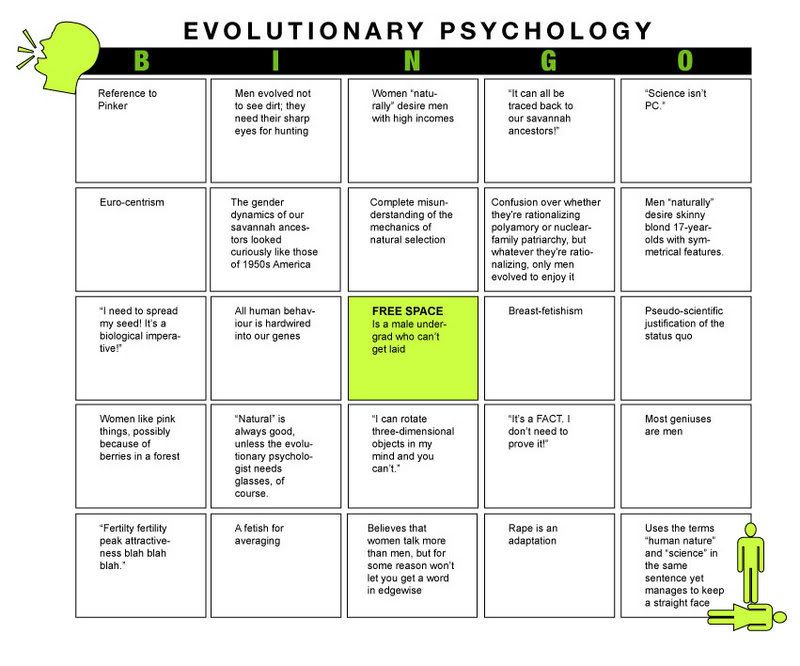
But according to pop science reporters and the researchers they choose to spotlight, nearly every single modern joke about the differences between men and women stems from millennia-old evolutionary adaptations.  (Indeed, the Telegraph article claims that the female proclivity for detecting color helped our foremothers with gathering berries.  Always with the damn berries… )  As stated in the graphic below, such reports all too often suggest that prehistoric society on the African savannah looked just like something Don Draper or Phyllis Schlafly would have designed:

Men hunt, women nest, and every macho social pattern we see today has been passed down to us from our prehistoric ancestors.  Even though historians find that these patterns, like our racial categories, are barely more than two centuries old, if that.  And that the gender binary is far from universal.  Misinterpreting scientific findings is just as dire as ignoring them. 

When it comes to what women and men can and can’t do, neuroscientist Lise Eliot notes, “Expectations are crucial.”  When boys and young men grow up in a culture that mocks their supposed incompetence in all things domestic (“Guys don’t do that!”), it comes as no surprise that only the most self-confident will pursue any interest they have.  Meanwhile, studies show girls perform as well as boys do in math and science until they reach puberty.  Maybe the onset of menstruation paralyzes our visual-spatial intelligence because we’ve got to get picking those berries, or maybe girls pick up on the not-so-subtle message that guys think coquettish beauty is more important than nerdy brains in the dating game.  (For more details on the sexism faced by aspiring female scientists, see Cordelia Fine’s excellent book, Delusions of Gender.)  In her research, Dr. Eliot finds only two indisputable neurological differences between males and females:

1) Male brains are 8% to 11% larger than females’.

2) Female brains reach maturation earlier than male brains. 

All other neurological studies that find major differences between the sexes are studies of adults: i.e., the people most shaped by their culture and society.  Only cross-cultural studies of adults can isolate nurture from nature.  In any case, Eliot is a proponent of neuroplasticity, the idea that the pathways and synapses of the brain change depending upon its environment and the neural processes and behaviors it engages in.  In other words, painting or gaming from an early age or frequently throughout your life will condition your brain to do these tasks and related ones well.  It explains why the gender roles of a given time and place are so powerfulwhy mastering unfamiliar tasks is an uphill climb for men and women but also why countries committed to equality have the narrowest gender gaps. 

“Plasticity is the basis for all learning and the best hope for recovery after injury,” Eliot writes.  “Simply put, your brain is what you do with it.”  For more, see her brilliant parenting book, Pink Brain, Blue Brain: How Small Differences Grow into Troublesome Gaps—and What We Can Do About It.   

But I’ll never believe that a neuroscientist has all the answers.  I live in a country that showed the world the dangers of hastily trying to trace all social patterns back to biology.  As a result, the media here in Germany is usually much more reticent to casually toss around arguments like those in The Telegraph or The Times or Medical Daily.  Natural scientists have made discoveries like neuroplasticity and limb-lengthening that are crucial to progress, but social scientists have discovered that equality and empathy are crucial to any society that values peace and respect over power and greed. 

Or, in other words.


Interpreting History Part II: Oppression Has Never Been Universal

5 Aug

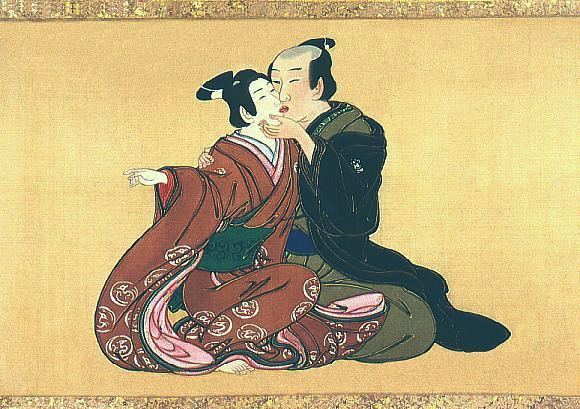
(“Samurai Kiss” via)


Nothing divides a country quite like a national holiday.  When I was studying in St. Petersburg ten years ago, there was as much apathy as there was celebration on the Russian Federation’s June 12th decennial.  German reactions to Reunification Day every October 3rd are anything but united.  And on the United States Fourth of July last month, Chris Rock tweeted, “Happy white peoples independence day, the slaves weren’t free but I’m sure they enjoyed fireworks.”

Amid the outbursts of “unpatriotic!”, conservative blogger Jeff Schreiber shot back, “Slavery existed for 2000yrs before America. We eradicated it in 100yrs. We now have a black POTUS. #GoFuckYourself.” 

Schreiber has since written a post on his blog, America’s Right, apologizing for cursing and conceding that the slave trade was unconscionable.  But for all his insistence that he never intends to diminish the horrors of American slavery, he adds that President Obama’s policies are now “enslaving Americans in a different way.”  (Real classy.)  And for all his reiteration that slavery was always wrong, he still hasn’t straightened out all the facts skewed in his Tweet.

“Slavery existed for 2,000 years before America.”  He uses this supposed fact to relativize the oppression, as if to shrug, “Well, everyone was doing it back then.”  His tweet implies that the ubiquity of the slave trade makes America’s abolition of it exceptional, not its participation.  This argument hinges on fiction.  Slavery did not exist for 2,000 consecutive years.  In the West, it was pervasive in Antiquity and the Modern era, but it was downright uncommon in the Middle Ages.  (While anathema to our modern ideas of freedom for the individual, medieval serfdom was not slavery.)  Slavery was re-instituted in the West roughly 500 years ago with the advent of colonialism.  And the United States held on to it long after most other colonial powers had abolished it.  Critics can say what they want about the effectiveness of Chris Rock’s rain-on-a-parade tactics, but his argument did not distort history.      

In my last post, I argued the risks of concealing the human rights abuses of the past for the sake of nostalgia, if anything because it is the height of inaccuracy.  But portraying history as an unbroken tradition of straight, white, able-bodied male dominance like Schreiber did is also inaccurate.  The universal human rights movement in its modern form is indeed only a few decades old, but the idea of equality for many minorities can be found all over in history at various times and places.  The Quakers have often been pretty keen on it. 

And almost no minority has been universally condemned.  People with dwarfism appear to have been venerated in Ancient Egypt.  Gay men had more rights in Ancient Greece and in many American Indian societies than in 20th century Greece or the United States.  Muslim women wielded the right to divorce long before Christian women.  English women in the Middle Ages were more educated about sex than their Victorian heiresses.  Much of the Jewish community in Berlin, which suffered such unspeakable crimes culminating in the mid-20th century, were at earlier times better integrated into the city than Jewish people were in many other capitals of Central Europe.  In short, history does not show that racism, misogyny, homophobia, ableism, transphobia, and our current beauty standards are dominant social patterns only recently broken by our ultra-modern culture of political correctness.  The oppression of minorities may be insidious and resilient throughout history, but it has never been universal. 

Downplaying the crimes of the past by claiming everybody did it is both historically inaccurate and socially irresponsible.  It is perverse when such misconceptions fuel arguments for further restrictions on human rights.  In 2006, Republican Congress member W. Todd Akin from Missouri claimed that, “Anybody who knows something about the history of the human race knows that there is no civilization which has condoned homosexual marriage widely and openly that has long survived.”  Even if this were true, the argument is absurd.  (It appears that no civilization has regularly chosen women with dwarfism for positions of executive power, but does that mean it’s a bad idea?)  But the argument collapses because it relies on facts that are untrue.

Granted hyperbole is a constant temptation in politics.  Stating things in the extreme is a good way to grab attention.  In an earlier post on sex, I asserted that mainstream culture assumes women’s sex drive is lower than men’s because female sexual expression has been “discouraged for millennia.”  Patriarchy has certainly been a major cultural pattern around the world and throughout history, and we cannot emphasize its power on both the collective and individual psyche enough.  But patriarchy is by no means a cultural universal.  Ethnic groups in Tibet, Bhutan, and Nepal continue to practice polyandry into the present day, while history shows many others that have done the same at various times.  These exceptions question the biological theory that heterosexual male jealousy is an insurmountable obstacle to sexual equality.  And prevents any conservative excuse that insists, “Everybody’s been doing it.”    

They haven’t been.  Xenophobia has never been universal.  Humans may have a natural fear of the unfamiliar, of what they perceive to be the Other, but our definitions of the Other change constantly throughout time and space, as frequently and bizarrely as fashion itself.   This makes history craggy, complex, at times utterly confusing.  Like the struggle for human rights, it is simultaneously depressing and inspiring.  But whatever our political convictions, we gotta get the facts straight.

Despite what Stephen Colbert says.


Interpreting History Part I: Count Me Out

29 Jul

alter ego(Image by Bob May used under CC license via)


Anytime my partner and I don’t know what to do or say, one of us asks, “What’s in the news?” and we dive into a political discussion.  So it’s no surprise that we’ve become somewhat embarrassingly addicted to Aaron Sorkin’s The Newsroom.  The news media has been (unsurprisingly) critical of a show founded on the idea of chastising the news media.  Feminists have been (sometimes rightly) critical of its portrayal of women.  The show has almost countless strengths and weaknesses, but I find myself still obsessing over the brilliant, captivating opening scene that kicked off the series.  If you can’t this clip, it basically boils down to a flustered news anchor named Will McAvoy overcome with disgust at the state of the nation and nostalgia for the 1950s and 60s: “America’s not the greatest country in the world anymore,” he sighs.  “We sure used to be.”

We stood up for what was right.  We fought for moral reasons.  We passed laws, we struck down laws for moral reasons.  We waged wars on poverty, not poor people.  We sacrificed, we cared about our neighbors.  We put our money where our mouths were, and we never beat our chests…  We cultivated the world’s greatest artists and the world’s greatest economy.  We reached for the stars, acted like men.  We aspired to intelligence.  We didn’t belittle it.  It didn’t make us feel inferior…  We didn’t scare so easy.     

“Nostalgia” literally means “aching to come home.”  It’s the temporal form of homesickness, time rather than place being the source of pain.  We all do it.  It can be oddly soothing at times to be in awe of another era, especially the one you were born in.  But Will McAvoy should watch Woody Allen’s Midnight in Paris for proof that nostalgia is an ultimately futile pastime that every sad sack of every era has hopelessly indulged in.  (If “things were better back in the day,” then how come every generation says this?)  But since McAvoy’s nostalgia is an earnest, political battle cry, heaping laurels on the good old 1950s and 60s when the leaders of the day did their job right, I’m more inclined to have him watch Mad Men.  Or just open up the 1960 children’s illustrated encyclopedia I found at my great aunt’s house, which states, among other things: “The Australian aborigine is similar to the American negro in strength, but less intelligent.”  Didn’t scare so easy, indeed.     

The problem with nostalgia is that it is far more emotional than intellectual and thereby lends itself to inaccuracy all too easily.  America was indeed doing great things sixty years ago.  And reprehensible things.  We hid our disabled and gay citizens away in institutions, asylums and prisons.  We enforced the compulsory sterilization of mentally disabled and Native American women.  We took decades to slowly repeal segregationist laws that the Nazis had used as models.  We maintained laws that looked the other way when husbands and boyfriends abused their partners or children.  In short, we handed out privilege based on gender, sexuality, ethnicity, religion, physical and mental capabilities with far greater frequency and openness than we do today.  Perhaps we were the “greatest country in the world” compared to the others.  (Europe and East Asia were trying to recover from the devastation of World War II, after all, while other nations were trying to recover from the devastation of colonialism.)  But McAvoy’s wistful monologue is much more a comparison of America Then with America Now.  And that is hard to swallow when considering that a reversion to that society would require so many of us to give up the rights we’ve been given since then.   

Am I “another whiny, self-interested feminist” out to bludgeon the straight, cis, WASPy male heroes of history?  Am I “just looking to be offended”?  No, I’m struggling.  Next to literature and foreign languages, history has always been my favorite subject.  And pop history always touches upon this question:

“If you could go back to any period in history, which would it be?” 

From an architectural point of view?  Any time before the 1930s.  From an environmental point of view?  North America before European contact.  From a male fashion point of view?  Any period that flaunted fedoras or capes.  From a realistic point of view?  No other time but the present.  Because if I am to be at all intellectually honest in my answer, there has never been a safer time for me to be myself. 

Last year, I read The Lives of Dwarfs: Their Journey from Public Curiosity To Social Liberation by Betty Adelson.  Despite my love of history, I hated almost every minute of it.  Lies my Teacher Told Me by James Loewen had helped me understand how so many black American students feel uninspired by U.S. history and the figures we hold up as heroes because so many of those men would have kept them in shackles.  But it wasn’t until I read The Lives of Dwarfs that I understood how nasty it feels on a gut-level to face the fact that most of history’s greatest figures would more likely than not consider you sub-human. 

With the exception of Ancient Egypt, my own lifetime has been the only period wherein someone with dwarfism could have a fair chance of being raised by their family and encouraged to pursue an education and the career of their choice, as I was.  At any other point in Western history, it would have been more probable that I would have been stuck in an institution, an asylum or the circus (the Modern Era before the 1970s), enslaved by the aristocracy (Rome, Middle Ages, Renaissance) or left for dead (Ancient Greece).  Of course inspiring cases like Billy Barty show that a few courageous/decent parents bucked the trends and proved to be the exception to the rule, but that’s what they were.  Exceptions. 

I am fortunate to have been born when I was and for that reason, nostalgia for any other period in time can never be an intellectually honest exercise for someone like me.  The moment someone says, “Yeah, well, let’s not dwell on odd cases like that.  I’m talking about the average person,” they’re essentially saying, “Your experience is less important than mine.”

Everyone is entitled to have warm, fuzzy feelings about the era in which they grew up.  If any period can put a lump in my throat, it’s the 1970s.  The Sesame Street era.  The boisterous, primary-colored festival flooded with Williams Doll, Jesse’s Dream Skirt, inner city pride à la Ezra Jack Keats, and androgynous big hair all set to funky music can evoke an almost embarrassing sigh from me.  Donning jeans and calling everyone by their first name, that generation seemed set on celebrating diversity and tearing down hierarchies because, as the saying goes, Hitler had finally given xenophobia a bad name.  Could there be a more inspiring zeitgeist than “You and me are free to be to you and me”? 


But I’m being selective with my facts for the sake of my feelings. 

Sesame Street and their ilk were indeed a groundbreaking force, but it was hardly the consensus.  Segregation lingered in so many regions, as did those insidious forced sterilization laws.  LGBT children were far more likely to be disowned back then than today—Free To Be You And Me had nothing to say about that—and gay adults could be arrested in 26 states.  The leading feminist of the time was completely screwing up when it came to trans rights.  Although more and more doctors were advocating empowerment for dwarf babies like me, adult dwarfs faced an 85% unemployment rate with the Americans with Disabilities Act still decades away.  And Sesame Street was actually banned in Mississippi on segregationist grounds.  When the ban was lifted, its supporters of course remained in the woodwork.  We have made so much progress since then.  It would be disingenuous for me to ignore that simply for the sake of nostalgia. 

To be fair to Sorkin, it’s a hard habit to kick.  We have always glorified the past to inspire us, no matter how inaccurate.  Much of American patriotism prides itself on our being the world’s oldest democracy, but we were not remotely a democracy until 1920.  Before then, like any other nation that held free elections, we were officially an androcracy, and of course we didn’t guarantee universal suffrage until the Voting Rights Act of 1965.  That my spellcheck doesn’t even recognize the word “androcracy” signifies how little attention we afford our history of inequality.  But we have to if accuracy is going to have anything to do with history.  A brash statement like “We sure used to be [the greatest country in the world],” as a battle cry for self-improvement is asking to be called out on the inanity of this claim. 

Everyone is entitled to appreciate certain facets or moments in history, just as everyone is entitled to look back fondly upon their childhood.  Veracity falters, however, with the claim that not just certain facets but society as a whole was all-around “better.”  This is never true, unless you’re comparing a time of war to the peacetime preceding it (1920s Europe vs. 1940s Europe, Tito’s Yugoslavia vs. the Balkans in the 1990s), and even then the argument is sticky (Iraq during the insurgency vs. Iraq under Saddam Hussein).  In the words of Jessica Robyn Cadwallader, concealing the crimes of the past risks their reiteration.  Whenever we claim that something was socially better at a certain point in history, we must admit that something was also worse.  It always was. 

But such a sober look at the past need not be depressing.  It reminds me how very grateful I am to be alive today.  My nephews are growing up in a society that is more accepting than almost any other that has preceded it.  That is one of helluva battle cry.  Because what could possibly be more inspiring than history’s proof that whatever our missteps, things have slowly, slowly gotten so much better?


Body Image Part I: The Ick Factor of Certain Bodies

2 Jun

Contemporary pair(Image by Luca Rossato used under CC via)


“Did you do it to function better or to look normal?” 

This is Number One question about limb-lengthening for people with dwarfism, and it opens the Pandora’s box of Body Image, a topic that, no matter who you are, lends itself to resolution no more easily than does Religion.  But as I begin a series on the depths of our own feelings about our bodies, I want to first tackle the biggest influence of our self-worth: i.e., others’ opinion.  After all, if we were fully convinced that no one else cared one bit what we looked like, how much would we care?

The answer to that may not be easy, but the Number One reason why any of us care what others think about our looks certainly is.  It’s all about Dating.  Getting laid.  Finding a mate.  Every parent of a child with dwarfism is warned at Little People of America meetings that whatever ostracizing goes on in elementary school will be outdone by the perils of puberty.  The mainstream often dismisses this as an unfortunately natural stage of development, but people designated as minorities by the mainstream know that it is merely an introduction to what lies beyond adolescence.  Too often the adult world dodges any responsibility it bears for the lookism young people embrace. 

Whether following conventional or unconventional beauty standards, adults obsess over unattractiveness.  We are simply less blunt than teenagers, but therein all the more insidious, disguising our trashing of others as the (pseudo-)philosophy of having a “type”:  

I just need a really well-built man.  I can’t get into skinny guys.” 

I mean, I don’t want to be taller than my man.  No one does.” 

I’d honestly be grossed out if I found out my date was transsexual.

I do not like hairy bodies.” 

Whatever.  We all do it, but we do it way too much.  Most of us can see patterns to our attractions, but the more we talk about it, the more we cultivate it in our minds, convincing ourselves that it’s what we need in order to be turned on.  Which at best really does nothing—does it really help to weed out people in a crowd based on their bodies before we even talk to them?  is there some efficiency to dating that you get points for?—and at worse, limits our experiences and nurtures the dangerous misconception that beauty standards are immovable objects. 

A coworker of mine once claimed, “I’m not racist, but I’m just not attracted to black girls.”  Dude.  Forgetting for a moment that starting any sentence with “I’m not a racist, but—” is possibly one of the least convincing ways to exonerate yourself, are you sure of this because you’ve never been attracted to black girls before?  By that logic, I’m just not attracted to Slovakian guys.  Or Sri Lankan guys.  Or Cornish guys.  Or Oklahoman guys.  Or… wait a minute, this could go on for a while.  Even if you are set in your ways and for some reason believe this helps you, what good does it do to voice it? 

Granted faces and bodies evoke visceral feelings that transcend reason.  Attraction itself is never a choice.  But history has proven that disgust at the idea of interracial or international relationships is the result of social conditioning, and likewise homophobia, transphobia, lookism and ableism thrive thanks to the open support they are given in the media and in everyday conversation.

The battle against lookism is too often dismissed as hopeless by the simplified assertion that “people like to look at pretty people, end of story.”  Yes, we do.  But the definition of “pretty” is too often assumed to be universal, somehow rooted in our biological urge to choose a mate whose genes are resilient.  Studies of history and across cultures prove the definition is socially constructed.  Pale has been considered at times beautiful and at other times sickly.  Tan has been sometimes seen as gorgeous and other times derided on racist grounds.  Round and curvy is sometimes good and sometimes bad.  Skinny is sometimes good and sometimes bad.  Our supposedly “natural” repulsion at signs of unhealthiness is as random as fashion itself, often disenfranchising disabled individuals while simultaneously promoting faces injected with poison, lungs too constricted to breathe properly, bodies too lacking in fat to menstruate, not to mention blue and green eyelids.  Mentioning our repulsion at others’ natural physical features can be so unproductive, so paranoia-inducing, so ultimately responsible for others’ self-hatred.  This why I admire anyone who fights whatever temptation they have to describe what they dislike by instead describing what they love. 

When we tell our loved ones what exquisite hair or adorable hands or gorgeous eyes they have, it’s more a display of affection than a statement of what we require to be intrigued.  When we tell someone, “You are so beautiful,” it’s a testament to the sum of their parts, the combination of their perfections and imperfections.  And there’s nothing wrong with discussing styles or personas one finds attractive.  Gentle voices, deep voices, explosive laughter, sly eyes, short hair, long hair, a graceful step, a firm step, an assertive look, a cool stance; understanding why any of this draws one in leads to more awareness of one’s own character.  It also sparks dialogue that challenges the bland beauty standards of the day. 

But someone’s physical traits alone are superficial—not to mention transient—and placing any real value on them is shallow.  We all have our shallow sides, but we should be embarrassed to advertise them too openly, the way sitcom directors should be embarrassed to have the audience squeal when two characters kiss.


Celebrating Even What’s Long, Long Overdue

12 May

Equality, Difference(Image by Nikole Handel used under Creative Commons license via)


“Justice is what love looks like in public.”

—Cornel West

Unless you’ve somehow managed to ignore all Western media except my blog this week, you know that Obama has become the first sitting U.S. president to voice full support for marriage equality.  As expected, opponents of the cause are united in their outrage, while supporters are split between those who see a social victory and those who see mere political calculation. 

I understand the cynical/frustrated reaction.  When it comes to any issues of equality and civil rights, the idea that At last the president considers you a full human being! can feel like ice cold comfort.  The idea that you have to “wait” for a majority to grow to accept you as you are, that support for your rights is considered politically “risky” or “courageous” is supremely depressing.  The idea that you should be “grateful” to anyone for believing that the way you were born is as valid as the way they were born can be soul-crushing.  I love my parents to pieces, but I don’t like thinking I should thank them for not dumping me in an institution or an orphanage at birth, as so many other parents of dwarfs have done.

But to see the struggle toward justice only in these harsh terms, however true they may be, is to ensure that the entire process will be nothing but painful.  It is the right of any disenfranchised person to do so, but they should always understand that when others celebrate, it’s comes from self-preservation, from the need to transform pent-up fury into explosive joy when an opportunity finally arises.    

When Obama was elected, it would have been entirely valid to view the historic moment only as a cruel reminder of America’s long history of injustice: What kind of a nation takes 230 years to consider someone with a certain skin color electable?!  But very few Obama supporters—black or white—saw it this way.  When the votes came in on November 4th, 2008, when the state that had only 41 years before fought all the way to the Supreme Court to keep interracial couples apart ended up swinging left and ensured that night that the next president would be the son of just such a couple, we were shocked.  And the shock felt fantastic.  All the exhausting work that went in to combating those 230 years of injustice had to come out somehow and most felt they had little choice about the tears streaming down their face.

That’s why I’ve found myself beaming at this week’s headlines emblazoned above the president’s likeness.  I did the same in the summer of 2003 when my radio told me that nine judges had just ruled that gay men and women were no longer allowed to be arrested anywhere in the United States for simply being gay.  Sure it was sickening to consider that just two decades before, nine judges had ruled the other way, upholding Georgia’s right to imprison two men who had been happened upon in their own home by a police officer.  But as I stopped my car to take it all in, I reveled in the fact that, no matter the political calculation or nit-picking bureaucracy involved, bigotry had lost that day.

Whatever his personal beliefs, of which we will never be certain, President Obama has just placed himself on the right side of history.  If one interprets this in the most cynical way—i.e., that he only did it to fire up his base and win votes—it’s our democracy in action, indicating that the majority is leaning toward equality.  (And thank god he didn’t use that phrase “I’ve learned not to judge gays and lesbians,” a cop-out that implies there is something morally ambiguous to judge.)  Bigotry is an inexcusable force that has been obstructing equality for far too long, but it’s losing the battle.  And I can’t think of any better reason to stop, if only just for a moment, and celebrate.


In Comedy, It’s All About Deciding Who’s Us & Who’s Them

28 Apr

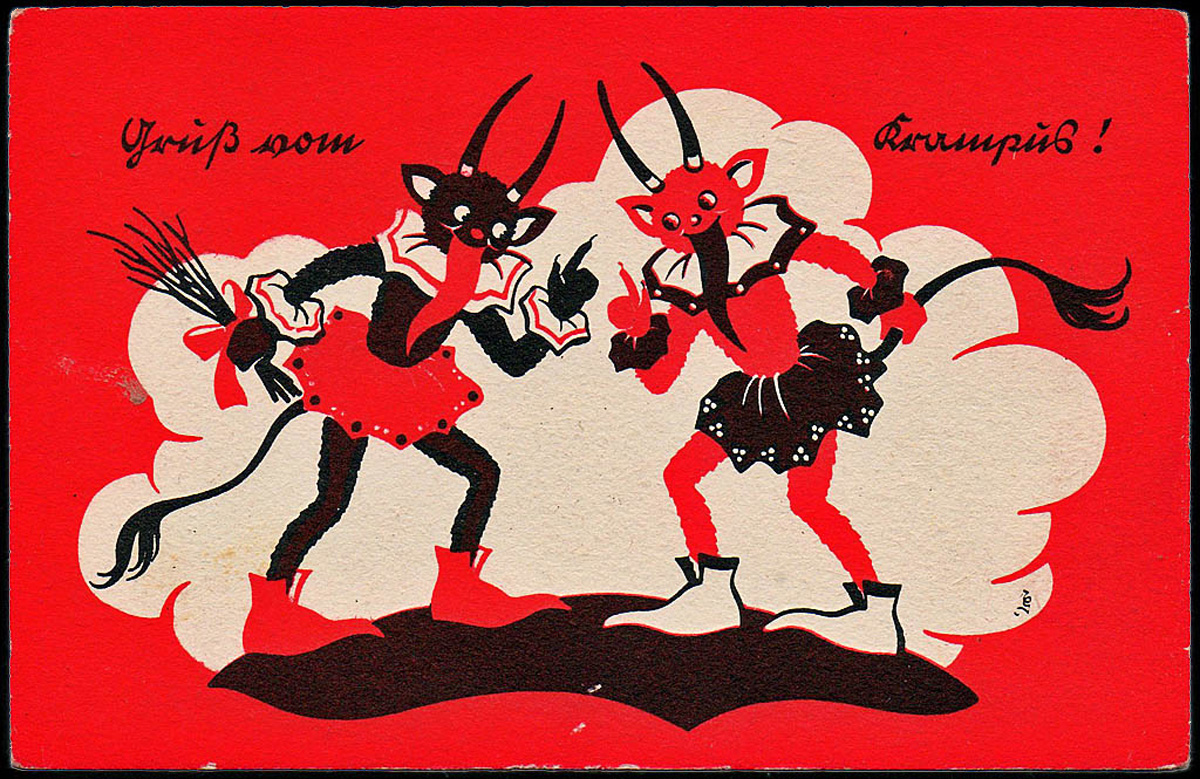
Krampus twins(Via)


The Guardian’s stylebook contains the greatest commentary on style I’ve ever seen in print:

political correctness: a term to be avoided on the grounds that it is, in Polly Toynbee’s words, “an empty right-wing smear designed only to elevate its user.”

Around the same time, while researching the back stories of Life’s Too Short for my review, I came upon the controversy over the word “mong” in which Ricky Gervais found himself embroiled this past fall.  Apparently “mong” is a British English insult derived from “Mongoloid,” the very antiquated and now unacceptable term once used to describe people with Down’s Syndrome.  Both Americans and Brits have probably heard “retard” used the same way.  Gervais eventually apologized to those who objected—including the mother of a child with Down’s Syndrome who has frequently endured the insult—but not without first dragging his heels screaming at what he called “the humorless PC brigade.” 

I will never get over how many comedians insist that any criticism of their work is an indictment of all comedy; as if there’s no such thing as an unfunny comedian, only stupid audiences.  This logic sets the bar for comedy so low that no comedian need ever try to be original.  Ignoring the “PC brigade” (i.e., anyone who doesn’t live with the privileges they do), they can simply regenerate old stereotypes, mining the minstrel shows, the frat houses and the school yards, and if no one laughs at this, it’s simply because we’re all too uptight, right?  Wrong.  We don’t refrain from laughing because we feel we shouldn’t.  We refrain because, unlike the repressed who giggle away in awe, we’ve heard it a thousand times before and we know it’s far from unique.  And isn’t unique what every comedian, entertainer and artist strives to be?   

Like politics, comedy can be divided into two categories: that which confronts our problems with our own selves, and that which confronts our problems with others.  Xenophobia literally means the (irrational*) fear of strangers and the second type of comedy relies upon this fear.  There has to be a “them” for “us” to laugh at.  So Republicans laugh at Democrats.  Hippies laugh at yuppies.  Academics laugh at hippies.  Progressives laugh at bigots.  It’s fair game when beliefs are targeted because we must always take responsibility for our beliefs.  However, when the joke defines “them” as those who have had no choice whatsoever about their distinguishing quality—ethnicity, gender identity, sexuality, physical traits, mental or physical capabilities, or class background—and who continue to be disenfranchised by society’s delusions of normalcy, the joke had better target those delusions to be in any way original.  Otherwise, why pay for cable or tickets to hear someone lazily reiterate the guffaws of playground bullies? 

Every good comedian, from Stephen Colbert to Eddie Izzard to Christian Lander to the writers at The Onion, knows that the best jokes mock people’s hang-ups and clumsy reactions to minority issues, not the mere existence of minorities. My beloved Flight of the Conchords frequently flip gender roles and ethnic stereotypes, exposing the absurdity of racism and misogyny.  As the following video demonstrates, 1970s machismo has been begging to be made fun of.  However, when it comes to physical Otherness, it is the body—not fearful attitudes toward it—that they choose to snicker over, 54 seconds into the video:


Hermaphrodite?  Really?  An intersex kid’s medical reality is your toy?  C’mon, Conchords.  You’ve proven you’re great at making fun of white Kiwis tripping over Maori culture.  (“Jemaine, you’re part Maori…  Please be the Maori!  If you don’t do it, we’re gonna have to get Mexicans!”)  Surely you could come up with some good bit about hipster comedians clinging to lookist and ableist jokes like teddy bears and throwing temper tantrums when they’re taken away.  Or take a tip from Mitchell & Webb and take a jab at the way the ableism of reality TV masquerades as sensitivity:


Of course comedians have the right to make jokes objectifying minorities.  But I’m more interested in why they feel the need to, why they choose to objectify some people and not others.  Being gay, disabled, trans, intersex or non-white is not inherently hilarious to anyone who doesn’t live their lives sheltered from anyone unlike them.  The American freak shows of P.T. Barnum and the racist British sitcoms of the 1970s signify not just how profoundly disenfranchised minorities were in these countries, but how absurdly provincial audiences must have been in order to be so easily titillated.  Many comedians who reiterate chauvinist jokes argue that in doing so they are pushing the boundaries, expanding freedom of thought in defiance of PC oppression, when in fact they are merely retreating to well-trod ground, relying on ideas that challenge nothing but the very young idea that minorities deserve to be included in the dialogue as speakers, not objects.  As Bill Bryson has pointed out, the backlash against “political correctness” took place the moment the idea was introduced and has always been far more hysterical than what it protests.   

Toni Morrison has said, “What I really think the political correctness debate is really about is the power to be able to define.  The definers want the power to name.  And the defined are taking that power away from them.”  Revealing that it is all about power explains why emotions run so high whenever minorities get upset by certain jokes and comedians get upset about their being upset.  But this redistribution of power can be productive.  Taking old slurs and xenophobic tropes away from today’s politicians and comedians challenges them to think beyond their own experience and to wean themselves off society’s long-held fears, to redefine “them” as those enslaved by the limits of their imagination; in essence, to really push the boundaries.  Yet too often they default to the tired claim that this challenge infringes on their right to free speech. 

Some progressive critics do bring on the censorship accusation by using the ineffective phrase “You can’t say that!” and sometimes this is indeed an open attempt at censorship because most media outlets self-censor.  For example, Little People of America has called for the Federal Communications Commission to add “midget” to its list of words you can’t say on television.  I understand the temptation to insist upon the same treatment afforded other minorities: If certain ethnic and gender slurs are banned by newspapers and TV networks, why not others?  But this tactic too easily insults those other minorities—are you claiming black people have it easier than you?—and creates the concept of a forbidden fruit that will only tantalize right-wing politicians and shock jock comedians.  Simplifying the issue into Good Words/Bad Words can be a waste of an opportunity.  Instead of limiting itself to which words are always unacceptable regardless of context or nuance, the dialogue should always aim to reveal which minority jokes truly blow people’s minds and which lazily replicate institutionalized chauvinism. 

Instead of splitting hairs over the modern meaning of the word “mong,” I’d love it if a comedian went at the fact that Dr. Down came up with the term “Mongoloid” because he thought patients with the diagnosis resembled East Asians.  Because really.  Who’s asking to be made fun of here?


* “Phobia” always indicates an irrational fear, hence arachnophobia, agoraphobia, claustrophobia, homophobia, etc.  Fears that are well-founded are not phobias.

Female Privilege

14 Apr

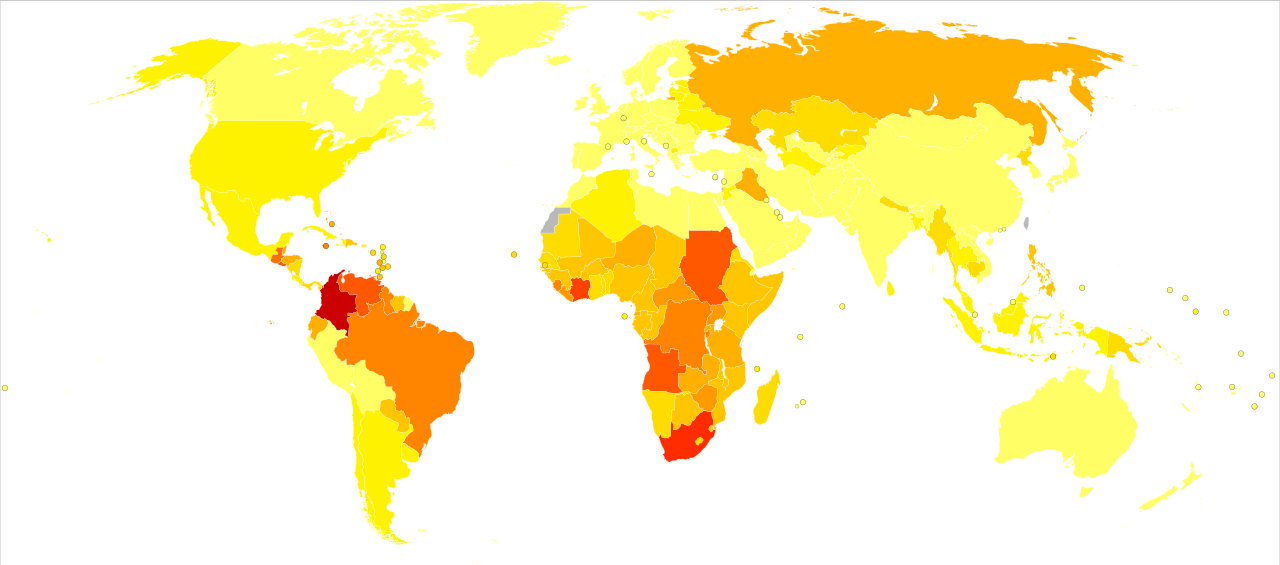
(Rates of violence worldwide, used under CC license via)


Recently at Feministing, Cara Hoffman wrote about violence that targets men, setting off an angry debate. Most commenters rightly supported the idea of feminism openly discussing the ways in which men are specifically victimized, but there were some who said this had no place in the movement. Such a women-only approach to feminism is indeed sexism that, like male chauvinism, will never be successful as long as it is determined to concern itself with only one half of the population. The hero and heroine gender tradition oppresses men, women and those who identify as neither. As women, we should never be so insecure as to ignore anyone’s true disenfranchisement or to deny the privileges patriarchy automatically bestows upon us.  

Yes, being female comes with certain privileges under patriarchy. (And no, I don’t mean Phyllis Schlafly’s you-get-your-restaurant-meals-paid-for-so-be-happy-staying-out-of-the-workforce sort of “privilege.”) Privilege is granted by society to certain people based on things we had absolutely nothing to do with: our gender identity, our ethnicity, our sexuality, our physical traits, our mental capabilities, our class background. That is why any privilege—like any form of disenfranchisement—is the essence of injustice. 

Men face oppressive double-standards in dating and the family unit that I will address in a later post, but, in the wake of the arrest of Trayvon Martin’s killer, I want to focus for now on prejudices against men that are truly life-threatening. Beginning at the personal level, my husband has been beaten up twice by strangers. My brother and several guyfriends have been attacked outside clubs by strangers. Others were shoved down the stairs and slammed against lockers in school by bullies. I’ve never once been challenged to fight as they have, just as they have never experienced sexual harassment as I have. Of course far too many women are beaten by both men and other women, just as far too many men are sexually assaulted by both women and other men, but my personal experience and my husband’s are representative of the increased risk each of us face for certain kinds of attack in our society. There’s no need to try to decide which is worse: the threat of sexual assault or the threat of coming to blows. Both can end in the worst possible way, both are always inexcusable. Both target people based on their apparent gender. 

As a woman, I am far less likely to be challenged to fight or to be suspected of violence by authorities. As a woman, I am automatically more trusted to be around children. As a woman living in the United States and Europe, I have never been asked to die for my country.  As a woman, I can express more affection to a member of my gender without fear of gay bashing than a man can. As a woman, I can buy products of any color without fear of gay bashing. As a woman who’s not physically strong, I don’t have to worry as much as a man does about being picked on by bullies looking for an easy target. As an achondroplastic woman, I’ve always been less likely to be confronted by an assailant looking to engage in dwarf tossing than an achondroplastic man is. As a woman, I am permitted to choose emotional fulfillment over professional success without being considered a failure. This is why homeless women attract less contempt than homeless men. And part of why men are three times more likely to commit suicide than women. 

In a previous post discussing female sexuality, I quoted Chloe S. Angyal’s point that traditional gender roles consider sexuality a no-win situation for women, that any type of behavior we choose can be seen as an invitation to sexual assault. For men, the same Catch-22 can apply for men regarding violence. Looking tough? You’re a threat that needs to be knocked down. Looking vulnerable? You’re the perfect victim to pounce on. If you are identifiable as a minority through your appearance or behaviors, you’d better make sure you avoid the wrong parts of town, which, in some cases, may include your entire home town or country. Or shoot first. 

Like the virgin/whore cycle with which women are encumbered, men are confronted with the brute/wuss standard from the earliest of ages. You’re a monster if you use your fists to solve your problems, but you’re a sissy if you can’t. Non-violent young men must endure society’s suspicion that they are prone to be violent while at the same time enduring their own vulnerability as a victim of violence. The reality of violence against women can never be denied or downplayed, but neither can violence against men, who are 2 to 4 times more likely to be killed by violence than women. Because of the pressures of the traditional model of masculinity, men are far less likely than women to seek help after being threatened or assaulted. 

Most violence enacted upon boys and men is by other boys and men, and this proves that, as with violence against women, the solution is not to condemn a gender, but to condemn an attitude. Googling “female privilege” results in some very creepy websites, wherein men rage about women who won’t sleep with them after they held the door for them, and patriarchy relies on this polarization of the genders for survival.  Despite what so many of those misogynistic websites claim, women who identify as feminists demonstrate less hostility toward men than women who embrace traditional gender roles because we know that those traditions screw everyone over, including men.  That’s why we unite with men against them, taking them apart bit by bit, non-violently.    


Four Tiers of Fear

31 Mar


“How DARE you call me a racist!” 

We’ve all heard that one before, and it’s becoming ever more frequent with the debate over Trayvon Martin’s death.  Marriage equality opponents have been adopting the same tone over the past few years, claiming “homophobic” is now an insult.  In the video posted above, Jay Smooth makes an excellent argument for shifting the focus from criticizing actions instead of people in order to spark more productive dialogue about racism and this can be applied to any discussion about xenophobia. 

But outrage at any charges of xenophobia is not only an issue of grammar.  This outrage usually relies on the assumption that “racist” or “homophobic” automatically denotes a Neo-Nazi level of vitriol.  (This is why it’s frequently accompanied by the protest, “Some of my best friends are black/gay/dwarfs!”)  The outrage silences any discussion about the more insidious forms of chauvinism, and this is the very discussion that needs to happen, because the most insidious forms are the most ubiquitous. 

Most people who harbor transphobic, racist, ableist, sexist, lookist, ethnocentric or homophobic views are not Neo-Nazis.  Most would never physically harm anyone, and as Jay Smooth demonstrates, most would never admit to being xenophobic.  My theory is that chauvinism appears in society today in four different forms:

***

1. Violence: Both organized and individual violence, though of course the more organized, the more terrifying.  (The Southern Poverty Law Center reports this month that hate groups are on the rise in the United States.)  A hate crime should not necessarily be punished more severely than any other case of assault or murder, but its designation is an essential counter-statement by society to the statement the violence was intended to make.  While the most horrific form of xenophobia, violence is also the least common.

2. Overt Animosity: Harassment and disrespect that falls short of violence.  It’s insulting someone to their face, knowingly using slurs, arguing in earnest against someone’s human rights.  It’s refusing to hire, date or talk to someone because they belong to a certain ethnic group, or because they do not belong to a certain ethnic group.  It’s parents disowning their children for being gay, trans or disabled.  It’s the guy I witnessed at the mall yesterday who tapped a Chinese woman on the shoulder, closed his eyes and babbled, “Ching-chong-chang!” before dashing off.  It’s the Yale Delta Kappa Epsilon fraternity’s pledge, which included the chant, “No means yes!  Yes means anal!”  It’s the New Orleans cop saying Travyon Martin was a “thug and… deserved to die like one.”  Because the intention is either to provoke or dismiss the victim, it’s extremely difficult to find a constructive counter-argument.  Beyond ignoring such provocations because they are beneath us, our only hope is to appeal to any capacity for empathy the offenders may have when they are not in a provocative mood.  Such cruelty always stems from profound personal insecurities.         

3. Covert Animosity: Disrespect behind someone’s back.  This usually occurs when the speaker thinks they are surrounded by their “own kind,” and thus unlikely to offend anyone present with their slurs or jokes.  We’ve all heard at least one relative or coworker talk this way.  Often an environment encourages such disrespect and the peer pressure to join in is high.  Often someone will insult an entire minority privately but be utterly decent when meeting an individual from that minority.  A friend of mine once dismissed a boy band on TV as “a bunch of fags” just hours after he’d been raving to me about my awesome neighbor, who he knew is openly gay.  Sometimes this behavior is excused on the grounds that the speakers are from “a different generation,” an excuse I rarely accept since those with more progressive views can often be found in the same generation.

4. The Xenophobic Status Quo: The stereotypes and privilege that surround us.  Most of us have some of these prejudices without knowing it because we have been bombarded with them from birth on.  It’s the invisibility of minorities in the media and the social segregation in public that causes us to stare when we see certain people.  It’s the jokes that rely on the assumption that all heterosexuals find gay sex, intersexuality or transsexuality at least a little gross.  Or the assumption that physical disabilities, mental disabilities and physical deformities are always tragic and sometimes morbidly fascinating.  It’s the virgin/whore standard to which Western women are still held, leading us to comment far more on the appropriateness of their clothes and promiscuity than on men’s.  It’s our collective misogyny, homophobia and transphobia that converge to make us wonder why a man would ever want to wear a dress, but not why a woman would want to wear jeans.  It’s the prevalence of chauvinist expressions in our language (e.g. “Congressman,” “flesh-colored”) and of chauvinist traditions in our books, films and legends (e.g. our god is a white male) that makes them difficult to avoid and easy to reiterate.  It’s our demanding transgendered people wait for the rest of us to “get used” to the idea of their transitioning instead of questioning our belief in the gender binary.  It’s our view of every person who belongs to a minority not as an individual but as an example representing that minority with every move they make.  It’s the assumption that a difference upsets normalcy in lieu of the concession that normalcy is a delusion.  The privileges bestowed by our society on some members at the exclusion of others, rewarding those who have done nothing but be born with characteristics considered “normal,” are perhaps the most insidious reinforcement of these prejudices.

***

There is a danger to placing too much emphasis on the differences between the four tiers—I never want to end up in a conversation where people’s actions are excused as being “only Tier 4 sexist”—because all four tiers feed off each other.  They don’t exist in a vacuum.  The non-violent ideas of covert animosity and the xenophobic status quo provide confrontational people with a means of choosing their victims.  Conversely, regularly seeing society’s long tradition of hate crimes and public humiliation both in our history books and in our everyday news is what leaves us all dangerously unsurprised by the less belligerent forms of disenfranchisement many of us help perpetuate. 

Yet it is important to distinguish between these manifestations of fear in order to avoid the assumption that only violence and overt animosity qualify as xenophobia.  That assumption lets millions of people off the hook.  You don’t have to belong to the Westboro Baptist Church in order to have homophobic views.  You don’t have to belong to the NPD or the BNP or the Georgia Militia in order to have racist views.  You don’t have to wait in a dark alley for a stranger in order to commit rape.  You don’t have to threaten someone in order to to make them feel unwelcome.  Our society has been built on many xenophobic assumptions, making it very easy for all of us to pick some of them up along the way.  The fight for equality aims to make it more and more difficult, but it needs to be able to recognize its targets and use tactics suitable to each. 

I make these distinctions in the hopes of facilitating the conversation on chauvinism.  Yet it should come as no surprise that chauvinism is difficult to discuss because, in the words of Jay Smooth, it’s a system that has been designed to insult and subjugate.  In other words, it’s hard to speak politely about the idea of being impolite. 


On Not Being Thought of as “Suspicious”

24 Mar

Like many horrified readers, I’ve been following the news of the murder of Trayvon Martin this week, waiting for more information, waiting to see if his case will even be tried.  His killer, George Zimmerman, has yet to be arrested, protected by a seven year-old Florida law called “Stand Your Ground,” which was enacted after hurricane lootings and which essentially promotes vigilante justice.  No matter how the legal system deals with Zimmerman, if at all, Trayvon Martin—like Amadou Diallo before him—will never be able to tell his side of the story. 

Those of us who choke back tears on sight of Trayvon’s picture do so with one thought echoing in our heads: What if it had been me.  Except there is a system in place that makes many of us edit that thought into What if it had been my little brother or What if it had been my best friend because we are automatically less vulnerable, because we are not men and/or we are not black.  That’s what privilege is.  And it tastes terrible to anyone with a conscience.

While the extent to which Trayvon’s killer was willing to pursue an unarmed boy may be exceptional, his prejudice against the boy is anything but.  White privilege does not only give most white people in North America, Oceania and Europe the benefit of the doubt, but it frees us of the burdens of having to represent our race with every step we take in public.  In public we are judged as individuals, not examples. 

Of course younger people will always be eyed with more suspicion of violence than older people, but finding oneself at the intersection of youth, maleness and black ethnicity automatically attracts such suspicion like nothing else.  Unlike President Obama, I’ve never once been followed by security guards simply upon entering a shopping center.  Unlike a friend from Côte d’Ivoire, I can go on vacation anywhere in Europe, even though I’m not a European citizen.  I take these freedoms so much for granted that I view them as basic rights, but since they are only accorded to some citizens, they are privileges

In this NPR article, Corey Dade talks about advice his parents gave him as a young man built on their experience of being black in public in the United States.  Cynicism would consider it just another set of privileges to add my list, but it’s been a while since I’ve read anything so humbling.  I’ve never once worried about police officers surrounding my parents’ house after I went out to retrieve something from the car.  I’ve never had to.  That others do makes me lucky.  In the coldest sense of the word.


The Make-Believe Dwarfs of My Childhood

3 Mar

lookism

(Image by Paul Bailey used under CC license via)


Though it often can be the best way to get a message across, art complicates politics because it mixes matters of taste with matters of justice.  One lends itself to reason, the other doesn’t.  Too often sentimental feelings about a film or song with offensive elements will result in fans denying the offense altogether.  “Little House on the Prairie isn’t racist!  I grew up on it and I turned out fine!”  Maybe you did thanks to your innate curiosity about the experiences of others or inspiring teachers in your life, but you didn’t learn anything valuable about civil rights from that book.  I grew up on Dumbo and I think it is an artistically brilliant film with many good messages, one of which is the problem of lookism.  However, getting a white actor to put on his best black voice to play a character named “Jim Crow” in the heyday of the minstrel shows was a supremely stupid idea.  We shouldn’t deny ourselves our personal tastes, but that shouldn’t preclude calling out the artists’ mistakes.   

Likewise, we shouldn’t cry wolf over artwork that simply doesn’t match our tastes.  I’m one of the few people on earth who doesn’t enjoy The Lord of the Rings—I saw it for the first time in my twenties and fell asleep—but that’s primarily because I get bored by fantasy epics that are predominantly serious.  (I’m not wild about The Chronicles of Narnia either.  If there’s going to be magic, I prefer the tongue-in-cheek tone maintained in the worlds of Roald Dahl, L. Frank Baum or the Pirates of the Caribbean.)  It is sometimes difficult to divorce my dislike of the style from my annoyance that the Lord of the Rings definition of a dwarf receives more attention in almost every corner of our culture than the one based on reality.  Google “dwarf” right now in the image search and see how long you have to wait until a real human being is featured.  But neither Peter Jackson nor J. R. R. Tolkien is solely responsible for this; the latter of course drew this definition from the fantasy tradition.  And the use of dwarfs in fantasy is not always problematic. 

Peter Dinklage has demonstrated that dwarfism is no more important than skin color or foot size in Game of Thrones.  And while I couldn’t sit through Lord of the Rings as an adult, I have a special place in my heart for the 1988 film Willow, which was panned by almost every critic I respect.  Perhaps my nostalgia and childhood crush on Warwick Davis blinds me to the film’s artistic faults, but my enjoyment of it was rooted in politics before I even knew the word “politics.”  Because for once a dwarf was the main character.  And he looked like a real dwarf; he wasn’t wearing any pointed ears or goblin nose or orange face-paint.  And I wanted to be Sorsha, the bad-ass warrior princess.  Yes, she’s a damsel in distress during the final battle, but it’s 3′ 6″ Warwick Davis who wins that battle for her, not buff Val Kilmer. 

While I’m uncomfortable with fantasy’s tradition of insisting that dwarfs are a separate race and thus, in many cases, non-human, I loved Willow for giving both the dwarf-sized people and the average-sized people names free of connotation (“nelwyns” and “dakinis”).  They are neutral words that demonstrate one of the advantages of neologisms.  (Though I’ll admit the film’s line “Stupid dakini!” has echoed in my head at various points in my life.)  The film also uses the fictional word “peck” as the thinly veiled equivalent to “midget,” an insult the eponymous character must endure from dakinis throughout the film, adding more gravitas to his saving the day and personal appeal to dwarf viewers like myself.  Too often in fantasy, physical characteristics are indicative of personality traits.  This is an occasionally racist, always lookist device that disenfranchises hideous hags, macho musclemen, dark demons, pretty princesses, and innocent invalids.  Willow offers a welcome respite.  As sappy and as simple as the message is—anyone can be a hero—it bears repeating.

Speaking of lookist, I also adored Snow White and the Seven Dwarves as a kid.  I always played Snow White, of course—what child doesn’t imagine themselves as the attention-getting protagonist?—but I was also secretly proud that the first feature-length animated film, one of the most famous of the Grimms’ fairy tales, included dwarfs who weren’t ludicrously unrealistic.  They were kind, they had no mysticism and, as much as I loved her and her poufy dress, they had far more personality than Snow White herself.  For these reasons, I didn’t mind using them as an example when children asked me about my size.  My mother once said, “We’ll write to Disney and tell them most dwarfs aren’t bashful or dopey at all!”  I recall at the time wishing she wouldn’t put a damper on a film I loved so much, but now I am grateful to her for fostering such moral vigilance in me.  

Because once I hit puberty, I instantly saw the problems.  Like Disney’s The Hunchback of Notre Dame and scores of other films, Snow White asserts that male characters who are disabled or deformed can never hope to get the girl.  Considered innocent, asexual people, they are doomed to the Friend Zone.  And women with disabilities?  There aren’t many fairy tales about them.  The story emphasizes even in Snow White’s name that looks are everything.   

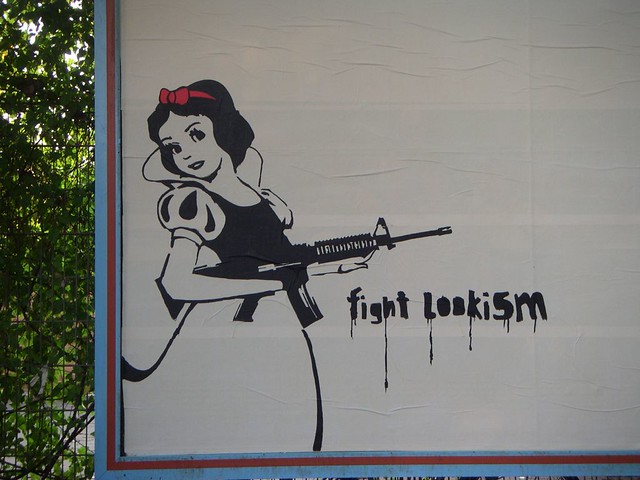
My childhood in combination with my experience with dwarfism endowed me with a nostalgia for stories I nevertheless was forced to analyze critically as I grew up, so I cannot deny either.  Everyone should keep a healthy distance between one’s understanding of the world and fairy tales.  My partner and I used the above image of Snow White on our wedding invitations, although we changed the slogan to “Everyone Is Beautiful”—a lesson I did not learn from Snow White herself, but from learning how my dwarfism conflicted with her.


Working with the F Word

12 Feb

audre lorde rough paper background by Starving ArtistIf you’ve explored this blog, you’ve heard me toss around that lovely word “feminism.”  And I bet a few of you cringed, rolled your eyes or ignored it: “Feminism is the idea that men and women are equal.  We get it.”

Traditional gender roles inflict thousands of double-standards on women and men, and I’ll discuss them in greater detail soon.  But feminism is so much more than that.  Despite the “fem” in feminism, women’s rights are neither the limit nor the core of equality.  As Gloria Steinem recently said, it’s about challenging hierarchies.  It’s about saying, “You’re not the boss of me!”  There is no other word for opposing all hierarchies based on characteristics about which we have no choice: our ethnicity, our sexuality, our race, our gender identity, our class background, our physical traits and capabilities, our mental capacities.  There should be.

Because chauvinism is the common enemy.  Feminism started off aiming to liberate women.  And that includes poor women.  And women of every possible ethnic background.  And in every country.  And women with physical differences and disabilities.  And women with mental disabilities and psychiatric disorders.  And women who are attracted to women.  And women who are attracted to both genders.  And women who transition into their sex.  And those who transition into another.  And those whose biology or sense of self does not correlate to either male or female.  And those who are men.  As a woman with achondroplasia, how could I ignore anyone who is screwed over for the way the way they were born?  As a woman with achondroplasia who chose to undergo controversial limb-lengthening procedures, how could I condemn anyone forced to make deeply personal decisions directly linked to their identity?  And the questions logically expands to: How could anyone?

Do “human rights” or “egalitarianism” adequately imply opposition to any manifestation of chauvinism?  Labels are so problematic.  Internet and library searches for “egalitarianism” usually produce discussions of class and poverty, while “human rights” tends toward macrocosmic, international issues of war, poverty and suffrage.  In effect, these terms can be narrower or broader than feminism.  Yet there are advantages to redefining a well-known term like feminism rather than trying to invent and disperse a new one.  When self-proclaimed feminist Amanda Palmer defended a project objectifying conjoined twins, Sady Doyle at Tiger Beatdown gave her the lecture of a lifetime that sums it up better than I’ve ever heard:

… this “feminism” thing: it’s not for some people, it’s not for you specifically, it’s not a fun little badge you get to slap onto your actions when it suits you. It is a system of carefully worked-out thoughts, which has been developed for many, many years by many thousands of people, and one of the most unavoidable parts of this system, which we can’t get away from if we are thinking for even a second with any ounce of intellectual rigor or honesty, is that everybody matters. Everybody matters precisely as much as you do. Which is why you don’t get to use them as a means of gratifying yourself with attention when the attention is good, or deny them the right to be heard or respected when the attention is bad.

Feminist history is stained with instances of female chauvinism, racism, ethnocentrism, classism, homophobia, transphobia and ableism, and continues to be by the likes of many.  And we’ve got to keep calling that out with the same vigilance we accord any issue.  As the xenophobic view claims that multiculturalism and universal human rights are inefficient and the only battle worth fighting is your own, a non-violent society only functions when based on the concept of reciprocity.  Despite the structures in place that assume otherwise, everybody’s health, job, relationships, sex life, family, and happiness matter exactly as much as yours do.

That’s what the F word means to my husband, my mom and my dad, my sister-in-law, my closest friends, my favorite teachers, and me.  And if that still makes you cringe, if you still find the label too problematic, leave me a well-thought out argument in the comments.