Tag Archives: Language

In the U.S., Paralympic Athletes Might As Well Be “Untitled”

9 Sep

(Via)


The Paralympics end today after a week of what seemed to be decent coverage, though it depended on where you tried to watch them.  The host country allotted 150 hours of coverage to the Games, Australia clocked in 100 hours, and Germany and France allotted 65 and 77 hours respectively.  Meanwhile, the United States broadcast a whopping five and half hours and no live coverage at all, as per tradition.  Yay.

Considering how little attention was afforded the Games themselves, it is unsurprising that there was little dialogue stateside about disability rights and issues of equality.  What a missed opportunity.  The British media immersed itself in it, with articles like “Is it Ok To Call The Athletes Brave?”  Indeed, disrespectful attitudes toward people with disabilities today are more often implicitly patronizing than openly derisive, and it was pleasing to see the public address this.

The Paralympic Guide to Reporting that was handed out to media outlets brought up several interesting points about language.  It rightfully asserts that disabling conditions or features should not be turned into personal nouns that define the entire person or people in question: i.e., the disabled, the blind, a paraplegic.  Adjectives and verbs—a paraplegic athlete, athletes with disabilities—are less limiting, portraying a medical condition as one of many characteristics a person has.  (This has been repeated to me ad infinitum by a friend who’s uncomfortable whenever I refer to myself as a dwarf.  “You are Emily.  You have dwarfism!” he insists.  “And you have hazel eyes and freckles and long hair…”)  Other terms and phrases to avoid noted by the guide include:

normal

able-bodied

wheelchair bound

confined to a wheelchair

suffers from

afflicted with

victim of

The last three are commonly used today.  They’re problematic because they imply that a disability is always regrettable.  Sometimes it is, and sometimes it isn’t.  Suffering may have been an apt term for my achondroplasia two months ago, when severe lumbar pain made it hard for me to think of anything else during a sightseeing trip in England.  But suffering has nothing to do with all the ways in which my condition has brought me in contact with all sorts of unique people and places and outlooks.  I can’t imagine my life without it.  It’s my version of normal.  Unless the patient specifically says otherwise, any assumption that a disability is a round-the-clock tragedy is wrong.

For the sake of splitting hairs, I sometimes think the words disabled and disability are problematic because they automatically draw attention to what a person cannot do.  In the worst case, they can sound pitiful.  I’m very fond of the word typical in lieu of normal or able-bodied because it highlights that the standard by which we group people is based on a body type chosen by the scientific community.  It implies medical averages, not social values.  Typical is used in everyday speech to mean “usual” at best and “unexciting” at worst, unlike normal, which implies a state of correctness worth striving for, like in the phrase “back to normal.”  Discussions of autism and some other psychiatric conditions now commonly use the term neurotypical to refer to people without the diagnoses.  Maybe physiotypical could someday be the term for non-disabled people.

But as I’ve said a few times before, the search for acceptable terms is not about deciding what automatically classifies a speaker as Tolerant or Bigoted.  Words are only half as important as the intentions behind them, and the desire to understand another’s perspective is what separates an empathic person from a selfish one.  In the recent words of Professor Charles Negy, “Bigots… never question their prejudices.”  

The above list of do’s and don’ts is probably disconcerting to some readers.  I always feel simultaneously inspired and confused when given a list of hot-button words I’m told to avoid from now on.  Hell, I’ve written the word able-bodied before, and I’m someone excluded by it.  I find no problem with the word handicapped—I had handicapped housing rights in college and a handicapped parking sticker during my limb-lengthening procedures—but it’s considered offensively archaic in the U.K., apparently similar to invalid or cripple.  As we’ve seen in the midget vs. dwarf vs. LP debate, rarely is there ever a consensus in a given community over labels.  Labels are almost always problematic.  In my experience, the dialogue always matters more than the conclusion it comes to. 

And the inability of the U.S. media to have such dialogue during the Paralympics was pitiful.


In Comedy, It’s All About Deciding Who’s Us & Who’s Them

28 Apr

Krampus twins(Via)


The Guardian’s stylebook contains the greatest commentary on style I’ve ever seen in print:

political correctness: a term to be avoided on the grounds that it is, in Polly Toynbee’s words, “an empty right-wing smear designed only to elevate its user.”

Around the same time, while researching the back stories of Life’s Too Short for my review, I came upon the controversy over the word “mong” in which Ricky Gervais found himself embroiled this past fall.  Apparently “mong” is a British English insult derived from “Mongoloid,” the very antiquated and now unacceptable term once used to describe people with Down’s Syndrome.  Both Americans and Brits have probably heard “retard” used the same way.  Gervais eventually apologized to those who objected—including the mother of a child with Down’s Syndrome who has frequently endured the insult—but not without first dragging his heels screaming at what he called “the humorless PC brigade.” 

I will never get over how many comedians insist that any criticism of their work is an indictment of all comedy; as if there’s no such thing as an unfunny comedian, only stupid audiences.  This logic sets the bar for comedy so low that no comedian need ever try to be original.  Ignoring the “PC brigade” (i.e., anyone who doesn’t live with the privileges they do), they can simply regenerate old stereotypes, mining the minstrel shows, the frat houses and the school yards, and if no one laughs at this, it’s simply because we’re all too uptight, right?  Wrong.  We don’t refrain from laughing because we feel we shouldn’t.  We refrain because, unlike the repressed who giggle away in awe, we’ve heard it a thousand times before and we know it’s far from unique.  And isn’t unique what every comedian, entertainer and artist strives to be?   

Like politics, comedy can be divided into two categories: that which confronts our problems with our own selves, and that which confronts our problems with others.  Xenophobia literally means the (irrational*) fear of strangers and the second type of comedy relies upon this fear.  There has to be a “them” for “us” to laugh at.  So Republicans laugh at Democrats.  Hippies laugh at yuppies.  Academics laugh at hippies.  Progressives laugh at bigots.  It’s fair game when beliefs are targeted because we must always take responsibility for our beliefs.  However, when the joke defines “them” as those who have had no choice whatsoever about their distinguishing quality—ethnicity, gender identity, sexuality, physical traits, mental or physical capabilities, or class background—and who continue to be disenfranchised by society’s delusions of normalcy, the joke had better target those delusions to be in any way original.  Otherwise, why pay for cable or tickets to hear someone lazily reiterate the guffaws of playground bullies? 

Every good comedian, from Stephen Colbert to Eddie Izzard to Christian Lander to the writers at The Onion, knows that the best jokes mock people’s hang-ups and clumsy reactions to minority issues, not the mere existence of minorities. My beloved Flight of the Conchords frequently flip gender roles and ethnic stereotypes, exposing the absurdity of racism and misogyny.  As the following video demonstrates, 1970s machismo has been begging to be made fun of.  However, when it comes to physical Otherness, it is the body—not fearful attitudes toward it—that they choose to snicker over, 54 seconds into the video:


Hermaphrodite?  Really?  An intersex kid’s medical reality is your toy?  C’mon, Conchords.  You’ve proven you’re great at making fun of white Kiwis tripping over Maori culture.  (“Jemaine, you’re part Maori…  Please be the Maori!  If you don’t do it, we’re gonna have to get Mexicans!”)  Surely you could come up with some good bit about hipster comedians clinging to lookist and ableist jokes like teddy bears and throwing temper tantrums when they’re taken away.  Or take a tip from Mitchell & Webb and take a jab at the way the ableism of reality TV masquerades as sensitivity:


Of course comedians have the right to make jokes objectifying minorities.  But I’m more interested in why they feel the need to, why they choose to objectify some people and not others.  Being gay, disabled, trans, intersex or non-white is not inherently hilarious to anyone who doesn’t live their lives sheltered from anyone unlike them.  The American freak shows of P.T. Barnum and the racist British sitcoms of the 1970s signify not just how profoundly disenfranchised minorities were in these countries, but how absurdly provincial audiences must have been in order to be so easily titillated.  Many comedians who reiterate chauvinist jokes argue that in doing so they are pushing the boundaries, expanding freedom of thought in defiance of PC oppression, when in fact they are merely retreating to well-trod ground, relying on ideas that challenge nothing but the very young idea that minorities deserve to be included in the dialogue as speakers, not objects.  As Bill Bryson has pointed out, the backlash against “political correctness” took place the moment the idea was introduced and has always been far more hysterical than what it protests.   

Toni Morrison has said, “What I really think the political correctness debate is really about is the power to be able to define.  The definers want the power to name.  And the defined are taking that power away from them.”  Revealing that it is all about power explains why emotions run so high whenever minorities get upset by certain jokes and comedians get upset about their being upset.  But this redistribution of power can be productive.  Taking old slurs and xenophobic tropes away from today’s politicians and comedians challenges them to think beyond their own experience and to wean themselves off society’s long-held fears, to redefine “them” as those enslaved by the limits of their imagination; in essence, to really push the boundaries.  Yet too often they default to the tired claim that this challenge infringes on their right to free speech. 

Some progressive critics do bring on the censorship accusation by using the ineffective phrase “You can’t say that!” and sometimes this is indeed an open attempt at censorship because most media outlets self-censor.  For example, Little People of America has called for the Federal Communications Commission to add “midget” to its list of words you can’t say on television.  I understand the temptation to insist upon the same treatment afforded other minorities: If certain ethnic and gender slurs are banned by newspapers and TV networks, why not others?  But this tactic too easily insults those other minorities—are you claiming black people have it easier than you?—and creates the concept of a forbidden fruit that will only tantalize right-wing politicians and shock jock comedians.  Simplifying the issue into Good Words/Bad Words can be a waste of an opportunity.  Instead of limiting itself to which words are always unacceptable regardless of context or nuance, the dialogue should always aim to reveal which minority jokes truly blow people’s minds and which lazily replicate institutionalized chauvinism. 

Instead of splitting hairs over the modern meaning of the word “mong,” I’d love it if a comedian went at the fact that Dr. Down came up with the term “Mongoloid” because he thought patients with the diagnosis resembled East Asians.  Because really.  Who’s asking to be made fun of here?


* “Phobia” always indicates an irrational fear, hence arachnophobia, agoraphobia, claustrophobia, homophobia, etc.  Fears that are well-founded are not phobias.

In Activism, The Medium Is The Message

6 Apr


An acquaintance recently referred to me in a discussion about limb-lengthening on a Tumblr page.  Having heard about my medical experiences from mutual friends, he insinuated that I may have been forced into it, reported the procedure is used to make people with dwarfism “look normal” and dismissed it as therefore morally wrong.

Around the same time that week, The New York Times featured a discussion regarding whether the Internet’s contributions to political discourse are always productive under the headline, “Fighting War Crimes, Without Leaving the Couch?”  The Internet itself is so multi-faceted it undoubtedly does as much good as harm.  Like all media, it has both cerebral and shallow corners.  And, as the Times piece reveals, there is a fine line between slacktivism and activism.  But the recent trend toward microblogging—Tweets, Facebook status updates, Tumblr—for political discussions is rife with problems.  For every productive comments thread I’ve read, there are conversations that never evolve beyond slogans, sneering, choir-preaching, or kneejerk reactions with most information based on hearsay.  Every single piece of information cited in the Tumblr discussion on limb-lengthening contained at least one factual error.  (More here on the fact that it was posted in the context of sick fascination rather than bio-ethics.)  That microblogging brings those who don’t have the time or energy to compose an entire blog post or article into the discussion is hardly a compelling argument, since it quickly extends to Those Who Don’t Have the Time to Research Or Think Much About the Issues. 

I’m quite used to having my story cited in debates because of the exposure I’ve allowed it.  I love debate like other people love video games and limb-lengthening is a contentious issue.  (Just ask my friend who witnessed a stranger with dwarfism approach his mother and demand, “How could you ruin your child’s life like this?!”)  When ignoring the broad-sweeping nature of his assertion, I consider this friend of a friend’s kneejerk opposition to cosmetic surgery preferable to, say, the handful of journalists who have interviewed me and chosen to portray limb-lengthening as a painless miracle cure for anyone unhappy with their size.  But reading his hasty dismissal of my seven-year-long experience based only on what our mutual friends had told him brought back memories of all the people I’ve observed summarizing deeply personal, overwhelmingly complicated decisions in 140 characters or less, both online and off:

“It’s been TWO months since she died.  He’s gotta move on.” 

“It was so selfish of her to get pregnant now with everything her husband’s going through.”   

“It’s absolutely horrible to abort a fetus that tests positive for a disability.  Who would do such a thing?!” 

“Only one girlfriend?  Well, then she’s not really gay.  She was just experimenting.” 

“It’s ultimately selfish to want a child with dwarfism.  You wouldn’t want to do that to a child.”

“No wonder she got mugged.  Any girl who goes hiking alone should know better.”

“It’s so stupid that women are supposed to be upset about not being able to have their own kids.  They could just adopt.” 

Assuming others’ motivations, knowing what’s best for everyone, passing on poorly researched information; too often gossip masquerades as political discourse, both in the media and at home.  We all feel compelled to have an opinion.  About everything.  The more noble root of this is the desire to actively take an interest in everything.  But that nobleness dies the moment we can’t be bothered to consider anything beyond our gut reaction before spouting off; the moment a desire to improve the world devolves into the simple urge to mark everything we see with our own personal “GOOD” or “BAD” stamp. 

Obviously, as a blogger I am constantly offering my opinions.  But I remain acutely conscious of my chosen medium, taking inspiration from Marshall McLuhan whose quote heads this post.  There is a difference between tabloids and broadsheets, between documentaries and reality TV, between a blog entry and a Tweet, and it’s not just big words: It’s the intellectual commitment required of the audience in order to consume.  True learning demands this commitment and risks upsetting our world view.  Voyeurism indulges our complacency and guarantees our prejudices will be cemented.     

Every blog post I put out is both a labor of love and a terrifying experience.  Every week I hear the imaginary voices of every individual who could in any way be implied in my arguments howling at me, “Who do you think you are?!”  The voices aren’t loud enough to scare me into silence.  But, combined with the inspiring examples set by my partner, my mom and dad, Ariel Meadow Stallings, Barack Obama and many others, they motivate my every edit of that girl in high school who was so well known for her righteous indignation that she was voted “Most Argumentative” in the yearbook.

That girl has made so many mistakes along the way.  I found out that posting your religious views online can earn you applause from strangers but cost you a friendship.  I’ve learned using the “I know someone who…” argument can offend or embarrass said person if you haven’t asked their permission, even when it’s intended as praise.  I’ve learned passion alone inspires your supporters but usually sounds like ranting to the unconvinced, especially on Facebook.  I’ve learned mass emails are not only passé outside the workplace but were never very popular to begin with.  (At least not among the recipients.)  I’ve learned to never read the comments section on YouTube unless I want to lose all my faith in humanity.

I intend to address all the reasons why I underwent limb-lengthening eventually, but at the moment I’m not sure yet if I can in anything less than the 13 pages I needed in Surgically Shaping Children.  I’m sorry to play Tantalus to those unable to shell out the cash for the book or find it at their library.  This undoubtedly limits the number of people I inform.  But, for now at least, I prefer to be held responsible for a few well-informed individuals rather than many misinformed ones.  And no matter how I end up condensing it, I know I won’t ever be able to fit seven years of limb-lengthening into one Tweet.    


Four Tiers of Fear

31 Mar


“How DARE you call me a racist!” 

We’ve all heard that one before, and it’s becoming ever more frequent with the debate over Trayvon Martin’s death.  Marriage equality opponents have been adopting the same tone over the past few years, claiming “homophobic” is now an insult.  In the video posted above, Jay Smooth makes an excellent argument for shifting the focus from criticizing actions instead of people in order to spark more productive dialogue about racism and this can be applied to any discussion about xenophobia. 

But outrage at any charges of xenophobia is not only an issue of grammar.  This outrage usually relies on the assumption that “racist” or “homophobic” automatically denotes a Neo-Nazi level of vitriol.  (This is why it’s frequently accompanied by the protest, “Some of my best friends are black/gay/dwarfs!”)  The outrage silences any discussion about the more insidious forms of chauvinism, and this is the very discussion that needs to happen, because the most insidious forms are the most ubiquitous. 

Most people who harbor transphobic, racist, ableist, sexist, lookist, ethnocentric or homophobic views are not Neo-Nazis.  Most would never physically harm anyone, and as Jay Smooth demonstrates, most would never admit to being xenophobic.  My theory is that chauvinism appears in society today in four different forms:

***

1. Violence: Both organized and individual violence, though of course the more organized, the more terrifying.  (The Southern Poverty Law Center reports this month that hate groups are on the rise in the United States.)  A hate crime should not necessarily be punished more severely than any other case of assault or murder, but its designation is an essential counter-statement by society to the statement the violence was intended to make.  While the most horrific form of xenophobia, violence is also the least common.

2. Overt Animosity: Harassment and disrespect that falls short of violence.  It’s insulting someone to their face, knowingly using slurs, arguing in earnest against someone’s human rights.  It’s refusing to hire, date or talk to someone because they belong to a certain ethnic group, or because they do not belong to a certain ethnic group.  It’s parents disowning their children for being gay, trans or disabled.  It’s the guy I witnessed at the mall yesterday who tapped a Chinese woman on the shoulder, closed his eyes and babbled, “Ching-chong-chang!” before dashing off.  It’s the Yale Delta Kappa Epsilon fraternity’s pledge, which included the chant, “No means yes!  Yes means anal!”  It’s the New Orleans cop saying Travyon Martin was a “thug and… deserved to die like one.”  Because the intention is either to provoke or dismiss the victim, it’s extremely difficult to find a constructive counter-argument.  Beyond ignoring such provocations because they are beneath us, our only hope is to appeal to any capacity for empathy the offenders may have when they are not in a provocative mood.  Such cruelty always stems from profound personal insecurities.         

3. Covert Animosity: Disrespect behind someone’s back.  This usually occurs when the speaker thinks they are surrounded by their “own kind,” and thus unlikely to offend anyone present with their slurs or jokes.  We’ve all heard at least one relative or coworker talk this way.  Often an environment encourages such disrespect and the peer pressure to join in is high.  Often someone will insult an entire minority privately but be utterly decent when meeting an individual from that minority.  A friend of mine once dismissed a boy band on TV as “a bunch of fags” just hours after he’d been raving to me about my awesome neighbor, who he knew is openly gay.  Sometimes this behavior is excused on the grounds that the speakers are from “a different generation,” an excuse I rarely accept since those with more progressive views can often be found in the same generation.

4. The Xenophobic Status Quo: The stereotypes and privilege that surround us.  Most of us have some of these prejudices without knowing it because we have been bombarded with them from birth on.  It’s the invisibility of minorities in the media and the social segregation in public that causes us to stare when we see certain people.  It’s the jokes that rely on the assumption that all heterosexuals find gay sex, intersexuality or transsexuality at least a little gross.  Or the assumption that physical disabilities, mental disabilities and physical deformities are always tragic and sometimes morbidly fascinating.  It’s the virgin/whore standard to which Western women are still held, leading us to comment far more on the appropriateness of their clothes and promiscuity than on men’s.  It’s our collective misogyny, homophobia and transphobia that converge to make us wonder why a man would ever want to wear a dress, but not why a woman would want to wear jeans.  It’s the prevalence of chauvinist expressions in our language (e.g. “Congressman,” “flesh-colored”) and of chauvinist traditions in our books, films and legends (e.g. our god is a white male) that makes them difficult to avoid and easy to reiterate.  It’s our demanding transgendered people wait for the rest of us to “get used” to the idea of their transitioning instead of questioning our belief in the gender binary.  It’s our view of every person who belongs to a minority not as an individual but as an example representing that minority with every move they make.  It’s the assumption that a difference upsets normalcy in lieu of the concession that normalcy is a delusion.  The privileges bestowed by our society on some members at the exclusion of others, rewarding those who have done nothing but be born with characteristics considered “normal,” are perhaps the most insidious reinforcement of these prejudices.

***

There is a danger to placing too much emphasis on the differences between the four tiers—I never want to end up in a conversation where people’s actions are excused as being “only Tier 4 sexist”—because all four tiers feed off each other.  They don’t exist in a vacuum.  The non-violent ideas of covert animosity and the xenophobic status quo provide confrontational people with a means of choosing their victims.  Conversely, regularly seeing society’s long tradition of hate crimes and public humiliation both in our history books and in our everyday news is what leaves us all dangerously unsurprised by the less belligerent forms of disenfranchisement many of us help perpetuate. 

Yet it is important to distinguish between these manifestations of fear in order to avoid the assumption that only violence and overt animosity qualify as xenophobia.  That assumption lets millions of people off the hook.  You don’t have to belong to the Westboro Baptist Church in order to have homophobic views.  You don’t have to belong to the NPD or the BNP or the Georgia Militia in order to have racist views.  You don’t have to wait in a dark alley for a stranger in order to commit rape.  You don’t have to threaten someone in order to to make them feel unwelcome.  Our society has been built on many xenophobic assumptions, making it very easy for all of us to pick some of them up along the way.  The fight for equality aims to make it more and more difficult, but it needs to be able to recognize its targets and use tactics suitable to each. 

I make these distinctions in the hopes of facilitating the conversation on chauvinism.  Yet it should come as no surprise that chauvinism is difficult to discuss because, in the words of Jay Smooth, it’s a system that has been designed to insult and subjugate.  In other words, it’s hard to speak politely about the idea of being impolite. 


Don’t Think They’ll Miss It

25 Feb

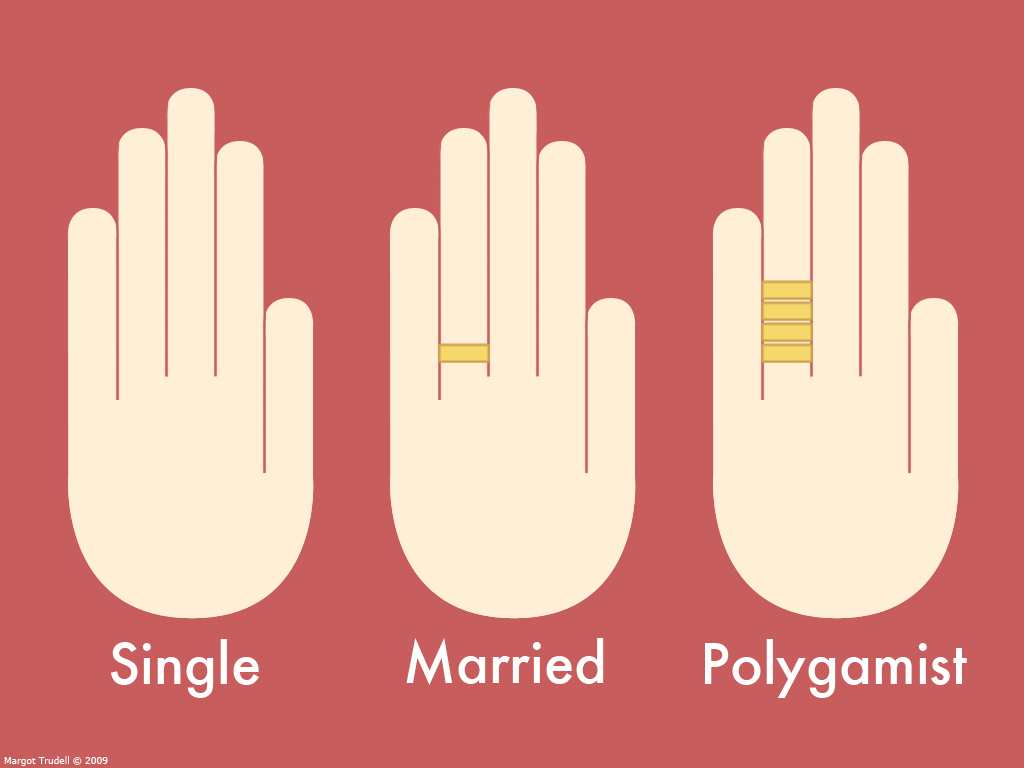
Rings (Image by Margot Trudell used under CC license via)


The French government has done away with “Mademoiselle,” the term of address for unmarried women, becoming the second country I know of to have officially done so.  The other country is my current residence, Germany, though most foreigners are unaware that “Fräulein” was tossed out in 1972 and sounds quite sexist today.  I have explained to my husband that many Americans use it because most of their knowledge of German comes from The Sound of Music, but he says any use by an American immediately evokes the image of U.S. Army soldiers cat-calling, “Hey, Fräulein…”  Every woman in Germany is addressed as “Frau” (literally, “woman”) and now every woman in France is “Madame” (“my lady”).  No more attention is given to their marital status than is given to the men’s.  It’s simple and I like it, especially in contrast to the Anglophone attempts at a solution, which have been anything but simple.

In English, the non-sexist term is the neologism “Ms.”  It’s pronounced “mizz,” possibly in a subconscious attempt to be as unphonetic in its spelling as “Mrs.”  Neologisms can be tremendously helpful because they can be devoid of connotation.  Take, for example, the word “cis.”  It has been invented for the purposes of referring to anyone who is not transsexual.  It avoids any insinuations of “normal” or “natural,” an all-too-frequent problem when discussing biological traits that deviate from the average and those that don’t. 

But neologisms are not always free of connotation.  I have met numerous women who buck the term “Ms.” based on its association with the women’s liberation movement of the 1970s, while others embrace it based on the same association, and so all three terms continue to be used.  In order to avoid offense in Anglophone culture, it is necessary to know both the woman’s marital status and her political leanings.  Non-native speakers of English frequently find themselves tongue-tied and brain-cramped trying to differentiate between “Ms.” and “Miss.”  (“Which one’s sexist again?  And how do you pronounce it?”)  Swedes find this particularly silly, having done away with honorific titles altogether in a refusal to draw any attention to marital status, gender, age, or class.  

Growing up with a mother who did not take my father’s surname, I argued that “Ms. Sullivan” was the only appropriate title for her because “Miss Sullivan” would imply she wasn’t married and “Mrs. Sullivan” would imply it was my father’s name.  But is the latter really true?  Every day I have lived in Germany, both before and after my wedding, I have been addressed as “Frau Sanford.”  If, before my marriage, anyone were ever to call me “Fräulein Sanford,” it would sound as ridiculous as calling my husband “Master Lehr.”  Treating women and men equally is often not just the fairest way of doing things, but the easiest.


The Simpsons, Dwarfism & Getting It Almost Right For Once

12 Nov

Livro ou TV?(Image by Lubs Mary. used under Creative Commons license via)


Somewhere, among the many things cluttered in the back of my head, has long been the wonder as to whether The Simpsons would ever address dwarfism as a topic. Last night, I found out they did two years ago in the episode “Eeny Teeny Maya Moe” and I was shocked to see them decide against the freak show trope that our generation adores so dearly.  Not only did they transcend the snickering, but they pounced upon it and deftly demonstrated how blurred are the lines between comfort and discomfort.

Of course it feels silly to be grateful upon seeing one’s difference portrayed respectfully and productively.  But forgetting all the crappy media that take cheaps shots at dwarfs (James Bond, The Man Show, Celebrity Apprentice, Austin Powers), I’ve become quite used to good art reveling in the yuk-yuk fascination (Scrubs, This Is Spinal Tap, QI, Bob Dylan).  Not to mention the fantasy genre’s long-held tradition (from The Wizard of Oz to The Imaginarium of Dr. Parnassus) of utilizing dwarfism to denote either a separate race or mysticism (“It must be a fucking dream, there’s a fucking dwarf in it!“), which is not explicitly offensive, but also not particularly helpful in deconstructing prejudice and misconceptions.  Across the genres, Hollywood usually contributes more to the list of names we get called (Oompa Loompas, Hobbits, Mini-Me, etc.) than to diversity awareness.

The Simpsons episode isn’t perfect – how does one deal with minority issues perfectly? – but I was quite pleased.  The one moment that left a bitter taste in my mouth is the final line: “Who would have thought a woman so short could make me feel so big?”  Little People of America and many of their supporters perpetuate this same, pathetic slogan of empowerment: physically short, but mentally/spiritually/emotionally huge.  Short, but.  Little, but.  You’re well-meaning, but.

Little is not less.  Little is not inferior.  Little is not cute.  Little is not submissive.  Little is not weak.  Little is not a Napoleon Complex.  Little is little.  Big is not greater.  Big is not better.  Big is not powerful.  Big is not dominant.  Big is not strong.  Big is not a Gentle Giant.  Big is big.  To consider size as indicative of personality traits is as ludicrous as equating anything from freckles to elbow shape with personality traits.  (Any attempt to compliment Oprah Winfrey or Alice Walker by saying, “She may have been dark-skinned, but she brought light to the lives of many” would be considered wholly idiotic and righftully so.)  Having two x chromosomes does not impede my intelligence or independence or strength, and neither does having an autosomal dominant mutation in my fibroblast growth factor receptor gene 3.

If you want to praise an individual’s ability to overcome social obstacles, do not place blame for the obstacles on their genetics.  Society’s incessant xenophobia and vanity are constantly let off the hook because a genetic difference is still seen as that which upsets normalcy, rather than that which is handicapped by our delusions of normalcy.  It is all too often supported by the reasoning that if a majority is scared of a difference, then it must be a natural fear, and natural is practically synonymous with good.  It will take quite a few more episodes like that on The Simpsons before the discourse changes and someone says, “Who would have a thought a woman so shat on by our culture’s omnipresent lookism could have the patience to deal with my own individual prejudices?”