Archive | Scars & Sexuality RSS feed for this section

The Gender Police

5 May

(Image by Stephen Alcorn © 2003 http://www.alcorngallery.com)


Last Sunday, Pastor Sean Harris of the Berean Baptist Church in Fayetteville, North Carolina gave a sermon on gender:

So your little son starts to act a little girlish when he is 4 years old and instead of squashing that like a cockroach and saying, ‘Man up, son, get that dress off you and get outside and dig a ditch, because that is what boys do,’ you get out the camera and you start taking pictures of Johnny acting like a female and then you upload it to YouTube and everybody laughs about it and the next thing you know, this dude, this kid is acting out childhood fantasies that should have been squashed.

Dads, the second you see your son dropping the limp wrist, you walk over there and crack that wrist. Man up. Give him a good punch. Ok? You are not going to act like that. You were made by God to be a male and you are going to be a male. And when your daughter starts acting too butch, you reign [sic] her in. And you say, ‘Oh, no, sweetheart. You can play sports. Play them to the glory of God. But sometimes you are going to act like a girl and walk like a girl and talk like a girl and smell like a girl and that means you are going to be beautiful. You are going to be attractive. You are going to dress yourself up.’

Harris used the sermon to voice support for an upcoming proposed amendment to the state constitution that would define marriage as between a man and a woman.  North Carolina law already prohibits same-sex marriage.  The constitutional amendment would simply make it ever more so, as well as ban same-sex civil unions.  Update on 9 May: The amendment passed.

The hostility Harris invoked is one of the absolute best arguments for the opposition.  Play his sermon on a loop next to the 2010 study finding American children of lesbian parents report the lowest rate of abuse and repeat: Who’s advocating happy, loving families here?  But it should concern not only those who believe in same-sex marriage or non-violent childcare, but anyone who believes in equality and a non-threatening approach to character development.  Because, unfortunately, Harris was merely saying directly what children, teens and adults are told stealthily almost every day.  

In the 2007 documentary For the Bible Tells Me So, religious scholars and sociologists conclude that the reason socially conservative religious groups target same-sex marriage so passionately is because it disrupts patriarchy.  Indeed, Harris’s rant embodies the two most arbitrary, constricting rules for heterosexual women and men in dating that endure today.  That is, nothing is worse for a guy than seeming effeminate, and nothing is worse for a woman than being ugly.

Most readers may agree that these rules exist but certainly not to the extreme that Harris advocates.  Rarely does Western society openly invoke the violent, threatening imagery he did.  But these rules take various forms, often masquerading as indisputable facts about innate gender differences, and are reinforced in films and magazines, and as mantras in everyday conversation. Many of the following probably sound familiar to you:

1) Women constantly want to constantly shop the way guys constantly want to get laid.

2) A woman should ultimately let the guy pursue her lest she emasculate him and, in any case, she should want to be pursued.  Because every woman is a princess and every guy is a hunter.

3) Guys can’t be sexually assaulted by women.  They can only be grossed out by the advances of ugly women.

4) She can play sports or join the army, but she needs some makeup to be attractive and should always take care of her looks more than a guy should.

5) But she shouldn’t wear heels if it makes her taller than her man.

6) While many men can expect conventionally attractive women to overlook their gray hair, baldness, wrinkles, and/or chubbiness for their success or sense of humor, a woman cannot expect a conventionally attractive man to do the same for her.  Beauty and the Beast was about the woman seeing past her lover’s looks, not the guy! 

7) Guys don’t cry, but women do.  A lot.  Because guys use assertiveness to get what they want, while women show their vulnerability to get what they want.

8) Guys don’t cuddle with each other.  That’s gay.  But women cuddling is either sweet or hot.

9) He’s castrated if she asked him out, she’s physically stronger than he is, he earns less than she does, he takes her surname, or she talks more than he does at parties. 

10) And he’s gay if he’s interested in dresses, skirts or makeup.

11) Or if he enjoys books or films about women’s experiences.

What silliness. Exiling the very real horrors of LGBT persecution to the peripheries for just a split second, how many of you nearly choked yourself laughing at Harris’s order to “get outside and dig a ditch because that’s what boys do”? 

Nothing should be off-limits to anyone unless they honestly, independently have no interest in it.  Most of us are probably disinterested in or uncomfortable with some of the aforementioned behaviors, but the disinterest should arise from self-awareness, not authoritative training.  And I’ve met enough self-aware, self-confident individuals to know that these behaviors do not fall along gender lines, but personalities. 

My neighbor loves ponies as much as she loves repairing cars.  My husband’s buddy plays rugby and knits.  My guyfriend loves arranging flowers and wearing skirts as much as he loves target-shooting and watching Formula One.  I love arguing politics and watching figure skating with my mom and dad as much as I cringe at discussing shoes or watching football.  All of us are encouraged by our partners, demonstrating that our fears of persecution for such gender-bender are usually reinforced not by the opposite sex but, as Ashely Judd so eloquently pointed out last month, by our peers. 

Many men try to talk their girlfriends out of wearing makeup, while many women are supportive of—and often intrigued to the point of being attracted to—men who adopt traditionally feminine activities.  (If it weren’t the case, “Too bad he’s gay!” wouldn’t be the famous expression it is.)  Despite this, women thrust ludicrous beauty standards upon themselves, making catty comments about each other’s supposed failures, while men police one another with gay slurs.  That these cultural rules bear so much repeating signifies that they are indeed rules, not facts.   A glance at history and across cultures demonstrates that they are fashions.  That enforcing them requires scare tactics—“You’ll never get laid!” “You’ll never land a man!”—should land the final blow to their credibility.


In Comedy, It’s All About Deciding Who’s Us & Who’s Them

28 Apr

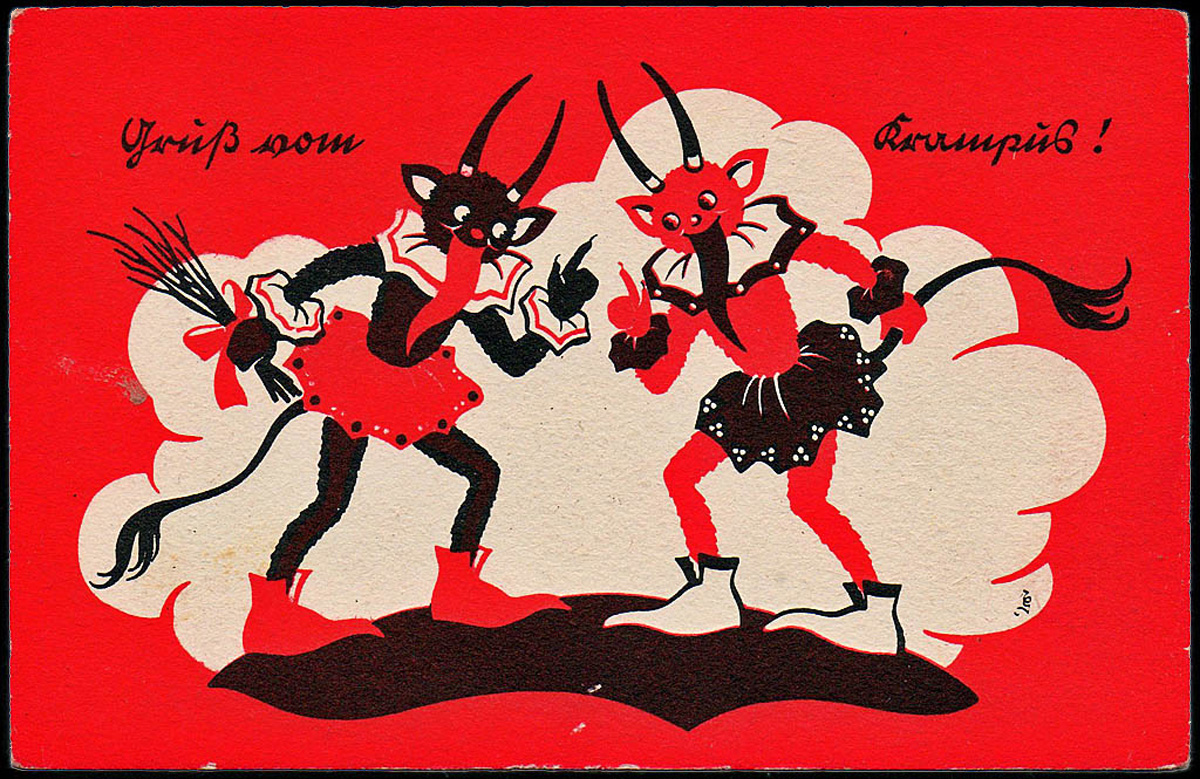
Krampus twins(Via)


The Guardian’s stylebook contains the greatest commentary on style I’ve ever seen in print:

political correctness: a term to be avoided on the grounds that it is, in Polly Toynbee’s words, “an empty right-wing smear designed only to elevate its user.”

Around the same time, while researching the back stories of Life’s Too Short for my review, I came upon the controversy over the word “mong” in which Ricky Gervais found himself embroiled this past fall.  Apparently “mong” is a British English insult derived from “Mongoloid,” the very antiquated and now unacceptable term once used to describe people with Down’s Syndrome.  Both Americans and Brits have probably heard “retard” used the same way.  Gervais eventually apologized to those who objected—including the mother of a child with Down’s Syndrome who has frequently endured the insult—but not without first dragging his heels screaming at what he called “the humorless PC brigade.” 

I will never get over how many comedians insist that any criticism of their work is an indictment of all comedy; as if there’s no such thing as an unfunny comedian, only stupid audiences.  This logic sets the bar for comedy so low that no comedian need ever try to be original.  Ignoring the “PC brigade” (i.e., anyone who doesn’t live with the privileges they do), they can simply regenerate old stereotypes, mining the minstrel shows, the frat houses and the school yards, and if no one laughs at this, it’s simply because we’re all too uptight, right?  Wrong.  We don’t refrain from laughing because we feel we shouldn’t.  We refrain because, unlike the repressed who giggle away in awe, we’ve heard it a thousand times before and we know it’s far from unique.  And isn’t unique what every comedian, entertainer and artist strives to be?   

Like politics, comedy can be divided into two categories: that which confronts our problems with our own selves, and that which confronts our problems with others.  Xenophobia literally means the (irrational*) fear of strangers and the second type of comedy relies upon this fear.  There has to be a “them” for “us” to laugh at.  So Republicans laugh at Democrats.  Hippies laugh at yuppies.  Academics laugh at hippies.  Progressives laugh at bigots.  It’s fair game when beliefs are targeted because we must always take responsibility for our beliefs.  However, when the joke defines “them” as those who have had no choice whatsoever about their distinguishing quality—ethnicity, gender identity, sexuality, physical traits, mental or physical capabilities, or class background—and who continue to be disenfranchised by society’s delusions of normalcy, the joke had better target those delusions to be in any way original.  Otherwise, why pay for cable or tickets to hear someone lazily reiterate the guffaws of playground bullies? 

Every good comedian, from Stephen Colbert to Eddie Izzard to Christian Lander to the writers at The Onion, knows that the best jokes mock people’s hang-ups and clumsy reactions to minority issues, not the mere existence of minorities. My beloved Flight of the Conchords frequently flip gender roles and ethnic stereotypes, exposing the absurdity of racism and misogyny.  As the following video demonstrates, 1970s machismo has been begging to be made fun of.  However, when it comes to physical Otherness, it is the body—not fearful attitudes toward it—that they choose to snicker over, 54 seconds into the video:


Hermaphrodite?  Really?  An intersex kid’s medical reality is your toy?  C’mon, Conchords.  You’ve proven you’re great at making fun of white Kiwis tripping over Maori culture.  (“Jemaine, you’re part Maori…  Please be the Maori!  If you don’t do it, we’re gonna have to get Mexicans!”)  Surely you could come up with some good bit about hipster comedians clinging to lookist and ableist jokes like teddy bears and throwing temper tantrums when they’re taken away.  Or take a tip from Mitchell & Webb and take a jab at the way the ableism of reality TV masquerades as sensitivity:


Of course comedians have the right to make jokes objectifying minorities.  But I’m more interested in why they feel the need to, why they choose to objectify some people and not others.  Being gay, disabled, trans, intersex or non-white is not inherently hilarious to anyone who doesn’t live their lives sheltered from anyone unlike them.  The American freak shows of P.T. Barnum and the racist British sitcoms of the 1970s signify not just how profoundly disenfranchised minorities were in these countries, but how absurdly provincial audiences must have been in order to be so easily titillated.  Many comedians who reiterate chauvinist jokes argue that in doing so they are pushing the boundaries, expanding freedom of thought in defiance of PC oppression, when in fact they are merely retreating to well-trod ground, relying on ideas that challenge nothing but the very young idea that minorities deserve to be included in the dialogue as speakers, not objects.  As Bill Bryson has pointed out, the backlash against “political correctness” took place the moment the idea was introduced and has always been far more hysterical than what it protests.   

Toni Morrison has said, “What I really think the political correctness debate is really about is the power to be able to define.  The definers want the power to name.  And the defined are taking that power away from them.”  Revealing that it is all about power explains why emotions run so high whenever minorities get upset by certain jokes and comedians get upset about their being upset.  But this redistribution of power can be productive.  Taking old slurs and xenophobic tropes away from today’s politicians and comedians challenges them to think beyond their own experience and to wean themselves off society’s long-held fears, to redefine “them” as those enslaved by the limits of their imagination; in essence, to really push the boundaries.  Yet too often they default to the tired claim that this challenge infringes on their right to free speech. 

Some progressive critics do bring on the censorship accusation by using the ineffective phrase “You can’t say that!” and sometimes this is indeed an open attempt at censorship because most media outlets self-censor.  For example, Little People of America has called for the Federal Communications Commission to add “midget” to its list of words you can’t say on television.  I understand the temptation to insist upon the same treatment afforded other minorities: If certain ethnic and gender slurs are banned by newspapers and TV networks, why not others?  But this tactic too easily insults those other minorities—are you claiming black people have it easier than you?—and creates the concept of a forbidden fruit that will only tantalize right-wing politicians and shock jock comedians.  Simplifying the issue into Good Words/Bad Words can be a waste of an opportunity.  Instead of limiting itself to which words are always unacceptable regardless of context or nuance, the dialogue should always aim to reveal which minority jokes truly blow people’s minds and which lazily replicate institutionalized chauvinism. 

Instead of splitting hairs over the modern meaning of the word “mong,” I’d love it if a comedian went at the fact that Dr. Down came up with the term “Mongoloid” because he thought patients with the diagnosis resembled East Asians.  Because really.  Who’s asking to be made fun of here?


* “Phobia” always indicates an irrational fear, hence arachnophobia, agoraphobia, claustrophobia, homophobia, etc.  Fears that are well-founded are not phobias.

Four Tiers of Fear

31 Mar


“How DARE you call me a racist!” 

We’ve all heard that one before, and it’s becoming ever more frequent with the debate over Trayvon Martin’s death.  Marriage equality opponents have been adopting the same tone over the past few years, claiming “homophobic” is now an insult.  In the video posted above, Jay Smooth makes an excellent argument for shifting the focus from criticizing actions instead of people in order to spark more productive dialogue about racism and this can be applied to any discussion about xenophobia. 

But outrage at any charges of xenophobia is not only an issue of grammar.  This outrage usually relies on the assumption that “racist” or “homophobic” automatically denotes a Neo-Nazi level of vitriol.  (This is why it’s frequently accompanied by the protest, “Some of my best friends are black/gay/dwarfs!”)  The outrage silences any discussion about the more insidious forms of chauvinism, and this is the very discussion that needs to happen, because the most insidious forms are the most ubiquitous. 

Most people who harbor transphobic, racist, ableist, sexist, lookist, ethnocentric or homophobic views are not Neo-Nazis.  Most would never physically harm anyone, and as Jay Smooth demonstrates, most would never admit to being xenophobic.  My theory is that chauvinism appears in society today in four different forms:

***

1. Violence: Both organized and individual violence, though of course the more organized, the more terrifying.  (The Southern Poverty Law Center reports this month that hate groups are on the rise in the United States.)  A hate crime should not necessarily be punished more severely than any other case of assault or murder, but its designation is an essential counter-statement by society to the statement the violence was intended to make.  While the most horrific form of xenophobia, violence is also the least common.

2. Overt Animosity: Harassment and disrespect that falls short of violence.  It’s insulting someone to their face, knowingly using slurs, arguing in earnest against someone’s human rights.  It’s refusing to hire, date or talk to someone because they belong to a certain ethnic group, or because they do not belong to a certain ethnic group.  It’s parents disowning their children for being gay, trans or disabled.  It’s the guy I witnessed at the mall yesterday who tapped a Chinese woman on the shoulder, closed his eyes and babbled, “Ching-chong-chang!” before dashing off.  It’s the Yale Delta Kappa Epsilon fraternity’s pledge, which included the chant, “No means yes!  Yes means anal!”  It’s the New Orleans cop saying Travyon Martin was a “thug and… deserved to die like one.”  Because the intention is either to provoke or dismiss the victim, it’s extremely difficult to find a constructive counter-argument.  Beyond ignoring such provocations because they are beneath us, our only hope is to appeal to any capacity for empathy the offenders may have when they are not in a provocative mood.  Such cruelty always stems from profound personal insecurities.         

3. Covert Animosity: Disrespect behind someone’s back.  This usually occurs when the speaker thinks they are surrounded by their “own kind,” and thus unlikely to offend anyone present with their slurs or jokes.  We’ve all heard at least one relative or coworker talk this way.  Often an environment encourages such disrespect and the peer pressure to join in is high.  Often someone will insult an entire minority privately but be utterly decent when meeting an individual from that minority.  A friend of mine once dismissed a boy band on TV as “a bunch of fags” just hours after he’d been raving to me about my awesome neighbor, who he knew is openly gay.  Sometimes this behavior is excused on the grounds that the speakers are from “a different generation,” an excuse I rarely accept since those with more progressive views can often be found in the same generation.

4. The Xenophobic Status Quo: The stereotypes and privilege that surround us.  Most of us have some of these prejudices without knowing it because we have been bombarded with them from birth on.  It’s the invisibility of minorities in the media and the social segregation in public that causes us to stare when we see certain people.  It’s the jokes that rely on the assumption that all heterosexuals find gay sex, intersexuality or transsexuality at least a little gross.  Or the assumption that physical disabilities, mental disabilities and physical deformities are always tragic and sometimes morbidly fascinating.  It’s the virgin/whore standard to which Western women are still held, leading us to comment far more on the appropriateness of their clothes and promiscuity than on men’s.  It’s our collective misogyny, homophobia and transphobia that converge to make us wonder why a man would ever want to wear a dress, but not why a woman would want to wear jeans.  It’s the prevalence of chauvinist expressions in our language (e.g. “Congressman,” “flesh-colored”) and of chauvinist traditions in our books, films and legends (e.g. our god is a white male) that makes them difficult to avoid and easy to reiterate.  It’s our demanding transgendered people wait for the rest of us to “get used” to the idea of their transitioning instead of questioning our belief in the gender binary.  It’s our view of every person who belongs to a minority not as an individual but as an example representing that minority with every move they make.  It’s the assumption that a difference upsets normalcy in lieu of the concession that normalcy is a delusion.  The privileges bestowed by our society on some members at the exclusion of others, rewarding those who have done nothing but be born with characteristics considered “normal,” are perhaps the most insidious reinforcement of these prejudices.

***

There is a danger to placing too much emphasis on the differences between the four tiers—I never want to end up in a conversation where people’s actions are excused as being “only Tier 4 sexist”—because all four tiers feed off each other.  They don’t exist in a vacuum.  The non-violent ideas of covert animosity and the xenophobic status quo provide confrontational people with a means of choosing their victims.  Conversely, regularly seeing society’s long tradition of hate crimes and public humiliation both in our history books and in our everyday news is what leaves us all dangerously unsurprised by the less belligerent forms of disenfranchisement many of us help perpetuate. 

Yet it is important to distinguish between these manifestations of fear in order to avoid the assumption that only violence and overt animosity qualify as xenophobia.  That assumption lets millions of people off the hook.  You don’t have to belong to the Westboro Baptist Church in order to have homophobic views.  You don’t have to belong to the NPD or the BNP or the Georgia Militia in order to have racist views.  You don’t have to wait in a dark alley for a stranger in order to commit rape.  You don’t have to threaten someone in order to to make them feel unwelcome.  Our society has been built on many xenophobic assumptions, making it very easy for all of us to pick some of them up along the way.  The fight for equality aims to make it more and more difficult, but it needs to be able to recognize its targets and use tactics suitable to each. 

I make these distinctions in the hopes of facilitating the conversation on chauvinism.  Yet it should come as no surprise that chauvinism is difficult to discuss because, in the words of Jay Smooth, it’s a system that has been designed to insult and subjugate.  In other words, it’s hard to speak politely about the idea of being impolite. 


When It Comes to Sex, Fair Is Fair

17 Mar

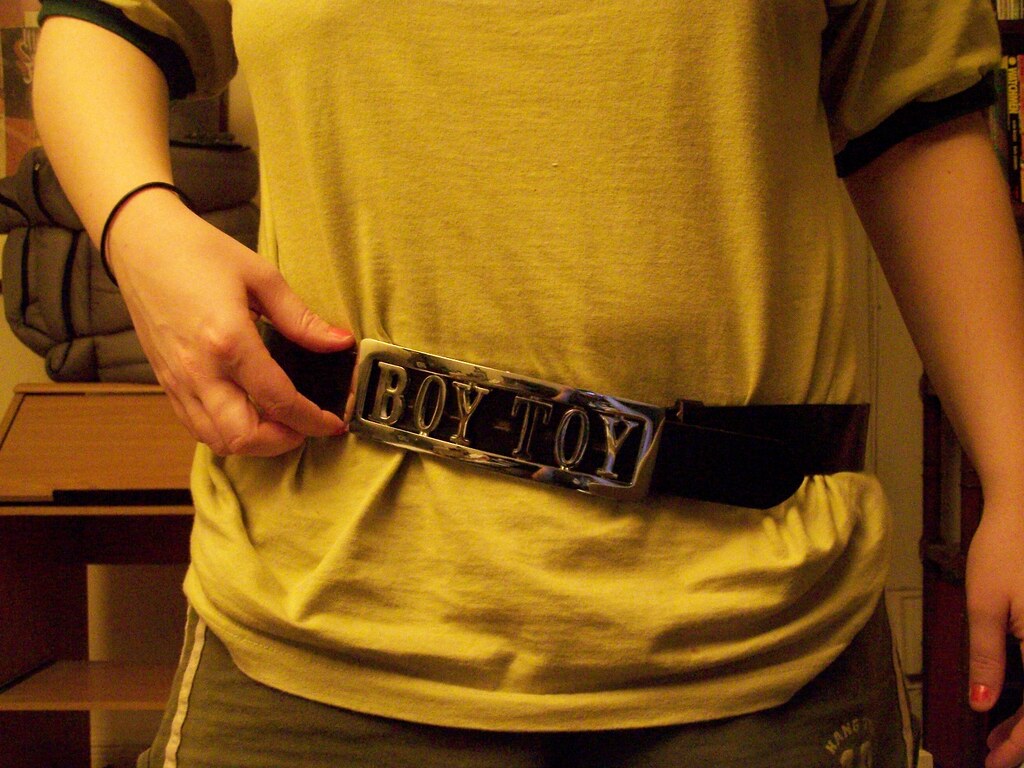
Boy Toy(Image by Ian used under CC license via)


Disclaimer: This post is going to talk a lot about sex, so for my relatives out there, don’t say I didn’t warn you.

***

I was recently walking around Tokyo’s Electric Town, a sensory overload of video game stores, electronics boutiques, and maid cafés.  Wait, what?  The young women outside these cafés were dressed in lacy maids’ outfits, complete with fishnets, platform shoes and cat ears on their heads.  Addressing their customers as “Master,” they apparently serve them on one knee, providing spoon-feedings and massages to those willing to pay extra.  These cafés were everywhere.

The guy accompanying me probably sensed my feminist judgment before I voiced it.  “So, what would have to change for you to be okay with it?” he asked. 

Quite simply, half the cafés would cater to female customers, hosted by provocatively dressed, eager-to-please, teenage-looking boys.  Half the people on the street in Tokyo are women, but the maid cafés offer them only work, not service.  No wonder nerd women feel so alone.  But it’s not fair to single out Electric Town.  Every well-known naughty incarnation of sex from the Playboy Mansion to token event dancers embodies the same problem: Whether selling dominance or submission, it’s all for the straight male customer.  In Delusions of Gender, Cordelia Fine has identified one of the panes of the glass ceiling to be the not uncommon tradition of businessmen bonding by going to strip clubs together.  The most a straight female customer can hope for at such venues is to be bored, however much her partner may hope she’s taking down notes. 

Just as the word “doctor” or “lawyer” almost always causes a listener to envision a man, the word “escort,” or “stripper” evokes a woman.  Girls are aware of this from the earliest of ages.  Many have argued with me that the lack of lascivious fare catering to female clients is indicative of supply and demand; women aren’t as interested in commercial forms of sex, so there aren’t any.  It is true that the demand may not be overt enough for the market to notice, but this is not because it is non-existent.  It is because, like the demand for non-heteronormative sexuality, it has been discouraged for millennia. 

Men are animals, they can’t help it, goes the traditional view.  But women are not and thus they should only be sexual when satisfying men’s desires, either by playing the role of the virgin he wants to have a family with or the whore he wants to have fun with.  Yet if women’s sex drive is indeed naturally lower than men’s, why are so many societies so concerned with suppressing it? 

Around the world from Kuwait to Kansas, authoritarians go to great lengths to reduce if not altogether prohibit female sexual expression.  Over 92 million girls have undergone genital mutilation in Africa alone in order to reduce their libido.  American evangelical Christians oppose mandating the HPV vaccine for pre-teen girls, arguing that reducing the fear of cervical cancer will increase girls’ promiscuity.  In Haiti, Jordan, Syria and Morocco, “honor” killings and crimes of passion in instances of adultery are still legally permissible (only) when it is a female who has had pre-marital or extramarital sex.  A 2002 U.N. report found legislative provisions allowing for partial defense of “honor” killings in Argentina, Ecuador, Egypt, Guatemala, Iran, Israel, Peru, the Palestinian National Authority, and Venezuela.  Let me repeat: Politicians, religious leaders and parents endorse scaring women with the threat of murder, others with the threat of cancer, to control their sexuality. 

I’m sure this sounds outrageously antiquated to most readers, but aside from the fact that it is a grave reality for women in many cultures, vestiges of this machismo endure in secular culture.  Guys still try to insult each other by attacking their mothers’ sex lives, and women’s bodies and promiscuity are still discussed far more than men’s.  Have you ever heard anyone say, “Your dad’s a whore”?  Or heard a guy who won’t put out described as “frigid”?  Chloe Angyal summed it up beautifully at New York’s Slutwalk this past October:

The idea behind the word “slut,” and the beliefs and behavior that it justifies, is alive and well.  This idea says that sex decreases a woman’s worth.  This idea says that a woman who steps outside the bounds of acceptable femininity by enjoying sex, or seeking sex, or having a lot of sex, deserves whatever sexual violence is done to her… This idea says that almost anything a woman does, says, wears or is, can be used to justify that violence. Are you confident and outgoing?  That could have been construed as flirting, and that is practically consent.  Are you shy and reticent?  You should have been confident and outgoing enough to firmly say “no.”  Are you considered attractive by the standards of our culture?  Well, you know how men get around pretty women.  Are you considered unattractive by the standards of our culture?  What man would force himself on an ugly woman?  You must have asked for it.  This idea sets up a no-win situation, where no woman is pure enough to be blameless.

However, as women’s scantily clad bodies are condemned in Congress and in churches while being used to advertise everything from ice cream to phone companies, I suspect it’s not only the suppression of female desire at work.   When I imagine men being marketed as boy toys, the first obstacle that comes to mind is homophobia.  I’m sure you can just hear the shouts of “Yuck!  Sick!” that would erupt if male butts were given as much attention on television as female breasts are, or if guy-on-guy action were insinuated in music videos as frequently as lesbianism is.  Men who dislike the self-objectifying performances of Mick Jagger or Robbie Williams or male ballet dancers usually call them gay slurs.  I feel safe in assuming similar insults would be hurled by many male Star Wars fans had the master at Jabba the Hut’s palace been a madam who enslaved Luke Skywalker on a chain in a pair of golden briefs.  In 2008, a study found nearly 40% of women appearing in films wore sexually revealing clothing, compared to 7.8% of men, proving that straight women put up with sexy representations of their gender with the same frequency that straight men are shielded from it.  The homophobia behind these cultural patterns is the very same that restricts gay sexuality to the gay district.  And it is often to these corners that lusty women go.  Sex and The City was addressing a real problem when it encouraged women to watch gay male porn in order to see men that are truly sexualized. 

However, as discussed in my last post, sexualization comes at a price when it is the result of overwhelming demand, not free choice.  The American Psychological Association says a person is sexualized when their “value comes only from his or her sexual appeal or behavior, to the exclusion of other characteristics; [when] a person is held to a standard that equates physical attractiveness (narrowly defined) with being sexy; [when] a person is sexually objectified—that is, made into a thing for others’ sexual use, rather than seen as a person with the capacity for independent action and decision making.”  Self-objectification is a free choice an individual can make only insofar as that individual has never been pressured into it.  Bombarded with the media images cited above, women are taught to self-objectify from girlhood on.  Even the professional dominatrix, no matter how powerful, is fulfilling a male customer’s requests.  The beauty standards embodied by these sexualized models result in women and gay men suffering from eating disorders at far higher rates than straight men.  In Cinderella Ate My Daughter, Peggy Orenstein writes:

I object—strenuously—to the sexualization of girls but not necessarily to girls having sex. I expect and want my daughter to have a healthy, joyous erotic life before marriage.  Long, long, long before marriage.  I… want her to understand why she’s doing it: not for someone else’s enjoyment, not to keep a boyfriend from leaving, not because everyone else is.  I want her to do it for herself.  I want her to explore and understand her body’s responses, her own pleasure, her own desire.  I want her to be able to express her needs in a relationship, to say no when she needs to, to value reciprocity, and to experience true intimacy.  The virgin/whore cycle of the pop princesses, like so much of the girlie-girl culture, pushes in the opposite direction, encouraging girls to see self-objectification as a female rite of passage. 

Reciprocity is the key word.  If you want your girlfriend to accompany you to a maid café, you’d better be willing to follow her to a Fantasy Boys’ Strip Tease.  If you want her to learn a naughty routine to add some spark, you’d better learn one for her.  If you want your wife to be fine with you sleeping around, you’d better encourage her to have affairs.  If you ask for oral sex, you’d better be willing to give it.  And don’t you dare make your daughter wear a purity ring until marriage if you won’t demand the same of your son or your own self.  Indeed, if the social pressure that urges women to submit were diverted to straight men, the resulting dialogue would reveal a great deal about how much free choice really enters into it. 

Studies in sex-positive feminism and BDSM culture reveal that many self-confident, consenting individuals are interested in the sex industry, but without the gender disparity pop culture promotes.  And while it is true that many women have no interest in commercial forms of sex like pornography or strip clubs, nor do many men.  Whether the red light district is silly or sexy is a matter of taste.  Whether it is male chauvinist is not.  In the words of one YouTube commenter—a rare source of inspiration—“this is what music videos would look like if women ran the world.

Look ridiculous?  In the words of Nadine Gordimer, “So many sensual moves are, if you set yourself outside of them.”  It’s no more ridiculous than the song it parodies or the cat ears donned by the Electric Town maids.  If every second maid were replaced with men posing like Bret and Jemaine do, I’d find nothing wrong with Electric Town, except for its carbon footprint. 


Today’s Princesses: Teaching Them “That Self-Absorption Is The Same As Self-Confidence”

10 Mar

When I was growing up, I had a hard time remembering that McDonald’s and Disney were not the same company.  I still have a hard time remembering that.  Both aggressively market products few can spend their entire lives resisting because their advertising budgets are unrivaled and because they have mastered the recipes for broad appeal.  Both are aggressively exported to other countries, representing all that is optimistic, colorful, unsubtle and indulgent about America.  Both are harmless in small doses but unhealthy when they attain the monopoly on a child’s life they’ve been aiming for.

I’ve just finished Cinderella Ate My Daughter: Dispatches from the Front Lines of the New Girlie-Girl Culture by Peggy Orenstein.  Like Eric Schlosser in Fast Food Nation, Orenstein examines a corner of our culture that does not take constructive criticism well.  It is because of the magnitude of the pink princess deluge driven by Disney and their ilk combined with their defensive refusal to admit any fault or responsibility—“It’s what every girl wants!”—that her work deserves such a warm welcome.

For any of her failures to perfectly repair the girlie-girl culture in 200 pages, Orenstein offers several impeccable articulations of the problems.  Princess packages are problematic when they impose rote scripts and must-have shopping lists, stifling rather than encouraging creativity.  Sexualization is problematic when the implied goal is not to attain pleasure but to please a man in exchange for being approved of as pretty.  Social networking online is problematic when “the self becomes a brand to be marketed to others rather than developed from within.”  And the Muppets are problematic when, for all their ingenuity, they still can’t come up with more than two female Muppets.  I think I’m going to end up quoting her a lot.

The New York Times praised her book while emphasizing that it is little cause for alarm seeing as most girls outgrow the pink princess phase.  As a former Snow White wannabe, I know this can be true, but I had kick-ass feminists in my life to help me along the way, including a dad who sewed my costumes.  I hesitate to agree with the Times’s assertion that “most” move on.   Orenstein provides depressing figures on the rise of female eating disorders, the recent drop in computer science degrees, the persistent problem of young women equating “feeling good” with “looking hot.”  Even as I tend to surround myself with self-confident, intellectual women who define themselves as much more than their prettiness and their purchases, I regularly encounter those who fit into Orenstein’s figures.  They are the ones whose fathers only gave them credit cards, never engaging them in intellectual discussion, and who now avoid debate like an ugly outfit.  They are the ones who know that appearing pretty means non-threatening, so self-confidence is tossed out for coyness, self-assertion is abandoned for pouting, and wit is relinquished for fawning giggles in the presence of men.  They are the ones who torture themselves over their looks—“I’m so ugly! I’m so fat!”—in order to land a man and then keep him from cheating, spending more of their day unhappy than any other people I know.  They are the ones who have not left the princess phase because they do not know how to. 

Too often criticism of the princess culture is misconstrued as bitter resentment by those who just don’t have what it takes to wow the guys or woo the pageant judges.  Nothing could be further from the truth.  It is sincere concern inspired by the hard evidence of the very real dangers that motivates critics like Orenstein:

There is… ample evidence that the more mainstream media girls consume, the more importance they place on being pretty and sexy.  And a ream of studies shows that teenage girls and college students who hold conventional beliefs about femininity—especially those that emphasize beauty and pleasing behavior—are less ambitious and more likely to be depressed than their peers.  They are also less likely to report that they enjoy sex or insist that their partners wear condoms. 

Depression, eating disorders, STDs, and unwanted pregnancy are nothing to sneeze at.  Meanwhile, a study conducted at the University of Houston found women who identify as feminists demonstrate less hostility toward men than women who don’t.  A Rutgers University study found they are also more likely to be in a relationship and their partners report more satisfaction with their sex lives.  Isn’t that the happily ever after every parent wants for their daughter?      

Sometimes Orenstein’s feminist alternatives to the pink princesses sound soft compared to the roar of her reprimands.  Focusing only on the (admittedly daunting) price of the dolls, she misses a major opportunity to understand the educational, multi-cultural brilliance of the American Girl history series.  Disney’s The Princess and The Frog promotes independence, battles lookism and exemplifies egalitarian romance in all the ways Beauty and the Beast failed to, yet Orenstein’s review of the film was as weak as its box office performance.  Princess Fiona of Shrek is bad-ass and the third film in the series parodies princesses better than anything else it takes a jab at.  However, I wonder how necessary any model of romance—feminist or traditional—is for the preschool set.

Indeed, it is important to distinguish between the pre-pubescent girls and the post-pubescent ladies in books and toy stores, and on the screen.  Sparkles and daisies are innocuous. Unrealistic beauty standards and boy-crazy storylines are not.  The original Strawberry Shortcake and Rainbow Brite were not the cleverest female role models, but they acted their age and thus appropriately for their target audience.  Their cadres of friends were coed.  They regularly outwitted male villains—proving that girls’ problems aren’t limited to cat fights—and the reward was always a happier world, either more colorful or fruit-filled.  Like Hello Kitty, Strawberry Shortcake and Rainbow Brite demonstrated that to be cute is to be round and childlike, not dangerously busty-yet-skinny like Barbie and the Disney Princesses.  But both Rainbow Brite and Strawberry Shortcake have since been redesigned to at least suggest adolescence:     


Characters that were not invented first and foremost to sell dolls and costumes are usually a safer bet.  Lilo and her sister Nani of Lilo and Stitch are two of the best female characters in cinema history, let alone the Disney canon.  Meanwhile, Pippi Longstocking is worshipped in Northern Europe by boys and girls alike.  Indeed, wouldn’t a more pro-active welcoming of boys into the princess culture dilute a lot of its sexism?  How about dads reading The American Girls to their sons as often as moms read Harry Potter to their daughters?  Orenstein does recognize the potential for that revolution, citing a Creighton University study that showed half of boys aged 5 to 13 chose to play with “girls’ toys” as often as “boys’ toys,” but only after they were promised that their fathers wouldn’t find out about it.

Like the families relying on fast-food several times a week, many parents find it difficult to resist the pink marketers’ schemes and the peer pressure foisted upon their daughters in play groups.  There is nothing wrong with the occasional indulgence, just as there is nothing inherently wrong with the color pink.  But just as we have demanded healthier Happy Meals and more farmers’ markets, we should demand more varied toys, activities and role models for our children, refusing any monochrome model of girlhood.


The Make-Believe Dwarfs of My Childhood

3 Mar

lookism

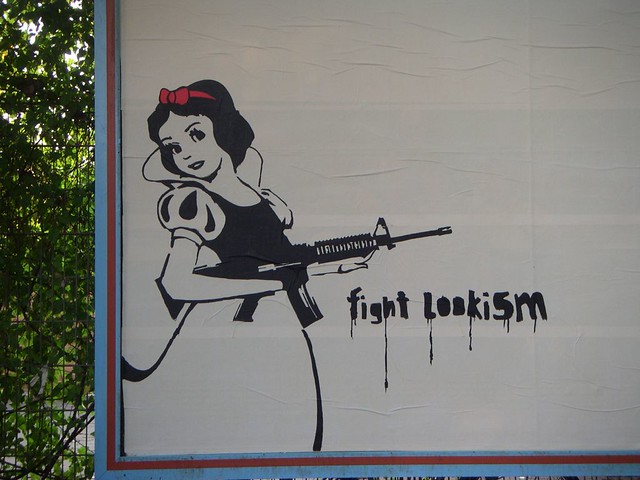
(Image by Paul Bailey used under CC license via)


Though it often can be the best way to get a message across, art complicates politics because it mixes matters of taste with matters of justice.  One lends itself to reason, the other doesn’t.  Too often sentimental feelings about a film or song with offensive elements will result in fans denying the offense altogether.  “Little House on the Prairie isn’t racist!  I grew up on it and I turned out fine!”  Maybe you did thanks to your innate curiosity about the experiences of others or inspiring teachers in your life, but you didn’t learn anything valuable about civil rights from that book.  I grew up on Dumbo and I think it is an artistically brilliant film with many good messages, one of which is the problem of lookism.  However, getting a white actor to put on his best black voice to play a character named “Jim Crow” in the heyday of the minstrel shows was a supremely stupid idea.  We shouldn’t deny ourselves our personal tastes, but that shouldn’t preclude calling out the artists’ mistakes.   

Likewise, we shouldn’t cry wolf over artwork that simply doesn’t match our tastes.  I’m one of the few people on earth who doesn’t enjoy The Lord of the Rings—I saw it for the first time in my twenties and fell asleep—but that’s primarily because I get bored by fantasy epics that are predominantly serious.  (I’m not wild about The Chronicles of Narnia either.  If there’s going to be magic, I prefer the tongue-in-cheek tone maintained in the worlds of Roald Dahl, L. Frank Baum or the Pirates of the Caribbean.)  It is sometimes difficult to divorce my dislike of the style from my annoyance that the Lord of the Rings definition of a dwarf receives more attention in almost every corner of our culture than the one based on reality.  Google “dwarf” right now in the image search and see how long you have to wait until a real human being is featured.  But neither Peter Jackson nor J. R. R. Tolkien is solely responsible for this; the latter of course drew this definition from the fantasy tradition.  And the use of dwarfs in fantasy is not always problematic. 

Peter Dinklage has demonstrated that dwarfism is no more important than skin color or foot size in Game of Thrones.  And while I couldn’t sit through Lord of the Rings as an adult, I have a special place in my heart for the 1988 film Willow, which was panned by almost every critic I respect.  Perhaps my nostalgia and childhood crush on Warwick Davis blinds me to the film’s artistic faults, but my enjoyment of it was rooted in politics before I even knew the word “politics.”  Because for once a dwarf was the main character.  And he looked like a real dwarf; he wasn’t wearing any pointed ears or goblin nose or orange face-paint.  And I wanted to be Sorsha, the bad-ass warrior princess.  Yes, she’s a damsel in distress during the final battle, but it’s 3′ 6″ Warwick Davis who wins that battle for her, not buff Val Kilmer. 

While I’m uncomfortable with fantasy’s tradition of insisting that dwarfs are a separate race and thus, in many cases, non-human, I loved Willow for giving both the dwarf-sized people and the average-sized people names free of connotation (“nelwyns” and “dakinis”).  They are neutral words that demonstrate one of the advantages of neologisms.  (Though I’ll admit the film’s line “Stupid dakini!” has echoed in my head at various points in my life.)  The film also uses the fictional word “peck” as the thinly veiled equivalent to “midget,” an insult the eponymous character must endure from dakinis throughout the film, adding more gravitas to his saving the day and personal appeal to dwarf viewers like myself.  Too often in fantasy, physical characteristics are indicative of personality traits.  This is an occasionally racist, always lookist device that disenfranchises hideous hags, macho musclemen, dark demons, pretty princesses, and innocent invalids.  Willow offers a welcome respite.  As sappy and as simple as the message is—anyone can be a hero—it bears repeating.

Speaking of lookist, I also adored Snow White and the Seven Dwarves as a kid.  I always played Snow White, of course—what child doesn’t imagine themselves as the attention-getting protagonist?—but I was also secretly proud that the first feature-length animated film, one of the most famous of the Grimms’ fairy tales, included dwarfs who weren’t ludicrously unrealistic.  They were kind, they had no mysticism and, as much as I loved her and her poufy dress, they had far more personality than Snow White herself.  For these reasons, I didn’t mind using them as an example when children asked me about my size.  My mother once said, “We’ll write to Disney and tell them most dwarfs aren’t bashful or dopey at all!”  I recall at the time wishing she wouldn’t put a damper on a film I loved so much, but now I am grateful to her for fostering such moral vigilance in me.  

Because once I hit puberty, I instantly saw the problems.  Like Disney’s The Hunchback of Notre Dame and scores of other films, Snow White asserts that male characters who are disabled or deformed can never hope to get the girl.  Considered innocent, asexual people, they are doomed to the Friend Zone.  And women with disabilities?  There aren’t many fairy tales about them.  The story emphasizes even in Snow White’s name that looks are everything.   

My childhood in combination with my experience with dwarfism endowed me with a nostalgia for stories I nevertheless was forced to analyze critically as I grew up, so I cannot deny either.  Everyone should keep a healthy distance between one’s understanding of the world and fairy tales.  My partner and I used the above image of Snow White on our wedding invitations, although we changed the slogan to “Everyone Is Beautiful”—a lesson I did not learn from Snow White herself, but from learning how my dwarfism conflicted with her.


Working with the F Word

12 Feb

audre lorde rough paper background by Starving ArtistIf you’ve explored this blog, you’ve heard me toss around that lovely word “feminism.”  And I bet a few of you cringed, rolled your eyes or ignored it: “Feminism is the idea that men and women are equal.  We get it.”

Traditional gender roles inflict thousands of double-standards on women and men, and I’ll discuss them in greater detail soon.  But feminism is so much more than that.  Despite the “fem” in feminism, women’s rights are neither the limit nor the core of equality.  As Gloria Steinem recently said, it’s about challenging hierarchies.  It’s about saying, “You’re not the boss of me!”  There is no other word for opposing all hierarchies based on characteristics about which we have no choice: our ethnicity, our sexuality, our race, our gender identity, our class background, our physical traits and capabilities, our mental capacities.  There should be.

Because chauvinism is the common enemy.  Feminism started off aiming to liberate women.  And that includes poor women.  And women of every possible ethnic background.  And in every country.  And women with physical differences and disabilities.  And women with mental disabilities and psychiatric disorders.  And women who are attracted to women.  And women who are attracted to both genders.  And women who transition into their sex.  And those who transition into another.  And those whose biology or sense of self does not correlate to either male or female.  And those who are men.  As a woman with achondroplasia, how could I ignore anyone who is screwed over for the way the way they were born?  As a woman with achondroplasia who chose to undergo controversial limb-lengthening procedures, how could I condemn anyone forced to make deeply personal decisions directly linked to their identity?  And the questions logically expands to: How could anyone?

Do “human rights” or “egalitarianism” adequately imply opposition to any manifestation of chauvinism?  Labels are so problematic.  Internet and library searches for “egalitarianism” usually produce discussions of class and poverty, while “human rights” tends toward macrocosmic, international issues of war, poverty and suffrage.  In effect, these terms can be narrower or broader than feminism.  Yet there are advantages to redefining a well-known term like feminism rather than trying to invent and disperse a new one.  When self-proclaimed feminist Amanda Palmer defended a project objectifying conjoined twins, Sady Doyle at Tiger Beatdown gave her the lecture of a lifetime that sums it up better than I’ve ever heard:

… this “feminism” thing: it’s not for some people, it’s not for you specifically, it’s not a fun little badge you get to slap onto your actions when it suits you. It is a system of carefully worked-out thoughts, which has been developed for many, many years by many thousands of people, and one of the most unavoidable parts of this system, which we can’t get away from if we are thinking for even a second with any ounce of intellectual rigor or honesty, is that everybody matters. Everybody matters precisely as much as you do. Which is why you don’t get to use them as a means of gratifying yourself with attention when the attention is good, or deny them the right to be heard or respected when the attention is bad.

Feminist history is stained with instances of female chauvinism, racism, ethnocentrism, classism, homophobia, transphobia and ableism, and continues to be by the likes of many.  And we’ve got to keep calling that out with the same vigilance we accord any issue.  As the xenophobic view claims that multiculturalism and universal human rights are inefficient and the only battle worth fighting is your own, a non-violent society only functions when based on the concept of reciprocity.  Despite the structures in place that assume otherwise, everybody’s health, job, relationships, sex life, family, and happiness matter exactly as much as yours do.

That’s what the F word means to my husband, my mom and my dad, my sister-in-law, my closest friends, my favorite teachers, and me.  And if that still makes you cringe, if you still find the label too problematic, leave me a well-thought out argument in the comments.


Welcome to Painting On Scars

4 Feb


So you’ve heard that “Kids can be so cruel”?  What a cop-out.  Adults are cruel.  Kids are constantly blunt and sometimes mean-spirited, but they have the chance to grow up.  Turning 30 this year, I realize that I’ve encountered more ableism over the past 10 years than any other time in my life – online, at dinner parties, and during my four years as an undergrad at Bard College when it was consistently rated in one of the Top Ten Most Liberal Schools by The Princeton Review.  If I ever have children biologically, they will each have a 50% chance of inheriting achondroplasia from me.  Whether or not they have achondroplasia, I’m much more concerned about the adults they will encounter in their lives than the kids.

Today ableism – a.k.a. disability discrimination – ranges from the yuk-yuk objectification of freaks, to the sick fascination with medical realities, to personal phobias of looking weak or unattractive, to well-intentioned charity that is truly patronizing That this so often comes from those whose own experiences of marginalization would logically render them better candidates for empathy has inspired me to start this blog. 

There also aren’t enough blogs about dwarfism.  There are hardly any blogs about dwarfism beyond childhood.  The community of dwarfs who have undergone limb-lengthening is non-existent, as if we want to pretend we were never dwarfs in the first place.  And feminist blogs for and about dwarfs who have undergone limb-lengthening continue to elude my Google efforts.

While my own experience invariably influences my perspective, I refuse to argue only about issues directly related to dwarfism and limb-lengthening.  Without knowing the word for it, I was raised to believe that if you’re going to support the rights of one minority, you’ve got to support them all.  In the end, they’re all related.

So consider this blog a continued reflection on the issues I addressed in this book.  Or The Most Inclusive, Progressive Forum Ever!  Or just another reminder that whether you’re discussing a sex issue or scar tissue, the personal is inescapably the political.