Archive | Scars & Race, Ethnicity & Nationality RSS feed for this section

Four Tiers of Fear

31 Mar


“How DARE you call me a racist!” 

We’ve all heard that one before, and it’s becoming ever more frequent with the debate over Trayvon Martin’s death.  Marriage equality opponents have been adopting the same tone over the past few years, claiming “homophobic” is now an insult.  In the video posted above, Jay Smooth makes an excellent argument for shifting the focus from criticizing actions instead of people in order to spark more productive dialogue about racism and this can be applied to any discussion about xenophobia. 

But outrage at any charges of xenophobia is not only an issue of grammar.  This outrage usually relies on the assumption that “racist” or “homophobic” automatically denotes a Neo-Nazi level of vitriol.  (This is why it’s frequently accompanied by the protest, “Some of my best friends are black/gay/dwarfs!”)  The outrage silences any discussion about the more insidious forms of chauvinism, and this is the very discussion that needs to happen, because the most insidious forms are the most ubiquitous. 

Most people who harbor transphobic, racist, ableist, sexist, lookist, ethnocentric or homophobic views are not Neo-Nazis.  Most would never physically harm anyone, and as Jay Smooth demonstrates, most would never admit to being xenophobic.  My theory is that chauvinism appears in society today in four different forms:

***

1. Violence: Both organized and individual violence, though of course the more organized, the more terrifying.  (The Southern Poverty Law Center reports this month that hate groups are on the rise in the United States.)  A hate crime should not necessarily be punished more severely than any other case of assault or murder, but its designation is an essential counter-statement by society to the statement the violence was intended to make.  While the most horrific form of xenophobia, violence is also the least common.

2. Overt Animosity: Harassment and disrespect that falls short of violence.  It’s insulting someone to their face, knowingly using slurs, arguing in earnest against someone’s human rights.  It’s refusing to hire, date or talk to someone because they belong to a certain ethnic group, or because they do not belong to a certain ethnic group.  It’s parents disowning their children for being gay, trans or disabled.  It’s the guy I witnessed at the mall yesterday who tapped a Chinese woman on the shoulder, closed his eyes and babbled, “Ching-chong-chang!” before dashing off.  It’s the Yale Delta Kappa Epsilon fraternity’s pledge, which included the chant, “No means yes!  Yes means anal!”  It’s the New Orleans cop saying Travyon Martin was a “thug and… deserved to die like one.”  Because the intention is either to provoke or dismiss the victim, it’s extremely difficult to find a constructive counter-argument.  Beyond ignoring such provocations because they are beneath us, our only hope is to appeal to any capacity for empathy the offenders may have when they are not in a provocative mood.  Such cruelty always stems from profound personal insecurities.         

3. Covert Animosity: Disrespect behind someone’s back.  This usually occurs when the speaker thinks they are surrounded by their “own kind,” and thus unlikely to offend anyone present with their slurs or jokes.  We’ve all heard at least one relative or coworker talk this way.  Often an environment encourages such disrespect and the peer pressure to join in is high.  Often someone will insult an entire minority privately but be utterly decent when meeting an individual from that minority.  A friend of mine once dismissed a boy band on TV as “a bunch of fags” just hours after he’d been raving to me about my awesome neighbor, who he knew is openly gay.  Sometimes this behavior is excused on the grounds that the speakers are from “a different generation,” an excuse I rarely accept since those with more progressive views can often be found in the same generation.

4. The Xenophobic Status Quo: The stereotypes and privilege that surround us.  Most of us have some of these prejudices without knowing it because we have been bombarded with them from birth on.  It’s the invisibility of minorities in the media and the social segregation in public that causes us to stare when we see certain people.  It’s the jokes that rely on the assumption that all heterosexuals find gay sex, intersexuality or transsexuality at least a little gross.  Or the assumption that physical disabilities, mental disabilities and physical deformities are always tragic and sometimes morbidly fascinating.  It’s the virgin/whore standard to which Western women are still held, leading us to comment far more on the appropriateness of their clothes and promiscuity than on men’s.  It’s our collective misogyny, homophobia and transphobia that converge to make us wonder why a man would ever want to wear a dress, but not why a woman would want to wear jeans.  It’s the prevalence of chauvinist expressions in our language (e.g. “Congressman,” “flesh-colored”) and of chauvinist traditions in our books, films and legends (e.g. our god is a white male) that makes them difficult to avoid and easy to reiterate.  It’s our demanding transgendered people wait for the rest of us to “get used” to the idea of their transitioning instead of questioning our belief in the gender binary.  It’s our view of every person who belongs to a minority not as an individual but as an example representing that minority with every move they make.  It’s the assumption that a difference upsets normalcy in lieu of the concession that normalcy is a delusion.  The privileges bestowed by our society on some members at the exclusion of others, rewarding those who have done nothing but be born with characteristics considered “normal,” are perhaps the most insidious reinforcement of these prejudices.

***

There is a danger to placing too much emphasis on the differences between the four tiers—I never want to end up in a conversation where people’s actions are excused as being “only Tier 4 sexist”—because all four tiers feed off each other.  They don’t exist in a vacuum.  The non-violent ideas of covert animosity and the xenophobic status quo provide confrontational people with a means of choosing their victims.  Conversely, regularly seeing society’s long tradition of hate crimes and public humiliation both in our history books and in our everyday news is what leaves us all dangerously unsurprised by the less belligerent forms of disenfranchisement many of us help perpetuate. 

Yet it is important to distinguish between these manifestations of fear in order to avoid the assumption that only violence and overt animosity qualify as xenophobia.  That assumption lets millions of people off the hook.  You don’t have to belong to the Westboro Baptist Church in order to have homophobic views.  You don’t have to belong to the NPD or the BNP or the Georgia Militia in order to have racist views.  You don’t have to wait in a dark alley for a stranger in order to commit rape.  You don’t have to threaten someone in order to to make them feel unwelcome.  Our society has been built on many xenophobic assumptions, making it very easy for all of us to pick some of them up along the way.  The fight for equality aims to make it more and more difficult, but it needs to be able to recognize its targets and use tactics suitable to each. 

I make these distinctions in the hopes of facilitating the conversation on chauvinism.  Yet it should come as no surprise that chauvinism is difficult to discuss because, in the words of Jay Smooth, it’s a system that has been designed to insult and subjugate.  In other words, it’s hard to speak politely about the idea of being impolite. 


The Make-Believe Dwarfs of My Childhood

3 Mar

lookism

(Image by Paul Bailey used under CC license via)


Though it often can be the best way to get a message across, art complicates politics because it mixes matters of taste with matters of justice.  One lends itself to reason, the other doesn’t.  Too often sentimental feelings about a film or song with offensive elements will result in fans denying the offense altogether.  “Little House on the Prairie isn’t racist!  I grew up on it and I turned out fine!”  Maybe you did thanks to your innate curiosity about the experiences of others or inspiring teachers in your life, but you didn’t learn anything valuable about civil rights from that book.  I grew up on Dumbo and I think it is an artistically brilliant film with many good messages, one of which is the problem of lookism.  However, getting a white actor to put on his best black voice to play a character named “Jim Crow” in the heyday of the minstrel shows was a supremely stupid idea.  We shouldn’t deny ourselves our personal tastes, but that shouldn’t preclude calling out the artists’ mistakes.   

Likewise, we shouldn’t cry wolf over artwork that simply doesn’t match our tastes.  I’m one of the few people on earth who doesn’t enjoy The Lord of the Rings—I saw it for the first time in my twenties and fell asleep—but that’s primarily because I get bored by fantasy epics that are predominantly serious.  (I’m not wild about The Chronicles of Narnia either.  If there’s going to be magic, I prefer the tongue-in-cheek tone maintained in the worlds of Roald Dahl, L. Frank Baum or the Pirates of the Caribbean.)  It is sometimes difficult to divorce my dislike of the style from my annoyance that the Lord of the Rings definition of a dwarf receives more attention in almost every corner of our culture than the one based on reality.  Google “dwarf” right now in the image search and see how long you have to wait until a real human being is featured.  But neither Peter Jackson nor J. R. R. Tolkien is solely responsible for this; the latter of course drew this definition from the fantasy tradition.  And the use of dwarfs in fantasy is not always problematic. 

Peter Dinklage has demonstrated that dwarfism is no more important than skin color or foot size in Game of Thrones.  And while I couldn’t sit through Lord of the Rings as an adult, I have a special place in my heart for the 1988 film Willow, which was panned by almost every critic I respect.  Perhaps my nostalgia and childhood crush on Warwick Davis blinds me to the film’s artistic faults, but my enjoyment of it was rooted in politics before I even knew the word “politics.”  Because for once a dwarf was the main character.  And he looked like a real dwarf; he wasn’t wearing any pointed ears or goblin nose or orange face-paint.  And I wanted to be Sorsha, the bad-ass warrior princess.  Yes, she’s a damsel in distress during the final battle, but it’s 3′ 6″ Warwick Davis who wins that battle for her, not buff Val Kilmer. 

While I’m uncomfortable with fantasy’s tradition of insisting that dwarfs are a separate race and thus, in many cases, non-human, I loved Willow for giving both the dwarf-sized people and the average-sized people names free of connotation (“nelwyns” and “dakinis”).  They are neutral words that demonstrate one of the advantages of neologisms.  (Though I’ll admit the film’s line “Stupid dakini!” has echoed in my head at various points in my life.)  The film also uses the fictional word “peck” as the thinly veiled equivalent to “midget,” an insult the eponymous character must endure from dakinis throughout the film, adding more gravitas to his saving the day and personal appeal to dwarf viewers like myself.  Too often in fantasy, physical characteristics are indicative of personality traits.  This is an occasionally racist, always lookist device that disenfranchises hideous hags, macho musclemen, dark demons, pretty princesses, and innocent invalids.  Willow offers a welcome respite.  As sappy and as simple as the message is—anyone can be a hero—it bears repeating.

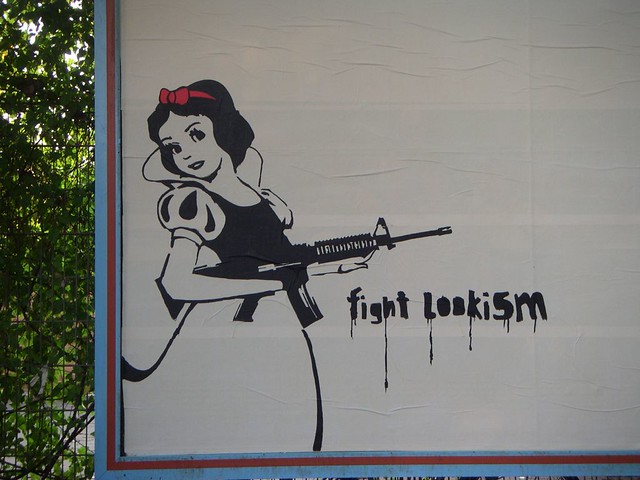
Speaking of lookist, I also adored Snow White and the Seven Dwarves as a kid.  I always played Snow White, of course—what child doesn’t imagine themselves as the attention-getting protagonist?—but I was also secretly proud that the first feature-length animated film, one of the most famous of the Grimms’ fairy tales, included dwarfs who weren’t ludicrously unrealistic.  They were kind, they had no mysticism and, as much as I loved her and her poufy dress, they had far more personality than Snow White herself.  For these reasons, I didn’t mind using them as an example when children asked me about my size.  My mother once said, “We’ll write to Disney and tell them most dwarfs aren’t bashful or dopey at all!”  I recall at the time wishing she wouldn’t put a damper on a film I loved so much, but now I am grateful to her for fostering such moral vigilance in me.  

Because once I hit puberty, I instantly saw the problems.  Like Disney’s The Hunchback of Notre Dame and scores of other films, Snow White asserts that male characters who are disabled or deformed can never hope to get the girl.  Considered innocent, asexual people, they are doomed to the Friend Zone.  And women with disabilities?  There aren’t many fairy tales about them.  The story emphasizes even in Snow White’s name that looks are everything.   

My childhood in combination with my experience with dwarfism endowed me with a nostalgia for stories I nevertheless was forced to analyze critically as I grew up, so I cannot deny either.  Everyone should keep a healthy distance between one’s understanding of the world and fairy tales.  My partner and I used the above image of Snow White on our wedding invitations, although we changed the slogan to “Everyone Is Beautiful”—a lesson I did not learn from Snow White herself, but from learning how my dwarfism conflicted with her.


Working with the F Word

12 Feb

audre lorde rough paper background by Starving ArtistIf you’ve explored this blog, you’ve heard me toss around that lovely word “feminism.”  And I bet a few of you cringed, rolled your eyes or ignored it: “Feminism is the idea that men and women are equal.  We get it.”

Traditional gender roles inflict thousands of double-standards on women and men, and I’ll discuss them in greater detail soon.  But feminism is so much more than that.  Despite the “fem” in feminism, women’s rights are neither the limit nor the core of equality.  As Gloria Steinem recently said, it’s about challenging hierarchies.  It’s about saying, “You’re not the boss of me!”  There is no other word for opposing all hierarchies based on characteristics about which we have no choice: our ethnicity, our sexuality, our race, our gender identity, our class background, our physical traits and capabilities, our mental capacities.  There should be.

Because chauvinism is the common enemy.  Feminism started off aiming to liberate women.  And that includes poor women.  And women of every possible ethnic background.  And in every country.  And women with physical differences and disabilities.  And women with mental disabilities and psychiatric disorders.  And women who are attracted to women.  And women who are attracted to both genders.  And women who transition into their sex.  And those who transition into another.  And those whose biology or sense of self does not correlate to either male or female.  And those who are men.  As a woman with achondroplasia, how could I ignore anyone who is screwed over for the way the way they were born?  As a woman with achondroplasia who chose to undergo controversial limb-lengthening procedures, how could I condemn anyone forced to make deeply personal decisions directly linked to their identity?  And the questions logically expands to: How could anyone?

Do “human rights” or “egalitarianism” adequately imply opposition to any manifestation of chauvinism?  Labels are so problematic.  Internet and library searches for “egalitarianism” usually produce discussions of class and poverty, while “human rights” tends toward macrocosmic, international issues of war, poverty and suffrage.  In effect, these terms can be narrower or broader than feminism.  Yet there are advantages to redefining a well-known term like feminism rather than trying to invent and disperse a new one.  When self-proclaimed feminist Amanda Palmer defended a project objectifying conjoined twins, Sady Doyle at Tiger Beatdown gave her the lecture of a lifetime that sums it up better than I’ve ever heard:

… this “feminism” thing: it’s not for some people, it’s not for you specifically, it’s not a fun little badge you get to slap onto your actions when it suits you. It is a system of carefully worked-out thoughts, which has been developed for many, many years by many thousands of people, and one of the most unavoidable parts of this system, which we can’t get away from if we are thinking for even a second with any ounce of intellectual rigor or honesty, is that everybody matters. Everybody matters precisely as much as you do. Which is why you don’t get to use them as a means of gratifying yourself with attention when the attention is good, or deny them the right to be heard or respected when the attention is bad.

Feminist history is stained with instances of female chauvinism, racism, ethnocentrism, classism, homophobia, transphobia and ableism, and continues to be by the likes of many.  And we’ve got to keep calling that out with the same vigilance we accord any issue.  As the xenophobic view claims that multiculturalism and universal human rights are inefficient and the only battle worth fighting is your own, a non-violent society only functions when based on the concept of reciprocity.  Despite the structures in place that assume otherwise, everybody’s health, job, relationships, sex life, family, and happiness matter exactly as much as yours do.

That’s what the F word means to my husband, my mom and my dad, my sister-in-law, my closest friends, my favorite teachers, and me.  And if that still makes you cringe, if you still find the label too problematic, leave me a well-thought out argument in the comments.


Welcome to Painting On Scars

4 Feb


So you’ve heard that “Kids can be so cruel”?  What a cop-out.  Adults are cruel.  Kids are constantly blunt and sometimes mean-spirited, but they have the chance to grow up.  Turning 30 this year, I realize that I’ve encountered more ableism over the past 10 years than any other time in my life – online, at dinner parties, and during my four years as an undergrad at Bard College when it was consistently rated in one of the Top Ten Most Liberal Schools by The Princeton Review.  If I ever have children biologically, they will each have a 50% chance of inheriting achondroplasia from me.  Whether or not they have achondroplasia, I’m much more concerned about the adults they will encounter in their lives than the kids.

Today ableism – a.k.a. disability discrimination – ranges from the yuk-yuk objectification of freaks, to the sick fascination with medical realities, to personal phobias of looking weak or unattractive, to well-intentioned charity that is truly patronizing That this so often comes from those whose own experiences of marginalization would logically render them better candidates for empathy has inspired me to start this blog. 

There also aren’t enough blogs about dwarfism.  There are hardly any blogs about dwarfism beyond childhood.  The community of dwarfs who have undergone limb-lengthening is non-existent, as if we want to pretend we were never dwarfs in the first place.  And feminist blogs for and about dwarfs who have undergone limb-lengthening continue to elude my Google efforts.

While my own experience invariably influences my perspective, I refuse to argue only about issues directly related to dwarfism and limb-lengthening.  Without knowing the word for it, I was raised to believe that if you’re going to support the rights of one minority, you’ve got to support them all.  In the end, they’re all related.

So consider this blog a continued reflection on the issues I addressed in this book.  Or The Most Inclusive, Progressive Forum Ever!  Or just another reminder that whether you’re discussing a sex issue or scar tissue, the personal is inescapably the political.