 (Via)
(Via)
Central Europe lost an hour last night in accordance with the most unpopular transnational tradition of the Modern Age. I’m taking the day off and leaving you with links to excellent articles here, here and here. Till next week!
 (Image by Folke Lehr)
Along with millions of other Americans, I used to boast a bit every March 17th: “You know, I really am Irish.” It’s a common American pastime to cite one’s known heritage, either as demonyms (“I’m English and Irish and… ”) or percentages (“I’m a quarter Irish, one eighth Polish…” ). I still believe in self-determination, but having lived in Europe for nearly a decade, I have ceased to rattle off these titles. Not only is the latter a vain attempt at exactitude with no chance of ever being exact—we’re not even really sure if my great-grandmother was Polish or Belarusian—but it resembles the sort of puzzle-piecing that only pseudo-scientists of suspicious political convictions find relevant. And it makes Europeans laugh. And then correct me. “No, you’re not Irish. Your ancestors were Irish.” Which is true.
While Americans sometimes refer to their ancestors’ nation as their “homeland,” they usually can’t construct a sentence in the country’s official language and certainly cannot name the country’s current head of government, the second largest city, or any of its history that isn’t directly related to U.S. history. At best they know a handful of expressions, a recipe or two, maybe the region where their parents’ parents’ parents lived. For this reason, their claims to nationality usually strike the natives as silly.
But the melting pot concept is often admirably used to celebrate diversity. It bungles any sense of loyalty and prevents jingoism. I can’t really argue that the English are “naturally” evil for what they did to my Irish ancestors when my last name is Sanford. My known ethnic heritage is a split between some of Europe’s most notorious conquerors (English, German) and their victims (Irish, Polish). To claim only one or two of them as “my people” feels ridiculous. If I ever have children, their great-grandfathers will have fought on opposite sides of World War II.
Then again, not everyone’s heritage is such a hodge-podge, and plenty of conservative genealogists try to prove why the blending of certain cultures is “better” than the blending of others. That the perpetrators of segregation, Nazism, apartheid, aristocracy, and the internment camps are the most famous fans of genealogy causes me to cringe whenever anyone claims pride in having Irish or Italian or Icelandic “blood.”
Such pride is much more understandable when coming from minorities who have been made to feel that they don’t belong in the country they were born in. My grandfather, Michael Sullivan, was the grandson of Irish immigrants to America. He was the oldest of 9 children, my mother has 43 cousins, and I’ve never tried to count how many of us there are in my generation. He often began sentences with the word “ ’Twas,” and liked to sing folk songs that seemed to have come from Ireland, but may very well have originated in immigrant settlements in the States. This is the extent of my experience with his Irishness, but his was far more profound. He grew up in a time when he could easily find signs reading, “Irish need not apply,” and “mick” was a word he hated in the way that only people who have been called a slur do. When he married Barbara Tupper and her grandmother found out he was Catholic, she crossed my grandmother out of the family Bible. All this made John F. Kennedy’s election in his lifetime radical. It is my grandfather’s story and it is important. But it’s not my story.
An attempt to make it my story would feel intellectually dishonest and pretty flaky to boot. As Andrew O’Heir writes this week at Salon: “Irishness [in America today] is a nonspecific global brand of pseudo-old pubs, watered-down Guinness, ‘Celtic’ tattoos and vague New Age spirituality, designed to make white people feel faintly cool without doing any of the hard work of actually learning anything.” Indeed, my middle name endows me with no expertise when it comes to picking out Celtic music or Irish books and films. I can’t tell what most Irish people actually enjoy and what’s just on display for tourists any more than I can tell what Finnish people actually enjoy and what’s just on display for tourists.
As said before, taking an interest in other cultures is always preferable to xenophobia. But it often comes with the temptation to flaunt minimal efforts like feats of greatness. Claiming credentials based on ancestry feels not entirely wrong, but not entirely right either.
The boundaries of countries and ethnicities are as blurry as our sense of self. Heritage is often seen as the recipe that resulted in an individual, yet there are so many more ingredients to the recipe. Yes, I wouldn’t be here today if the branches of my family tree were arranged any differently, but I also wouldn’t be here today if my parents had slept together in April 1981 instead of March. And placing too much importance on genetics insults any families who cannot or choose not to have children using only their own reproductive cells. Family is what you make of it.
This is not to say that everyone should always downplay their roots. Children with at least one parent who emigrated from another country often have undeniable ties to their ancestral culture – in any case, ties that are far more likely to be based on fact than fictitious romanticizing. Most of what constitutes our inexplicable sense of culture comes from traditions and foods and pastimes we experienced growing up, and great writers like Amy Tan, Gary Shteyngart, and Sandra Cisneros show that growing up with two cultures affords you special insights into both. If my German partner and I ever have children, we plan to raise them bilingually (English and German) and bi-culturally (Thanksgiving and St. Martin’s Day), teaching them anything there is to teach about where their mother grew up and where their father grew up. Whether or not to add some Swedish into the mix—my mother-in-law came from Stockholm—is a point of endless debate between us.
If we ever have grandchildren, it will be interesting to see how they approach their American heritage. If they’re at all ashamed or excessively proud, I’m determined to discuss it, but if they’re merely disinterested, so what? I predict that my great-grandchildren will not feel any strong connection to their American heritage, nor should they. As my partner points out, maybe they will be half-Czech or married to a Burkinabé and have their hands full raising their own children bilingually. Cultures and people move and morph constantly throughout time and space.
When I finally traveled to Ireland two years ago, there were traces of culture that seemed somehow familiar. And that was moving. But most of the charm—“The Irish Sea really is that green! They really do sing in the pubs!”—came from recognizing things I’d grown up seeing in movies, not in my grandfather’s house. And I also found traces of culture the following year in Amsterdam that were faintly familiar to me because, although I have no known Dutch forebearers, I grew up on Long Island.
My most impressive sense of belonging in Ireland came from the fact that I was not the palest person around. Not by a long shot. (Hence my captioning the above photo taken on the cliffs of Howth in an e-mail sent to friends: “If there’s anything Sullivan about me, it’s my complexion.”) Lookism can be a very powerful force. But it does not have to be. In Dublin, we were never once served by someone who didn’t have a Slavic accent. If the current flood of Eastern European immigrants end up staying in Ireland, their children will have much more of a claim to the place than I do.
They’ll at least be able to remember the name of the prime minister, after all.
 (Image by Day Donaldson used under Creative Commons license via)
Barbie turns 55 today and her birthday risks being overshadowed by a rival. Designer Nickolay Lamm has kicked off a very successful crowdsourcing campaign to fund the production of Lammily, a doll whose body is modeled after the mean proportions (taken from the Centers for Disease Control) for an American 19 year-old because, as her slogan goes, “average is beautiful.” The center photo above shows Lammily at her earliest design stage in contrast to Barbie. The left and right photos show her updated, final form.
Despite that her name sounds like the way most toddlers mangle mine, Lammily does seem quite lovely. But mostly because the problems with her competitor are countless. Barbie represents—and was very much intended to represent—an idea born in the middle of the last century that little girls should play not just with baby dolls or girl dolls, but with a woman doll, a post-pubescent beauty they should aspire to. The very first Barbie was inspired by the German Lilli, a character featured in tabloid comics who worked as a secretary by day and an escort by night. While it’s disputed whether or not the Lilli doll was in fact a sex toy, the longer you look at Barbie, the more that explanation makes sense.
Barbie is all fantasy: too thin to menstruate, with breasts so big she’d have to crawl on all fours to get around. (Sporty Lammily could knock her to the floor with a light kick.) Fantasies about beauty are fine as long as they remain a niche, not a standard. If her fame and influence were not so unparalleled, Barbie wouldn’t be a cause of much trouble. But she is the most famous doll in the world, and while she often changes jobs and outfits to bend to society’s trends, her body type never budges from the sex toy standard.
My mother swore I would never own a Barbie—how could it be healthy for a girl with dwarfism to idolize a lady who’s all legs?—but a neighbor bought me one for Christmas, and within the next 10 years I owned 12: Tropical Barbie, Superstar Barbie, Ice Capades Barbie, Gymnast Barbie, Fun-to-Dress Barbie, Loving You Barbie, Hollywood Hair Barbie, Cool Times Barbie, Dreamtime Barbie, Dream Glow Barbie, Dream Date Barbie, and my mother’s own, dragged-out-of-the-attic Barbie from the 1960s, whose earrings had turned her cheeks green. The funny thing is that every one of these Barbies had a slightly different face and slightly different blond hair with varying lengths and textures. But, just like the Disney Princesses, the bodies were all exactly the same. Barbie’s oh-so-80s Rocker friends Diva (brunette), DeeDee (black), and Dana (possibly Asian?) represented a broader range of hair and skin, but their bodies were all replicas of Barbie’s. This is what makes Lammily so radical.
But I don’t want an answer to Barbie. I want many answers to Barbie. Lammily correctly demonstrates that an average girl in the Western world is not blond. But blondes shouldn’t be any more excluded or celebrated than anyone else. Declaring “average” bodies and physical features a beauty standard continues to marginalize girls who deviate from the average. Another word for average is “normal” and it’s never fun for a young girl to hear that her body is “not normal.” Both Barbie and Disney have dared to dabble in the beauty of different ethnicities, but they haven’t been brave enough to try different body types – short, curvy, bony, disabled, with freckles or scars or glasses or birthmarks in the shape of Mexico.
In the words of artist Glenn Marla, there is no wrong way to have a body. If Mattel can invent over 50 varieties of blond hair for their preeminent princess, surely doll manufacturers can find a way to profit from providing a rainbow of body types. Maybe they will be brave enough by the next time International Women’s Day rolls around. That’s my fantasy, anyway.
 (Image by Mariana Rojas used under CC license via)
Miley Cyrus loves diversity. Just not, you know, discussing diversity and the complex history behind it. Since her performance at the Video Music Awards last September, she has drawn tremendous criticism for her treatment of the black backup dancers in her shows – cartoonishly imitating their dance moves, spanking them, simulating sex with them. Some, including Cyrus, have argued the portrayal is affectionate or even celebratory, while others perceive it as exploitative and reductive. Articles at Vulture and The Guardian likened it to a minstrel show.
Cyrus also uses dwarf dancers in a similar way. One of these dancers, Hollis Jane, has come forward to voice her regret:
Most of the time, getting a job purely because you’re a little person (in my opinion) is not a good thing. It is further fulfilling society’s idea that we are something to laugh at; that our value is simply to shock. We can all agree that right now all Miley Cyrus wants to do is make society’s jaw drop. So what’s more “weird” or “freaky” than having little people parading around in your show?
As someone who is trying to make it as a serious actress in this industry, not just trying to “be famous” or make money, there is nothing more frustrating than this stigma. The longer little people agree to be used as shock value, the longer it is going to take for us to be taken seriously.
I was a bear in Miley Cyrus’s VMA performance and it was my first time doing anything like that…anything where I was being used because of my height, not because of my talent. And I will be the first one to tell you that standing on that stage, in that costume was one of the most degrading things I felt like I could ever do. I realize not everyone shares my opinion and I might just be young and naive, but I feel like the acceptance of this kind of treatment has got to stop.
In an interview on Ronan Farrow Daily this week, Jane admirably pointed out that the problem lies in the broader culture, not just Miley Cyrus’s individual decisions. Powerful stars, aspiring dwarf actors, the media, and media consumers all bear a responsibility to quell the demand for dwarfs in freak shows.
To which Cyrus said in her W interview with Farrow:
I don’t give a shit. I’m not Disney, where they have, like, an Asian girl, a black girl, and a white girl, to be politically correct, and, like, everyone has bright-colored T-shirts. You know, it’s like, I’m not making any kind of statement. Anyone that hates on you is always below you, because they’re just jealous of what you have.
To which I say, we really don’t need another Amanda Palmer out there, another millionaire whose ego is so very fragile we can’t ever expect her to buck up the courage to engage with people “below” her, or to admit when she’s been wrong. Every entertainer accused of perpetuating stupid stereotypes has the opportunity to prove whether they are a respectable artist or a pathetic narcissist. An artist is trying to communicate something, and therefore cares first and foremost about what they are communicating. A narcissist defaults to seeing themselves as the victim in every conflict.
Hopefully those who love Cyrus’s music don’t love the way she deals with minorities.
 (Image by Eduardo Unda-Sanzana used under Creative Commons license via)
There is an argument gradually gaining momentum in the LGBT movement: “So what if being gay is a choice?” Rather than lecturing social conservatives that homosexuality is an inborn trait and not a chosen lifestyle, we should ask them what’s so bad about two consenting adults loving each other. With bisexual, pansexual, and genderfluid identities becoming more visible, and all sorts of people becoming more open to experimenting, who really cares if any of it is a choice?
It’s an important question in the broader debate about sex and gender. And it forces me to question the parameters of this blog.
Painting On Scars is founded on the rights of people who are viewed as minorities based on qualities they have no choice about: gender identity, sexuality, ethnicity, nationality, class background, physical traits, and mental abilities. This foundation is built on my own minority status being indisputably determined by factors beyond my control. There is no doubt whatsoever that I was, as Lady Gaga hollers, born this way.
And when it comes to confronting bigotry, there is something particularly painful about being belittled for something you have no choice about. All of us can feel insecure about the decisions we make, but being told that you’re seeking work in the wrong field or that you talk too loud on the phone is still far less harrowing than being told that your natural appearance is universally repulsive or that your gender makes you intellectually or emotionally inferior. Every one of us wants to be accepted for the way we were born because a rejection of it feels like a rejection of our very lives. As autism activist Jim Sinclair explains:
When parents say, “I wish my child did not have autism,” what they’re really saying is, “I wish the child I have did not exist and that I had a different, non-autistic child instead.” Read that again. This is what we hear when you mourn over our existence. This is what we hear when you pray for a cure. That your fondest wish for us is that someday we will cease to be, and strangers you can love will move in behind our faces.
For this reason, Painting On Scars examines the existence of minorities who are born this way and the myriad reasons why any of us still struggle to accept them. (More on the complexities of parenting disabled children here.)
However, the born-this-way rubric is not always helpful. What about the explicit decision to not conform? What about the human right to the pursuit of happiness? It seems only natural—for lack of a better word—to defend alternative traits and behaviors that are very much a choice but do no harm. Women who don’t wear makeup. Filmmakers who dare to feature minority accents. People who want to preserve their parents’ cultural traditions rather than assimilate for assimilation’s sake. Men who don’t identify as transgender but still very much like wearing dresses. Objection to these choices usually stems from a rigid belief in homogeneity or simply a difference in taste. Such objections make it clear to me as a blogger that as long as a difference doesn’t cause real harm, it is worth protecting from harm.
And conversely, I tend to defer to others when it comes to minority traits that people have little choice about but that do cause a good deal of harm: personality disorders, psychosis, sexual attraction to children, paranoia, trauma, suicide, or anything that precipitates emotionally abusive tendencies. I research these issues voraciously, not only because I have personal experience with many of them, but because they raise questions about human rights and individual freedom, as well as the greater good and personal safety. (The pro-mia and pro-ana movements, for example, argue that any attempt to treat or cure people with eating disorders qualifies as oppression rooted in narrow-mindedness.) Yet I refrain from opining about these issues publicly because my knowledge of them is as simplistic as they are complex.
Whether to change society or change oneself is a persistent predicament that accompanies every stage of life. When exploring the answer as it applies to minority issues, I keep coming back to the same question: Who suffers more in the change? Humans have repeatedly proven to cause less suffering when we accept body diversity, intellectual disabilities, LGBT identities, and gender equality than when we oppress them.
Of course, what constitutes oppression and what constitutes acceptance is sometimes disputable. Alex Andreou argues this week in The Guardian that the current search for the gene for homosexuality is quite harmful. While LGBT activists have traditionally opposed the idea of homosexuality as a choice to combat those who argue for a cure through therapy, LGBT critics of the genetic research fear that discovery of a gene for homosexuality will lead to its elimination. Those of us whose conditions are genetically determined and socially marginalized have been acutely aware of this problem not just since the advent of the Human Genome Project 30 years ago, but since eugenicists began sterilizing all sorts of peoples over 100 years ago. In democratic societies where governments no longer dare to be too vocal about medical decisions regarding minorities, everyone still fears the coming of the day when insurance companies inform expecting parents that they will not cover children who will cost more. Because the existence of minorities precludes the efficiency of a one-size-fits-all system, we will always cost more.
In the spring of 1994, I was headed into the operating room to have my Ilizarov fixators removed. While prepping for surgery, one of the members of the surgical team excitedly told my mother, “Have you heard the news about achondroplasia? They found the gene! We can test Emily for it!”
My mother signed a release allowing for them to perform the test during the operation. Several weeks later I received a letter confirming that my fibroblast growth receptor gene 3 had the achondroplasia mutation. My first reaction was, “No shit. Who cares?”
I had been officially diagnosed with achondroplasia on my third day after birth, though admittedly, such an early diagnosis back in the 1980s was a stroke of luck. A girl with achondroplasia who later became my best friend had been born at the same hospital six months earlier, so the doctors recognized our similarities and ordered x-rays on my limbs. My achondroplasia was obviously a result of nature, not nurture.
Then again, in olden days dwarfism was often thought to be caused by mothers with loose morals. I myself had once asked my mother if perhaps I got achondroplasia because of the decisions she had made about the birthing process. (I had just watched Look Who’s Talking and had learned a lot about the pop culture understanding of what goes into having a baby.) The gene for achondroplasia explained how I got it, how I could pass it on, and lay rest to any modern blame-it-on the-mother mindset that might suspect it was because of aspirin or salami or cinnamon. Such information can—but does not have to—affect your sense of self.
A few years ago a woman living in the U.S. contacted me because her two-year-old daughter had been diagnosed with achondroplasia. The girl’s grandparents lived in another country and had steadfastly dismissed the diagnosis. “Americans are famous for over-diagnosing every little thing,” they shrugged. “She’ll grow out of it!” (Pun intended?)
A friend from the same country explained to me that disabled people there generally have few support networks and even fewer opportunities for independence. Perhaps the grandparents’ refusal to believe in achondroplasia stemmed from their fierce desire to remain hopeful about her future.
Would running a genetic test finally convince them to accept reality? When I was born, my parents and I benefited greatly from the dwarf rights movement of the 1970s and 80s, which had emerged due to the egalitarian spirit of the times that indulged in civil rights and celebrating diversity. As with the gay rights movement, millions of supporters showed that they did not need to see the results of genetic testing in order to justify and defend a minority’s right to exist and be accepted. If they could do it, so can we.
 My country of residence votes today in what my partner has called “possibly the most boring German election in recent memory.” Sure the new Euro-skeptic party may be prove to be a rising star while the Pirate Party sinks (no pun intended), but with voter non-participation at an all-time high, conventional wisdom anticipates pretty much more of the same. There is, however, one new feature of this campaign season distinguishing it from years past – all of the major parties offer translations of their platform and websites in Leichte Sprache.
Leichte Sprache (“Simple Language”) is a variant of German developed by professionals who work closely with citizens with intellectual disabilities. It avoids long sentences, abbreviations and acronyms, jargon, foreign words, and Roman numerals. The text is often accompanied by images that convey meaning. Commonly used words supplant those used to signify sophistication; e.g. “allow” is preferred to “authorize.” Instead of “public transportation,” Leichte Sprache translators use “buses and trains.” Repeating the same word (“You should take these pills because these pills are the best”) is preferable to using synonyms (“You should take these pills because this medicine is the best”). Adverbs signifying time (“Maybe tomorrow it will rain”) are used in lieu of verb tenses (“Tomorrow it could rain”), because complex verb tenses should be avoided altogether. Figurative descriptions (“Rabeneltern” = “raven parents”) are replaced with literal ones (“bad parents”). The German custom of smashing compound words together without dashes or spaces (as in “Eheunbedenklichkeitsbescheinigung”) is also discouraged.
The closest English equivalent to Leichte Sprache is Simple English, which thusfar has only really gained traction on Wikipedia. While the Leichte Sprache Netzwerk focuses on the needs of citizens with intellectual disabilities, most advocates of Simple English in the U.S. list immigrants and other non-native English speakers as their primary target group. This is also a revolutionary idea. If you think the contractual agreement at iTunes is hard to wade through, imagine trying to read it in whatever foreign language you studied in high school.
Indeed, most expats I know who have only a basic knowledge of German tend to simply hand their contracts, tax forms, and newspapers over to a German friend for an explanation. For such people, Leichte Sprache versions would be a much more surmountable hurdle.
And anyone about to scoff at the idea of lazy immigrants trying to take the easy way out should try the following exercise. If you’ve studied little to no German, see how long it takes you to understand the Leichte Sprache version of this text:

Need a dictionary? Now compare reading that to reading the original version:
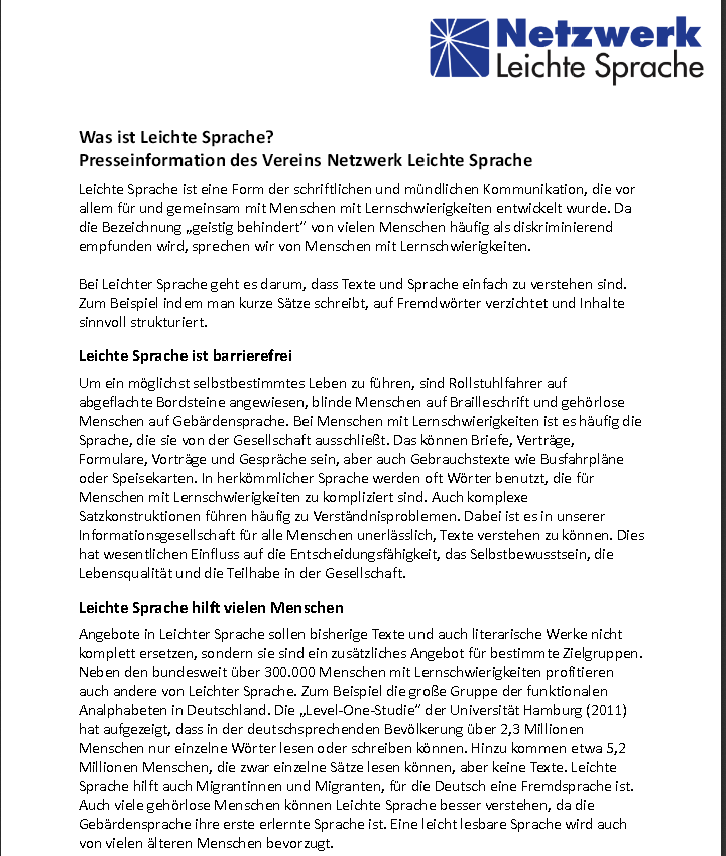
Which one would encourage you to at least give it a try? Naturally plenty of immigrants and expats strive and pride themselves on reaching the level of language used in the second text. But for those scientists and doctors and painters and cooks and economists who admit that foreign languages were never their strong point, something is far better than nothing.
Some have voiced concerns that this is a slippery slope toward an anti-intellectual populace; that all the poetry, intricacy, and subtlety of refined language will be thrown out with the bathwater if Leichte Sprache has its way. As a writer, I’ll be the first one at the barricades whenever anyone proposes that all public discourse accommodate the lowest common denominator. I’m the type to shudder at someone saying, “We’ve come 360 degrees” when they mean 180 degrees; at reporters saying “he’s a graceful person” when they mean “gracious”; at friends mistaking “literally” for “extremely.” Because when our language becomes shallow and meaningless, our ideas become shallow and meaningless.
But Leichte Sprache is no cause for worry because it is intended as an option, like Braille, not an imposed standard, like the Newspeak in Ninety-Eighty-Four. Far from stigmatizing intellectuals, it is a means of empowering groups of people that are all too often excluded from the discussion. And, perhaps most importantly, Leichte Sprache is a conscientious effort, a carefully constructed means of expression with many, many rules, whereas any shift toward linguistic parochialism among those of us without cognitive disabilities usually comes from an unwillingness to give much care or thought to what we say.
Indeed, it bears repeating that Leichte Sprache is not a matter of merely dumbing down the way we speak to certain people, with no concern for how patronizing we might sound. For anyone who thinks people with intellectual disabilities don’t notice when we’re talking down to them, there’s this:
The role of Leichte Sprache in today’s election may not be big enough to produce any surprises, but its implementation does recognize the rights of several minorities to participate in the political process. It also signifies Germany’s commitment to the U.N. Convention on the Rights of People with Disabilities. However, according to Leichte Sprache translator Andrea Tischner, the two parties currently in power are not doing all they could. Chancellor Angela Merkel’s center-right Christian Democrats, and their Bavarian sister party the Christian Social Union, have failed to translate much of their platform into Leichte Sprache, while the libertarian Free Democrats use too many big words in their translations. Interestingly, theirs has been the most diverse administration in the history of Germany—and possibly the world— with a female chancellor, a foreign-born vice-chancellor and an openly gay secretary of state. But according to Tischner, the best translations are offered by three of the four major parties on the left: the Social Democrats, the Greens, and the Pirates. She didn’t offer any assessment of how the anti-immigrant, Nazi-apologist Nationalists are handling things, but I think we can guess.
 (Image by Thomas Hawk used under Creative Commons license via)
“I’ve learned not to judge other people.” In the debate on marriage equality, many former opponents have softened their opinions with this all-too-common phrase. While a little progress and diplomacy in any debate is better than none, this should hardly be considered an acceptable assessment of same-sex marriage. Because whenever we say, “I don’t judge,” we’re implying that we think there is something morally ambiguous to judge about the situation.
We say “I don’t judge” when we observe pain or dishonesty and are hard pressed to think of a way it could have been prevented. We say it when we observe someone lose control and we know that everyone loses control sometimes. We say it when at least two sides are sparring and both have made major mistakes. It’s dishonest to pretend that we don’t have opinions about the decisions and actions we witness, because we all do. But ultimately saying, “I don’t judge” means my opinion is incomplete because I can’t say for sure what I would do in that situation. And when the act in question falls short of intentionally cruel behavior, it is often the appropriate thing to say.
It’s appropriate when we hear about a neighbor’s divorce (“I don’t know the details of the marriage, so I can’t judge”), when we hear that someone took a job that compromised their morals (“I can’t say what I would do if I were that strapped for cash”), when we see people with parenting methods that differ from our own (“That child isn’t my child, and I don’t know what I would do if she were”). We say it not to ignore the harm it may have wrought, but in order to remain humble, to avoid hypocrisy, and to remember that different circumstances prevent the human experience from being truly universal.
But we do not and should not say it regarding lifestyles that raise no moral questions. We don’t say, “She’s dating a foreigner, but I don’t judge,” or “They adopted a child, but I don’t judge.” If anyone said of my partner, “He married a woman with dwarfism, but I don’t judge,” that person would be implying there is something shameful or irresponsible about me and my condition.
A little over a hundred years ago, doctors were saying just that. A Virginia medical manual in 1878 advocated criminalizing marriages between average-sized men and women with dwarfism, insisting that such an act was on par with “murder.”
Modern readers hopefully find nothing morally ambiguous about two consenting adults falling in love and deciding to commit to one another. Regarding interracial or same-sex or international or medically “mixed” marriages, the only people who should invite our judgment are those who impugn these relationships with the statement, “I don’t judge.” It’s an oxymoron, not unlike a “Please” slathered sarcasm. And it would be swell to see it less and less in political discussions on civil rights.
 (Via)
(Via)
Tropes are ideas we construct based on observing patterns in society and wanting to understand them. Stereotypes are ideas we construct based on hearing about patterns in society and accepting them at face value. Needless to say, stereotypes based on that which we have no choice about—our sex, gender identity, sexuality, ethnicity, nationality, physical traits, or mental abilities—usually do more harm than good.
Not only do they deny minorities equal rights and opportunities, but a recent study shows that embracing racial stereotypes leads to creative stagnation. So how do we combat them?
In the wake of the Trayvon Martin verdict and President Obama’s call for a dialogue on race in America, Harvard researchers announced a competition to find the quickest, most effective method for getting people to let go of the prejudices they have about a certain group. The results? Calls for empathy and other try-to-put-yourself-in-their-shoes methods were largely ineffective. What worked best was showing the participants counter-stereotypical images. World leaders with severe disabilities. Parents proudly painting their son’s toenails. Construction workers nursing their babies. Sons helping out with the housework. Seeing is believing, apparently.
It is crucial to note that celebrating diversity can feel patronizing, especially to the subjects. The goal, after all, is to drive stereotypes to extinction so that observers find absolutely nothing extraordinary about any of the above images. Because the subjects do not feel extraordinary, at least not all the time – they feel normal. No person who can qualify as a minority or counter-stereotype should feel pressured to spotlight their everyday life if they don’t want to. But it is encouraging—if not unsurprising—to see that altering media portrayals of society alters a good deal of the prejudices plaguing too many corners of society.
As my friend Sarah Winawer-Wetzel recently said:
For me, it validates the importance of being out as a gay person. How else are people going to believe that a nice white Jewish girl who dresses femme and doesn’t look particularly counterculture can be queer if I’m not out like a friggin’ lightbulb everywhere I go? I’m not doing it just for me – I’m doing it so that when a little kid looks at the world and thinks about being gay, that kid sees the full spectrum of possibilities, not just a cultural stereotype. Those of us who control visuals and representations of people in the media need to remember to wield our power for good.
We often forget the power we wield when we have a stereotype in our hands, thinking it’s bigger than anything we can do about it. But it is not. And that is wonderful.
 (Image by Katie Cowden used under CC license via)
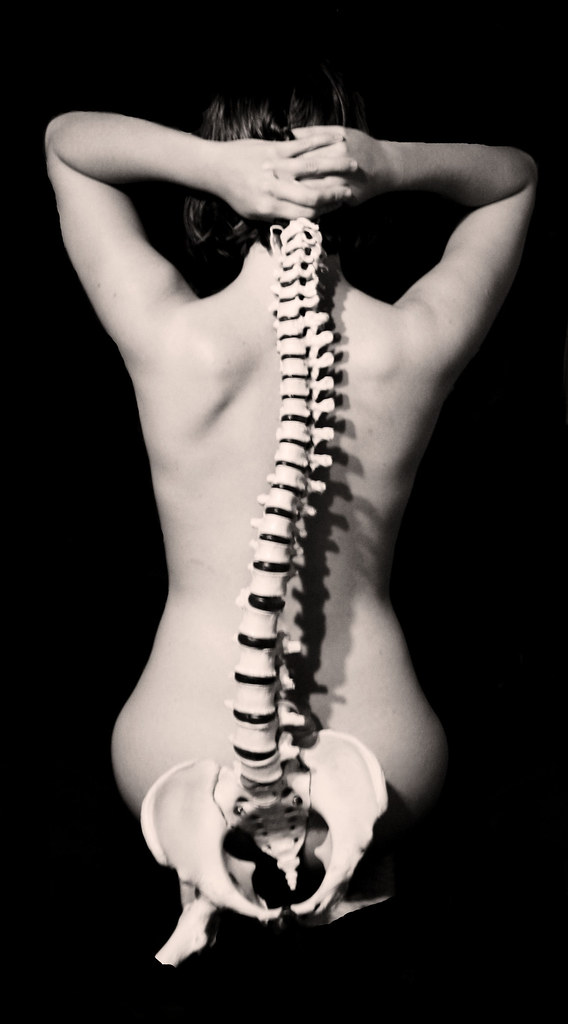
Fifty-five year-old Terry Ragland of Tennessee recently sought medical attention for lower back pain at her local orthopedic center. She was introduced to Dr. Timothy Sweo, who ordered x-rays. After analyzing the results, Sweo concluded that the pain was caused by a curve in the spine called lumbar lordosis. He delivered the diagnosis to the patient by saying plainly, “You have ghetto booty.”
Lumbar lordosis is a severe curvature of the lower spine most visible from the side and it can be caused by a variety of a factors. “Ghetto booty” is, according to the most popular Urban dictionary definition, “a term used when you see a girl with a firm, big, tight packed ass. {Most black girls have ghetto booties}.” In other words, it’s slang for simply having a big butt.
For a medical professional to use the term is fantastically patronizing at best. For a white male medical professional to use racially-charged sex slang with a black female patient he has only met once before is jaw-droppingly gauche. His attempted apology to Ragland via letter does not help his case: “I was trying to take a technical conversation regarding your lower back and make it less technical.”
Presuming orthopedic patients are unable to comprehend medical terms like “lumbar lordosis” is ludicrous. After a month into my first limb-lengthening procedure at age 11, I could explain the difference between lordosis and scoliosis, a corticotomy and an osteotomy, and I could name every bone in the human body. I wasn’t exceptional – I just wanted to understand the world I was living in, like every one of my fellow pediatric patients. Priscilla Alderson’s excellent book Children’s Consent to Surgery presents overwhelming evidence that child patients are far more aware than adults tend to give them credit for. And Ragland is not a child.
“It says to me that he doubts what type of intellect I have, how intelligent I am to be able to understand what he conveys to me in a medical term,” Ragland told reporters.
While Sweo’s condescension comprises a particularly stunning mix of nasty prejudices, he is hardly the first doctor to speak disrespectfully to a patient. Medical specialists are renowned for being scientifically brilliant but socially inept. After making you sit in the waiting room, sometimes for several hours, they swoop in, keep their eyes on your body or the floor, bark a few questions at you, rattle off some orders for the nurse to take down, and swoop out again. The patient is supposed take solace in the fact that it is all a sign of how important the doctor is.
Since this stereotype has become so pervasive, some medical professionals do make earnest attempts to shatter it, but their success varies. Some try through their body language and demeanor to give you the sense that they are genuinely listening and care about your all-around well-being. Others try by jamming a few blunt jokes into your narrow time slot. It gives you the sense that they’ve just watched Patch Adams and decided that being a clown is the perfect defense against being accused of coldness, so let ’er rip! Your body, your condition and your diseases are hilarious!
Indeed, the most exasperating aspect of the Dr. Sweo case is that he appears to genuinely believe that his comments might have been helpful. Usually it is easier to engage in productive discourse with someone whose intentions are good than with someone who aims to hurt. But in light of his oblivious apology, it seems Ragland has a better chance of getting through to other, more perceptive doctors via the media than to Sweo via complaint.
I have lumbar lordosis. It’s one of the primary symptoms of achondroplasia and it’s why I had to undergo spinal surgery last year. I could have crashed this site with a list of all the off-putting doctors and healers I encountered, as well as the sarcastic jokes my closest friends came up with to keep me sane. As Ragland files a formal complaint with the Tennessee Department of Health, there will inevitably be some backlash about PC culture gone mad and minorities being too sensitive and humorless. But more power to her for sticking up for herself, and for patients everywhere.

(Via)
If you live anywhere in the West, you know this transphobic joke. Girl and guy go to bed. Guy wakes up and finds out somehow that his lover was not born a woman. The moment of realization is sketched out across his face in excruciating slow-motion, and then he runs away in horror/vomits his brains out/gets very, very, very angry. The message?
1) A trans woman isn’t a “real” woman, she’s a freak.
2) His being attracted to her somehow makes him less of a man.
3) Most importantly, he’s been duped.
Feeling duped is the bedrock of transphobia. Those who feel indiscriminately upset at the very idea of transsexual and/or transgender people usually say something along the lines of, “They’re deceiving people! I’d be pretty pissed if I found out my girlfriend/boyfriend had had a sex change.” This feeling is usually enshrouded in the myth that transitioning into the opposite sex is done capriciously, just for laughs and the thrill of going undercover. This mentality never ever acknowledges the fact that many transsexual and transgender people feel as uncomfortable in the body they were born in as cis people would feel in a body they were not born in. And it fosters the view of cis people as victims of trans villains, ignoring that trans people in the United States have a suicide rate 26 times higher than the nationl average and that worldwide one trans person is murdered every three days.
This all too common belief that trans people are deceptive, and maliciously so, has now reached new heights as two trans men in the U.K. have been charged with and convicted of sexual assault. Their accusers claimed that the men’s failure to disclose their gender at birth before they slept with them was a form of fraud and thus the consent the women gave to sex was under false pretenses. I am in no position to make a final judgment about these two specific cases. Perhaps they involved many other factors revealing coercion and predatory behavior. I cannot speak for the defendants or the accusers. But I can and will speak out against the widespread belief that the freaks of the world are obliged to warn everyone they know about their atypical features and histories before they dare try to get close to someone.
My husband thought I must have been in a car accident years ago when we met for the first time at a birthday party. I was wearing a sleeveless top exposing the lavender scars that traverse my upper arms. I know I told him soon after, on our first date, about my long medical history, but that was because we were having an intellectual debate about the role of the media and I decided to use my childhood experiences as an example. I decided to do so because I liked him and trusted him in a very special way. It was not because I felt that anyone I was interested in romantically “deserved” to know.
What do potential sex partners deserve to know? Do they deserve to know I had my calf bones removed? Do they deserve to know I had my tonsils out? What if I had been born deaf and had a cochlear implant? What if I used to weigh twice as much, or half as much, as I do now? What about veterans or cancer patients who have lost body parts normally only seen by sex partners? Is it fraudulent of a cancer survivor to wear a prosthesis that would suggest she still has both breasts?
Indeed, the moment I read about the British cases, I was immediately reminded of a poem by Robert Hass about a woman who is abandoned at her doorstep by a young admirer after she tells him she has had a double mastectomy. “I’m sorry. I don’t think I could,” he mumbles before he turns his tail and runs. I do not know what it is like to be a cancer survivor or transsexual, but surely many of us know what it is like to fear being rejected for something we never had much of a choice about.
In reponse to the British accusations of sexual assault, law professor Alex Sharpe has asked, What if a potential sex partner appears white but is in fact of mixed race – is a failure to map out your entire family tree grounds for prosecution? Of course not. He points out that individuals are not legally obliged to reveal to sex partners that they are bisexual, married, divorced, have a past criminal record… The list is endless, and thus he argues: “Given that we all have gender histories but only some of us (transgender people) are required to disclose them, there appears to be a good basis for arguing that a legal requirement to disclose gender history constitutes discrimination contrary to Article 14 of the European Convention on Human Rights.”
Of course, any counselor or psychologist will tell you that trust, openness, and honesty are necessary for a healthy relationship and true intimacy, but the right to privacy and personal dignity are also necessary for any community founded on justice. And there can be no genuine trust when certain people reveal personal information only because society’s hang-ups about gender, sexuality, or atypical bodies demand they do.
Everyone is entitled to their sexuality. No one should ever be pressured into a heterosexual, homosexual or pansexual relationship. Open and honest dialogue about this is essential. But the more we blame minorities for upsetting our delusions of normalcy just by being who they are, the more we tell jokes implying that any normal person would be disgusted by their physiology, the more we insist that their identities are a perversion of ours, the more difficult we make it for them to be open and honest with us.
This past Wednesday, Berlin’s Central Station—the largest train station in Europe—was closed after a 220-pound Soviet bomb from World War II was discovered by construction workers. 840 residents were evacuated from the area before the bomb was successfully defused.
Not all such bombs can be defused. This past August, an American bomb discovered in Munich had to be detonated by experts, as you can see in the video above. Approximately fifteen unexploded World War II bombs are discovered in Germany every day. This does not happen where I come from.
To live in Berlin, my favorite place on earth, is to live in a city of scars.
The great Dara Ó Briain in a clip from QI that is well worth the poor visuals. Happy holiday greetings from Berlin!
Time for another break from the tough stuff. I want to talk about Disney. (In earnest, mind you. As always.) I just saw Pixar’s Brave and no, I’m not going to write about her feminism—or the ludicrous musings about her lesbianism—or the radical imperfectness of her eyebrows. What pleased me most about this film was its break from the Broadway tradition that has been dominating—dare I say strangling—animated cinema for decades. Throughout my childhood, Disney and their competitors would take you around the world with Alan Menken and his endless supply of wide-mouthed Middle American show tunes as your guide. The main characters’ accents ranged from Beverly Hills to Burbank.
Like The Princess and the Frog, Brave has the guts to feature songs, accents, and expressions native to the story’s setting. And it’s about time. The Broadway model has its merits, but it can start to feel like overkill when it forbids any trace of historical or foreign flavor. When it comes to their family films, Hollywood has traditionally handled their American audiences like cultural infants. There conventional wisdom asserts that any voice that doesn’t immediately evoke baseball and apple pie risks obliterating our ability to empathize. Only “artsy” films for grown-ups like Brokeback Mountain or Capote dare to let the dialect match the backdrop. Hence our heroes Aladdin and Belle and Ariel and Simba and Esmeralda, who all sound like they went to school with the cast of Saved by the Bell. As The New York Times observed in 1997, the closest the actors in Anastasia ever came to St. Petersburg was Pasadena. A character speaking the Queen’s English has been permitted with some regularity, but if they’re not Julie Andrews, they’re probably the villain or the butler.
Paradoxically, these animated family films set in far off lands usually feature one odd character who does speak with a local accent. So is this proof we can catch words pronounced differently, or does it not matter what Token Foreigner says because his character is inconsequential? Beauty and the Beast lets one or two sidekicks babble, “Ooo la la!” and “Sacre bleu !” but pretty much leaves the plot exposition up to everyone else. In Aladdin, the Arabic accent belongs only to the characters with the fewest lines, such as the merchant—who sings the racist song that was later edited—and Gazeem the thief, who dies before the end of Scene One. And by the way, I haven’t been able to find anyone in The Little Mermaid who sounds Danish, under the sea or above.
Not only does Brave inject its lines with a kick-ass charisma brought on by Scottish brogue, but most of its voice actors—with the exception of Emma Thompson and Julie Walters—are actually, truly, veritably from Scotland. Traditionally, the Token Foreigner in a children’s film has been provided by an American actor putting on a stereotypical accent. (Kelsey Grammer as a Russian aristocrat, Jerry Orbach as a French candlestick… ) The ability to imitate an accent is a great skill for both an actor and an interpreter, but it can easily go horribly wrong without anyone in charge of the film noticing. The fact that Dick van Dyke got away with his impression of Cockney in Mary Poppins suggests that U.S. film critics of the time had pretty low standards. Meryl Streep has been famously lauded for her ability to sound authentically Italian, Polish, and British, but almost none of those singing her praises are Italian, Polish, or British. Her portrayals may very well be accurate, but ever since Mary Poppins, Americans have a bit of a reputation for being too easily fooled. My Nordic partner always rolls his eyes and shakes his head at the Seinfeld episode that tried to pass off this accent as Finnish:
This is not to say that Americans are the only ones who can’t tell Finnish from gibberish. I’ve met plenty of French people who think Japanese sounds like that pathetically generic “Ching-chong-chang!” And Brits who have claimed—a little arrogantly—that the U.S. does not have as many dialects or accents as the U.K. Ethnologue cites 176 living languages in the U.S. compared to the U.K.’s 12. Great Britain and Northern Ireland may contain more dialects—though I would bet their dialects are fewer in number while boasting more speakers per dialect—but this begs the philosophical question of what separates a dialect from a language. The joke among linguists goes, “A language has an army and a navy.”
Every culture tends toward simplistic views of other cultures. When you begin to type “Brave Pixar” into Google, you get the apparently popular question, “Brave Pixar Irish or Scottish?” Anyone outside of the Celtic-speaking regions could be asking this question.
I’m sure Brave is still rife with Scottish stereotypes that are more craved by Hollywood than are authentic. And the ancient clans of the Highlands most likely sounded nothing like Billy Connolly or Craig Ferguson. But it is nice to see the filmmakers trust us enough to handle protagonists who do not speak exactly like the average American moviegoer. After all, what is the point to hearing stories from far off lands if it’s not to hear things we may not have heard before? And the more we are exposed to different authentic accents, the more likely we are to realize that every one of us has one. And that somewhere, someone is smiling at the way we talk.
 (Via)
(Via)
This week, humor site Cracked.com features a great article by J.F. Sargent titled “6 Insane Stereotypes That Movies Can’t Seem to Get Over.” Alongside the insidious ways in which racism, sexism, homophobia still manage to persevere in mainstream entertainment, Number Two on the list is “Anything (Even Death) Is Better Than Being Disabled”:
In movie universes, there’s two ways to get disabled: Either you get a sweet superpower out of it, like Daredevil, or it makes you absolutely miserable for the rest of your life. One of the most infamous examples is Million Dollar Baby, which ends with (spoilers) the protagonist becoming a quadriplegic and Clint Eastwood euthanizing her because, you know, what’s the point of living like that? Never mind the fact that millions of people do just that every day…
Showing someone using sheer willpower to overcome something is a great character arc, and Hollywood applies that to everything, from learning kung fu despite being an overweight panda to “beating” a real-world disability. The problem is, this arc has some tragic implications for the real-world people who come out with the message that they are “too weak” to overcome their disabilities.
The result is that moviegoers think that disabilities are way worse than they actually are, and filmmakers have to cater to that: For example, while filming an episode of Dollhouse where Eliza Dushku was blind, the producers brought in an actual blind woman to show the actress how to move and get around, but the result was that “she didn’t look blind,” and they had to make her act clumsier so the audience would buy it.
Even in Avatar, real paraplegics thought that Sam Worthington’s character was making way too much effort transferring from his chair, but that’s the way we’re used to seeing it in movies. It’s a vicious cycle, and it isn’t going to stop until either Hollywood wises up or people with disabilities stop living happy, fulfilling lives.
I’ve examined Hollywood’s ableist problems several times before and there are still plenty to dedicate an entire blog to. But, like The Daily Show or The Onion, Cracked has a long history of excellent social critique embedded amongst the fart jokes and it’s awesome. Especially when considering that not only mainstream but alternative entertainment all too often can’t seem to let go of the tired stereotypes. That Cracked is a site not officially dedicated to politics or social activism suggests that the comics writing for it believe calling out the industry for its embarrassing ineptitude is just common sense.

(Via)
This week I led a workshop about teaching pre-school children about diversity. I started by asking the teachers what privilege is, and I got the same answer a family member had given just days before: “Privilege is what people who are really lucky have. Like being born into a rich family, going to nice schools, or even just being exceptionally good-looking and therefore having an easier time of it.”
It is interesting that so many seem to be under the impression that privilege and luck are what extremely well-off people have. Privilege does belong to anyone whose place in society is considered “better than normal,” but also to anyone whose place is considered simply “normal.” As said before, privilege is granted by society to certain people based on things we had absolutely nothing to do with: our gender identity, our ethnicity, our sexuality, our physical traits, our mental capabilities, our class background. That is why any privilege—like any form of disenfranchisement—is unjust.
In the workshop, I read off the following list of statements that illustrate privilege to the participants who were lined up in a row. (It’s a hodge-podge of original statements and ones taken from privilege activities created by Peggy McIntosh, Earlham College, and the Head Start Program.) Anyone for whom the statement was true could step forward. Anyone else had to stay behind. All of us in the group stepped forward at least half the time. You can see for yourself where you would have ended up:
1) I always felt safe in my neighborhood as a child.
2) If I wish to, I can be with people of my race/ethnicity most of the time.
3) I never have to plan how to reveal my sexual orientation or gender identity to friends, family, or colleagues. It’s assumed.
4) I can go out in public without being stared at.
5) I participated in extracurricular activities as a child (swimming, football, ballet, piano, yoga, painting, etc.).
6) I can easily buy posters, picture books, dolls, toys and greeting cards featuring people of my race.
7) I can wear a skirt, a dress, jeans, or pants, without anyone staring or asking me to explain my choice.
8) In school, I could always take part in whatever activity or games the class was assigned.
9) None of my close friends or family has ever been arrested.
10) Rarely have I been asked to explain why my body looks the way it does or why I move or speak the way I do.
11) I have never worried that I might not be able to afford food.
12) When I learned about “civilization” in school, I was shown that people with my skin color made it what it is.
13) I have never heard of someone who looks like me being given up for adoption or aborted because of it.
14) Who I am attracted to is not considered a political issue.
15) I attended a private school.
16) I am never asked to speak for everyone in my ethnic group.
17) I can find colleges that have many people from my class background as students.
18) I can criticize our government without being seen as an outsider.
19) My family never had to move for financial reasons.
20) If I am assertive, it is never assumed that it comes from my need to “compensate” or struggle with my identity.
21) When I was a child, I never had to help my parents at their workplace regularly.
22) When I talk about my sexuality (such as joking or talking about relationships), I will not be accused of “pushing” my sexuality on others.
23) If I make a mistake or get into trouble, I am usually judged as an individual, not as an example of people who look like me.
24) I can go for months without being called straight, heterosexual, or cis.
25) I can use public facilities (store shelves, desks, cars, buses, restrooms, and train or plane seats) or standard materials (books, scissors, computers, televisions) without needing help or adaptations.
26) When I dress for a formal event, I don’t worry about being accused of looking too dolled up or not pretty enough.
27) As a child, I never had to help care for a family member.
28) When I watch family advertisements for food, medicine, clothing, games and toys, the families on TV usually look like mine.
29) I grew up feeling I could be whoever or whatever I wanted.
30) I have never been asked, “What do [people like] you like to be called?”
(Image by cchauvet used under CC license via)
Snow White and the Huntsman is out on DVD in Europe tomorrow. Unlike in most other Snow White films, the seven dwarfs are portrayed by average-sized actors, their bodies altered by digital manipulation. No one in the dwarf community is pleased about this. Little People of America issued a statement criticizing the filmmakers’ failure to give priority to performers with dwarfism, while Warwick Davis argued, “It is not acceptable to ‘black up’ as a white actor, so why should it be acceptable to ‘shrink’ an actor to play a dwarf?”
I don’t believe digitally generated dwarfism is on par with blackface and all that evokes, but it’s not too far off because there is a long tradition in cinema and theater of socially privileged actors portraying socially marginalized characters. And never the other way around. Blackface is a particularly hideous blemish on the history of entertainment because it was almost always used for mockery. Yellowface has a similarly horrid history: Until 1948, anti-miscegenation laws in the U.S. banned actors of different ethnicities from kissing onscreen, so whenever a white actor portrayed an Asian leading man, Anna May Wong knew the role of the heroine was off limits to her, despite her being the most successful Chinese-American actress of the era. Meanwhile, as noted before, the circus freak show tradition that caricatures people with disabilities is still going strong today.
To be fair, Snow White and the Huntsman does not create the illusion of dwarfism in order to mock it. This is why, to me, the blackface comparison seems overblown. (A more apt analogy to blackface would be an actor inhaling helium to play a dwarf, as David Hyde Pierce did for laughs on an episode of Frasier years ago.) When a character matter-of-factly has a disability and the performer simulates their body type with artifice, is this not comparable to any sort of makeup or costumes? Danny Woodburn (whom you might know from Seinfeld) discussed it in an excellent interview on The Patt Morrison Show in June:
Directors, producers have every right to cast who they want to cast. I just think this is something that merits discussion when the disability community—not just the little people community but the disability community—is so underrepresented in the film and television industry…
Others without disability portraying people with disability. When producers, directors don’t actively seek performers with disability—[and they’d have to] because a lot of those performers don’t have equal access to casting, don’t have equal access to representation—when they don’t actively seek out those performers, then there’s a real slight against our society, I believe…
This is about making a stand so that there’s at least some due diligence… When you have a community of disabled that is about twenty percent of the population and less than one percent of disabled actors appear on TV. And some of the disabled characters, many of them are not portrayed by disabled actors.
Woodburn and Little People of America raised this issue ten years ago when Peter Jackson announced that he would cast only average-sized actors in The Lord of the Rings. As noted before, part of me was glad to see those magical creatures distanced from real-life people with skeletal dysplasias, but if Jackson had chosen to use dwarf performers to portray the Hobbits or the Dwarves, might someone like Woodburn be as famous as Elijah Wood is today? It’s hard to say. Famous actors create box office draw. Almost no famous actors are disabled and almost no disabled actors are famous. And that’s the problem.
If digital manipulation and theater makeup are someday used to expand roles to minority performers, allowing actors of any body type or ability to play the Huntsman or Prince Charming, it will then lose its exclusionary feel. I adored Snow White and the Seven Dwarfs growing up and, even though I was the only kid with dwarfism, I always portrayed the princess in the living room productions put on for my parents and their friends. But cinema has almost never swung that way. There is no history of ethnic minorities portraying famous white characters or disabled performers portraying physiotypical heroes and heroines. Plenty of ambulatory men have sat in wheelchairs to portray FDR, but no disabled man has been cast as JFK. And that stings a bit.
And what stings even more is the way in which privileged actors so often earn automatic praise for portraying minority characters in epic films, as if all minorities are opaque, mystical people only geniuses could begin to understand. John Malkovich as a mentally disabled man in Of Men and Men, Colin Firth as stammering King George VI, and Patty Duke, Melissa Gilbert and more recently Abigail Breslin as Helen Keller have all been lauded for their performances. They are all fine actors who have proven a wide range of talent, and the stories they tell are truly moving. But the public’s nearly kneejerk assumption that a minority role is a feat of greatness for a privileged actor can feel very condescending.
In the very bizarre, direct-to-DVD film Tiptoes, Gary Oldman was digitally manipulated to take the role of the leading man with dwarfism. Peter Dinklage, who played the comedic supporting role (and, in my opinion, the only good moments in the film), said: “There was some flak. ‘Why would you put Gary Oldman on his knees? That’s almost like blackface.’ And I have my own opinions about political correctness, but I was just like, ‘It’s Gary Oldman. He can do whatever he wants.’ ”
Fair enough, but when he was sappily introduced in the trailer as playing “the role of a lifetime,” I almost lost my lunch.
This week the British newspaper The Telegraph asks:
Ever wondered why men can’t seem to tastefully decorate a house? Or have a tendency for dressing in clothes that clash? And why, for that matter, can’t women seem to hack it at computer games? Now scientists claim to have discovered the reason: the sexes see differently. Women are better able to tell fine differences between colors, but men are better at keeping an eye on rapidly moving objects, they say.
Professor Israel Abramov and colleagues at the City University of New York reached their conclusions after testing the sight of students and staff, all over 16, at two colleges…
The authors wrote: “Across most of the visible spectrum males require a slightly longer wavelength than do females in order to experience the same hue.” So, a man would perceive a turquoise vase, for instance, as being a little more blue than a woman who was looking at it too.
Abramov, professor of cognition, admitted they currently had “no idea” about how sex influenced color perception. However, writing in the journal Biology of Sex Differences, he said it seemed “reasonable to postulate” that differences in testosterone levels were responsible…
Men can’t perceive colors as deftly as women can. That’s why all the great Western painters like Van Gogh and Cézanne and Leonardo and Picasso and Renoir and Monet and Munch and Vermeer and Kandinsky and Matisse are female. And all the major fashion designers of the last century like Hugo Boss and Karl Lagerfeld and Gianni Versace and Giorgio Armani and Calvin Klein and Ralph Lauren were women. Oh, wait.
Maybe the study meant to say testosterone only triggers color ineptitude when male ears register the words “home decorating.” Or that male color perception improves when money is involved.
Or maybe The Telegraph author was exaggerating just a bit. Tacking jazzy headlines onto reports of scientific studies are all the rage these days, no matter how much they distort the findings. In June, Medical Daily ran an article under the title, “Racism Is Innate.” Innate means, according to my biologist father, “present at birth,” so this seemed like a call to toss all those No child is born a racist buttons onto the trash heap. Except that anyone who bothered to read the article would discover that the study simply concluded that brain scans of adults show simultaneous activity in the centers that process fear and emotion and those that differentiate between familiar and unfamiliar faces. The idea that fear of the Other can be neurologically mapped lends itself to a great deal of speculation and debate, but nowhere did the study claim that racism is present at birth.
Such truth-stretching borders on mendacity, yet it pervades the science sections of so many newspapers. Scientific studies are supposed to be free of bias, but the news media is severely biased toward publishing whatever will grab readers’ attention. As several researchers have pointed out, differences between the sexes are currently considered a much more interesting discovery than no difference, so publishers often remain silent on an issue until they find a study that provides the juicier headline, no matter how numerous the contradicting studies are. When the market is left to decide, it chooses salability over comprehensiveness.
Such an irresponsible approach to science results in a gravely misinformed public. I can’t tell you how many people have repeated the claim that our modern Western female beauty standards are “natural” because a round waist resembles pregnancy and triggers the male fear of cuckoldry. No one seems to remember that several cross–cultural studies discredited this idea years ago. But how can anyone be expected to remember something the media chose not to promote in the first place?
And forget about waiting until the study is corroborated. In 2007, The Times ran a headline claiming that women are naturally drawn to the color pink because of our savannah foremothers’ need to gather berries while the men hunted. The Times published the study without consulting any historians, who eventually pointed out that pink was considered a manly color as recently as 1918 until fashion trends changed. Oops.
This doesn’t mean that we should, as Mitt Romney has demanded, “keep science out of politics.” Science is impartiality and corroboration and the best method we have for sorting facts from wishful thinking—for preventing our emotional, egotistical needs from weakening our objectivity. To me, science is the most humbling force in the universe because it demands we always admit what we do not know. It prevents hasty conclusions based on flimsy evidence, gut feelings, and political agendas. It questions crude stereotypes and discovers more complex structures.
But according to pop science reporters and the researchers they choose to spotlight, nearly every single modern joke about the differences between men and women stems from millennia-old evolutionary adaptations. (Indeed, the Telegraph article claims that the female proclivity for detecting color helped our foremothers with gathering berries. Always with the damn berries… ) As stated in the graphic below, such reports all too often suggest that prehistoric society on the African savannah looked just like something Don Draper or Phyllis Schlafly would have designed:
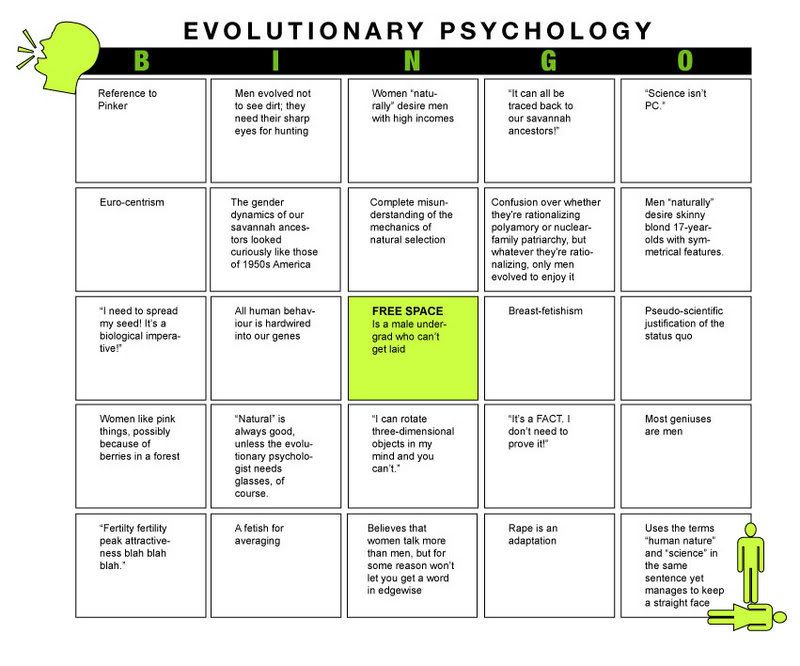
Men hunt, women nest, and every macho social pattern we see today has been passed down to us from our prehistoric ancestors. Even though historians find that these patterns, like our racial categories, are barely more than two centuries old, if that. And that the gender binary is far from universal. Misinterpreting scientific findings is just as dire as ignoring them.
When it comes to what women and men can and can’t do, neuroscientist Lise Eliot notes, “Expectations are crucial.” When boys and young men grow up in a culture that mocks their supposed incompetence in all things domestic (“Guys don’t do that!”), it comes as no surprise that only the most self-confident will pursue any interest they have. Meanwhile, studies show girls perform as well as boys do in math and science until they reach puberty. Maybe the onset of menstruation paralyzes our visual-spatial intelligence because we’ve got to get picking those berries, or maybe girls pick up on the not-so-subtle message that guys think coquettish beauty is more important than nerdy brains in the dating game. (For more details on the sexism faced by aspiring female scientists, see Cordelia Fine’s excellent book, Delusions of Gender.) In her research, Dr. Eliot finds only two indisputable neurological differences between males and females:
1) Male brains are 8% to 11% larger than females’.
2) Female brains reach maturation earlier than male brains.
All other neurological studies that find major differences between the sexes are studies of adults: i.e., the people most shaped by their culture and society. Only cross-cultural studies of adults can isolate nurture from nature. In any case, Eliot is a proponent of neuroplasticity, the idea that the pathways and synapses of the brain change depending upon its environment and the neural processes and behaviors it engages in. In other words, painting or gaming from an early age or frequently throughout your life will condition your brain to do these tasks and related ones well. It explains why the gender roles of a given time and place are so powerful—why mastering unfamiliar tasks is an uphill climb for men and women but also why countries committed to equality have the narrowest gender gaps.
“Plasticity is the basis for all learning and the best hope for recovery after injury,” Eliot writes. “Simply put, your brain is what you do with it.” For more, see her brilliant parenting book, Pink Brain, Blue Brain: How Small Differences Grow into Troublesome Gaps—and What We Can Do About It.
But I’ll never believe that a neuroscientist has all the answers. I live in a country that showed the world the dangers of hastily trying to trace all social patterns back to biology. As a result, the media here in Germany is usually much more reticent to casually toss around arguments like those in The Telegraph or The Times or Medical Daily. Natural scientists have made discoveries like neuroplasticity and limb-lengthening that are crucial to progress, but social scientists have discovered that equality and empathy are crucial to any society that values peace and respect over power and greed.
Or, in other words.
 (Image by Viewminder used under CC license via)
We’ve been waiting all summer for this decision. On Thursday here in Berlin, the German Ethics Council ruled that male circumcision is legally permissible without a doctor’s order, but several conditions must be met:
Some of these requirements, especially the last two, go against what some fundamentalist religious leaders mandate. Why all the fuss? In Europe, where female genital cutting is illegal, male circumcision is only common in Muslim and Jewish communities. Last year, a German court in Cologne ruled that the circumcision of an underage male constitutes aggravated assault and battery, and the debate has been raging ever since. It has split the nation into two parties: Those that see the procedure as cosmetic at best and mutilating at worst, carried out on patients too young to give consent, versus those that believe any ban on age-old rituals and tribal markers constitutes religious and/or ethnic persecution. That the ritual German lawyers sought to ban is a Jewish custom makes it a particularly sensitive case here.
When we hear stories of female genital cutting in Africa, Westerners are generally horrified. But few in the United States understand that many Europeans gape at our 60% rate of male circumcision and consider it to be of course not quite but almost as cruel. “How on earth could parents do that to their baby boy?!” is the reaction I get from the vast majority of Christian and non-denominational European males I talk to. They are much more prone to believe studies citing the problems it can cause—for example, a supposedly higher rate of dyspareunia for women who have intercourse with circumcised men—than studies that downplay such fears. I usually admit to them that, because it is so very common where I come from, I’d never given it much thought beyond those pop culture jokes about what looks better.
Which just goes to show how powerful cultural customs and values can be. Both female and male genital cutting involves groups that say we should protect the parents’ right to choose what they think is best for their children without government interference, while the others say the government should protect children from procedures that offer no medical benefit before they are old enough to decide for themselves, regardless of what their parents want.
I’ve written before that as someone who’s undergone limb-lengthening, I know how complex decisions about body alteration can be. Determining an appropriate age of consent for surgery can be even more complicated. But also due to my experience, I wince along with Jessica Valenti when parents choose procedures for their children that offer no real medical benefit. While discussing circumcision, my European friends argue that patients should reach the age of consent before undergoing any procedure that, unlike limb-lengthening, does not become more medically complicated with age. Should courts ever rule this way, this will inevitably lead to bans on juvenile nose-jobs like the one Valenti cites. But then what about ear-piercing?
Years ago, I was a panelist at a conference called “Surgically Shaping Children” at the Hastings Center, a think tank for bio-ethics, where we addressed elective procedures such as limb-lengthening on dwarfs and determining a gender for intersex children. After a two-day debate and a resulting book, we concluded that the best way to prevent parents from making decisions that could be damaging to their children is to keep both the parents and their children as informed as possible about every issue that’s at stake: medical facts, cultural identity, individual identity, and agency. The German Ethics Council’s ruling also implies that such comprehensive understanding is necessary.
I think a ban on circumcision would have created more cultural resentment than understanding. But the scientific community, and society as a whole, should take the place of the legal system in helping parents understand all the complexities of altering a child’s body without a medical purpose. There may be no easy answer, but the discussion has got to keep on going.
 (Image by Bob May used under CC license via)
Anytime my partner and I don’t know what to do or say, one of us asks, “What’s in the news?” and we dive into a political discussion. So it’s no surprise that we’ve become somewhat embarrassingly addicted to Aaron Sorkin’s The Newsroom. The news media has been (unsurprisingly) critical of a show founded on the idea of chastising the news media. Feminists have been (sometimes rightly) critical of its portrayal of women. The show has almost countless strengths and weaknesses, but I find myself still obsessing over the brilliant, captivating opening scene that kicked off the series. If you can’t this clip, it basically boils down to a flustered news anchor named Will McAvoy overcome with disgust at the state of the nation and nostalgia for the 1950s and 60s: “America’s not the greatest country in the world anymore,” he sighs. “We sure used to be.”
We stood up for what was right. We fought for moral reasons. We passed laws, we struck down laws for moral reasons. We waged wars on poverty, not poor people. We sacrificed, we cared about our neighbors. We put our money where our mouths were, and we never beat our chests… We cultivated the world’s greatest artists and the world’s greatest economy. We reached for the stars, acted like men. We aspired to intelligence. We didn’t belittle it. It didn’t make us feel inferior… We didn’t scare so easy.
“Nostalgia” literally means “aching to come home.” It’s the temporal form of homesickness, time rather than place being the source of pain. We all do it. It can be oddly soothing at times to be in awe of another era, especially the one you were born in. But Will McAvoy should watch Woody Allen’s Midnight in Paris for proof that nostalgia is an ultimately futile pastime that every sad sack of every era has hopelessly indulged in. (If “things were better back in the day,” then how come every generation says this?) But since McAvoy’s nostalgia is an earnest, political battle cry, heaping laurels on the good old 1950s and 60s when the leaders of the day did their job right, I’m more inclined to have him watch Mad Men. Or just open up the 1960 children’s illustrated encyclopedia I found at my great aunt’s house, which states, among other things: “The Australian aborigine is similar to the American negro in strength, but less intelligent.” Didn’t scare so easy, indeed.
The problem with nostalgia is that it is far more emotional than intellectual and thereby lends itself to inaccuracy all too easily. America was indeed doing great things sixty years ago. And reprehensible things. We hid our disabled and gay citizens away in institutions, asylums and prisons. We enforced the compulsory sterilization of mentally disabled and Native American women. We took decades to slowly repeal segregationist laws that the Nazis had used as models. We maintained laws that looked the other way when husbands and boyfriends abused their partners or children. In short, we handed out privilege based on gender, sexuality, ethnicity, religion, physical and mental capabilities with far greater frequency and openness than we do today. Perhaps we were the “greatest country in the world” compared to the others. (Europe and East Asia were trying to recover from the devastation of World War II, after all, while other nations were trying to recover from the devastation of colonialism.) But McAvoy’s wistful monologue is much more a comparison of America Then with America Now. And that is hard to swallow when considering that a reversion to that society would require so many of us to give up the rights we’ve been given since then.
Am I “another whiny, self-interested feminist” out to bludgeon the straight, cis, WASPy male heroes of history? Am I “just looking to be offended”? No, I’m struggling. Next to literature and foreign languages, history has always been my favorite subject. And pop history always touches upon this question:
“If you could go back to any period in history, which would it be?”
From an architectural point of view? Any time before the 1930s. From an environmental point of view? North America before European contact. From a male fashion point of view? Any period that flaunted fedoras or capes. From a realistic point of view? No other time but the present. Because if I am to be at all intellectually honest in my answer, there has never been a safer time for me to be myself.
Last year, I read The Lives of Dwarfs: Their Journey from Public Curiosity To Social Liberation by Betty Adelson. Despite my love of history, I hated almost every minute of it. Lies my Teacher Told Me by James Loewen had helped me understand how so many black American students feel uninspired by U.S. history and the figures we hold up as heroes because so many of those men would have kept them in shackles. But it wasn’t until I read The Lives of Dwarfs that I understood how nasty it feels on a gut-level to face the fact that most of history’s greatest figures would more likely than not consider you sub-human.
With the exception of Ancient Egypt, my own lifetime has been the only period wherein someone with dwarfism could have a fair chance of being raised by their family and encouraged to pursue an education and the career of their choice, as I was. At any other point in Western history, it would have been more probable that I would have been stuck in an institution, an asylum or the circus (the Modern Era before the 1970s), enslaved by the aristocracy (Rome, Middle Ages, Renaissance) or left for dead (Ancient Greece). Of course inspiring cases like Billy Barty show that a few courageous/decent parents bucked the trends and proved to be the exception to the rule, but that’s what they were. Exceptions.
I am fortunate to have been born when I was and for that reason, nostalgia for any other period in time can never be an intellectually honest exercise for someone like me. The moment someone says, “Yeah, well, let’s not dwell on odd cases like that. I’m talking about the average person,” they’re essentially saying, “Your experience is less important than mine.”
Everyone is entitled to have warm, fuzzy feelings about the era in which they grew up. If any period can put a lump in my throat, it’s the 1970s. The Sesame Street era. The boisterous, primary-colored festival flooded with William’s Doll, Jesse’s Dream Skirt, inner city pride à la Ezra Jack Keats, and androgynous big hair all set to funky music can evoke an almost embarrassing sigh from me. Donning jeans and calling everyone by their first name, that generation seemed set on celebrating diversity and tearing down hierarchies because, as the saying goes, Hitler had finally given xenophobia a bad name. Could there be a more inspiring zeitgeist than “You and me are free to be to you and me”?
But I’m being selective with my facts for the sake of my feelings.
Sesame Street and their ilk were indeed a groundbreaking force, but it was hardly the consensus. Segregation lingered in so many regions, as did those insidious forced sterilization laws. LGBT children were far more likely to be disowned back then than today—Free To Be You And Me had nothing to say about that—and gay adults could be arrested in 26 states. The leading feminist of the time was completely screwing up when it came to trans rights. Although more and more doctors were advocating empowerment for dwarf babies like me, adult dwarfs faced an 85% unemployment rate with the Americans with Disabilities Act still decades away. And Sesame Street was actually banned in Mississippi on segregationist grounds. When the ban was lifted, its supporters of course remained in the woodwork. We have made so much progress since then. It would be disingenuous for me to ignore that simply for the sake of nostalgia.
To be fair to Sorkin, it’s a hard habit to kick. We have always glorified the past to inspire us, no matter how inaccurate. Much of American patriotism prides itself on our being the world’s oldest democracy, but we were not remotely a democracy until 1920. Before then, like any other nation that held free elections, we were officially an androcracy, and of course we didn’t guarantee universal suffrage until the Voting Rights Act of 1965. That my spellcheck doesn’t even recognize the word “androcracy” signifies how little attention we afford our history of inequality. But we have to if accuracy is going to have anything to do with history. A brash statement like “We sure used to be [the greatest country in the world],” as a battle cry for self-improvement is asking to be called out on the inanity of this claim.
Everyone is entitled to appreciate certain facets or moments in history, just as everyone is entitled to look back fondly upon their childhood. Veracity falters, however, with the claim that not just certain facets but society as a whole was all-around “better.” This is never true, unless you’re comparing a time of war to the peacetime preceding it (1920s Europe vs. 1940s Europe, Tito’s Yugoslavia vs. the Balkans in the 1990s), and even then the argument is sticky (Iraq during the insurgency vs. Iraq under Saddam Hussein). In the words of Jessica Robyn Cadwallader, concealing the crimes of the past risks their reiteration. Whenever we claim that something was socially better at a certain point in history, we must admit that something was also worse. It always was.
But such a sober look at the past need not be depressing. It reminds me how very grateful I am to be alive today. My nephews are growing up in a society that is more accepting than almost any other that has preceded it. That is one of helluva battle cry. Because what could possibly be more inspiring than history’s proof that whatever our missteps, things have slowly, slowly gotten so much better?
 (Image ©Folke Lehr)
The very first time I entered Berlin, on a backpacking trip across Europe, I remember thinking that it was fairly ugly compared to Paris and the idyllic villages of Bavaria. But seeing the remains of the Wall at The East Side Gallery and the Memorial Church left from World War II blew my mind. By the time I finished studying here, I was deeply in love. Soon I will have lived here longer than any other place. My partner calls it “the only livable German city.” Even though I am still very much American, Berlin is home to me in every sense of the word.
And seeing as I kvetch so much about the cultural and social problems of our day, I want to take a breath and gush about a place I adore. (I’m quite sure my head will explode if I see myself write the word “society” one more time without a break.) So what’s the big deal about Berlin?
For one thing, it’s a city, and having grown up at first in the suburbs of Long Island and then rural Upstate New York, I’ve found I’m happiest in the urban setting. Yes, people are less friendly and there’s more pollution. But there’s also little room for gossip or judgment or homogeneity. You can wear anything you like and no one cares, or you accidentally start a new trend. Nothing is done only for tradition’s sake. So much is done for art’s sake. You can get anywhere you need to go, including out of the country, without a car. And while it’s no social utopia, anyone who’s visibly different gets stared at less in the cities than anywhere else.
But Berlin also has lots to offer that New York and Paris and London and Hamburg and Munich do not, because, in the words of our mayor, it’s “arm aber sexy” (poor but sexy):
Decent Housing. While gentrification is naturally creeping into many of my favorite neighborhoods sections, Berlin still offers cool places at a fair price. Students and recent graduates are not economically exiled to ludicrously dirty or dangerous or diminutive areas. The less expensive districts have beautiful parks. Social workers can afford three-bedroom turn-of-the-century apartments with stucco lining the walls and balconies with French doors. Housing developers are also restricted to buying up only a few houses in a single block to prevent aesthetic monotony. I believe a society that doesn’t remind you every day of how little you earn by refusing you security, cleanliness or beauty is a free society. (The S word! Oops!)
Hip without the Hipsters. In the words of Gary Shteyngart, “Whether German or foreign, these young people genuinely care about the communities they have forged out of the rubble of the 20th century’s most problematic metropolis… It’s still okay to be excited by things in Berlin.” Take that, Williamsburg.
Das Kiezgefühl. It’s a city five times the area of Paris, yet every neighborhood has its own cozy feel to it. We know our postman by name. Our favorite bookstore owner lent us his bikes while we were on vacation in his home country. My partner buys groceries for the little old lady who lives above us. On Christmas Eve this year, I said hello to seven familiar faces in the 10 minutes it took to walk home from the U-Bahn station. In between I hummed, “Can you tell me how to get… ?”
Good Parenting in Public. Unlike in the U.S. and other nations I’ve inhabited, it’s extremely rare to ever see a German parent screaming at their child. It’s also your responsibility to call the police if they so much as slap them, which I’ve never once witnessed. With the introduction of paid paternity leave, many Berlin dads have jumped at the chance to take time off to actually get to know their children, pushing baby carriages with all the finesse of an expert.
No Urban Sprawl. Along with containing huge forests, nearly 70 lakes and more canals than Venice, Berlin ends at the countryside of Brandenburg. The budget of communism and the physical imposition of the Wall made the city stop rather abruptly, and the environment can be grateful for it.
You Can Walk Around Freely At Two in the Morning. Despite having the highest crime rate in Germany, Berlin is very laidback compared to most major cities. I also love it that local crime is rarely a topic of conversation among Berliners, unlike in the U.S.
Döner Kebab. And kettwurst and currywurst and Bionade (organic soda). And flammkuchen and excellent schnitzel. Furthermore, German breakfasts—a wide selection of good bread and soft pretzels with salami or liverwurst or mettwurst or teewurst or jam or cheese or honey or Nutella—cannot be beat. Yeah, and beer. And in the words of a recent English guest, “It’s dirt cheap!”
Streetcars! And no turnstiles, meaning no hassles with over-sized luggage or broken card readers or premature goodbyes. And the S-Bahn seats are heated in winter. And it’s one of the few cities whose airports are directly linked onto the public transportation system, so there are no exorbitant shuttle fees obstructing your way to the city center.
The Scars of Recent History. The Berlin Wall once stood at the west end of my street. On the east end, Soviet and Nazi bullet holes line the columns of the local school. Street markers signify houses where Jewish families were arrested. The city’s biggest mountain, Teufelsberg (“Devil’s Mountain”), is made out of rubble. Undetonated bombs are still discovered regularly throughout the year. The local tabloid newspaper screams hysterically when the Homosexual Memorial is vandalized. Berlin knows what happened here, and it wants you to know, too.
Anything Still Goes. Every year, the districts of Friedrichshain and Kreuzberg rebel against their joint bureaucratic status by having a food fight on the Oberbaum Bridge. It’s known far and wide as the “Gemüseschlacht” (Battle of the Vegetables). Need I say more?

 Painting On Scars