Archive | Scars & Gender RSS feed for this section

Does GoldieBlox Break the Box?

9 Jun


After its Kickstarter fundraising campaign (see above) proved to be a success, GoldieBlox is here and available for retail.  Designed by an engineer appalled at the 1 to 10 ratio of female to male professionals in her field, the toy is the latest in a series of efforts across the West to combat the gender gap and get girls excited about scientific concepts from the earliest possible age.  Questioning the stereotype of women as “naturally” less competent in math, science and visual-spatial thinking is always admirable.  But does GoldieBlox really amount to anything more than simply painting science pink?    

Parents who want to conscientiously ensure their daughters feel every option is available to them will probably already have bought them Legos and Erector Sets.  But parents and relatives and neighbors who rely more on tradition when picking out presents may be swayed by the color-coding GoldieBlox employs.  As in: “I need a present for a cute girl.  Look, this is pink and cute.  I’ll take it.”  Having worked in early childhood education as well as social justice, I wish every adult responsible for stocking a child’s toy box would be conscientious enough to consider the value and purpose of their every purchase—or at least read the picture book all the way through—before heading to the cash register.  But plenty of adults who want to make kids happy don’t share my interest in kids’ things.  They truly appreciate age recommendations on the boxes, and the pink and blue color-coding.  It is these adults and their beloved little girls who will benefit tremendously from the GoldieBlox expansion of the world of pink into the realm of engineering. 

But why do we need to color code anything to let people know which gender it’s for?  Do we need to rename it GoldieNASA to get more women to work there?  Last year, when Bic introduced pens for women (“Easy glide – feel the smoothness!”), its Amazon page almost crashed under the weight of sarcastic reviews:


No Good For Man Hands


And then there were the appropriate reactions in November to the Honda She’s, a car marketed to women in Japan with special light and air-conditioning features to prevent wrinkles.  Feminists asked:


26


Indeed, the most offensive aspect of the pink-is-for-girls mentality is the antiquated belief that women need a softer, daintier, less intimidating variation of the standard, which was built for men by men.  Any woman who stops posing for a portrait and approaches that standard is an accident waiting to happen!  Right?

Pink cars and laptops and cell phones and building blocks trigger my gag reflex because they seem to be so obviously marketed as the deviation from the more serious male standard.  But is it fair of me to assume this?  Would GoldieNASA really be so bad?  A friend who works as a software engineer and buys so many Hello Kitty products I suspect he accounts for half of Sanrio’s market share would say no.  He agrees with me that Barbie and the Disney Princesses inappropriately introduce pre-schoolers to sexual self-objectification and viciously narrow beauty standards.  He is both irritated and concerned about those of any gender identity who think they should use their vulnerability to get what they want.  But his kitchen cupboards are brimming with cups emblazoned with pink hearts and daisies and butterflies.  He would love to work at GoldieNASA.

There is nothing inherently wrong with the color pink or with girls and boys, and men and women, being cute.  In fact, trashing the color pink and all things marketed at girlie-girls is often motivated by a powerful misogynistic tradition: the belief that things for girls are dumb and frivolous because girls are dumb and frivolous.  This is usually why boys and girls watch films and read books marketed to boys—like Harry Potter or Star Wars or every Pixar film but Brave—while only girls watch films and read books marketed to girls.  Some misogynists and feminists uphold this disparity by uniting in their belief that twirling around in ball-gowns is silly because it’s not a skill needed by the average adult in modern life.  Indeed, it is not.  But then neither is sword-fighting.    

For this reason, it is imperative to teach kids that the value of a toy or story derives from its content, not its color.  Within this lesson lies the truth that there is more to being a girl than dressing up and being cute, just as there is more to being a boy than being stoic and winning every competition.  Every child should feel every option is available to them because the most innovative minds approach the world with the least reliance on tradition.

GoldieBlox will have succeeded when it is ubiquitous in any child’s room because it will signify that adults are picking their purchases based not on color but on this simple rubric:


PINK!

19 May

(Image by Monika Tugcu used under CC license via)


This holiday weekend I’m sparing you my deep and profound thoughts about the Barbie Dreamhouse exhibit that opened this week in downtown Berlin and the protest that accompanied it.  Instead, I’ll let the issues and problems of beauty standards and femininity and sexuality and body image and fashion and pink and sparkles be summed up by a little story I discovered this year:

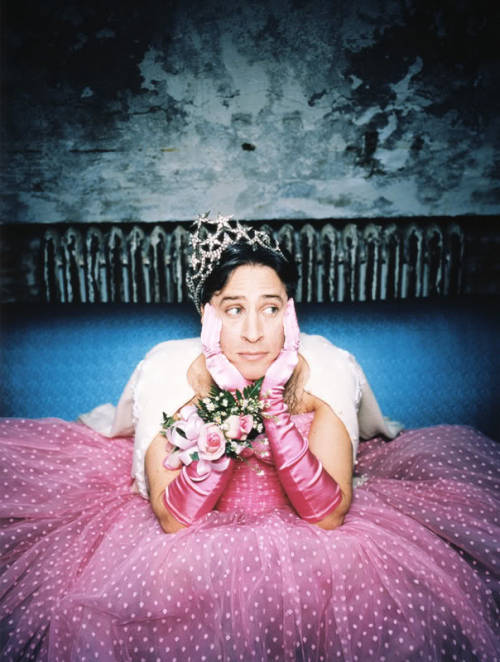
In 1999, Jon Stewart was invited to be featured in People magazine’s annual list of 50 Most Beautiful People.  (I’ve written about the List before in The Body Image Series, highlighting Michael Chabon’s excellent reaction to it.)  Stewart agreed to be featured but insisted on wearing a pink prom dress and a tiara for the photo shoot.  Why? 

I feel pretty!


Who Should Have To Expose Themselves?

5 May

(Via)


If you live anywhere in the West, you know this transphobic joke.  Girl and guy go to bed.  Guy wakes up and finds out somehow that his lover was not born a woman.  The moment of realization is sketched out across his face in excruciating slow-motion, and then he runs away in horror/vomits his brains out/gets very, very, very angry.  The message? 

1)      A trans woman isn’t a “real” woman, she’s a freak.

2)      His being attracted to her somehow makes him less of a man.

3)      Most importantly, he’s been duped.

Feeling duped is the bedrock of transphobia.  Those who feel indiscriminately upset at the very idea of transsexual and/or transgender people usually say something along the lines of, “They’re deceiving people!  I’d be pretty pissed if I found out my girlfriend/boyfriend had had a sex change.”  This feeling is usually enshrouded in the myth that transitioning into the opposite sex is done capriciously, just for laughs and the thrill of going undercover.  This mentality never ever acknowledges the fact that many transsexual and transgender people feel as uncomfortable in the body they were born in as cis people would feel in a body they were not born in.  And it fosters the view of cis people as victims of trans villains, ignoring that trans people in the United States have a suicide rate 26 times higher than the nationl average and that worldwide one trans person is murdered every three days.

This all too common belief that trans people are deceptive, and maliciously so, has now reached new heights as two trans men in the U.K. have been charged with and convicted of sexual assault.  Their accusers claimed that the men’s failure to disclose their gender at birth before they slept with them was a form of fraud and thus the consent the women gave to sex was under false pretenses.  I am in no position to make a final judgment about these two specific cases.  Perhaps they involved many other factors revealing coercion and predatory behavior.  I cannot speak for the defendants or the accusers.  But I can and will speak out against the widespread belief that the freaks of the world are obliged to warn everyone they know about their atypical features and histories before they dare try to get close to someone.

My husband thought I must have been in a car accident years ago when we met for the first time at a birthday party.  I was wearing a sleeveless top exposing the lavender scars that traverse my upper arms.  I know I told him soon after, on our first date, about my long medical history, but that was because we were having an intellectual debate about the role of the media and I decided to use my childhood experiences as an example.  I decided to do so because I liked him and trusted him in a very special way.  It was not because I felt that anyone I was interested in romantically “deserved” to know.

What do potential sex partners deserve to know?  Do they deserve to know I had my calf bones removed?  Do they deserve to know I had my tonsils out?  What if I had been born deaf and had a cochlear implant?  What if I used to weigh twice as much, or half as much, as I do now?  What about veterans or cancer patients who have lost body parts normally only seen by sex partners?  Is it fraudulent of a cancer survivor to wear a prosthesis that would suggest she still has both breasts?  

Indeed, the moment I read about the British cases, I was immediately reminded of a poem by Robert Hass about a woman who is abandoned at her doorstep by a young admirer after she tells him she has had a double mastectomy.  “I’m sorry.  I don’t think I could,” he mumbles before he turns his tail and runs.  I do not know what it is like to be a cancer survivor or transsexual, but surely many of us know what it is like to fear being rejected for something we never had much of a choice about.

In reponse to the British accusations of sexual assault, law professor Alex Sharpe has asked, What if a potential sex partner appears white but is in fact of mixed race – is a failure to map out your entire family tree grounds for prosecution?  Of course not.  He points out that individuals are not legally obliged to reveal to sex partners that they are bisexual, married, divorced, have a past criminal record…  The list is endless, and thus he argues: “Given that we all have gender histories but only some of us (transgender people) are required to disclose them, there appears to be a good basis for arguing that a legal requirement to disclose gender history constitutes discrimination contrary to Article 14 of the European Convention on Human Rights.”

Of course, any counselor or psychologist will tell you that trust, openness, and honesty are necessary for a healthy relationship and true intimacy, but the right to privacy and personal dignity are also necessary for any community founded on justice.  And there can be no genuine trust when certain people reveal personal information only because society’s hang-ups about gender, sexuality, or atypical bodies demand they do. 

Everyone is entitled to their sexuality.  No one should ever be pressured into a heterosexual, homosexual or pansexual relationship.  Open and honest dialogue about this is essential.  But the more we blame minorities for upsetting our delusions of normalcy just by being who they are, the more we tell jokes implying that any normal person would be disgusted by their physiology, the more we insist that their identities are a perversion of ours, the more difficult we make it for them to be open and honest with us.


Who You Telling To Wear Makeup?

28 Apr

fashion show(Image by Alex Craig used under CC license via)


While chatting with colleagues over coffee this week, I ended up “outing” myself as a dwarf who’s had limb-lengthening.  (Experience has taught me some people notice right away when they meet me that something is up, while others go a long time without the slightest idea, especially in the wintertime when my scars are hidden under sleeves and pants.)  We arrived at this topic by discussing fashion—and the recent scandal in Sweden that’s left me almost speechless—and then beauty and self-confidence.  Several of my colleagues pointed out that every person they know who’s undergone cosmetic surgery never struck them as unattractive before the fact.  Only an idiot would think that there’s only one kind of beautiful nose or mouth or whathaveyou.  And only a jerk would tell someone to have cosmetic surgery.

As you may have guessed, I agreed wholeheartedly.  But what about telling someone to wear makeup?

This week, a man writing to Slate’s Dear Prudence advice column confessed he feels simultaneously guilty and helpless about the fact that some of his female friends are unlucky in love because “their looks are probably the only thing holding them back.”  Prudence tends give good, progressive advice, but this time, instead of telling him the ladies should move in less superficial circles, she suggested he pair them up with some similarly “average-looking” male buddies.  She then added, “If the problem with your female friends is not their intrinsic looks but the fact that they dress like schlubs or never wear makeup, then a guy’s perspective that they aren’t doing everything with what they’ve got could spur them into action.”

Ugh.  Say what you want about clothes, but the makeup debate is as messy and gunky as makeup itself, which is why I’ve avoided it up until now.  But am I the only one who thinks telling someone to start using makeup is entirely different from giving them your opinion about the way they dress?

Everyone, from my partner to my grandmother, rolls their eyes at certain fashion choices and, as I’ve said before, anyone who denies they ever do it is lying.  It betrays a pathetic insecurity to trash others’ dress for the sake of your own self-aggrandizement—e.g. “I wouldn’t be caught dead in that!”—but it is fair to say what just isn’t your cup of tea.  We can snark a little about someone’s clothes, hairstyles, accessories, headgear or makeup style (if they have one) without too much malice because someone is probably snarking about ours.  No one on earth dresses in a way that is universally attractive because there is no such thing as a universal beauty standard.  And as the saying goes, there is no arguing taste.  Someone thinks this is kick-ass, and someone else thinks it’s sloppy:

Captain Jack Sparrow

Someone thinks this is dreamy and someone else thinks it’s one big yawn:

Jason Straatmann Actor Japan Suit Tie Cufflinks Model

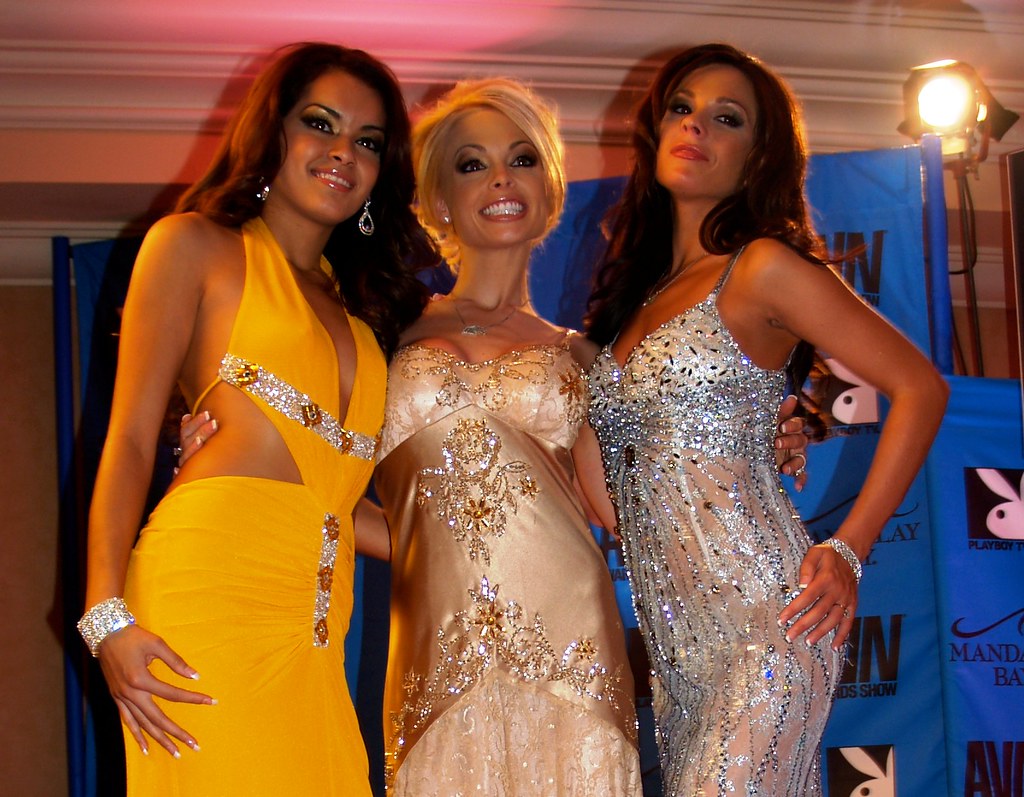
Someone thinks this is sexy and someone else thinks it’s garish: 

Untitled

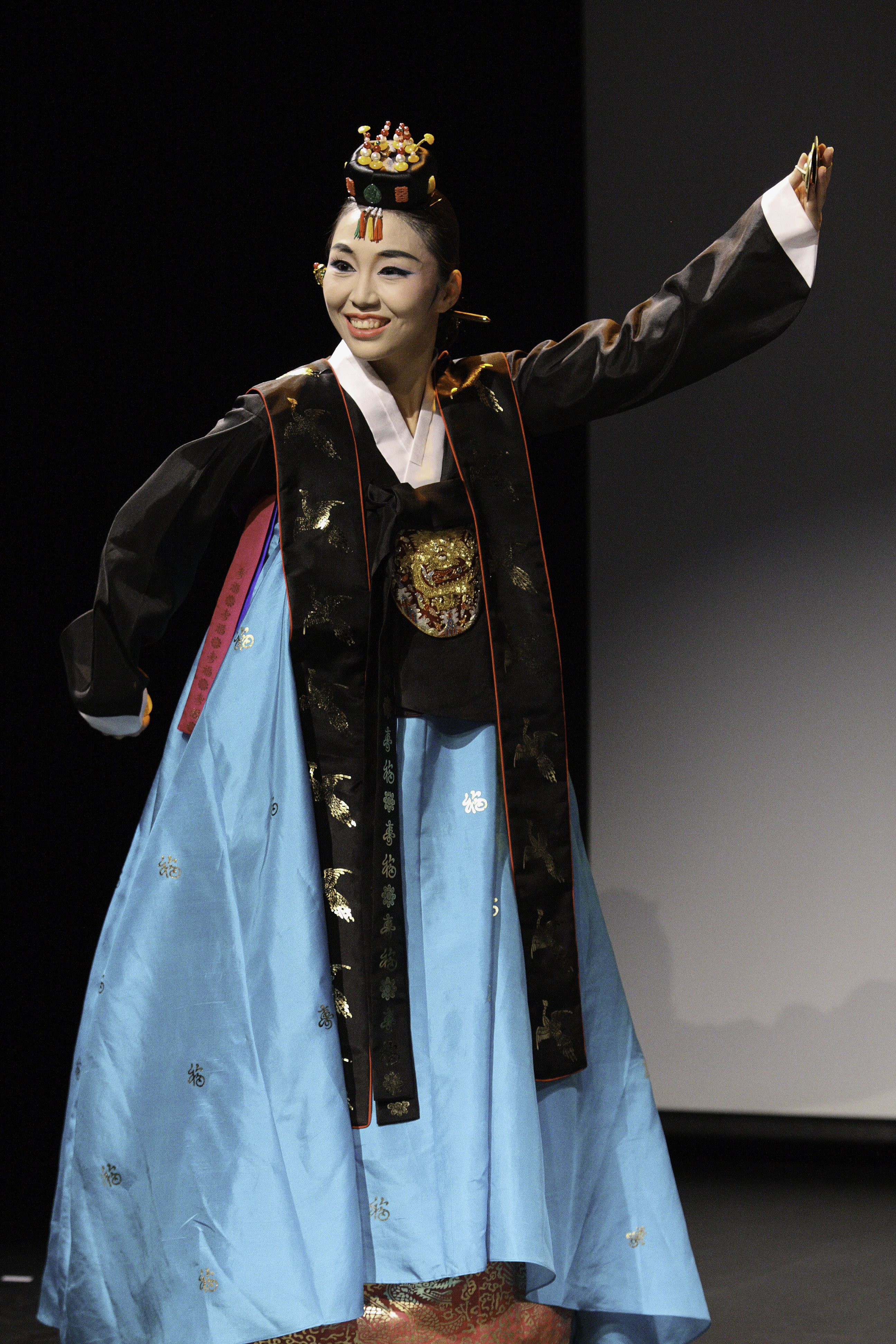
People find beauty in this:

Traditional Korean dance

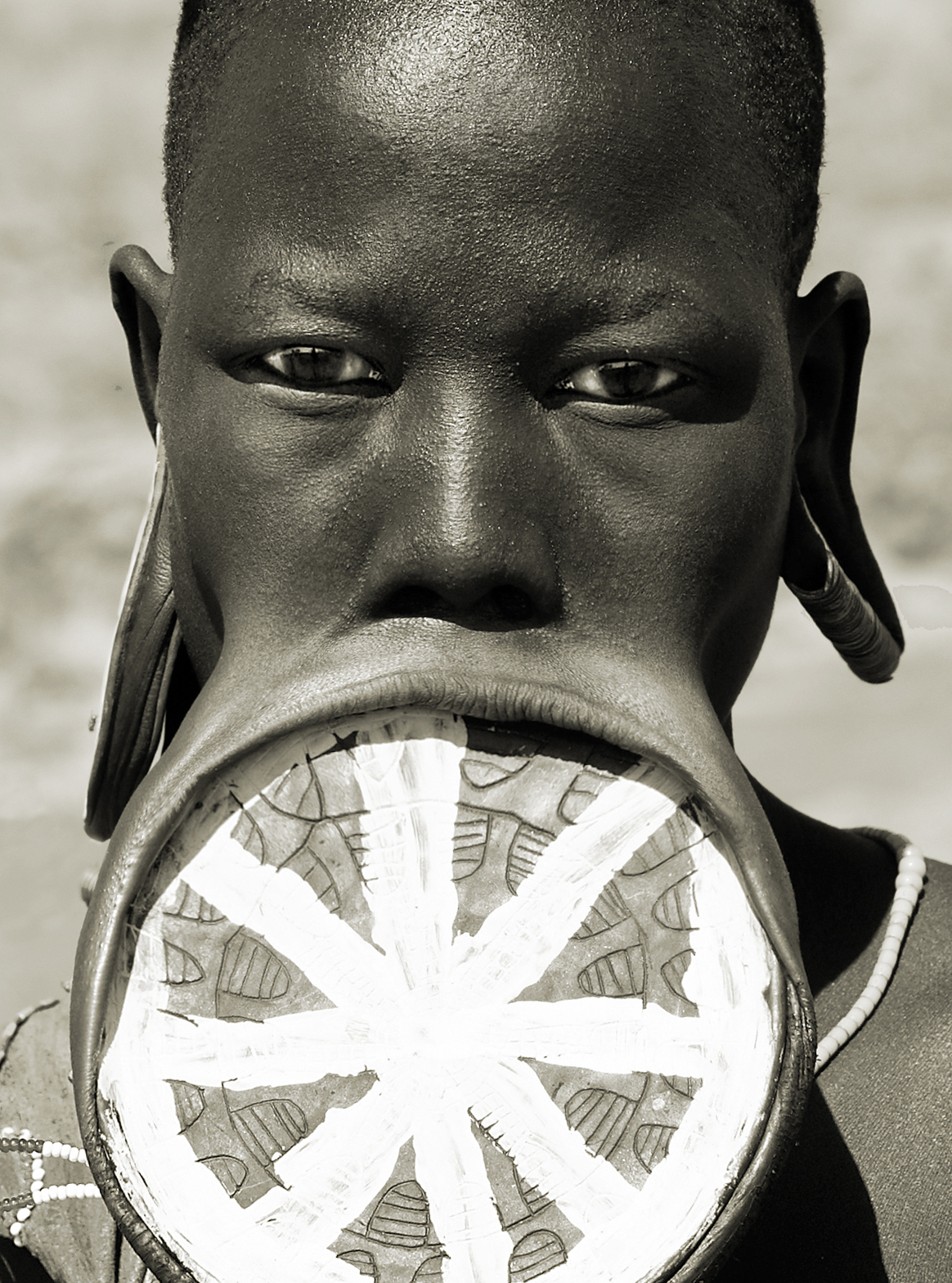
Or this:

Ethiopia, Mursi woman

Or this:

Bollenhut-Gutach

Or this:

4601942293_27f40e0122_o

Or this:

Namibië, oktober 2008

Or this:

 
And that’s just a tiny sample from around the world. There is even more variation across time because, as Oscar Wilde said, “Fashion is a form of ugliness so intolerable that we have to alter it every six months.”  I think some of my friends, like some of the subjects above, have a great sense of style, while others do not.  They in turn probably think the same about me.  But if any of them thought I should wear makeup more often than I do—which is almost never—and told me so, they wouldn’t be my friends.  But what if they’re my supervisors?      

In January, a study featured in The New York Times revealed that (American) women who wear makeup are considered more competent and more likable in the workplace.  A panel of stylists and professors made various points about this that basically all boiled down to, “It’s a choice.  If it makes women feel more confident, they should go for it.”  But if the study indicates that their confidence would result from garnering more positive attention for their looks, then their lack of confidence without makeup would result from a fear of not getting attention for their looks. 

Many modern women, especially lipstick feminists, repeat, “Empowerment is all about being free to choose!”  There is truth in this.  I know guys who were bullied in school for wearing concealer or plucking their eyebrows.  Women meanwhile are often forced into a nearly impossible balancing act wherein no makeup = plain Jane, but too much = slut, and kudos to anyone who refuses to play that game.  Good girl culture, as well as the results from the study, assert that “less makeup is more – you should look like you’re not wearing any.”  This rule seems potentially problematic to me because it is insidious.  If someone gets used to just slightly “improving” their face every day, it is more likely they’ll feel insecure without these improvements.  I occasionally enjoy wearing heavy makeup bordering on the outrageous (like glitter), but it feels like a mask and everyone knows it’s a mask.  When it’s so obviously part of a costume, there’s not much danger that I’ll start considering it an inalienable component of myself.  But the subtle makeup seems to be a lot harder for people to let go of.  I know women who refuse to be photographed without their makeup on—and you probably do, too—and if that doesn’t sound like an unhealthy insecurity, I don’t know what does.

In any case, it doesn’t sound like they are “free to choose,” as lipstick feminists advocate.  As I’ve written before in explaining my choice to have my limbs lengthened, we should be free to make complex decisions about our bodies without others making snap judgments about our motivations.  Anyone who does is a coward.  But it is also cowardly of us to voice hatred for our natural faces and simultaneously deny that this has any impact on others.  In the words of philosopher Arthur W. Frank, “When we make a choice, we confront others with that choice.”  The freedom to choose diminishes when a strong majority bends in one direction, because majorities create social pressure.  In a society that literally rewards women who wear makeup—i.e., with higher salaries—it is undeniable that many do so in order to win these rewards, ultimately playing by the rules under the guise of empowerment.  The cosmetics industry, like any industry, always aims to make their customers feel that they cannot live without their product and so they too have embraced the slogan of “Empowerment!”  Leading The Onion to smirk, “Women Now Empowered By Everything A Woman Does!” 

It would be obnoxious of me to assume that every woman with a compact in her purse does it to acquiesce.  I know and admire selfconfident women who love putting on bright red lipstick and self-confident men who wish they could, too, without being gawked at.  Primping can be fun.  Painting your skin certain colors can make you feel fine and refreshed, like slipping into a brand-new top or getting a new haircut.  Or brushing your teeth after a hangover. 

But it’s not quite the same thing, is it?  Once again, it’s a mask.  A friend of mine who loves dressing up but hates wearing makeup recently said, “I guess, ultimately, it’s weird looking in the mirror and seeing something that doesn’t look like me.  I don’t really like makeup on other people either though, so perhaps it’s a general class of trying to hide oneself that bugs me.”   

Indeed, that is one of my many reasons for rarely ever using cosmetics, why I graciously declined friends’ offers to do me up on my wedding day, why I cringe at the idea of anyone pressuring women into it.  I also like being able to rub my face without having to worry about smudging.  I’d rather spend the money on a million other things.  My partner hates the taste of cream, gloss or powder—“Kissing someone wearing foundation is like kissing a sandbox!”—and I must say I don’t blame him.  Most importantly perhaps, I don’t understand why our culture believes that women’s faces require some paint in order to be attractive but men’s faces don’t.  If I can’t compensate for the plainness of my natural face with my charisma, then no one should be able to.

Of course, almost all of us conform to our culture’s beauty standards to some degree.  I’ve worn concealer for blemishes and plucked my eyebrows to make them even, but I feel a strong attachment to my scars and so I’ve kept them.  I don’t always like my face—don’t we all have those days when we look in the mirror and just feel yucky and dissatisfied?—but even if I thought putting on some modern Western style of makeup would make me look “better,” it wouldn’t look like me.  Experience has also taught me that a dissatisfaction with one’s looks is almost always rooted in something more substantial: feeling not very fit, feeling overtired and stressed, feeling lazy because there’s been too much or too little to do.  And even if it’s not, I often feel very satisfied with my face, so on a bad day why not simply walk away from the mirror, focus on something a little more profound than my appearance, and have confidence that the feeling of self-satisfaction will return?

As psychologist Nancy Etcoff wrote in The Times:

Women who feel that makeup use is obligatory but unwanted, that it requires a forced confrontation with the mirror when they’d rather put their attention elsewhere, do not feel more confident after using it.  Research suggests that women can feel objectified by makeup, and for such women, any potential advantage may be offset by the emotional labor of wearing it.

And, in an excellent article on weddings, Ariel Meadow Stallings of Offbeatbride.com writes:

I’ve been thinking a lot lately about the pursuit of authenticity versus the pursuit of attention.  The first feels very internal, like you really have to look with-in yourself with a lot of introspection and thought to determine what’s important … while the other feels very external, like you’re hunting for other people’s eyeballs.  And why does one seem like so much fun, while the other seems like so much work? …

I guess it comes down to this: Attention gives you the cheap high of other people’s energy focused at you … but authenticity gives you that deep, long-lasting satisfaction of knowing that you’re on the right path and you’re doing the right thing.  While the quick high is more fun in the short run, the deep satisfaction is ultimately more filling.

This is why it is fine to wear makeup but wrong to tell someone else to.  Not only is it a ludicrously presumptuous, boundary-crossing thing to say—like telling someone to switch careers or leave their spouse—but it’s vacuous because it has nothing to do with matters of justice or morality.  It is sheerly a matter of beauty standards.  The worst thing about beauty standards is that they create peer pressure based merely on taste.  The best thing about them is that, as seen above, there are millions of them, and they are constantly changing.  If humans are capable of thinking the lip-plate is attractive, then surely we are capable of thinking a woman without makeup is attractive. 

Women and men should feel free to smear their faces with whatever they wish or go without, to pluck their eyebrows or leave them be, to shave any body part or refrain.  (Bearing in mind doctors have recently explained the cringeworthy risks of shaving certain parts.)  But the moment they say that someone should do the same in order to feel better or lure lovers or advance their career, we have a problem.  And it’s not physical.


Who Gets Stuck in the Friend Zone
24 Mar

Love for all!(Image by Matthias Ripp used under CC license via)

Well, I finally sat down and saw The Phantom of the Opera a quarter of a century after everyone else.  (If you don’t know the story, this parody sums it up pretty well.)  I won’t say what I thought of all the songs songs songs because I’m bound to alienate half my readers either way, but by the second to last scene, I was hollering at the screen: “Girl, you’d better not go for that swaggering bully in the mask!”  But then she ripped the mask off and he couldn’t stop crying and I was up to my eyelids in Kleenex, wailing: “If only he hadn’t killed so many people!  (And talked to her instead of stalked her… )  Now he’s just another disfigured guy stuck in the Friend Zone!  But his pain is reeeeeeeeal!”

This week, the word “Friend Zone” has been entered into the Oxford English Dictionary.  Many of my favorite feminists are not pleased.  Because the term is generally thought to be something only straight, bitter men complain about (see these Urban Dictionary definitions), many argue that it’s a misogynistic trope.  Lamenting the Friend Zone sends the message, however subliminally, that spending time with a female is pointless unless you gain access to her naughty bits.  Because who would want to be friends with a woman?! 
Such a bleak view of women is certainly a problem among many men.  In the words of John Mix Meyer, “Girls are not machines you put kindness coins into until sex falls out.”  Nice for the sake of nice is respect.  Nice only for the sake of getting laid is not.  As I’ve said before, cross-gender friendship could use a lot more support in books, film, and mainstream society.

But I’ve also used the word “Friend Zone” before because I don’t believe it refers only to this one chauvinistic idea.  Unrequited love isn’t fun for anyone.  Lots of women have been stuck in the Friend Zone, too.  Many people are expected by pop culture to always end up there, because society deems them asexual, and it could be helpful to examine why.  Almost every adult on earth craves love and sex, and we are all trying to figure out what attracts those we deem attractive. 

Men who sigh, “Girls don’t like nice guys,” need to get over their narcissism.  But there are others who wonder in earnest why the Friend Zone seems so jam-packed with quiet guys who genuinely respect women.  In stories of every genre, from classic literature (Madame Bovary) to modern literature (Freedom) to dime-a-dozen bodice-rippers (The Bridges of Madison County), bored heroines look past their straight-laced suitors to the tall dark stranger who’s not exactly famous for his fidelity or his feminism.  Love triangles always make for good drama, but when the heroine more often than not decides that the devoted sweetheart belongs in the Friend Zone and the unpredictable bad boy belongs in bed, many scratch their heads and repeat, “Why do girls always go for jerks?”  Or, as The Mr. T Experience sings, “I have some problems… but even Hitler had a girlfriend, so why can’t I?”

The answer often depends on the situation, but there are two fundamental, heteronormative traditions that prop it up:

The Macho Stereotype – Any guy who isn’t strong and independent to the point of being daring isn’t a “real man.”  Obeying the rules, doting on your wife, and being mediocre is emasculating.  Hence the double standard men are held to in real life: they are always expected to focus more on their success and autonomy than their emotional fulfillment.  Sociologist Stephanie Coontz has pointed out that the inordinate importance of independence to male worth is why homeless men arouse so much more disgust than homeless women.

The Gentler Sex Stereotype – A nice girl can see the diamond in the rough.  A man with a nasty wife is hen-pecked and pathetic, but a woman with a bad boy just might be the only one who understands him.  From a conservative standpoint, it’s virtuous of a woman to be so selfless and forgiving.  From a liberal standpoint, it’s the thrill of conquest and her extraordinarily open mind that keeps her trying.  

A man’s worth is defined by his success, albeit many women accept broad definitions of success.  Western romances across the ages assert that special girls who search for the softer side of the bully or the bad boy will find it: Beauty and the Beast, Wuthering Heights, My Fair Lady, The Sound of Music, The Music Man, Guys and Dolls, Bonnie and Clyde, right up to Fifty Shades of Grey.  Pop culture reiterates ad nauseam how much men love the chase, but this trope shows that scores of women do, too.  For the starry-eyed heroine, it’s a challenge to stray from the disapproving masses—or her parents—and become the One Special Woman who can tame the beast and bring joy to his lonely life.  The higher the risk, the greater the reward.  The reward is knowing that she is deeper, different from those other girls who swoon over bland perfection.  Hence even America’s most famous feminist, Lisa Simpson, has looked past loyal, bespectacled Milhouse for Nelson, the schoolyard bully from a broken home.  

By far the most horrific result of this romantic tradition is the fact that too many women in real life endure abuse, or worse. Pop culture sometimes concedes this and still has the audacity to romanticize it.  My high school did a production of Rodgers & Hammerstein’s Carousel the same year Time magazine declared it the Best Musical of All Time.  After wife-beater Billy Bigelow dies in an armed robbery, his widow tells their daughter, “It is possible, dear, for someone to hit you, hit you hard, and it not hurt at all.”  You see, truly devoted wives know that offering yourself up as his punching bag is a way to show your love and nurture him as he struggles with his demons. Only a selfish bitch would leave him when he needs her most.

Carousel was written in 1956, but the trope is still going strong. The final film of the Twilight series lead NPR’s Linda Holmes to observe:

When a saga popular with pre-adolescent girls peaks romantically on a night that leaves the heroine to wake up covered with bruises in the shape of her husband’s hands — and when that heroine then spends the morning explaining to her husband that she’s incredibly happy even though he injured her, and that it’s not his fault because she understands he couldn’t help it in light of the depth of his passion — that’s profoundly irresponsible.

Yes, we’re all having a good yuk over the unhinged quality of it all.  And yes, it’s a movie with a monster baby… But romanticizing an intimate relationship that leaves bruises and scars is a particularly terrible idea in a film aimed at girls. Talking about this is tiresome, but then so is putting it in the movie.

Indeed.

But attraction to the forbidden is not always dangerous.  Sometimes the bad boy is just misunderstood.  There is a powerful romantic tradition of fine ladies risking wealth and status for true love.  (See Aladdin, Titanic, Robin Hood, Moulin Rouge, Lady and the Tramp, Lady Chatterley’s Lover, The Pirates of Penzance, The Pirates of the Caribbean.)  There are also classic tales of heroines opening the gates to social progress by debunking their families’ horrid prejudices when they fall for men outside their race/nationality/religion/species.  (See Pocahontas, South Pacific, Fiddler on the Roof, The Little Mermaid.)  The heroines of Guess Who’s Coming to Dinner and Angst essen Seelen auf stare down the racial tensions of the era in which the films were released.  Meanwhile, Cyrano DeBergerac and the Phantom of the Opera both find out—albeit too late—that their beloveds would have looked past their disfigurement and loved them back. 

Since then, we’ve seen heroines end up with men with disabling injuries (often from war), while a handful go for guys who are congenitally disabled or disfigured.  As noted recently, Peter Dinklage’s romantic roles are possibly, finally breaking dwarf men out of the Friend Zone.  Great art obsesses over the blurry border between right and wrong, friend and lover, beauty and banality.  These compassionate heroines who try to understand the “bad” boys and the rejects help us deepen our perceptions of attractiveness.

It’s worth noting that the Phantom and Cyrano compensate for the supposed repulsiveness of their disfigurement with the sexiness of their genius.  They are supercrips.  Granted Gothic tales love to examine the complexity of blinding light draped in darkness.  I like a study of conflicting traits as much as the next starving liberal arts grad.  But it’s a ludicrously ableist tradition that only gives disabled superheroes a shot at intimacy, restricting ordinary disabled men like Quasimodo or the Seven Dwarfs to the Friend Zone.  And it’s an absurdly lookist tradition that restricts almost all of our disfigured and disabled women there.

Can you name a famous heroine who’s disfigured or physically disabled?  (Can you name a famous actress who’s visibly disabled, for that matter?  I might be able to, but I’d have to check Wikipedia to be sure.)  In the old days, disabled and disfigured girls might arouse sympathy (see Helen Keller), but the women were hags.  Period.  If women who were merely not conventionally attractive ever dared to step out of the Friend Zone and into the dating game, they were annoyingReally annoying.  And they were swatted away like flies.

Nowadays, love stories try to speak to women’s insecurities about their looks with quirky retellings of the Ugly Duckling or Cinderella.  The heroine perceives herself as unattractive, moaning, “Is it because of my [thighs/eyes/nose]?!”  (Rather than cursing, “That shallow jerk stuck me in the Friend Zone!”)  But we eventually see that she truly is a knock-out and it’s just a matter of finding the right man who will wipe the soot off her face, pay for a makeover, or simply remove her glasses.  Children’s films are getting a little better: Shrek and The Princess and the Frog feature heroines who are green-skinned for part of the courtship, though their Otherness is not quite as realistic as the Phantom’s or Quasimodo’s.  We’ve yet to see a heroine reveal a real-life physical disability and see her hot lover swoon.

And why not?  Francis Bacon said, “There is no exquisite beauty without some strangeness in the proportion.”  I’ve overheard countless guys say, “Chicks dig scars.”  Which is true.  Lots of chicks got scars, too.

The popularity of a story is by no means an empirical examination of our values.  Most people I know are so much deeper than pop culture gives us credit for.  And there is a lot more to many of these stories than the tropes I just reduced them to.  But it would be daft to pretend that they have nothing to do with our collective psyche.  Every one of us treasures those romantic moments we experienced that were “just like in a movie.”  Our most popular books and films simultaneously reflect and influence what we tend to think is hot.  And when it comes to opening our minds, fiction is often the best messenger.  We look to entertainment for escape and to art for enlightenment.  The most powerful stories provide both. 

When I attended a lecture at the Network of Disabled Women in Berlin two weeks ago, there was a debate as to whether reality TV shows and documentaries help or harm perceptions of disabled women.  Good documentaries smash stereotypes by providing facts and figures, but the over-representation of disabled women in such reports combined with their invisibility in love stories, detective stories, and silly sitcoms suggests that they exist solely as objects of study.  They are there to satisfy our curiosity, but we’re rarely asked to root for them the way we root for Rapunzel or Bridget Jones.  We never follow them on a journey dripping with passion.  We should. 

The Oxford English Dictionary’s newborn definition of “Friend Zone” reads: “a situation in which a platonic relationship exists between two people, one of whom has an undeclared romantic or sexual interest in the other.”  It doesn’t say it’s exclusively a problem for men.  And good for them.  To me, the term will always evoke the potentially destructive idea that certain “types” of people don’t ever need or deserve intimacy.  And we’ve got to keep questioning it.  Children, animals, and self-proclaimed asexuals automatically belong in the Friend Zone, along with your clients, patients, and students.  The disabled, the disfigured, the elderly, the ordinary, and the unsuccessful do not automatically belong there.  I’m counting on all of us, the storytellers and the lovers, to recognize the word so that we can recognize the problem.

Props to The Observer for (Finally) Doing the Right Thing

20 Jan

a bit of controversy surrounding the transgender flag: san francisco (2012)A little background: A while ago a British journalist named Suzanne Moore, who specializes in women’s rights, made an offhand transphobic comment in an article about body image:  “We [women] are angry with ourselves for not being happier, not being loved properly and not having the ideal body shape – that of a Brazilian transsexual.”  There was an ensuing backlash from many in the trans community, especially on Twitter.  Her friend and fellow writer Julie Burchill penned a column in her defense titled, “Transsexuals Should Cut It Out,” which appeared last week in The Observer.  Without ever saying what exactly the trans activists in question had said to Moore that was so horrific, Burchill just called them names: “A bunch of dicks in chick’s clothing… bed-wetters in bad wigs… trannies…  They’re lucky I’m not calling them ‘shemales.’  Or shims.”

(Oh, really?  They’re lucky you don’t use the most dehumanizing terms you can think of?  Even though you just kind of did…  But I guess every member of every minority really should feel grateful to anyone who refrains from attacking their freak qualities with the worst slurs.  And in that case, thank you, Julie Burchill.  Thank you for not referring to people with dwarfism as midgets or Paralympic athletes as cripples.  I know the temptation is always there to vomit in disgust at people who are physically different and it takes a will of iron to keep the insults from dribbling out.  You are truly strong.  Anyone less magnanimous than you would mouth off.  You have shown yourself to be the paragon of generosity.  I for one am now going to get up every morning and feel grateful there are people like you saintly enough to walk down the street and not spit at those of us who truly belong in the circus.)

The Observer received a barrage of emails and commentary from horrified readers and promptly demonstrated that a small group of thoughtful citizens can indeed change the world when it pulled the column from its website.  The editors have issued this apology (emphasis mine):

This clearly fell outside what we might consider reasonable. The piece should not have been published in that form. I don’t want the Observer to be conducting debates on those terms or with that language. It was offensive, needlessly. We made a misjudgment and we apologise for that.

A newspaper shouldn’t reject writing that merely argues against trans rights or any sort of human rights.  As awful as bigotry is, dialogue between opposing sides is the only way to change minds and spur progress.  But any publication looking to host productive debate should always be able to discriminate between substantive reasoning and a pointless list of pejoratives.  I wouldn’t oppose printing Burchill’s piece because her argument was chauvinistic, but because she failed to be civil and because she wasn’t even addressing the trans activists’ stance.  She was simply snarking about their bodies.  And I’ve said it once, and I’ll say it again: If you can’t make your point without trashing traits your opponent has no choice about—their gender identity, ethnicity, biology, sexuality, or class background—then your argument doesn’t have a leg to stand on.  At worst, it’s abuse, and doesn’t even belong in high school.  (Indeed, that’s what anti-bullying policies are all about.)  At best, it’s meaningless.  (Would anyone try to convince the world to depose Saddam Hussein by ranting about the ugliness of his moustache?)

Upon first discovering Burchill’s piece last week, I assumed the only reason the editors would publish such an uninhibited temper tantrum was because they’re a business and believe feuds sell papers.  It is a relief to see now that they do not want their readers thinking that’s the kind of business they’re running.

Unsurprisingly, The Telegraph and others have bellowed, “CENSORSHIP!” and—you can see it coming a mile away—“PC police!” and have joined up with Burchill in republishing her piece.  They apparently have no qualms about profiting from the attention a semi-famous writer’s bad manners will grab.  Which is why it is so important to commend The Observer.  A week ago, I was deeply depressed by their descent into yellow journalism.  Their current endeavors to wipe off the self-inflicted stains are better late than never.


(Via)


Dragging Entertainment Into the 21st Century

21 Oct

(Via)


This week, humor site Cracked.com features a great article by J.F. Sargent titled “6 Insane Stereotypes That Movies Can’t Seem to Get Over.”  Alongside the insidious ways in which racism, sexism, homophobia still manage to persevere in mainstream entertainment, Number Two on the list is “Anything (Even Death) Is Better Than Being Disabled”:

In movie universes, there’s two ways to get disabled: Either you get a sweet superpower out of it, like Daredevil, or it makes you absolutely miserable for the rest of your life. One of the most infamous examples is Million Dollar Baby, which ends with (spoilers) the protagonist becoming a quadriplegic and Clint Eastwood euthanizing her because, you know, what’s the point of living like that? Never mind the fact that millions of people do just that every day…

Showing someone using sheer willpower to overcome something is a great character arc, and Hollywood applies that to everything, from learning kung fu despite being an overweight panda to “beating” a real-world disability. The problem is, this arc has some tragic implications for the real-world people who come out with the message that they are “too weak” to overcome their disabilities.

The result is that moviegoers think that disabilities are way worse than they actually are, and filmmakers have to cater to that: For example, while filming an episode of Dollhouse where Eliza Dushku was blind, the producers brought in an actual blind woman to show the actress how to move and get around, but the result was that “she didn’t look blind,” and they had to make her act clumsier so the audience would buy it.

Even in Avatar, real paraplegics thought that Sam Worthington’s character was making way too much effort transferring from his chair, but that’s the way we’re used to seeing it in movies. It’s a vicious cycle, and it isn’t going to stop until either Hollywood wises up or people with disabilities stop living happy, fulfilling lives.

I’ve examined Hollywood’s ableist problems several times before and there are still plenty to dedicate an entire blog to.  But, like The Daily Show or The Onion, Cracked has a long history of excellent social critique embedded amongst the fart jokes and it’s awesome.  Especially when considering that not only mainstream but alternative entertainment all too often can’t seem to let go of the tired stereotypes.  That Cracked is a site not officially dedicated to politics or social activism suggests that the comics writing for it believe calling out the industry for its embarrassing ineptitude is just common sense.


What’s Privilege?

7 Oct

(Via)


This week I led a workshop about teaching pre-school children about diversity.  I started by asking the teachers what privilege is, and I got the same answer a family member had given just days before: “Privilege is what people who are really lucky have.  Like being born into a rich family, going to nice schools, or even just being exceptionally good-looking and therefore having an easier time of it.”

It is interesting that so many seem to be under the impression that privilege and luck are what extremely well-off people have.  Privilege does belong to anyone whose place in society is considered “better than normal,” but also to anyone whose place is considered simply “normal.”  As said before, privilege is granted by society to certain people based on things we had absolutely nothing to do with: our gender identity, our ethnicity, our sexuality, our physical traits, our mental capabilities, our class background.  That is why any privilege—like any form of disenfranchisement—is unjust.     

In the workshop, I read off the following list of statements that illustrate privilege to the participants who were lined up in a row.  (It’s a hodge-podge of original statements and ones taken from privilege activities created by Peggy McIntosh, Earlham College, and the Head Start Program.)  Anyone for whom the statement was true could step forward.  Anyone else had to stay behind.  All of us in the group stepped forward at least half the time.  You can see for yourself where you would have ended up: 

 1)      I always felt safe in my neighborhood as a child.

2)      If I wish to, I can be with people of my race/ethnicity most of the time.

3)      I never have to plan how to reveal my sexual orientation or gender identity to friends, family, or colleagues.  It’s assumed.

4)      I can go out in public without being stared at.

5)      I participated in extracurricular activities as a child (swimming, football, ballet, piano, yoga, painting, etc.).

6)      I can easily buy posters, picture books, dolls, toys and greeting cards featuring people of my race.

7)      I can wear a skirt, a dress, jeans, or pants, without anyone staring or asking me to explain my choice.

8)      In school, I could always take part in whatever activity or games the class was assigned.

9)      None of my close friends or family has ever been arrested.

10)  Rarely have I been asked to explain why my body looks the way it does or why I move or speak the way I do.

11)  I have never worried that I might not be able to afford food.

12)  When I learned about “civilization” in school, I was shown that people with my skin color made it what it is.

13)  I have never heard of someone who looks like me being given up for adoption or aborted because of it.

14)  Who I am attracted to is not considered a political issue.

15)  I attended a private school.

16)  I am never asked to speak for everyone in my ethnic group.

17)  I can find colleges that have many people from my class background as students.

18)  I can criticize our government without being seen as an outsider.

19)  My family never had to move for financial reasons.

20)  If I am assertive, it is never assumed that it comes from my need to “compensate” or struggle with my identity.

21)  When I was a child, I never had to help my parents at their workplace regularly.

22)  When I talk about my sexuality (such as joking or talking about relationships), I will not be accused of “pushing” my sexuality on others.

23)  If I make a mistake or get into trouble, I am usually judged as an individual, not as an example of people who look like me.

24)  I can go for months without being called straight, heterosexual, or cis.

25)  I can use public facilities (store shelves, desks, cars, buses, restrooms, and train or plane seats) or standard materials (books, scissors, computers, televisions) without needing help or adaptations.

26)  When I dress for a formal event, I don’t worry about being accused of looking too dolled up or not pretty enough.

27)  As a child, I never had to help care for a family member.

28)  When I watch family advertisements for food, medicine, clothing, games and toys, the families on TV usually look like mine.

29)  I grew up feeling I could be whoever or whatever I wanted.

30)  I have never been asked, “What do [people like] you like to be called?”


Biology and “The Imprecision of Stereotypes”

16 Sep


This week the British newspaper The Telegraph asks:

Ever wondered why men can’t seem to tastefully decorate a house?  Or have a tendency for dressing in clothes that clash?  And why, for that matter, can’t women seem to hack it at computer games?  Now scientists claim to have discovered the reason: the sexes see differently.  Women are better able to tell fine differences between colors, but men are better at keeping an eye on rapidly moving objects, they say.

Professor Israel Abramov and colleagues at the City University of New York reached their conclusions after testing the sight of students and staff, all over 16, at two colleges…

The authors wrote: “Across most of the visible spectrum males require a slightly longer wavelength than do females in order to experience the same hue.”  So, a man would perceive a turquoise vase, for instance, as being a little more blue than a woman who was looking at it too.

Abramov, professor of cognition, admitted they currently had “no idea” about how sex influenced color perception.  However, writing in the journal Biology of Sex Differences, he said it seemed “reasonable to postulate” that differences in testosterone levels were responsible…

Men can’t perceive colors as deftly as women can.  That’s why all the great Western painters like Van Gogh and Cézanne and Leonardo and Picasso and Renoir and Monet and Munch and Vermeer and Kandinsky and Matisse are female.  And all the major fashion designers of the last century like Hugo Boss and Karl Lagerfeld and Gianni Versace and Giorgio Armani and Calvin Klein and Ralph Lauren were women.  Oh, wait. 

Maybe the study meant to say testosterone only triggers color ineptitude when male ears register the words “home decorating.”  Or that male color perception improves when money is involved. 

Or maybe The Telegraph author was exaggerating just a bit.  Tacking jazzy headlines onto reports of scientific studies are all the rage these days, no matter how much they distort the findings.  In June, Medical Daily ran an article under the title, “Racism Is Innate.”  Innate means, according to my biologist father, “present at birth,” so this seemed like a call to toss all those No child is born a racist buttons onto the trash heap.  Except that anyone who bothered to read the article would discover that the study simply concluded that brain scans of adults show simultaneous activity in the centers that process fear and emotion and those that differentiate between familiar and unfamiliar faces.  The idea that fear of the Other can be neurologically mapped lends itself to a great deal of speculation and debate, but nowhere did the study claim that racism is present at birth. 

Such truth-stretching borders on mendacity, yet it pervades the science sections of so many newspapers.  Scientific studies are supposed to be free of bias, but the news media is severely biased toward publishing whatever will grab readers’ attention.  As several researchers have pointed out, differences between the sexes are currently considered a much more interesting discovery than no difference, so publishers often remain silent on an issue until they find a study that provides the juicier headline, no matter how numerous the contradicting studies are.  When the market is left to decide, it chooses salability over comprehensiveness.

Such an irresponsible approach to science results in a gravely misinformed public.  I can’t tell you how many people have repeated the claim that our modern Western female beauty standards are “natural” because a round waist resembles pregnancy and triggers the male fear of cuckoldry.  No one seems to remember that several crosscultural studies discredited this idea years ago.  But how can anyone be expected to remember something the media chose not to promote in the first place? 

And forget about waiting until the study is corroborated.  In 2007, The Times ran a headline claiming that women are naturally drawn to the color pink because of our savannah foremothers’ need to gather berries while the men hunted.  The Times published the study without consulting any historians, who eventually pointed out that pink was considered a manly color as recently as 1918 until fashion trends changed.  Oops.

This doesn’t mean that we should, as Mitt Romney has demanded, “keep science out of politics.”  Science is impartiality and corroboration and the best method we have for sorting facts from wishful thinking—for preventing our emotional, egotistical needs from weakening our objectivity.  To me, science is the most humbling force in the universe because it demands we always admit what we do not know.  It prevents hasty conclusions based on flimsy evidence, gut feelings, and political agendas.  It questions crude stereotypes and discovers more complex structures. 

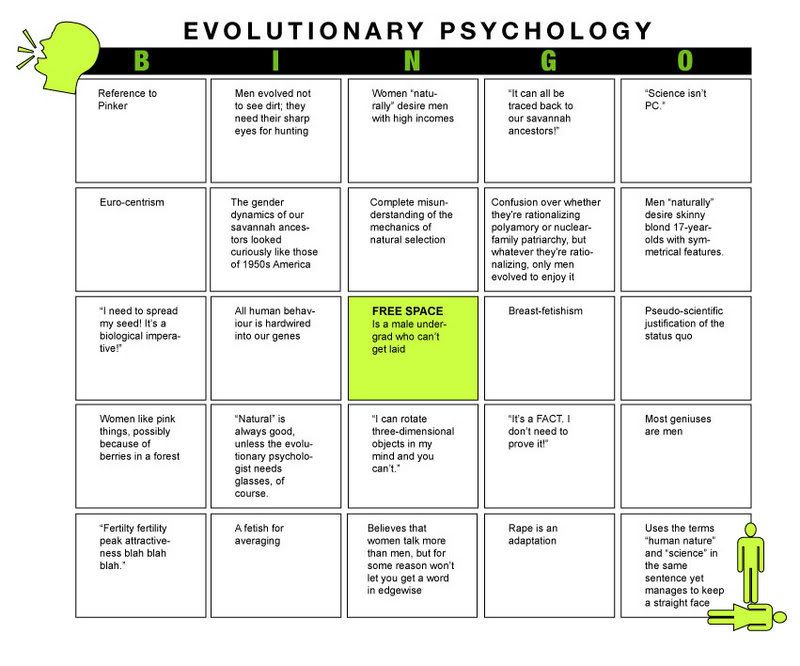
But according to pop science reporters and the researchers they choose to spotlight, nearly every single modern joke about the differences between men and women stems from millennia-old evolutionary adaptations.  (Indeed, the Telegraph article claims that the female proclivity for detecting color helped our foremothers with gathering berries.  Always with the damn berries… )  As stated in the graphic below, such reports all too often suggest that prehistoric society on the African savannah looked just like something Don Draper or Phyllis Schlafly would have designed:

Men hunt, women nest, and every macho social pattern we see today has been passed down to us from our prehistoric ancestors.  Even though historians find that these patterns, like our racial categories, are barely more than two centuries old, if that.  And that the gender binary is far from universal.  Misinterpreting scientific findings is just as dire as ignoring them. 

When it comes to what women and men can and can’t do, neuroscientist Lise Eliot notes, “Expectations are crucial.”  When boys and young men grow up in a culture that mocks their supposed incompetence in all things domestic (“Guys don’t do that!”), it comes as no surprise that only the most self-confident will pursue any interest they have.  Meanwhile, studies show girls perform as well as boys do in math and science until they reach puberty.  Maybe the onset of menstruation paralyzes our visual-spatial intelligence because we’ve got to get picking those berries, or maybe girls pick up on the not-so-subtle message that guys think coquettish beauty is more important than nerdy brains in the dating game.  (For more details on the sexism faced by aspiring female scientists, see Cordelia Fine’s excellent book, Delusions of Gender.)  In her research, Dr. Eliot finds only two indisputable neurological differences between males and females:

1) Male brains are 8% to 11% larger than females’.

2) Female brains reach maturation earlier than male brains. 

All other neurological studies that find major differences between the sexes are studies of adults: i.e., the people most shaped by their culture and society.  Only cross-cultural studies of adults can isolate nurture from nature.  In any case, Eliot is a proponent of neuroplasticity, the idea that the pathways and synapses of the brain change depending upon its environment and the neural processes and behaviors it engages in.  In other words, painting or gaming from an early age or frequently throughout your life will condition your brain to do these tasks and related ones well.  It explains why the gender roles of a given time and place are so powerfulwhy mastering unfamiliar tasks is an uphill climb for men and women but also why countries committed to equality have the narrowest gender gaps. 

“Plasticity is the basis for all learning and the best hope for recovery after injury,” Eliot writes.  “Simply put, your brain is what you do with it.”  For more, see her brilliant parenting book, Pink Brain, Blue Brain: How Small Differences Grow into Troublesome Gaps—and What We Can Do About It.   

But I’ll never believe that a neuroscientist has all the answers.  I live in a country that showed the world the dangers of hastily trying to trace all social patterns back to biology.  As a result, the media here in Germany is usually much more reticent to casually toss around arguments like those in The Telegraph or The Times or Medical Daily.  Natural scientists have made discoveries like neuroplasticity and limb-lengthening that are crucial to progress, but social scientists have discovered that equality and empathy are crucial to any society that values peace and respect over power and greed. 

Or, in other words.


Wear Whatever You Want – We Can Handle It!

2 Sep

(Via)


This family portrait of a father and son in a small town—deep in the province and deeply religious—in Southern Germany has been traveling around the world.  When his five year-old boy expressed a love for dresses but found himself alone on the playground, Nils Pickert writes in Emma magazine that the only way to make sure his son knew that he supported him 100% was to be a role model of self-confidence and don a skirt himself.

“Yeah, I’m one of those fathers who believes in liberation when it comes to parenting,” he writes.  “I am not one of those academic dads who ruminates and lectures about equality between the sexes, and then, the moment a child arrives, slips back into the old comfortable gender roles: He does his own thing by having a career, she takes care of the rest.”

When he switched to a new kindergarten, the teasing got to be too much and the author’s son stopped wearing dresses to pre-school.  But he turned to his father and asked, wide-eyed, “Papa, when are you going to wear a skirt again?”  So Dad made sure to keep wearing his skirt out in public.  He writes, “I’m very grateful to the woman who stared at us on the street until she walked into a lamppost.  My son roared with laughter.  And the next day, he fished a dress out of his closet again.”

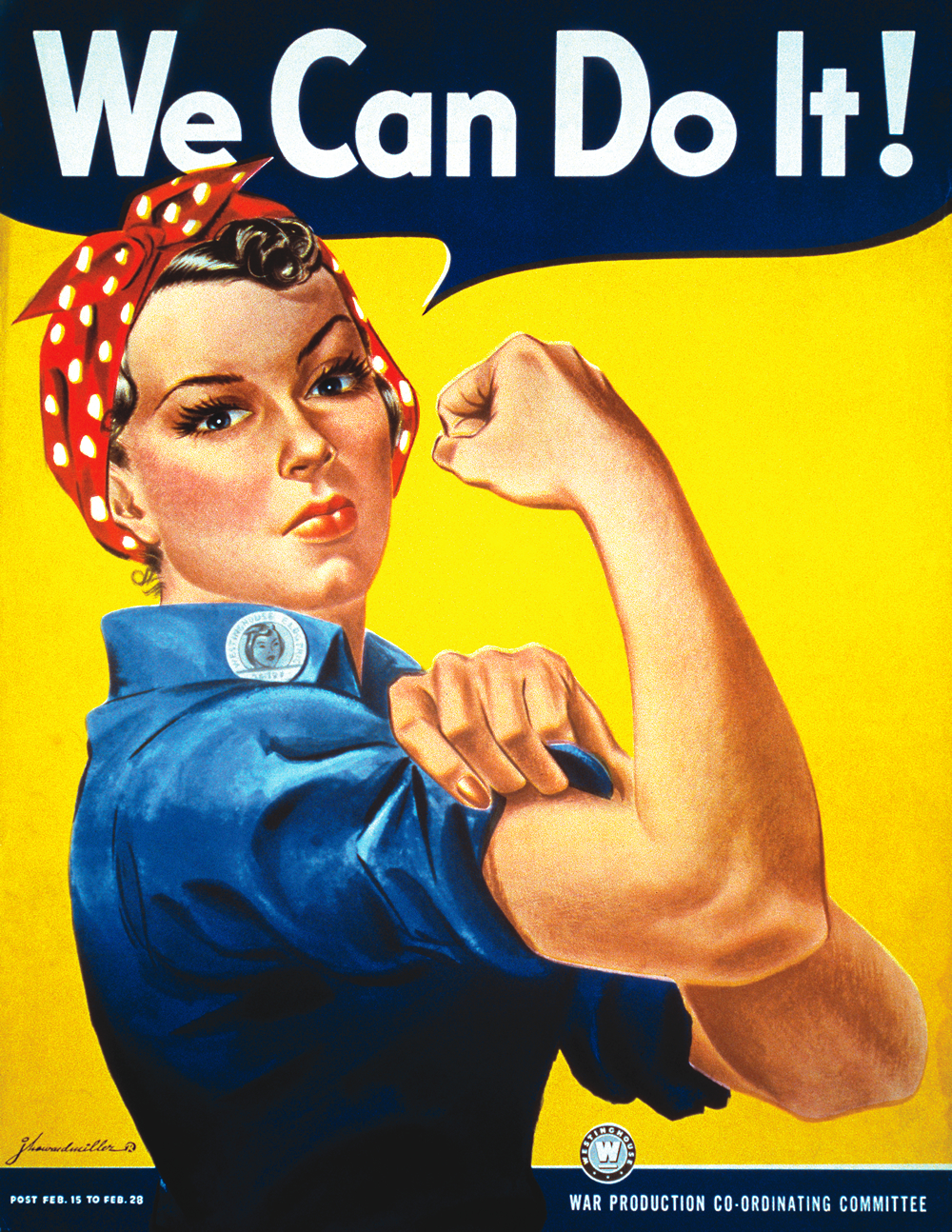
I don’t have much to add to this story besides the smile it brought to my face.  And a hope that someday these two will be models for a poster that will take its place in history alongside Rosie the Riveter.


Germany Rules on Male Circumcision

26 Aug

Justice(Image by Viewminder used under CC license via)

We’ve been waiting all summer for this decision.  On Thursday here in Berlin, the German Ethics Council ruled that male circumcision is legally permissible without a doctor’s order, but several conditions must be met:

    • Both parents must be in full agreement.
    • All possible risks to the procedure must be explained in full detail.
    • Local anesthetics must be an option.
    • The procedure must be certified by a medical professional.

Some of these requirements, especially the last two, go against what some fundamentalist religious leaders mandate.  Why all the fuss?  In Europe, where female genital cutting is illegal, male circumcision is only common in Muslim and Jewish communities.  Last year, a German court in Cologne ruled that the circumcision of an underage male constitutes aggravated assault and battery, and the debate has been raging ever since.  It has split the nation into two parties: Those that see the procedure as cosmetic at best and mutilating at worst, carried out on patients too young to give consent, versus those that believe any ban on age-old rituals and tribal markers constitutes religious and/or ethnic persecution.  That the ritual German lawyers sought to ban is a Jewish custom makes it a particularly sensitive case here.

When we hear stories of female genital cutting in Africa, Westerners are generally horrified.  But few in the United States understand that many Europeans gape at our 60% rate of male circumcision and consider it to be of course not quite but almost as cruel.  “How on earth could parents do that to their baby boy?!” is the reaction I get from the vast majority of Christian and non-denominational European males I talk to.  They are much more prone to believe studies citing the problems it can cause—for example, a supposedly higher rate of dyspareunia for women who have intercourse with circumcised men—than studies that downplay such fears.  I usually admit to them that, because it is so very common where I come from, I’d never given it much thought beyond those pop culture jokes about what looks better.

Which just goes to show how powerful cultural customs and values can be.  Both female and male genital cutting involves groups that say we should protect the parents’ right to choose what they think is best for their children without government interference, while the others say the government should protect children from procedures that offer no medical benefit before they are old enough to decide for themselves, regardless of what their parents want.

I’ve written before that as someone who’s undergone limb-lengthening, I know how complex decisions about body alteration can be.  Determining an appropriate age of consent for surgery can be even more complicated.  But also due to my experience, I wince along with Jessica Valenti when parents choose procedures for their children that offer no real medical benefit.  While discussing circumcision, my European friends argue that patients should reach the age of consent before undergoing any procedure that, unlike limb-lengthening, does not become more medically complicated with age.  Should courts ever rule this way, this will inevitably lead to bans on juvenile nose-jobs like the one Valenti cites.  But then what about ear-piercing? 

Years ago, I was a panelist at a conference called “Surgically Shaping Children” at the Hastings Center, a think tank for bio-ethics, where we addressed elective procedures such as limb-lengthening on dwarfs and determining a gender for intersex children.  After a two-day debate and a resulting book, we concluded that the best way to prevent parents from making decisions that could be damaging to their children is to keep both the parents and their children as informed as possible about every issue that’s at stake: medical facts, cultural identity, individual identity, and agency.  The German Ethics Council’s ruling also implies that such comprehensive understanding is necessary. 

I think a ban on circumcision would have created more cultural resentment than understanding.  But the scientific community, and society as a whole, should take the place of the legal system in helping parents understand all the complexities of altering a child’s body without a medical purpose.  There may be no easy answer, but the discussion has got to keep on going.

Fighting the Good Fight or Feeding The Ego?

19 Aug

Body Art Chameleon“I know so many men and boys and trans individuals who wear dresses for so many different reasons, and they do it a lot more than mainstream movies, TV, and advertising suggest.” 

I felt my fingers tremble just a tiny bit as I typed this sentence last week.  Not because of the subject matter.  Not because of the point I was trying to make.  Because of the “I.”  Was that word going to drive home my point, or derail it?

Studies show personally knowing someone who belongs to a minority group increases the likelihood that you will have empathy for that minority.  If you have a family member who is gay, you’re less likely to oppose marriage equality.  If you know someone with dwarfism well, you’re less likely to see their medical diagnosis whenever you look at them.  GLAAD emphasized the political potential for all this in a brilliant meme last fall.  Urging LGBT individuals to talk openly about their partners and love lives at the dinner table with the same frequency as their straight family members, they called it, “I’m Letting Aunt Betty Feel Awkward This Thanksgiving.” 

Truly caring for someone with a different perspective often—though, sadly, not always—inspires us to try to understand their perspective and this enhances our own.  Letting others know that They are not so different from Us because we know and care deeply about many of Them can effectively break down barriers.  And, when discussing social injustice, it’s always best to ask someone with personal experience, lest we unwittingly make erroneous assumptions.  But, of course, just having friends who belong to minority groups doesn’t solve everything. 

As I wrote about knowing men and trans people who wear dresses to elucidate that They are actually Us, I cringed at the idea of flaunting my loved ones’ Otherness for the purposes of my blog.  By inserting myself into the statement, there was a risk that some would think I was trying to prove my open-mindedness.  I’ve bragged like that in the past, especially when I was an egocentric teen.  (You know, back when you practiced writing your name over and over?)  And my own Otherness has been flaunted a few times by friends and acquaintances seeking attention for their open-mindedness.  It’s a serious problem in the social justice movements.  

In Black Like Me, the author tells the story of a New Yorker he encounters who has come to the South to “observe” the plight of the black citizens.  “You people are my brothers,” the New Yorker insists.  “It’s people like me that are your only hope.  How do you expect me to observe if you won’t talk to me?”  Although the man’s opposition to segregation was morally correct, his overt self-regard and patronizing disgust at his brothers’ “ingratitude” makes it one of the most cringe-inducing scenes in the book.

In Baratunde Thurston’s fantastic memoir, How To Be Black (just out this year), the author asks writers and activists about white people’s fear of being called racist.  damali ayo, the author of How To Rent A Negro and Obamistan! Land Without Racism, says it best:

It shows our values as a culture when somebody says, “I don’t want to be a called a racist.”  Really what they’re saying is, “I want you to like me.  I don’t want to not be liked.  I want to still be okay with you.”  They don’t mean, “What I really want is to know and understand experiences of people of color…”  That would be great.

And so, it just shows that, as I always have said, we are operating at this third-grade level of race relations.  And it’s that third-grader that goes, “Please like me, do please like me,” versus “Can I understand?”

We all want to be liked and we all want to do the right thing.  But the the third-grader mindset can’t help but focus more on the former.  It is evident in common phrases like:

“We were the only white people there!” 

 “I’ve always wanted a gay friend!” 

“I think I’m [bisexual/learning disabled], too, because I [kissed a girl once/have difficulty concentrating]!” 

“I’m not prejudiced!  I have so many [nonwhite/foreign/LGBT/disabled] friends!”

Of course, in certain contexts and worded differently, these statements would not be offensive.  What makes them offensive is the need to let others know all about us, the belief that our support for equality deserves praise, the patronizing (and unjust) view that minorities should be grateful for our lack of prejudice.  We can note that we were the only white people in a group in order to spark a dialogue about social segregation, or we can flaunt the experience like a medal from the Liberal Olympics.  We can worry that having a homogeneous circle of friends will limit our perspective, or we can believe that racking up as many minority friends as we can is proof of our expertise on all minority issues.  We can try to empathize with someone labeled “different” because of their sexuality or biology in order to remove stigmas and barriers, or we can try to seek the attention they are getting for ourselves.  We can respond to accusations that we have offended by trying to understand why someone would be hurt, or we can respond by listing our liberal credentials.

This depends primarily on the individual.  Someone who likes to brag about their open-mindedness usually brags about most things they do.  This personality trait seems to be particularly common among educated elites—parodied so well at Stuff White People Like—because elite education frequently fosters competitiveness.  (Taking the time to count your degrees, count the books you own, count the minority friends you have…)  Competitiveness is anathema to selflessness.   But while bragging about the number of books we own is silly because we’re obviously missing the point of reading, bragging about the number of minority friends we have is grave because we’re missing the point of human rights.

Do we donate to charity privately because it makes us feel better to spend the money on someone else?  Or do we hope that others will notice and admire our sacrifice?  Then again, drawing attention to the work we’re doing is usually important if we want to advertise the cause and urge others to join.  That’s where things get murky.

A while back, within a few months of each other, two friends stood up to ableism and told me about it after the fact.  A guyfriend came fuming to me about his teacher who had used the word “midget” and who had then insisted, despite my guyfriend’s protests, that it wasn’t offensive at all.  A girlfriend told me that a mutual acquaintance had said something crass about my dwarfism and that she had told him to back off repeatedly because she wouldn’t tolerate such bigotry in her presence.  The first friend focused his story on the offender’s behavior.  The second focused her story on her heroic defense.  People who want to understand the problem more than anything tend to focus their feelings on the injustice they encountered.  People who want to be liked more than anything tend to focus their feelings on their performance.

This shouldn’t ever deter anyone from working for equality and social justice, from celebrating diversity or from spreading awareness.  Open minds should always be highly valued.  But to paraphrase the recent words of the Crunk Feminist Collective, by not being racist—or sexist or homophobic or lookist or ableist or transphobic—we’re not doing anything special.  We’re doing what we’re supposed to do.


When It Comes To A Boy In A Dress, The Question Is: What’s Wrong With Us?

12 Aug

When I was about 10 years-old, a friend of mine with achondroplasia was being teased at her school for being so short.  After being shunned at lunchtime repeatedly—“No freaks at this table!”—her mother finally called her local chapter of Little People of America, which sent a spokesman into the school to give a presentation.  After he read Thinking Big to the class, explaining thoroughly in an age-appropriate manner why my friend looked the way she did, one of the biggest bullies raised his hand.  “So, you mean, she’s little because she’s a dwarf?” he asked.

The spokesman offered to let my friend answer the question herself and she replied, “Yes.”

The boy who had teased her so much suddenly had tears in his eyes.  It later came out that his new baby brother had just been diagnosed with dwarfism.  He had had no idea until that moment that his brother was going to grow up to look just like the girl he’d targeted. 

To anyone who insists, “He couldn’t have known,” he could have.  We could have let him know.  What is school for, if not the pursuit of knowledge?  With the exception of women, all minorities risk marginalization not only by others’ lack of empathy but by the lack of visibility automatically brought on by their lower numbers.  Any place that prides itself on learning should pride itself on learning about other perspectives, other identities, other behaviors, no matter how rare.

So “What’s Wrong With A Boy Who Wears A Dress?” asks The New York Times magazine on its cover this week.  Despite that the flippant headline sacrifices sensitivity for saleability, at least it’s shedding light on the subject.  I know so many men and boys and trans individuals who wear dresses for so many different reasons, and they do it a lot more than mainstream movies, TV, and advertising suggest:


When asked why he likes regularly wearing his wife’s nightgowns, one man shrugged, “It’s comfy.”

The Times article has its flaws.  When discussing how boys who wear dresses turn out later in life, the article stuffs them into three overly simplistic boxes: a) gay, b) heterosexual, and c) transsexual.  Such labels do not encompass all the ways and reasons people of various gender identities and sexualities wear dresses into adulthood.  As one friend observed, “The path of least resistance for so many is to wear dresses in secret.  By using these limiting categories, the article implies that and also does nothing to change that.”  The use of the categories also implies that these individuals owe us a clear-cut, sex-based explanation for their behavior, which is itself a symptom of narrow mindedness.  No one demands a woman explain why she likes wearing jeans.

And yet the article also keeps its subjects silent.  While documenting the struggles of both conservative and liberal parents, the author would have been wise to include the perspective of adults who wore or wear dresses.  In the absence of their agency, their nervous parents are essentially speaking for them.  (Rule Number One in Battling Intolerance: Never, ever let a minority’s agency be ignored.)

But for all these errors, the article concludes with those who ultimately support their sons as best they can.  One dad heard that his five year-old was being taunted in kindergarten for wearing pink socks, so he bought himself a pair of pink Converse sneakers to wear in solidarity.  The kindergarten teacher jumped in, too, opening up a class discussion about the history of gender rules and shocking the kids with the information that girls were once not allowed to wear pants. 

Whenever reports on “different” children list the anxieties parents have about their kids not being accepted, the message often starts to get muddled.  Sometimes the article is clear that we as members of society need to get over our hysterical hang-ups and start accepting these children as they are so that they and their parents no longer have to worry what we and our own children will say.  Too often, however, the article spends so much time quoting the parents’ fears that the source of the problem starts to sound more and more like the child’s disruptive identity, not others’ clumsy reactions to his identity.  And that’s wrong.

Whenever a child is made fun of for being himself, it’s our problem, not his.  Biologists can say what they want about a fear of difference being an evolutionary adaptation, but our culture values differences two ways, either as “abnormal” (i.e., strange and pitiful) or “super-normal” (strange and admirable).  The Beatles’ mop-tops were abnormal to parents of the time (“They look like girls!”), and super-normal to their teenage children.  In the nature vs. nurture debate, we need to stop saying “nurture” and start saying “culture,” because changing the environment a child grows up in means changing the behaviors of more than just one set of parents.  Mine never once told my younger brother, “Only sissies cry,” but his little league coach told the team just that.

This is our culture and we are the ones shaping it as the creators and consumers.  By making and watching films and TV shows that state what’s “gay,” “wimpy,” “ugly,” “freaky,” or “gross.”  By stating, “Guys just don’t do that,” or letting such remarks go unchallenged.  By repeating traditional views of minorities—e.g. the dwarfs of Snow White and Lord of the Rings—and failing to provide more realistic portrayals with greater frequency.  As adults, we bear so much responsibility for shaping the world the younger generation is trying to navigate.   (As this German Dad proved so well.)

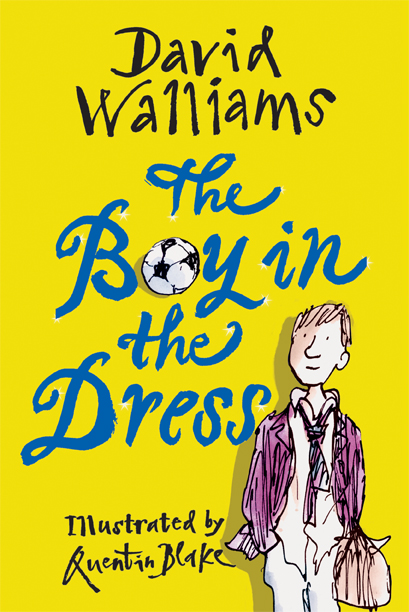
Since the Sixties, many parents and teachers and educational programs have embraced books that promote understanding of ethnic diversity such as People and of disability such as I Have A Sister: My Sister Is Deaf to broaden our children’s perspective and nurture empathy toward people they do not encounter every day.  Yet books like My Princess Boy or The Boy In The Dress have yet to break into the standard curriculum.  There seems to be an unspoken assumption that such books are primarily for the boys they’re about.  (Buy them only after your son starts actively asking for a tiara.)  But everyone should be reading them, for the same reason everyone should be reading Thinking Big.  By waiting to address the idea of free gender expression until a little boy gets bullied, we are cultivating the assumption that the problem never existed until that little boy came along.  The problem was always there.  

Critics have argued The Boy In the Dress is unsuitable for any boy in real life who feels the like the protagonist because any school he attends in real life is far less likely to rally around him so enthusiastically.  But that’s exactly why this book needs to be read and discussed and picked apart by school classes around the world, not just by boys alone in their bedrooms. 

As a teacher, babysitter and relative, I encourage the little boys in my life to play dress-up, house or princess with their female playmates because I’ve yet to hear a convincing argument as to why it’s any different from encouraging the girls to get down and dirty in the mud with their brothers.  Sure it’s radical—just as my mother’s wearing jeans to school 42 years ago was radical—and the last thing I want to do is turn a child into something he’s not.  But as with a girl, I want him to feel that every option is open to him, despite any hang-ups tradition has about it.  And if it becomes evident that he truly has no interest in anything soft or sparkly, I at least want to do my best to ensure that he never, ever makes fun of any boys who feel otherwise.


Interpreting History Part II: Oppression Has Never Been Universal

5 Aug

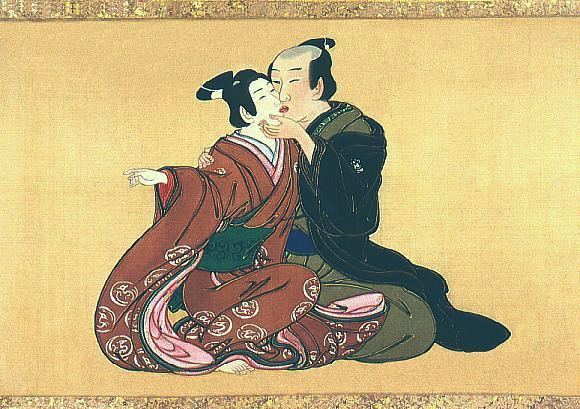
(“Samurai Kiss” via)


Nothing divides a country quite like a national holiday.  When I was studying in St. Petersburg ten years ago, there was as much apathy as there was celebration on the Russian Federation’s June 12th decennial.  German reactions to Reunification Day every October 3rd are anything but united.  And on the United States Fourth of July last month, Chris Rock tweeted, “Happy white peoples independence day, the slaves weren’t free but I’m sure they enjoyed fireworks.”

Amid the outbursts of “unpatriotic!”, conservative blogger Jeff Schreiber shot back, “Slavery existed for 2000yrs before America. We eradicated it in 100yrs. We now have a black POTUS. #GoFuckYourself.” 

Schreiber has since written a post on his blog, America’s Right, apologizing for cursing and conceding that the slave trade was unconscionable.  But for all his insistence that he never intends to diminish the horrors of American slavery, he adds that President Obama’s policies are now “enslaving Americans in a different way.”  (Real classy.)  And for all his reiteration that slavery was always wrong, he still hasn’t straightened out all the facts skewed in his Tweet.

“Slavery existed for 2,000 years before America.”  He uses this supposed fact to relativize the oppression, as if to shrug, “Well, everyone was doing it back then.”  His tweet implies that the ubiquity of the slave trade makes America’s abolition of it exceptional, not its participation.  This argument hinges on fiction.  Slavery did not exist for 2,000 consecutive years.  In the West, it was pervasive in Antiquity and the Modern era, but it was downright uncommon in the Middle Ages.  (While anathema to our modern ideas of freedom for the individual, medieval serfdom was not slavery.)  Slavery was re-instituted in the West roughly 500 years ago with the advent of colonialism.  And the United States held on to it long after most other colonial powers had abolished it.  Critics can say what they want about the effectiveness of Chris Rock’s rain-on-a-parade tactics, but his argument did not distort history.      

In my last post, I argued the risks of concealing the human rights abuses of the past for the sake of nostalgia, if anything because it is the height of inaccuracy.  But portraying history as an unbroken tradition of straight, white, able-bodied male dominance like Schreiber did is also inaccurate.  The universal human rights movement in its modern form is indeed only a few decades old, but the idea of equality for many minorities can be found all over in history at various times and places.  The Quakers have often been pretty keen on it. 

And almost no minority has been universally condemned.  People with dwarfism appear to have been venerated in Ancient Egypt.  Gay men had more rights in Ancient Greece and in many American Indian societies than in 20th century Greece or the United States.  Muslim women wielded the right to divorce long before Christian women.  English women in the Middle Ages were more educated about sex than their Victorian heiresses.  Much of the Jewish community in Berlin, which suffered such unspeakable crimes culminating in the mid-20th century, were at earlier times better integrated into the city than Jewish people were in many other capitals of Central Europe.  In short, history does not show that racism, misogyny, homophobia, ableism, transphobia, and our current beauty standards are dominant social patterns only recently broken by our ultra-modern culture of political correctness.  The oppression of minorities may be insidious and resilient throughout history, but it has never been universal. 

Downplaying the crimes of the past by claiming everybody did it is both historically inaccurate and socially irresponsible.  It is perverse when such misconceptions fuel arguments for further restrictions on human rights.  In 2006, Republican Congress member W. Todd Akin from Missouri claimed that, “Anybody who knows something about the history of the human race knows that there is no civilization which has condoned homosexual marriage widely and openly that has long survived.”  Even if this were true, the argument is absurd.  (It appears that no civilization has regularly chosen women with dwarfism for positions of executive power, but does that mean it’s a bad idea?)  But the argument collapses because it relies on facts that are untrue.

Granted hyperbole is a constant temptation in politics.  Stating things in the extreme is a good way to grab attention.  In an earlier post on sex, I asserted that mainstream culture assumes women’s sex drive is lower than men’s because female sexual expression has been “discouraged for millennia.”  Patriarchy has certainly been a major cultural pattern around the world and throughout history, and we cannot emphasize its power on both the collective and individual psyche enough.  But patriarchy is by no means a cultural universal.  Ethnic groups in Tibet, Bhutan, and Nepal continue to practice polyandry into the present day, while history shows many others that have done the same at various times.  These exceptions question the biological theory that heterosexual male jealousy is an insurmountable obstacle to sexual equality.  And prevents any conservative excuse that insists, “Everybody’s been doing it.”    

They haven’t been.  Xenophobia has never been universal.  Humans may have a natural fear of the unfamiliar, of what they perceive to be the Other, but our definitions of the Other change constantly throughout time and space, as frequently and bizarrely as fashion itself.   This makes history craggy, complex, at times utterly confusing.  Like the struggle for human rights, it is simultaneously depressing and inspiring.  But whatever our political convictions, we gotta get the facts straight.

Despite what Stephen Colbert says.


Interpreting History Part I: Count Me Out

29 Jul

alter ego(Image by Bob May used under CC license via)


Anytime my partner and I don’t know what to do or say, one of us asks, “What’s in the news?” and we dive into a political discussion.  So it’s no surprise that we’ve become somewhat embarrassingly addicted to Aaron Sorkin’s The Newsroom.  The news media has been (unsurprisingly) critical of a show founded on the idea of chastising the news media.  Feminists have been (sometimes rightly) critical of its portrayal of women.  The show has almost countless strengths and weaknesses, but I find myself still obsessing over the brilliant, captivating opening scene that kicked off the series.  If you can’t this clip, it basically boils down to a flustered news anchor named Will McAvoy overcome with disgust at the state of the nation and nostalgia for the 1950s and 60s: “America’s not the greatest country in the world anymore,” he sighs.  “We sure used to be.”

We stood up for what was right.  We fought for moral reasons.  We passed laws, we struck down laws for moral reasons.  We waged wars on poverty, not poor people.  We sacrificed, we cared about our neighbors.  We put our money where our mouths were, and we never beat our chests…  We cultivated the world’s greatest artists and the world’s greatest economy.  We reached for the stars, acted like men.  We aspired to intelligence.  We didn’t belittle it.  It didn’t make us feel inferior…  We didn’t scare so easy.     

“Nostalgia” literally means “aching to come home.”  It’s the temporal form of homesickness, time rather than place being the source of pain.  We all do it.  It can be oddly soothing at times to be in awe of another era, especially the one you were born in.  But Will McAvoy should watch Woody Allen’s Midnight in Paris for proof that nostalgia is an ultimately futile pastime that every sad sack of every era has hopelessly indulged in.  (If “things were better back in the day,” then how come every generation says this?)  But since McAvoy’s nostalgia is an earnest, political battle cry, heaping laurels on the good old 1950s and 60s when the leaders of the day did their job right, I’m more inclined to have him watch Mad Men.  Or just open up the 1960 children’s illustrated encyclopedia I found at my great aunt’s house, which states, among other things: “The Australian aborigine is similar to the American negro in strength, but less intelligent.”  Didn’t scare so easy, indeed.     

The problem with nostalgia is that it is far more emotional than intellectual and thereby lends itself to inaccuracy all too easily.  America was indeed doing great things sixty years ago.  And reprehensible things.  We hid our disabled and gay citizens away in institutions, asylums and prisons.  We enforced the compulsory sterilization of mentally disabled and Native American women.  We took decades to slowly repeal segregationist laws that the Nazis had used as models.  We maintained laws that looked the other way when husbands and boyfriends abused their partners or children.  In short, we handed out privilege based on gender, sexuality, ethnicity, religion, physical and mental capabilities with far greater frequency and openness than we do today.  Perhaps we were the “greatest country in the world” compared to the others.  (Europe and East Asia were trying to recover from the devastation of World War II, after all, while other nations were trying to recover from the devastation of colonialism.)  But McAvoy’s wistful monologue is much more a comparison of America Then with America Now.  And that is hard to swallow when considering that a reversion to that society would require so many of us to give up the rights we’ve been given since then.   

Am I “another whiny, self-interested feminist” out to bludgeon the straight, cis, WASPy male heroes of history?  Am I “just looking to be offended”?  No, I’m struggling.  Next to literature and foreign languages, history has always been my favorite subject.  And pop history always touches upon this question:

“If you could go back to any period in history, which would it be?” 

From an architectural point of view?  Any time before the 1930s.  From an environmental point of view?  North America before European contact.  From a male fashion point of view?  Any period that flaunted fedoras or capes.  From a realistic point of view?  No other time but the present.  Because if I am to be at all intellectually honest in my answer, there has never been a safer time for me to be myself. 

Last year, I read The Lives of Dwarfs: Their Journey from Public Curiosity To Social Liberation by Betty Adelson.  Despite my love of history, I hated almost every minute of it.  Lies my Teacher Told Me by James Loewen had helped me understand how so many black American students feel uninspired by U.S. history and the figures we hold up as heroes because so many of those men would have kept them in shackles.  But it wasn’t until I read The Lives of Dwarfs that I understood how nasty it feels on a gut-level to face the fact that most of history’s greatest figures would more likely than not consider you sub-human. 

With the exception of Ancient Egypt, my own lifetime has been the only period wherein someone with dwarfism could have a fair chance of being raised by their family and encouraged to pursue an education and the career of their choice, as I was.  At any other point in Western history, it would have been more probable that I would have been stuck in an institution, an asylum or the circus (the Modern Era before the 1970s), enslaved by the aristocracy (Rome, Middle Ages, Renaissance) or left for dead (Ancient Greece).  Of course inspiring cases like Billy Barty show that a few courageous/decent parents bucked the trends and proved to be the exception to the rule, but that’s what they were.  Exceptions. 

I am fortunate to have been born when I was and for that reason, nostalgia for any other period in time can never be an intellectually honest exercise for someone like me.  The moment someone says, “Yeah, well, let’s not dwell on odd cases like that.  I’m talking about the average person,” they’re essentially saying, “Your experience is less important than mine.”

Everyone is entitled to have warm, fuzzy feelings about the era in which they grew up.  If any period can put a lump in my throat, it’s the 1970s.  The Sesame Street era.  The boisterous, primary-colored festival flooded with Williams Doll, Jesse’s Dream Skirt, inner city pride à la Ezra Jack Keats, and androgynous big hair all set to funky music can evoke an almost embarrassing sigh from me.  Donning jeans and calling everyone by their first name, that generation seemed set on celebrating diversity and tearing down hierarchies because, as the saying goes, Hitler had finally given xenophobia a bad name.  Could there be a more inspiring zeitgeist than “You and me are free to be to you and me”? 


But I’m being selective with my facts for the sake of my feelings. 

Sesame Street and their ilk were indeed a groundbreaking force, but it was hardly the consensus.  Segregation lingered in so many regions, as did those insidious forced sterilization laws.  LGBT children were far more likely to be disowned back then than today—Free To Be You And Me had nothing to say about that—and gay adults could be arrested in 26 states.  The leading feminist of the time was completely screwing up when it came to trans rights.  Although more and more doctors were advocating empowerment for dwarf babies like me, adult dwarfs faced an 85% unemployment rate with the Americans with Disabilities Act still decades away.  And Sesame Street was actually banned in Mississippi on segregationist grounds.  When the ban was lifted, its supporters of course remained in the woodwork.  We have made so much progress since then.  It would be disingenuous for me to ignore that simply for the sake of nostalgia. 

To be fair to Sorkin, it’s a hard habit to kick.  We have always glorified the past to inspire us, no matter how inaccurate.  Much of American patriotism prides itself on our being the world’s oldest democracy, but we were not remotely a democracy until 1920.  Before then, like any other nation that held free elections, we were officially an androcracy, and of course we didn’t guarantee universal suffrage until the Voting Rights Act of 1965.  That my spellcheck doesn’t even recognize the word “androcracy” signifies how little attention we afford our history of inequality.  But we have to if accuracy is going to have anything to do with history.  A brash statement like “We sure used to be [the greatest country in the world],” as a battle cry for self-improvement is asking to be called out on the inanity of this claim. 

Everyone is entitled to appreciate certain facets or moments in history, just as everyone is entitled to look back fondly upon their childhood.  Veracity falters, however, with the claim that not just certain facets but society as a whole was all-around “better.”  This is never true, unless you’re comparing a time of war to the peacetime preceding it (1920s Europe vs. 1940s Europe, Tito’s Yugoslavia vs. the Balkans in the 1990s), and even then the argument is sticky (Iraq during the insurgency vs. Iraq under Saddam Hussein).  In the words of Jessica Robyn Cadwallader, concealing the crimes of the past risks their reiteration.  Whenever we claim that something was socially better at a certain point in history, we must admit that something was also worse.  It always was. 

But such a sober look at the past need not be depressing.  It reminds me how very grateful I am to be alive today.  My nephews are growing up in a society that is more accepting than almost any other that has preceded it.  That is one of helluva battle cry.  Because what could possibly be more inspiring than history’s proof that whatever our missteps, things have slowly, slowly gotten so much better?


When It Comes to the Sexes, Ignorance Is Bitterness

1 Jul


“Men and women can’t really be friends, can they?”  In the wake of Nora Ephron’s passing on Tuesday, there’s been a revival of this When Harry Met Sally question.  And you can probably guess what my answer is.  With no disrespect intended to the late feminist, I’m really hoping this is one of her contributions to pop culture whose staying power will erode with time.  It’d be easy to dismiss it as no big deal, nothing more than a cute gimmick, but an excellent NY Times piece from earlier this spring asserts what I have always suspected: Our society’s lack of faith in cross-gender friendships signifies its traditional lack of faith in men and women being able to understand each other.  And that’s a big deal.

According to tradition, men and women view each other as the Other and only meet for the sake of mating and family, hence the cultures wherein women were banned from being seen with any man who was not their husband or relative.  Western pop culture promotes vestiges of this in its assumption that any regular contact with a member of the opposite gender will lead to you falling for them, especially if you’re a guy.  As Jeff Deutchman writes in this several-volume Slate article, “It’s called having no standards.”  When Harry Met Sally says, Fine, maybe as a guy you don’t fall for every woman who crosses your line of vision, but it’s your only motivation for maintaining a friendship with one, and attraction will always poison friendship.  Oh, puh-lease.

“Only worth it if I get laid” may be the rule for a Hollywood character, but it is a very bleak view of the other gender.  Friendship may be impossible if you are set on maintaining that view, but in that case, too bad for you.  And everyone else around you.  I’ve seen friendships survive unrequited love, illicit feelings, romantic trysts and break-ups, and go on to rival any sisterhood or buddy bond in depth.  Men and women can sure as hell be friends, and I don’t mean friendly chit-chat at dinner parties.  I mean call-up-and-confide-your-deepest-fears, ask-for-advice-on-your-most-serious-problems, make-you-laugh-in-a-way-almost-no-one-else-can friends.  Instead of Harry and Sally, they embody Jerry Seinfeld and Elaine Benes, or Emma Morley and Dexter Mayhew, nurturing an allegiance that says “So what?” to any sexual tension, past or present.  They are anathema to the “Men are from Mars, Women are from Venus” folklore, just as international relationships are anathema to racist myths. 

It is true that men and women are culturally conditioned to think and behave differently, just as Germans and Americans are culturally conditioned to think and behave differently, as are New Yorkers and Texans, Berliners and Bavarians, Long Islanders and Upstaters.  But there is always far more variation in the thoughts and behaviors within cultures than across them.  Our traditional categories ignore this, suppressing any details that throw themselves into question, no matter how critical.  Arguing against male-female understanding by emphasizing the traditionally recognized differences is disingenuous because it relies on an extremely narrow, heteronormative perspective. 

Social conservatives often cite hormonal and genetic differences as wedges between men and women, straights and gays, but such arguments are cherry-picking the facts to prop up the antiquated gender binary.  In a New York magazine article on transgender children appearing last month, a theory presented by Dr. Jean Malpas breaks down the concepts of sex and gender into not two but four parts, visually represented on a stick-figure:

  • Biological Gender: your chromosomes and genitals.  Indicated on the stick-figure’s crotch.
  • Sexuality: your romantic attraction to others.  Indicated on the stick-figure’s heart.
  • Gender Style: sometimes called Gender Expression, your preferred self-presentation in matters such as fashion, posture, speech patterns and hobbies. Indicated by a circle around the outside of the stick-figure’s body.
  • Gender Identity: your innate sense of being male or female or androgynous, regardless of biology or style or sexual interest.  Indicated on the stick-figure’s brain.

We are so much more complex than Harry and Sally, and so much deeper than they give us credit for.  Just as an international relationship requires at least one if not both partners to be bilingual, a cross-gender friendship requires at least one if not both friends to be intellectually curious, empathic and uninterested in the stereotypes they have been taught regarding both their own gender and someone else’s.  Indeed, the author of the Slate article claims that cross-gender friendships work best between individuals who are “less gendered.”  (Guys who are unafraid to enjoy movies like The Joy Luck Club, no matter the risk of looking effeminate; women who are unafraid to make asses of themselves, no matter the risk of looking unladylike… )  Bonding over common experiences is easy.  Considering a different point of view despite cultural pressures signifies genuine respect, the very sort needed to fuel any kind of progress.  This is why having close friends of all kinds of gender identities, styles and sexualities can be so awesome. 

Friendship, unlike politics, requires the participants to not just listen to each other but hear what the other is saying.  As a woman who wants a career, I am still expected to juggle it with almost all the responsibilities of childcare because mothers who focus more on their success than their family are negligent.  Many guyfriends are sympathetic to this, while pointing out to me that with or without a family, they are expected to focus more on their success than their emotional fulfillment.  Discussing such ambivalent feelings with friends of the same gender identity can be very helpful, but peer pressure can impede it.  Discussing such feelings with a romantic partner is very important, but it carries the burden of how these feelings will affect the relationship.  Discussions that take place outside of a romantic relationship are more likely honest than resentful because the problem can be identified without having to be solved right away.  That’s what friends are for.   

But it receives little support from tradition because Harry and Sally insist that straight men and women are doomed to fall in love, and traditional notions of love have very little to do with respect.  In passionate romance, possessiveness trumps respect, and while overt jealousy may now be seen as uncool, the tendency for men and women to break off along gender lines at parties seems to correlate directly with the number of monogamous couples.  Pursuing a new friendship with a man your husband doesn’t like—who isn’t gay—can still be judged as inappropriate.  But it’s a double standard, because many men and women strongly dislike their partners’ same-gender friends, yet to try to quell such friendships would be seen as Yoko Ono tyrannical. 

As partners, we should understand that cross-gender friendships more often indicate open minds than loose morals.  Navigating the complexities of life-long commitment is where men and women need to be able to understand each other most.  People whose primary or only close communication with the other gender is through their partner are more likely to assign misunderstandings to their partner’s entire gender.  (“Women are incapable of being on time!”  “Men can’t be trusted for the life of them to buy Christmas presents!”)  The more opaque we consider the Other to be, the less likely we are to try to understand their perspective, as well as the perspectives of those who don’t fit into our stereotypes.  It’s no coincidence that the cultures that place the most restrictions on male-female interaction afford the fewest freedoms to women and LGBT individuals.

But things are getting better.  Cross-gender friendships are more accepted now than ever before because men and women of all gender identities are communicating and understanding each other at record levels.  Not only are new mothers freer to nurture an identity outside the home, but new dads are more likely to hug their children and tell them they love them now than at any other time in modern history.  Attraction and the possibility for it will probably always complicate relationships—and politics and life—to some degree, but open dialogue continues to prove that the Other is never as impenetrable as we have been told.  In the words of researcher Kathryn Dindia, “Men are from North Dakota, women are from South Dakota.”  Our friendships are both the cause and the result of this.


Pfingsten

26 May


It’s Memorial Day weekend in the U.S., Pentecost weekend here in Germany, and seeing as I have now gone way longer in broadcasting consecutive new material without a single re-run than The Simpsons ever has, I’m taking the day off and leaving you with the above revelation.  Till next week!


The Gender Police

5 May

(Image by Stephen Alcorn © 2003 http://www.alcorngallery.com)


Last Sunday, Pastor Sean Harris of the Berean Baptist Church in Fayetteville, North Carolina gave a sermon on gender:

So your little son starts to act a little girlish when he is 4 years old and instead of squashing that like a cockroach and saying, ‘Man up, son, get that dress off you and get outside and dig a ditch, because that is what boys do,’ you get out the camera and you start taking pictures of Johnny acting like a female and then you upload it to YouTube and everybody laughs about it and the next thing you know, this dude, this kid is acting out childhood fantasies that should have been squashed.

Dads, the second you see your son dropping the limp wrist, you walk over there and crack that wrist. Man up. Give him a good punch. Ok? You are not going to act like that. You were made by God to be a male and you are going to be a male. And when your daughter starts acting too butch, you reign [sic] her in. And you say, ‘Oh, no, sweetheart. You can play sports. Play them to the glory of God. But sometimes you are going to act like a girl and walk like a girl and talk like a girl and smell like a girl and that means you are going to be beautiful. You are going to be attractive. You are going to dress yourself up.’

Harris used the sermon to voice support for an upcoming proposed amendment to the state constitution that would define marriage as between a man and a woman.  North Carolina law already prohibits same-sex marriage.  The constitutional amendment would simply make it ever more so, as well as ban same-sex civil unions.  Update on 9 May: The amendment passed.

The hostility Harris invoked is one of the absolute best arguments for the opposition.  Play his sermon on a loop next to the 2010 study finding American children of lesbian parents report the lowest rate of abuse and repeat: Who’s advocating happy, loving families here?  But it should concern not only those who believe in same-sex marriage or non-violent childcare, but anyone who believes in equality and a non-threatening approach to character development.  Because, unfortunately, Harris was merely saying directly what children, teens and adults are told stealthily almost every day.  

In the 2007 documentary For the Bible Tells Me So, religious scholars and sociologists conclude that the reason socially conservative religious groups target same-sex marriage so passionately is because it disrupts patriarchy.  Indeed, Harris’s rant embodies the two most arbitrary, constricting rules for heterosexual women and men in dating that endure today.  That is, nothing is worse for a guy than seeming effeminate, and nothing is worse for a woman than being ugly.

Most readers may agree that these rules exist but certainly not to the extreme that Harris advocates.  Rarely does Western society openly invoke the violent, threatening imagery he did.  But these rules take various forms, often masquerading as indisputable facts about innate gender differences, and are reinforced in films and magazines, and as mantras in everyday conversation. Many of the following probably sound familiar to you:

1) Women constantly want to constantly shop the way guys constantly want to get laid.

2) A woman should ultimately let the guy pursue her lest she emasculate him and, in any case, she should want to be pursued.  Because every woman is a princess and every guy is a hunter.

3) Guys can’t be sexually assaulted by women.  They can only be grossed out by the advances of ugly women.

4) She can play sports or join the army, but she needs some makeup to be attractive and should always take care of her looks more than a guy should.

5) But she shouldn’t wear heels if it makes her taller than her man.

6) While many men can expect conventionally attractive women to overlook their gray hair, baldness, wrinkles, and/or chubbiness for their success or sense of humor, a woman cannot expect a conventionally attractive man to do the same for her.  Beauty and the Beast was about the woman seeing past her lover’s looks, not the guy! 

7) Guys don’t cry, but women do.  A lot.  Because guys use assertiveness to get what they want, while women show their vulnerability to get what they want.

8) Guys don’t cuddle with each other.  That’s gay.  But women cuddling is either sweet or hot.

9) He’s castrated if she asked him out, she’s physically stronger than he is, he earns less than she does, he takes her surname, or she talks more than he does at parties. 

10) And he’s gay if he’s interested in dresses, skirts or makeup.

11) Or if he enjoys books or films about women’s experiences.

What silliness. Exiling the very real horrors of LGBT persecution to the peripheries for just a split second, how many of you nearly choked yourself laughing at Harris’s order to “get outside and dig a ditch because that’s what boys do”? 

Nothing should be off-limits to anyone unless they honestly, independently have no interest in it.  Most of us are probably disinterested in or uncomfortable with some of the aforementioned behaviors, but the disinterest should arise from self-awareness, not authoritative training.  And I’ve met enough self-aware, self-confident individuals to know that these behaviors do not fall along gender lines, but personalities. 

My neighbor loves ponies as much as she loves repairing cars.  My husband’s buddy plays rugby and knits.  My guyfriend loves arranging flowers and wearing skirts as much as he loves target-shooting and watching Formula One.  I love arguing politics and watching figure skating with my mom and dad as much as I cringe at discussing shoes or watching football.  All of us are encouraged by our partners, demonstrating that our fears of persecution for such gender-bender are usually reinforced not by the opposite sex but, as Ashely Judd so eloquently pointed out last month, by our peers. 

Many men try to talk their girlfriends out of wearing makeup, while many women are supportive of—and often intrigued to the point of being attracted to—men who adopt traditionally feminine activities.  (If it weren’t the case, “Too bad he’s gay!” wouldn’t be the famous expression it is.)  Despite this, women thrust ludicrous beauty standards upon themselves, making catty comments about each other’s supposed failures, while men police one another with gay slurs.  That these cultural rules bear so much repeating signifies that they are indeed rules, not facts.   A glance at history and across cultures demonstrates that they are fashions.  That enforcing them requires scare tactics—“You’ll never get laid!” “You’ll never land a man!”—should land the final blow to their credibility.


In Comedy, It’s All About Deciding Who’s Us & Who’s Them

28 Apr

Krampus twins(Via)


The Guardian’s stylebook contains the greatest commentary on style I’ve ever seen in print:

political correctness: a term to be avoided on the grounds that it is, in Polly Toynbee’s words, “an empty right-wing smear designed only to elevate its user.”

Around the same time, while researching the back stories of Life’s Too Short for my review, I came upon the controversy over the word “mong” in which Ricky Gervais found himself embroiled this past fall.  Apparently “mong” is a British English insult derived from “Mongoloid,” the very antiquated and now unacceptable term once used to describe people with Down’s Syndrome.  Both Americans and Brits have probably heard “retard” used the same way.  Gervais eventually apologized to those who objected—including the mother of a child with Down’s Syndrome who has frequently endured the insult—but not without first dragging his heels screaming at what he called “the humorless PC brigade.” 

I will never get over how many comedians insist that any criticism of their work is an indictment of all comedy; as if there’s no such thing as an unfunny comedian, only stupid audiences.  This logic sets the bar for comedy so low that no comedian need ever try to be original.  Ignoring the “PC brigade” (i.e., anyone who doesn’t live with the privileges they do), they can simply regenerate old stereotypes, mining the minstrel shows, the frat houses and the school yards, and if no one laughs at this, it’s simply because we’re all too uptight, right?  Wrong.  We don’t refrain from laughing because we feel we shouldn’t.  We refrain because, unlike the repressed who giggle away in awe, we’ve heard it a thousand times before and we know it’s far from unique.  And isn’t unique what every comedian, entertainer and artist strives to be?   

Like politics, comedy can be divided into two categories: that which confronts our problems with our own selves, and that which confronts our problems with others.  Xenophobia literally means the (irrational*) fear of strangers and the second type of comedy relies upon this fear.  There has to be a “them” for “us” to laugh at.  So Republicans laugh at Democrats.  Hippies laugh at yuppies.  Academics laugh at hippies.  Progressives laugh at bigots.  It’s fair game when beliefs are targeted because we must always take responsibility for our beliefs.  However, when the joke defines “them” as those who have had no choice whatsoever about their distinguishing quality—ethnicity, gender identity, sexuality, physical traits, mental or physical capabilities, or class background—and who continue to be disenfranchised by society’s delusions of normalcy, the joke had better target those delusions to be in any way original.  Otherwise, why pay for cable or tickets to hear someone lazily reiterate the guffaws of playground bullies? 

Every good comedian, from Stephen Colbert to Eddie Izzard to Christian Lander to the writers at The Onion, knows that the best jokes mock people’s hang-ups and clumsy reactions to minority issues, not the mere existence of minorities. My beloved Flight of the Conchords frequently flip gender roles and ethnic stereotypes, exposing the absurdity of racism and misogyny.  As the following video demonstrates, 1970s machismo has been begging to be made fun of.  However, when it comes to physical Otherness, it is the body—not fearful attitudes toward it—that they choose to snicker over, 54 seconds into the video:


Hermaphrodite?  Really?  An intersex kid’s medical reality is your toy?  C’mon, Conchords.  You’ve proven you’re great at making fun of white Kiwis tripping over Maori culture.  (“Jemaine, you’re part Maori…  Please be the Maori!  If you don’t do it, we’re gonna have to get Mexicans!”)  Surely you could come up with some good bit about hipster comedians clinging to lookist and ableist jokes like teddy bears and throwing temper tantrums when they’re taken away.  Or take a tip from Mitchell & Webb and take a jab at the way the ableism of reality TV masquerades as sensitivity:


Of course comedians have the right to make jokes objectifying minorities.  But I’m more interested in why they feel the need to, why they choose to objectify some people and not others.  Being gay, disabled, trans, intersex or non-white is not inherently hilarious to anyone who doesn’t live their lives sheltered from anyone unlike them.  The American freak shows of P.T. Barnum and the racist British sitcoms of the 1970s signify not just how profoundly disenfranchised minorities were in these countries, but how absurdly provincial audiences must have been in order to be so easily titillated.  Many comedians who reiterate chauvinist jokes argue that in doing so they are pushing the boundaries, expanding freedom of thought in defiance of PC oppression, when in fact they are merely retreating to well-trod ground, relying on ideas that challenge nothing but the very young idea that minorities deserve to be included in the dialogue as speakers, not objects.  As Bill Bryson has pointed out, the backlash against “political correctness” took place the moment the idea was introduced and has always been far more hysterical than what it protests.   

Toni Morrison has said, “What I really think the political correctness debate is really about is the power to be able to define.  The definers want the power to name.  And the defined are taking that power away from them.”  Revealing that it is all about power explains why emotions run so high whenever minorities get upset by certain jokes and comedians get upset about their being upset.  But this redistribution of power can be productive.  Taking old slurs and xenophobic tropes away from today’s politicians and comedians challenges them to think beyond their own experience and to wean themselves off society’s long-held fears, to redefine “them” as those enslaved by the limits of their imagination; in essence, to really push the boundaries.  Yet too often they default to the tired claim that this challenge infringes on their right to free speech. 

Some progressive critics do bring on the censorship accusation by using the ineffective phrase “You can’t say that!” and sometimes this is indeed an open attempt at censorship because most media outlets self-censor.  For example, Little People of America has called for the Federal Communications Commission to add “midget” to its list of words you can’t say on television.  I understand the temptation to insist upon the same treatment afforded other minorities: If certain ethnic and gender slurs are banned by newspapers and TV networks, why not others?  But this tactic too easily insults those other minorities—are you claiming black people have it easier than you?—and creates the concept of a forbidden fruit that will only tantalize right-wing politicians and shock jock comedians.  Simplifying the issue into Good Words/Bad Words can be a waste of an opportunity.  Instead of limiting itself to which words are always unacceptable regardless of context or nuance, the dialogue should always aim to reveal which minority jokes truly blow people’s minds and which lazily replicate institutionalized chauvinism. 

Instead of splitting hairs over the modern meaning of the word “mong,” I’d love it if a comedian went at the fact that Dr. Down came up with the term “Mongoloid” because he thought patients with the diagnosis resembled East Asians.  Because really.  Who’s asking to be made fun of here?


* “Phobia” always indicates an irrational fear, hence arachnophobia, agoraphobia, claustrophobia, homophobia, etc.  Fears that are well-founded are not phobias.

Female Privilege

14 Apr

(Rates of violence worldwide, used under CC license via)


Recently at Feministing, Cara Hoffman wrote about violence that targets men, setting off an angry debate. Most commenters rightly supported the idea of feminism openly discussing the ways in which men are specifically victimized, but there were some who said this had no place in the movement. Such a women-only approach to feminism is indeed sexism that, like male chauvinism, will never be successful as long as it is determined to concern itself with only one half of the population. The hero and heroine gender tradition oppresses men, women and those who identify as neither. As women, we should never be so insecure as to ignore anyone’s true disenfranchisement or to deny the privileges patriarchy automatically bestows upon us.  

Yes, being female comes with certain privileges under patriarchy. (And no, I don’t mean Phyllis Schlafly’s you-get-your-restaurant-meals-paid-for-so-be-happy-staying-out-of-the-workforce sort of “privilege.”) Privilege is granted by society to certain people based on things we had absolutely nothing to do with: our gender identity, our ethnicity, our sexuality, our physical traits, our mental capabilities, our class background. That is why any privilege—like any form of disenfranchisement—is the essence of injustice. 

Men face oppressive double-standards in dating and the family unit that I will address in a later post, but, in the wake of the arrest of Trayvon Martin’s killer, I want to focus for now on prejudices against men that are truly life-threatening. Beginning at the personal level, my husband has been beaten up twice by strangers. My brother and several guyfriends have been attacked outside clubs by strangers. Others were shoved down the stairs and slammed against lockers in school by bullies. I’ve never once been challenged to fight as they have, just as they have never experienced sexual harassment as I have. Of course far too many women are beaten by both men and other women, just as far too many men are sexually assaulted by both women and other men, but my personal experience and my husband’s are representative of the increased risk each of us face for certain kinds of attack in our society. There’s no need to try to decide which is worse: the threat of sexual assault or the threat of coming to blows. Both can end in the worst possible way, both are always inexcusable. Both target people based on their apparent gender. 

As a woman, I am far less likely to be challenged to fight or to be suspected of violence by authorities. As a woman, I am automatically more trusted to be around children. As a woman living in the United States and Europe, I have never been asked to die for my country.  As a woman, I can express more affection to a member of my gender without fear of gay bashing than a man can. As a woman, I can buy products of any color without fear of gay bashing. As a woman who’s not physically strong, I don’t have to worry as much as a man does about being picked on by bullies looking for an easy target. As an achondroplastic woman, I’ve always been less likely to be confronted by an assailant looking to engage in dwarf tossing than an achondroplastic man is. As a woman, I am permitted to choose emotional fulfillment over professional success without being considered a failure. This is why homeless women attract less contempt than homeless men. And part of why men are three times more likely to commit suicide than women. 

In a previous post discussing female sexuality, I quoted Chloe S. Angyal’s point that traditional gender roles consider sexuality a no-win situation for women, that any type of behavior we choose can be seen as an invitation to sexual assault. For men, the same Catch-22 can apply for men regarding violence. Looking tough? You’re a threat that needs to be knocked down. Looking vulnerable? You’re the perfect victim to pounce on. If you are identifiable as a minority through your appearance or behaviors, you’d better make sure you avoid the wrong parts of town, which, in some cases, may include your entire home town or country. Or shoot first. 

Like the virgin/whore cycle with which women are encumbered, men are confronted with the brute/wuss standard from the earliest of ages. You’re a monster if you use your fists to solve your problems, but you’re a sissy if you can’t. Non-violent young men must endure society’s suspicion that they are prone to be violent while at the same time enduring their own vulnerability as a victim of violence. The reality of violence against women can never be denied or downplayed, but neither can violence against men, who are 2 to 4 times more likely to be killed by violence than women. Because of the pressures of the traditional model of masculinity, men are far less likely than women to seek help after being threatened or assaulted. 

Most violence enacted upon boys and men is by other boys and men, and this proves that, as with violence against women, the solution is not to condemn a gender, but to condemn an attitude. Googling “female privilege” results in some very creepy websites, wherein men rage about women who won’t sleep with them after they held the door for them, and patriarchy relies on this polarization of the genders for survival.  Despite what so many of those misogynistic websites claim, women who identify as feminists demonstrate less hostility toward men than women who embrace traditional gender roles because we know that those traditions screw everyone over, including men.  That’s why we unite with men against them, taking them apart bit by bit, non-violently.