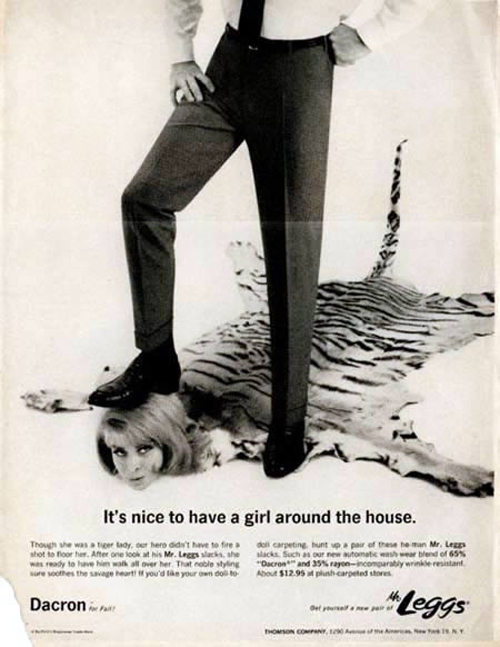
This week I led a workshop about teaching pre-school children about diversity. I started by asking the teachers what privilege is, and I got the same answer a family member had given just days before: “Privilege is what people who are really lucky have. Like being born into a rich family, going to nice schools, or even just being exceptionally good-looking and therefore having an easier time of it.”
It is interesting that so many seem to be under the impression that privilege and luck are what extremely well-off people have. Privilege does belong to anyone whose place in society is considered “better than normal,” but also to anyone whose place is considered simply “normal.” As said before, privilege is granted by society to certain people based on things we had absolutely nothing to do with: our gender identity, our ethnicity, our sexuality, our physical traits, our mental capabilities, our class background. That is why any privilege—like any form of disenfranchisement—is unjust.
In the workshop, I read off the following list of statements that illustrate privilege to the participants who were lined up in a row. (It’s a hodge-podge of original statements and ones taken from privilege activities created by Peggy McIntosh, Earlham College, and the Head Start Program.) Anyone for whom the statement was true could step forward. Anyone else had to stay behind. All of us in the group stepped forward at least half the time. You can see for yourself where you would have ended up:
1) I always felt safe in my neighborhood as a child.
2) If I wish to, I can be with people of my race/ethnicity most of the time.
3) I never have to plan how to reveal my sexual orientation or gender identity to friends, family, or colleagues. It’s assumed.
4) I can go out in public without being stared at.
5) I participated in extracurricular activities as a child (swimming, football, ballet, piano, yoga, painting, etc.).
6) I can easily buy posters, picture books, dolls, toys and greeting cards featuring people of my race.
7) I can wear a skirt, a dress, jeans, or pants, without anyone staring or asking me to explain my choice.
8) In school, I could always take part in whatever activity or games the class was assigned.
9) None of my close friends or family has ever been arrested.
10) Rarely have I been asked to explain why my body looks the way it does or why I move or speak the way I do.
11) I have never worried that I might not be able to afford food.
12) When I learned about “civilization” in school, I was shown that people with my skin color made it what it is.
13) I have never heard of someone who looks like me being given up for adoption or aborted because of it.
14) Who I am attracted to is not considered a political issue.
15) I attended a private school.
16) I am never asked to speak for everyone in my ethnic group.
17) I can find colleges that have many people from my class background as students.
18) I can criticize our government without being seen as an outsider.
19) My family never had to move for financial reasons.
20) If I am assertive, it is never assumed that it comes from my need to “compensate” or struggle with my identity.
21) When I was a child, I never had to help my parents at their workplace regularly.
22) When I talk about my sexuality (such as joking or talking about relationships), I will not be accused of “pushing” my sexuality on others.
23) If I make a mistake or get into trouble, I am usually judged as an individual, not as an example of people who look like me.
24) I can go for months without being called straight, heterosexual, or cis.
25) I can use public facilities (store shelves, desks, cars, buses, restrooms, and train or plane seats) or standard materials (books, scissors, computers, televisions) without needing help or adaptations.
26) When I dress for a formal event, I don’t worry about being accused of looking too dolled up or not pretty enough.
27) As a child, I never had to help care for a family member.
28) When I watch family advertisements for food, medicine, clothing, games and toys, the families on TV usually look like mine.
29) I grew up feeling I could be whoever or whatever I wanted.
30) I have never been asked, “What do [people like] you like to be called?”
This week the British newspaper The Telegraphasks:
Ever wondered why men can’t seem to tastefully decorate a house? Or have a tendency for dressing in clothes that clash? And why, for that matter, can’t women seem to hack it at computer games? Now scientists claim to have discovered the reason: the sexes see differently. Women are better able to tell fine differences between colors, but men are better at keeping an eye on rapidly moving objects, they say.
Professor Israel Abramov and colleagues at the City University of New York reached their conclusions after testing the sight of students and staff, all over 16, at two colleges…
The authors wrote: “Across most of the visible spectrum males require a slightly longer wavelength than do females in order to experience the same hue.” So, a man would perceive a turquoise vase, for instance, as being a little more blue than a woman who was looking at it too.
Abramov, professor of cognition, admitted they currently had “no idea” about how sex influenced color perception. However, writing in the journal Biology of Sex Differences, he said it seemed “reasonable to postulate” that differences in testosterone levels were responsible…
Men can’t perceive colors as deftly as women can. That’s why all the great Western painters like Van Gogh and Cézanne and Leonardo and Picasso and Renoir and Monet and Munch and Vermeer and Kandinsky and Matisse are female. And all the major fashion designers of the last century like Hugo Boss and Karl Lagerfeld and Gianni Versace and Giorgio Armani and Calvin Klein and Ralph Lauren were women. Oh, wait.
Maybe the study meant to say testosterone only triggers color ineptitude when male ears register the words “home decorating.” Or that male color perception improves when money is involved.
Or maybe The Telegraph author was exaggerating just a bit. Tacking jazzy headlines onto reports of scientific studies are all the rage these days, no matter how much they distort the findings. In June, Medical Daily ran an article under the title, “Racism Is Innate.” Innate means, according to my biologist father, “present at birth,” so this seemed like a call to toss all those No child is born a racist buttons onto the trash heap. Except that anyone who bothered to read the article would discover that the study simply concluded that brain scans of adults show simultaneous activity in the centers that process fear and emotion and those that differentiate between familiar and unfamiliar faces. The idea that fear of the Other can be neurologically mapped lends itself to a great deal of speculation and debate, but nowhere did the study claim that racism is present at birth.
Such truth-stretching borders on mendacity, yet it pervades the science sections of so many newspapers. Scientific studies are supposed to be free of bias, but the news media is severely biased toward publishing whatever will grab readers’ attention. As several researchers have pointed out, differences between the sexes are currently considered a much more interesting discovery than no difference, so publishers often remain silent on an issue until they find a study that provides the juicier headline, no matter how numerous the contradicting studies are. When the market is left to decide, it chooses salability over comprehensiveness.
Such an irresponsible approach to science results in a gravely misinformed public. I can’t tell you how many people have repeated the claim that our modern Western female beauty standards are “natural” because a round waist resembles pregnancy and triggers the male fear of cuckoldry. No one seems to remember thatseveralcross–culturalstudies discredited this idea years ago. But how can anyone be expected to remember something the media chose not to promote in the first place?
And forget about waiting until the study is corroborated. In 2007, The Times ran a headline claiming that women are naturally drawn to the color pink because of our savannah foremothers’ need to gather berries while the men hunted. The Times published the study without consulting any historians, who eventually pointed out that pink was considered a manly color as recently as 1918 until fashion trends changed. Oops.
This doesn’t mean that we should, as Mitt Romney has demanded, “keep science out of politics.” Science is impartiality and corroboration and the best method we have for sorting facts from wishful thinking—for preventing our emotional, egotistical needs from weakening our objectivity. To me, science is the most humbling force in the universe because it demands we always admit what we do not know. It prevents hasty conclusions based on flimsy evidence, gut feelings, and political agendas. It questions crude stereotypes and discovers more complex structures.
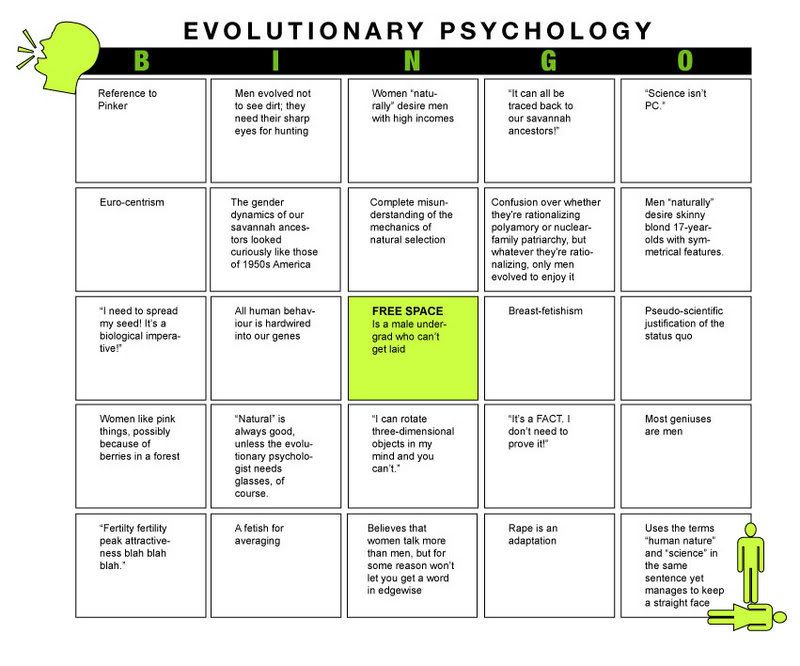
But according to pop science reporters and the researchers they choose to spotlight, nearly every single modern joke about the differences between men and women stems from millennia-old evolutionary adaptations. (Indeed, the Telegraph article claims that the female proclivity for detecting color helped our foremothers with gathering berries. Always with the damn berries… ) As stated in the graphic below, such reports all too often suggest that prehistoric society on the African savannah looked just like something Don Draper or Phyllis Schlafly would have designed:
Men hunt, women nest, and every macho social pattern we see today has been passed down to us from our prehistoric ancestors. Even though historians find that these patterns, like our racial categories, are barely more than two centuries old, if that. And that the gender binary is far from universal. Misinterpreting scientific findings is just as dire as ignoring them.
When it comes to what women and men can and can’t do, neuroscientist Lise Eliot notes, “Expectations are crucial.” When boys and young men grow up in a culture that mocks their supposed incompetence in all things domestic (“Guys don’t do that!”), it comes as no surprise that only the most self-confident will pursue any interest they have. Meanwhile, studies show girls perform as well as boys do in math and science until they reach puberty. Maybe the onset of menstruation paralyzes our visual-spatial intelligence because we’ve got to get picking those berries, or maybe girls pick up on the not-so-subtle message that guys think coquettish beauty is more important than nerdy brains in the dating game. (For more details on the sexism faced by aspiring female scientists, see Cordelia Fine’s excellent book, Delusions of Gender.) In her research, Dr. Eliot finds only two indisputable neurological differences between males and females:
1) Male brains are 8% to 11% larger than females’.
2) Female brains reach maturation earlier than male brains.
All other neurological studies that find major differences between the sexes are studies of adults: i.e., the people most shaped by their culture and society. Only cross-cultural studies of adults can isolate nurture from nature. In any case, Eliot is a proponent of neuroplasticity, the idea that the pathways and synapses of the brain change depending upon its environment and the neural processes and behaviors it engages in. In other words, painting or gaming from an early age or frequently throughout your life will condition your brain to do these tasks and related ones well. It explains why the gender roles of a given time and place are so powerful—why mastering unfamiliar tasks is an uphill climb for men and women but also why countries committed to equality have the narrowest gender gaps.
“Plasticity is the basis for all learning and the best hope for recovery after injury,” Eliot writes. “Simply put, your brain is what you do with it.” For more, see her brilliant parenting book, Pink Brain, Blue Brain: How Small Differences Grow into Troublesome Gaps—and What We Can Do About It.
But I’ll never believe that a neuroscientist has all the answers. I live in a country that showed the world the dangers of hastily trying to trace all social patterns back to biology. As a result, the media here in Germany is usually much more reticent to casually toss around arguments like those in The Telegraph or The Times or Medical Daily. Natural scientists have made discoveries like neuroplasticity and limb-lengthening that are crucial to progress, but social scientists have discovered that equality and empathy are crucial to any society that values peace and respect over power and greed.
“I know so many men and boys and trans individuals who wear dresses for so many different reasons, and they do it a lot more than mainstream movies, TV, and advertising suggest.”
I felt my fingers tremble just a tiny bit as I typed this sentence last week. Not because of the subject matter. Not because of the point I was trying to make. Because of the “I.” Was that word going to drive home my point, or derail it?
Studies show personally knowing someone who belongs to a minority group increases the likelihood that you will have empathy for that minority. If you have a family member who is gay, you’re less likely to oppose marriage equality. If you know someone with dwarfism well, you’re less likely to see their medical diagnosis whenever you look at them. GLAAD emphasized the political potential for all this in a brilliant meme last fall. Urging LGBT individuals to talk openly about their partners and love lives at the dinner table with the same frequency as their straight family members, they called it, “I’m Letting Aunt Betty Feel Awkward This Thanksgiving.”
Truly caring for someone with a different perspective often—though, sadly, not always—inspires us to try to understand their perspective and this enhances our own. Letting others know that They are not so different from Us because we know and care deeply about many of Them can effectively break down barriers. And, when discussing social injustice, it’s always best to ask someone with personal experience, lest we unwittingly make erroneous assumptions. But, of course, just having friends who belong to minority groups doesn’t solve everything.
As I wrote about knowing men and trans people who wear dresses to elucidate that They are actually Us, I cringed at the idea of flaunting my loved ones’ Otherness for the purposes of my blog. By inserting myself into the statement, there was a risk that some would think I was trying to prove my open-mindedness. I’ve bragged like that in the past, especially when I was an egocentric teen. (You know, back when you practiced writing your name over and over?) And my own Otherness has been flaunted a few times by friends and acquaintances seeking attention for their open-mindedness. It’s a serious problem in the social justice movements.
In Black Like Me, the author tells the story of a New Yorker he encounters who has come to the South to “observe” the plight of the black citizens. “You people are my brothers,” the New Yorker insists. “It’s people like me that are your only hope. How do you expect me to observe if you won’t talk to me?” Although the man’s opposition to segregation was morally correct, his overt self-regard and patronizing disgust at his brothers’ “ingratitude” makes it one of the most cringe-inducing scenes in the book.
In Baratunde Thurston’s fantastic memoir, How To Be Black (just out this year), the author asks writers and activists about white people’s fear of being called racist. damali ayo, the author of How To Rent A Negro and Obamistan! Land Without Racism, says it best:
It shows our values as a culture when somebody says, “I don’t want to be a called a racist.” Really what they’re saying is, “I want you to like me. I don’t want to not be liked. I want to still be okay with you.” They don’t mean, “What I really want is to know and understand experiences of people of color…” That would be great.
And so, it just shows that, as I always have said, we are operating at this third-grade level of race relations. And it’s that third-grader that goes, “Please like me, do please like me,” versus “Can I understand?”
We all want to be liked and we all want to do the right thing. But the the third-grader mindset can’t help but focus more on the former. It is evident in common phrases like:
“I think I’m [bisexual/learning disabled], too, because I [kissed a girl once/have difficulty concentrating]!”
“I’m not prejudiced! I have so many [nonwhite/foreign/LGBT/disabled] friends!”
Of course, in certain contexts and worded differently, these statements would not be offensive. What makes them offensive is the need to let others know all about us, the belief that our support for equality deserves praise, the patronizing (and unjust) view that minorities should be grateful for our lack of prejudice. We can note that we were the only white people in a group in order to spark a dialogue about social segregation, or we can flaunt the experience like a medal from the Liberal Olympics. We can worry that having a homogeneous circle of friends will limit our perspective, or we can believe that racking up as many minority friends as we can is proof of our expertise on all minority issues. We can try to empathize with someone labeled “different” because of their sexuality or biology in order to remove stigmas and barriers, or we can try to seek the attention they are getting for ourselves. We can respond to accusations that we have offended by trying to understand why someone would be hurt, or we can respond by listing our liberal credentials.
This depends primarily on the individual. Someone who likes to brag about their open-mindedness usually brags about most things they do. This personality trait seems to be particularly common among educated elites—parodied so well at Stuff White People Like—because elite education frequently fosters competitiveness. (Taking the time to count your degrees, count the books you own, count the minority friends you have…) Competitiveness is anathema to selflessness. But while bragging about the number of books we own is silly because we’re obviously missing the point of reading, bragging about the number of minority friends we have is grave because we’re missing the point of human rights.
Do we donate to charity privately because it makes us feel better to spend the money on someone else? Or do we hope that others will notice and admire our sacrifice? Then again, drawing attention to the work we’re doing is usually important if we want to advertise the cause and urge others to join. That’s where things get murky.
A while back, within a few months of each other, two friends stood up to ableism and told me about it after the fact. A guyfriend came fuming to me about his teacher who had used the word “midget” and who had then insisted, despite my guyfriend’s protests, that it wasn’t offensive at all. A girlfriend told me that a mutual acquaintance had said something crass about my dwarfism and that she had told him to back off repeatedly because she wouldn’t tolerate such bigotry in her presence. The first friend focused his story on the offender’s behavior. The second focused her story on her heroic defense. People who want to understand the problem more than anything tend to focus their feelings on the injustice they encountered. People who want to be liked more than anything tend to focus their feelings on their performance.
This shouldn’t ever deter anyone from working for equality and social justice, from celebrating diversity or from spreading awareness. Open minds should always be highly valued. But to paraphrase the recent words of the Crunk Feminist Collective, by not being racist—or sexist or homophobic or lookist or ableist or transphobic—we’re not doing anything special. We’re doing what we’re supposed to do.
Anytime my partner and I don’t know what to do or say, one of us asks, “What’s in the news?” and we dive into a political discussion. So it’s no surprise that we’ve become somewhat embarrassingly addicted to Aaron Sorkin’s The Newsroom. The news media has been (unsurprisingly) critical of a show founded on the idea of chastising the news media. Feminists have been (sometimes rightly) critical of its portrayal of women. The show has almost countless strengths and weaknesses, but I find myself still obsessing over the brilliant, captivating opening scene that kicked off the series. If you can’t this clip, it basically boils down to a flustered news anchor named Will McAvoy overcome with disgust at the state of the nation and nostalgia for the 1950s and 60s: “America’s not the greatest country in the world anymore,” he sighs. “We sure used to be.”
We stood up for what was right. We fought for moral reasons. We passed laws, we struck down laws for moral reasons. We waged wars on poverty, not poor people. We sacrificed, we cared about our neighbors. We put our money where our mouths were, and we never beat our chests… We cultivated the world’s greatest artists and the world’s greatest economy. We reached for the stars, acted like men. We aspired to intelligence. We didn’t belittle it. It didn’t make us feel inferior… We didn’t scare so easy.
“Nostalgia” literally means “aching to come home.” It’s the temporal form of homesickness, time rather than place being the source of pain. We all do it. It can be oddly soothing at times to be in awe of another era, especially the one you were born in. But Will McAvoy should watch Woody Allen’s Midnight in Paris for proof that nostalgia is an ultimately futile pastime that every sad sack of every era has hopelessly indulged in. (If “things were better back in the day,” then how come every generation says this?) But since McAvoy’s nostalgia is an earnest, political battle cry, heaping laurels on the good old 1950s and 60s when the leaders of the day did their job right, I’m more inclined to have him watch Mad Men. Or just open up the 1960 children’s illustrated encyclopedia I found at my great aunt’s house, which states, among other things: “The Australian aborigine is similar to the American negro in strength, but less intelligent.” Didn’t scare so easy, indeed.
The problem with nostalgia is that it is far more emotional than intellectual and thereby lends itself to inaccuracy all too easily. America was indeed doing great things sixty years ago. And reprehensible things. We hid our disabled and gay citizens away in institutions, asylums and prisons. We enforced the compulsory sterilization of mentally disabled and Native American women. We took decades to slowly repeal segregationist laws that the Nazis had used as models. We maintained laws that looked the other way when husbands and boyfriends abused their partners or children. In short, we handed out privilege based on gender, sexuality, ethnicity, religion, physical and mental capabilities with far greater frequency and openness than we do today. Perhaps we were the “greatest country in the world” compared to the others. (Europe and East Asia were trying to recover from the devastation of World War II, after all, while other nations were trying to recover from the devastation of colonialism.) But McAvoy’s wistful monologue is much more a comparison of America Then with America Now. And that is hard to swallow when considering that a reversion to that society would require so many of us to give up the rights we’ve been given since then.
Am I “another whiny, self-interested feminist” out to bludgeon the straight, cis, WASPy male heroes of history? Am I “just looking to be offended”? No, I’m struggling. Next to literature and foreign languages, history has always been my favorite subject. And pop history always touches upon this question:
“If you could go back to any period in history, which would it be?”
From an architectural point of view? Any time before the 1930s. From an environmental point of view? North America before European contact. From a male fashion point of view? Any period that flaunted fedoras or capes. From a realistic point of view? No other time but the present. Because if I am to be at all intellectually honest in my answer, there has never been a safer time for me to be myself.
Last year, I read The Lives of Dwarfs: Their Journey from Public Curiosity To Social Liberation by Betty Adelson. Despite my love of history, I hated almost every minute of it. Lies my Teacher Told Me by James Loewen had helped me understand how so many black American students feel uninspired by U.S. history and the figures we hold up as heroes because so many of those men would have kept them in shackles. But it wasn’t until I read The Lives of Dwarfs that I understood how nasty it feels on a gut-level to face the fact that most of history’s greatest figures would more likely than not consider you sub-human.
With the exception of Ancient Egypt, my own lifetime has been the only period wherein someone with dwarfism could have a fair chance of being raised by their family and encouraged to pursue an education and the career of their choice, as I was. At any other point in Western history, it would have been more probable that I would have been stuck in an institution, an asylum or the circus (the Modern Era before the 1970s), enslaved by the aristocracy (Rome, Middle Ages, Renaissance) or left for dead (Ancient Greece). Of course inspiring cases like Billy Barty show that a few courageous/decent parents bucked the trends and proved to be the exception to the rule, but that’s what they were. Exceptions.
I am fortunate to have been born when I was and for that reason, nostalgia for any other period in time can never be an intellectually honest exercise for someone like me. The moment someone says, “Yeah, well, let’s not dwell on odd cases like that. I’m talking about the average person,” they’re essentially saying, “Your experience is less important than mine.”
Everyone is entitled to have warm, fuzzy feelings about the era in which they grew up. If any period can put a lump in my throat, it’s the 1970s. The Sesame Street era. The boisterous, primary-colored festival flooded with William’s Doll, Jesse’s Dream Skirt, inner city pride à la Ezra Jack Keats, and androgynous big hair all set to funky music can evoke an almost embarrassing sigh from me. Donning jeans and calling everyone by their first name, that generation seemed set on celebrating diversity and tearing down hierarchies because, as the saying goes, Hitler had finally given xenophobia a bad name. Could there be a more inspiring zeitgeist than “You and me are free to be to you and me”?
But I’m being selective with my facts for the sake of my feelings.
Sesame Street and their ilk were indeed a groundbreaking force, but it was hardly the consensus. Segregation lingered in so many regions, as did those insidious forced sterilization laws. LGBT children were far more likely to be disowned back then than today—Free To Be You And Me had nothing to say about that—and gay adults could be arrested in 26 states. The leading feminist of the time was completely screwing up when it came to trans rights. Although more and more doctors were advocating empowerment for dwarf babies like me, adult dwarfs faced an 85% unemployment rate with the Americans with Disabilities Act still decades away. And Sesame Street was actually banned in Mississippi on segregationist grounds. When the ban was lifted, its supporters of course remained in the woodwork. We have made so much progress since then. It would be disingenuous for me to ignore that simply for the sake of nostalgia.
To be fair to Sorkin, it’s a hard habit to kick. We have always glorified the past to inspire us, no matter how inaccurate. Much of American patriotism prides itself on our being the world’s oldest democracy, but we were not remotely a democracy until 1920. Before then, like any other nation that held free elections, we were officially an androcracy, and of course we didn’t guarantee universal suffrage until the Voting Rights Act of 1965. That my spellcheck doesn’t even recognize the word “androcracy” signifies how little attention we afford our history of inequality. But we have to if accuracy is going to have anything to do with history. A brash statement like “We sure used to be [the greatest country in the world],” as a battle cry for self-improvement is asking to be called out on the inanity of this claim.
Everyone is entitled to appreciate certain facets or moments in history, just as everyone is entitled to look back fondly upon their childhood. Veracity falters, however, with the claim that not just certain facets but society as a whole was all-around “better.” This is never true, unless you’re comparing a time of war to the peacetime preceding it (1920s Europe vs. 1940s Europe, Tito’s Yugoslavia vs. the Balkans in the 1990s), and even then the argument is sticky (Iraq during the insurgency vs. Iraq under Saddam Hussein). In the words of Jessica Robyn Cadwallader, concealing the crimes of the past risks their reiteration. Whenever we claim that something was socially better at a certain point in history, we must admit that something was also worse. It always was.
But such a sober look at the past need not be depressing. It reminds me how very grateful I am to be alive today. My nephews are growing up in a society that is more accepting than almost any other that has preceded it. That is one of helluva battle cry. Because what could possibly be more inspiring than history’s proof that whatever our missteps, things have slowly, slowly gotten so much better?
The Guardian’s stylebook contains the greatest commentary on style I’ve ever seen in print:
political correctness: a term to be avoided on the grounds that it is, in Polly Toynbee’s words, “an empty right-wing smear designed only to elevate its user.”
Around the same time, while researching the back stories of Life’s Too Short for my review, I came upon the controversy over the word “mong” in which Ricky Gervais found himself embroiled this past fall. Apparently “mong” is a British English insult derived from “Mongoloid,” the very antiquated and now unacceptable term once used to describe people with Down’s Syndrome. Both Americans and Brits have probably heard “retard” used the same way. Gervais eventually apologized to those who objected—including the mother of a child with Down’s Syndrome who has frequently endured the insult—but not without first dragging his heels screaming at what he called “the humorless PC brigade.”
I will never get over how many comedians insist that any criticism of their work is an indictment of all comedy; as if there’s no such thing as an unfunny comedian, only stupid audiences. This logic sets the bar for comedy so low that no comedian need ever try to be original. Ignoring the “PC brigade” (i.e., anyone who doesn’t live with the privileges they do), they can simply regenerate old stereotypes, mining the minstrel shows, the frat houses and the school yards, and if no one laughs at this, it’s simply because we’re all too uptight, right? Wrong. We don’t refrain from laughing because we feel we shouldn’t. We refrain because, unlike the repressed who giggle away in awe, we’ve heard it a thousand times before and we know it’s far from unique. And isn’t unique what every comedian, entertainer and artist strives to be?
Like politics, comedy can be divided into two categories: that which confronts our problems with our own selves, and that which confronts our problems with others. Xenophobia literally means the (irrational*) fear of strangers and the second type of comedy relies upon this fear. There has to be a “them” for “us” to laugh at. So Republicans laugh at Democrats. Hippies laugh at yuppies. Academics laugh at hippies. Progressives laugh at bigots. It’s fair game when beliefs are targeted because we must always take responsibility for our beliefs. However, when the joke defines “them” as those who have had no choice whatsoever about their distinguishing quality—ethnicity, gender identity, sexuality, physical traits, mental or physical capabilities, or class background—and who continue to be disenfranchised by society’s delusions of normalcy, the joke had better target those delusions to be in any way original. Otherwise, why pay for cable or tickets to hear someone lazily reiterate the guffaws of playground bullies?
Every good comedian, from Stephen Colbert to Eddie Izzard to Christian Lander to the writers at The Onion, knows that the best jokes mock people’s hang-ups and clumsy reactions to minority issues, not the mere existence of minorities. My beloved Flight of the Conchords frequently flip gender roles and ethnic stereotypes, exposing the absurdity of racism and misogyny. As the following video demonstrates, 1970s machismo has been begging to be made fun of. However, when it comes to physical Otherness, it is the body—not fearful attitudes toward it—that they choose to snicker over, 54 seconds into the video:
Hermaphrodite? Really? An intersex kid’s medical reality is your toy? C’mon, Conchords. You’ve proven you’re great at making fun of white Kiwis tripping over Maori culture. (“Jemaine, you’re part Maori… Please be the Maori! If you don’t do it, we’re gonna have to get Mexicans!”) Surely you could come up with some good bit about hipster comedians clinging to lookist and ableist jokes like teddy bears and throwing temper tantrums when they’re taken away. Or take a tip from Mitchell & Webb and take a jab at the way the ableism of reality TV masquerades as sensitivity:
Of course comedians have the right to make jokes objectifying minorities. But I’m more interested in why they feel the need to, why they choose to objectify some people and not others. Being gay, disabled, trans, intersex or non-white is not inherently hilarious to anyone who doesn’t live their lives sheltered from anyone unlike them. The American freak shows of P.T. Barnum and the racist Britishsitcoms of the 1970s signify not just how profoundly disenfranchised minorities were in these countries, but how absurdly provincial audiences must have been in order to be so easily titillated. Many comedians who reiterate chauvinist jokes argue that in doing so they are pushing the boundaries, expanding freedom of thought in defiance of PC oppression, when in fact they are merely retreating to well-trod ground, relying on ideas that challenge nothing but the very young idea that minorities deserve to be included in the dialogue as speakers, not objects. As Bill Bryson has pointed out, the backlash against “political correctness” took place the moment the idea was introduced and has always been far more hysterical than what it protests.
Toni Morrison has said, “What I really think the political correctness debate is really about is the power to be able to define. The definers want the power to name. And the defined are taking that power away from them.” Revealing that it is all about power explains why emotions run so high whenever minorities get upset by certain jokes and comedians get upset about their being upset. But this redistribution of power can be productive. Taking old slurs and xenophobic tropes away from today’s politicians and comedians challenges them to think beyond their own experience and to wean themselves off society’s long-held fears, to redefine “them” as those enslaved by the limits of their imagination; in essence, to really push the boundaries. Yet too often they default to the tired claim that this challenge infringes on their right to free speech.
Some progressive critics do bring on the censorship accusation by using the ineffective phrase “You can’t say that!” and sometimes this is indeed an open attempt at censorship because most media outlets self-censor. For example, Little People of America has called for the Federal Communications Commission to add “midget” to its list of words you can’t say on television. I understand the temptation to insist upon the same treatment afforded other minorities: If certain ethnic and gender slurs are banned by newspapers and TV networks, why not others? But this tactic too easily insults those other minorities—are you claiming black people have it easier than you?—and creates the concept of a forbidden fruit that will only tantalize right-wing politicians and shock jock comedians. Simplifying the issue into Good Words/Bad Words can be a waste of an opportunity. Instead of limiting itself to which words are always unacceptable regardless of context or nuance, the dialogue should always aim to reveal which minority jokes truly blow people’s minds and which lazily replicate institutionalized chauvinism.
Instead of splitting hairs over the modern meaning of the word “mong,” I’d love it if a comedian went at the fact that Dr. Down came up with the term “Mongoloid” because he thought patients with the diagnosis resembled East Asians. Because really. Who’s asking to be made fun of here?
* “Phobia” always indicates an irrational fear, hence arachnophobia, agoraphobia, claustrophobia, homophobia, etc. Fears that are well-founded are not phobias.
We’ve all heard that one before, and it’s becoming ever more frequent with the debate over Trayvon Martin’s death. Marriage equality opponents have been adopting the same tone over the past few years, claiming “homophobic” is now an insult. In the video posted above, Jay Smooth makes an excellent argument for shifting the focus from criticizing actions instead of people in order to spark more productive dialogue about racism and this can be applied to any discussion about xenophobia.
But outrage at any charges of xenophobia is not only an issue of grammar. This outrage usually relies on the assumption that “racist” or “homophobic” automatically denotes a Neo-Nazi level of vitriol. (This is why it’s frequently accompanied by the protest, “Some of my best friends are black/gay/dwarfs!”) The outrage silences any discussion about the more insidious forms of chauvinism, and this is the very discussion that needs to happen, because the most insidious forms are the most ubiquitous.
Most people who harbor transphobic, racist, ableist, sexist, lookist, ethnocentric or homophobic views are not Neo-Nazis. Most would never physically harm anyone, and as Jay Smooth demonstrates, most would never admit to being xenophobic. My theory is that chauvinism appears in society today in four different forms:
***
1. Violence: Both organized and individual violence, though of course the more organized, the more terrifying. (The Southern Poverty Law Center reports this month that hate groups are on the rise in the United States.) A hate crime should not necessarily be punished more severely than any other case of assault or murder, but its designation is an essential counter-statement by society to the statement the violence was intended to make. While the most horrific form of xenophobia, violence is also the least common.
2. Overt Animosity: Harassment and disrespect that falls short of violence. It’s insulting someone to their face, knowingly using slurs, arguing in earnest against someone’s human rights. It’s refusing to hire, date or talk to someone because they belong to a certain ethnic group, or because they do not belong to a certain ethnic group. It’s parents disowning their children for being gay, trans or disabled. It’s the guy I witnessed at the mall yesterday who tapped a Chinese woman on the shoulder, closed his eyes and babbled, “Ching-chong-chang!” before dashing off. It’s the Yale Delta Kappa Epsilon fraternity’s pledge, which included the chant, “No means yes! Yes means anal!” It’s the New Orleans cop saying Travyon Martin was a “thug and… deserved to die like one.” Because the intention is either to provoke or dismiss the victim, it’s extremely difficult to find a constructive counter-argument. Beyond ignoring such provocations because they are beneath us, our only hope is to appeal to any capacity for empathy the offenders may have when they are not in a provocative mood. Such cruelty always stems from profound personal insecurities.
3. Covert Animosity: Disrespect behind someone’s back. This usually occurs when the speaker thinks they are surrounded by their “own kind,” and thus unlikely to offend anyone present with their slurs or jokes. We’ve all heard at least one relative or coworker talk this way. Often an environment encourages such disrespect and the peer pressure to join in is high. Often someone will insult an entire minority privately but be utterly decent when meeting an individual from that minority. A friend of mine once dismissed a boy band on TV as “a bunch of fags” just hours after he’d been raving to me about my awesome neighbor, who he knew is openly gay. Sometimes this behavior is excused on the grounds that the speakers are from “a different generation,” an excuse I rarely accept since those with more progressive views can often be found in the same generation.
4. The Xenophobic Status Quo: The stereotypes and privilege that surround us. Most of us have some of these prejudices without knowing it because we have been bombarded with them from birth on. It’s the invisibility of minorities in the media and the social segregation in public that causes us to stare when we see certain people. It’s the jokes that rely on the assumption that all heterosexuals find gay sex, intersexuality or transsexuality at least a little gross. Or the assumption that physical disabilities, mental disabilities and physical deformities are always tragic and sometimes morbidly fascinating. It’s the virgin/whore standard to which Western women are still held, leading us to comment far more on the appropriateness of their clothes and promiscuity than on men’s. It’s our collective misogyny, homophobia and transphobia that converge to make us wonder why a man would ever want to wear a dress, but not why a woman would want to wear jeans. It’s the prevalence of chauvinist expressions in our language (e.g. “Congressman,” “flesh-colored”) and of chauvinist traditions in our books, films and legends (e.g. our god is a white male) that makes them difficult to avoid and easy to reiterate. It’s our demanding transgendered people wait for the rest of us to “get used” to the idea of their transitioning instead of questioning our belief in the gender binary. It’s our view of every person who belongs to a minority not as an individual but as an example representing that minority with every move they make. It’s the assumption that a difference upsets normalcy in lieu of the concession that normalcy is a delusion. The privileges bestowed by our society on some members at the exclusion of others, rewarding those who have done nothing but be born with characteristics considered “normal,” are perhaps the most insidious reinforcement of these prejudices.
***
There is a danger to placing too much emphasis on the differences between the four tiers—I never want to end up in a conversation where people’s actions are excused as being “only Tier 4 sexist”—because all four tiers feed off each other. They don’t exist in a vacuum. The non-violent ideas of covert animosity and the xenophobic status quo provide confrontational people with a means of choosing their victims. Conversely, regularly seeing society’s long tradition of hate crimes and public humiliation both in our history books and in our everydaynews is what leaves us all dangerously unsurprised by the less belligerent forms of disenfranchisement many of us help perpetuate.
Yet it is important to distinguish between these manifestations of fear in order to avoid the assumption that only violence and overt animosity qualify as xenophobia. That assumption lets millions of people off the hook. You don’t have to belong to the Westboro Baptist Church in order to have homophobic views. You don’t have to belong to the NPD or the BNP or the Georgia Militia in order to have racist views. You don’t have to wait in a dark alley for a stranger in order to commit rape. You don’t have to threaten someone in order to to make them feel unwelcome. Our society has been built on many xenophobic assumptions, making it very easy for all of us to pick some of them up along the way. The fight for equality aims to make it more and more difficult, but it needs to be able to recognize its targets and use tactics suitable to each.
I make these distinctions in the hopes of facilitating the conversation on chauvinism. Yet it should come as no surprise that chauvinism is difficult to discuss because, in the words of Jay Smooth, it’s a system that has been designed to insult and subjugate. In other words, it’s hard to speak politely about the idea of being impolite.
If you’ve explored this blog, you’ve heard me toss around that lovely word “feminism.” And I bet a few of you cringed, rolled your eyes or ignored it: “Feminism is the idea that men and women are equal. We get it.”
Traditional gender roles inflict thousands of double-standards on women and men, and I’ll discuss them in greater detail soon. But feminism is so much more than that. Despite the “fem” in feminism, women’s rights are neither the limit nor the core of equality. As Gloria Steinem recently said, it’s about challenging hierarchies. It’s about saying, “You’re not the boss of me!” There is no other word for opposing all hierarchies based on characteristics about which we have no choice: our ethnicity, our sexuality, our race, our gender identity, our class background, our physical traits and capabilities, our mental capacities. There should be.
Because chauvinism is the common enemy. Feminism started off aiming to liberate women. And that includes poor women. And women of every possible ethnic background. And in every country. And women with physical differences and disabilities. And women with mental disabilities and psychiatric disorders. And women who are attracted to women. And women who are attracted to both genders. And women who transition into their sex. And those who transition into another. And those whose biology or sense of self does not correlate to either male or female. And those who are men. As a woman with achondroplasia, how could I ignore anyone who is screwed over for the way the way they were born? As a woman with achondroplasia who chose to undergo controversial limb-lengthening procedures, how could I condemn anyone forced to make deeply personal decisions directly linked to their identity? And the questions logically expands to: How could anyone?
Do “human rights” or “egalitarianism” adequately imply opposition to any manifestation of chauvinism? Labels are so problematic. Internet and library searches for “egalitarianism” usually produce discussions of class and poverty, while “human rights” tends toward macrocosmic, international issues of war, poverty and suffrage. In effect, these terms can be narrower or broader than feminism. Yet there are advantages to redefining a well-known term like feminism rather than trying to invent and disperse a new one. When self-proclaimed feminist Amanda Palmer defended a project objectifying conjoined twins, Sady Doyle atTiger Beatdowngave her the lecture of a lifetime that sums it up better than I’ve ever heard:
… this “feminism” thing: it’s not for some people, it’s not for you specifically, it’s not a fun little badge you get to slap onto your actions when it suits you. It is a system of carefully worked-out thoughts, which has been developed for many, many years by many thousands of people, and one of the most unavoidable parts of this system, which we can’t get away from if we are thinking for even a second with any ounce of intellectual rigor or honesty, is that everybody matters. Everybody matters precisely as much as you do. Which is why you don’t get to use them as a means of gratifying yourself with attention when the attention is good, or deny them the right to be heard or respected when the attention is bad.
Feminist history is stained with instances of female chauvinism, racism, ethnocentrism, classism, homophobia, transphobia and ableism, and continues to be by the likes of many. And we’ve got to keep calling that out with the same vigilance we accord any issue. As the xenophobic view claims that multiculturalism and universal human rights are inefficient and the only battle worth fighting is your own, a non-violent society only functions when based on the concept of reciprocity. Despite the structures in place that assume otherwise, everybody’s health, job, relationships, sex life, family, and happiness matter exactly as much as yours do.
That’s what the F word means to my husband, my mom and my dad, my sister-in-law, my closest friends, my favorite teachers, and me. And if that still makes you cringe, if you still find the label too problematic, leave me a well-thought out argument in the comments.
So you’ve heard that “Kids can be so cruel”? What a cop-out. Adults are cruel. Kids are constantly blunt and sometimes mean-spirited, but they have the chance to grow up. Turning 30 this year, I realize that I’ve encountered more ableism over the past 10 years than any other time in my life – online, at dinner parties, and during my four years as an undergrad at Bard College when it was consistently rated in one of the Top Ten Most Liberal Schools by The Princeton Review. If I ever have children biologically, they will each have a 50% chance of inheriting achondroplasia from me. Whether or not they have achondroplasia, I’m much more concerned about the adults they will encounter in their lives than the kids.
Today ableism – a.k.a. disability discrimination – ranges from the yuk-yuk objectification of freaks, to the sick fascination with medical realities, to personal phobias of looking weak or unattractive, to well-intentioned charity that istruly patronizing. That this so often comes from those whose own experiences of marginalization would logically render them better candidates for empathy has inspired me to start this blog.
There also aren’t enough blogs about dwarfism. There are hardly any blogs about dwarfism beyond childhood. The community of dwarfs who have undergone limb-lengthening is non-existent, as if we want to pretend we were never dwarfs in the first place. And feminist blogs for and about dwarfs who have undergone limb-lengthening continue to elude my Google efforts.
While my own experience invariably influences my perspective, I refuse to argue only about issues directly related to dwarfism and limb-lengthening. Without knowing the word for it, I was raised to believe that if you’re going to support the rights of one minority, you’ve got to support them all. In the end, they’re all related.
So consider this blog a continued reflection on the issues I addressed in thisbook. Or The Most Inclusive, Progressive Forum Ever! Or just another reminder that whether you’re discussing a sex issue or scar tissue, the personal is inescapably the political.





 Painting On Scars