Archive | April, 2015

Is It Wrong to Give Your Kid an Extraordinary Name?

26 Apr

Hello My Name Is... (Image by Alan O’Rourke of workcompass.com used under CC 2.0 via)


Every coupled friend I have here in Germany is, as of this year, a parent. And looking upon the names bestowed upon the new generation, I must say I like them all. Or at least, I don’t hate any of them. This is impressive when considering that, if my partner and I ever want to get into a fight, we simply start discussing names we would hypothetically pick for a child. Just give us five minutes and soon we’ll be shouting, “Bo-ring!” “Flaky!” “Hideous!”

And then we run up against the unanswerable question: Is it harder to have a mundane (a.k.a. boring) name or an unusual (a.k.a. weird) name?

While I enjoy the sound of my own name—as many if not most people do—I haven’t enjoyed seeing Emily end up in the top ten of the most popular U.S. baby names for the past three decades. Emily was the first name a sociologist in Freakonomics came up with when asked to list “typical white girl names” in the U.S. One hot summer in Upstate New York, I worked in a room with five other Emilys, all my age. One friend had so many Emilys in his life that he added permanent descriptors to differentiate us. (I was “Home Emily.”) Matt Groening was definitely on to something when he listed meeting-another-kid-with-your-name as one of childhood’s greatest traumas.

This is why I see the appeal of extraordinary names. After all, the whole point of giving a child their own name—as opposed to, say, calling them Person or Daughter No. 1—is to distinguish them from others. To have them, and not four other people, look up when you call them. In my years as a school teacher, I had a much easier time remembering Xenia, Letitia and Suma than Tom, Jim and Kate. I’m also grateful to parents who opt to avoid the sound-combinations that happen to be trending, reducing the likelihood of my having to remember which student is Julie and which is Julia, or whether the boy in front of me is Leon, Leo, or Leonard. I regularly confuse Kristen Stewart and Kristin Scott Thomas, but I’ll never forget Quvenzhané Wallis till the day I die.

Black Americans are renowned for frequently giving their children names that sound vaguely African with modern flourishes, from Baratunde and Beyoncé to Kwame and Malia. I spent a good deal of my childhood on Long Island and in Baltimore where I had classmates and friends named Chiwanna, LaTaesha, Zeeyaré, and Teyonté. South African comedian Trevor Noah has poked fun at how very not African such names sound where he comes from, but the attempt to reconstruct cultural ties, however inaccurate, is perhaps most understandable in the context of those whose ancestors were violently removed from their culture:


Looking down on extraordinary names can have xenophobic undertones. After all, the pre-1960s model of blending into middle class America resulted in immigrants named Wei-Li and Helmut swiftly transforming into Winnie and Herbert. An insistence that it’s cruel to name your child something unusual suggests something wrong with diversity or being a minority.

“That kid is gonna get teased so bad!” is the usual response to an extraordinary name. But wouldn’t it be better to teach your child how to react to schoolyard teasing with self-confidence and empowerment rather than avoid anything that might make them remarkable? Studies show the Boy Named Sue Effect is real. That is, my friends Lucrezia, Baldur and Bronwyn are more likely to have strong and sturdy personalities than my friends Matt, Matt and Matt.

As one psychologist explained in The New York Times:

Researchers have studied men with cross-gender names like Leslie. They haven’t found anything negative — no psychological or social problems — or any correlations with either masculinity or effeminacy. But they have found one major positive factor: a better sense of self-control. It’s not that you fight more, but that you learn how to let stuff roll off your back.

Then again, some endeavors to be different do seem less defensible than others. As noted before, a study in 2010 showed that teachers here in Germany are more likely to give lower grades and presume unruly behavior of kids named Cindy, Mandy or Kevin because they are assumed to come from anti-intellectual, anti-social homes. These names are common among children born in the Eighties and Nineties in the former East Germany where Hollywood had a strong influence, Kevin having boomed right after the international success of Home Alone. Smashing stereotypes about the people from behind the Iron Curtain is admirable, but destigmatizing Macauley Culkin feels less necessary.

And what about the potential for sounding pretentious? German punk singer Nina Hagen named her daughter Cosma Shiva after having allegedly seen a UFO while pregnant. The most compelling argument against picking a name from a distant culture I’ve heard comes from a fellow Long Islander with an Indian first name and a Jewish surname given by her Jewish dad and mother whose parents hail from Chennai:

I don’t think it’s offensive when a white couple reaches around the world for a name. I think it’s tacky. If you want to name your kid something foreign and exotic, then get to know someone foreign and exotic, and marry them. Otherwise, stick to what you know well. You’re trying to sound deep and yet your relationship to the culture isn’t deep. It’s shallow.

Not to immediately insult Dhani Harrison, but she has a point.

Having no cultural context for a name can be very problematic. What if the foreign name you’ve picked “just because it sounds nice” is widely known abroad as the name of a brutal dictator, infamous celebrity, or literary villain? If a WASPy American couple stumbled upon “Mohammad” or “Fidel” for the first time and decided to give it to their son just for the sound of it, they would be looked upon with a good deal of suspicion. In Amy Tan’s The Kitchen God’s Wife, a man returning home to China after a trip to the U.S. tricks his rival into taking on the name Judas when dealing with Western businessmen, promising him that it is the name of very well-known, powerful historical figure.

And controversy aside, phonetics often don’t translate easily across cultures. Not only are my favorite English names often butchered by German accents, but most of the German names that sound loveliest to me and my American family elicit horrified looks from my contemporaries in Berlin. (Apparently “Hannelore” is one of the ugliest names anyone could ever think of in Germany today.)

This proves, however, that it is often nothing more than a matter of taste.  One person’s tacky is another person’s terrific, and there is little we can do to change that.


Note to Artists Who Aren’t Günter Grass: Dwarfs Aren’t Children

19 Apr

La petite Géante(Image by Marc H used under CC license via)


German author and Nobel laureate Günter Grass passed away this week. His most celebrated work, The Tin Drum, is the story of a German boy living before, during and after the Nazi era, who decides he does not want to join the preposterously nonsensical world of adults and therefore is determined to stop growing. He throws himself down the stairs and successfully stunts his growth. Later he meets a dwarf circus performer named Bebra and joins up with him, performing on the Western front for German officers and eventually having an affair with Bebra’s lover, who also has dwarfism. The book, which involves far more storylines than I have adumbrated here, has justly earned nearly universal praise, and the 1979 film adaptation won the Oscar for Best Foreign Film and the grand prize at Cannes.

The Tin Drum is a story of magical realism that instrumentalizes dwarfism in a complex way. “Our kind must never sit in the audience,” says Bebra, “Our kind must perform and run the show or the others will run us. The others are coming. They will occupy the fairgrounds. They will stage torchlight parades, build rostrums, fill the rostrums, and from those rostrums preach our destruction.” These statements are loaded, ominously referencing dwarf entertainers like the Ovitz family who were being treated like lab rats by Dr. Mengele at Auschwitz. Günter Grass came to prominence as a leading voice in the Vergangenheitsbewältigung movement that broke the silence about his country’s crimes. Any failure to illustrate the reality of dwarfs during the Holocaust years echoes the many tales of Medieval and Early Modern courts that portray dwarf servants and jesters merely as part of the scenery while saying nothing about the fact that these people were, to put it bluntly, slaves traded among the aristocracy, sometimes in cages.

Edgar Allan Poe’s “Hopfrog,” written in 1849, is one of the few tales to allude to these human rights abuses. In 1992, the PBS American Playhouse program adapted the story as Fool’s Fire. (I was invited to audition for the part of the protagonist’s little sister. My acting career ended thereafter.) Director Julie Taymore made the decision to portray the average-sized characters in monster-like masks and the dwarf characters without.

This make-up treatment was the precise opposite of how the directors of the Harry Potter films would later chose to portray dwarf actor Warwick Davis’s goblin characters alongside the humans. In addition to miserly goblins and slave-like elves, the Harry Potter books include dwarf characters. They are mentioned in passing as “raucous dwarfs” in a pub in the third book and reinforce the servant trope when they are dressed up like Cupid and sent through the school delivering valentines in the second book. One must wonder why the author felt the need to include them at all. They represent, if anything, yet another point at which J.K. Rowling’s chef d’oeuvre fails to be nearly as progressive as she seems to think it is.

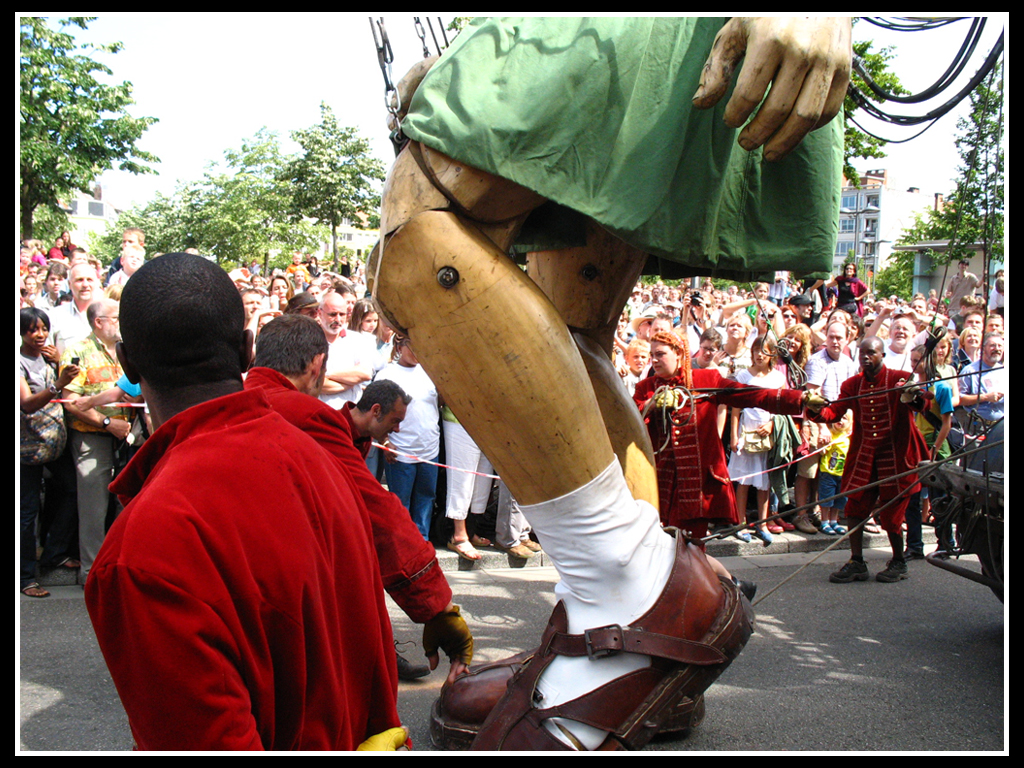
It’s never fun to get upset about all this.  Size can be a genuinely magical idea worth playing with (as seen above).  But genuine upset tends to grow the longer it goes unacknowledged. In college I took a writing workshop where we were encouraged to write about sensitive, taboo, and offensive words. The N-word and the C-word were brought up almost immediately, and I decided to demand a debate about the M-word for dwarfs.  One of my classmates pointed out, “The problem with rude stuff said about dwarfs is that it doesn’t strike us as offensive or controversial. It strikes us as funny.”

Exactly. We’re too amusing to be seen as victims. Our human rights cannot be violated because we are not fully human.

The Tin Drum is all about humanity and employs absurdist characters and events for harrowing, not hilarious effects. It is a complex novel, as is Stones from the River, a German-American war story I am inclined to prefer because the protagonist is a non-magical dwarf. After being arrested for taking a crack at the swatstika, she is hauled before a judge who reminds her that she can’t afford to speak out against Nazism when people like her are prime targets for eugenics researchers.

While The Tin Drum did not invent the idea of comparing children and dwarfs, it would be nice were it the only example of it. This has hardly been the case. It’s a gag nearly every person with dwarfism has heard for the umpteenth time. The Simpsons have done it. The brilliant comedy team Mitchell and Webb have done it. After my third-grade class watched Willy Wonka and the Chocolate Factory, my teacher pointed out—or perhaps conceded—that the Oompa-Loompas were portrayed by people who had dwarfism just like I did. One of my classmates said, “Oh no, they might have just have been children.” I looked at her cock-eyed, thinking, How can you not tell a dwarf from a child?

The fate of the main character in the crime-comedy In Bruges hinges on the villain mistaking a dwarf’s corpse for that of a child. The joke already appears earlier in the film, when the dwarf in question explains that he’s been hired to appear in a school boy’s uniform in a cinematic dream sequence and rolls his eyes at it. This sort of we-make-the-joke-but-also-make-fun-of-it-so-that-makes-okay schtick is reminiscent of Ricky Gervais’s Life’s Too Short, of which one critic at The Quietus aptly said:

Perhaps this is some triple-axle attempt at post-post-postmodern irony, an ultra-sophisticated comedic in-joke that has tied itself up in such obscure knots it only seems crass to the un-knowing, the obtuse. Well, that’d be me because from where I’m sitting it looks like we’re supposed to be laughing at a guy for being too short.

It’s unfortunate because I really love In Bruges. Just as I love Willy Wonka and That Mitchell and Webb Look. Call it cynical, call it ironic, call it hilarious, but in these cases and so many others, deleting the dwarf characters would have allowed me to enjoy myself completely.


When It Comes To Health, Who Should Minorities Trust?

12 Apr

Medication diet squircle(Image by Barry used under CC.20 via)


At the beginning of this year, I underwent orthopedic surgery and rare complications immediately arose from it, causing me to take three months of sick leave. In that time, both my country of origin and my country of residence experienced outbreaks of measles that have set the Internet ablaze with raging arguments about medicine, personal choice and the greater good. While the critics of Big Pharma have plenty of good points, recent studies of Big Herba—which is unregulated in the U.S.—have debunked an array of flaws that can be deadly. Glossing over the vitriol, at the crux of the matter lies a very reasonable question: When it comes to health, who should you trust?

“Trust to your doctor” sounds simple enough until we consider the many instances throughout history when medical professionals have abused this trust, particularly in regard to minorities. Health organizations around the world classified gay people as mentally ill as late as 2001. A panelist on Larry Wilmore’s The Nightly Show last month cited the Tuskegee syphilis experiment, which treated African-American men like lab rates from 1932 to 1972, as the basis for his overarching distrust of government health organizations. Investigations recently revealed that the U.S. Public Health Service committed similar crimes against mental patients and inmates in Guatemala in the 1940s. The polio vaccine, which has saved millions of lives globally, was first tested on physically and mentally disabled children living in asylums and orphanages. Researchers advocated the forced sterilization of trans people and ethnic minorities as recently as 2012. And of course there were the Nazis and the many, many scientists before them who passionately promoted eugenics. ITV recently rebroadcast a documentary hosted by Warwick Davis detailing Dr. Mengele’s horrific experiments on dwarfs at Auschwitz.

In other words, minorities don’t have to dig too deep to come up with plenty of reasons to be wary of scientists and doctors. Regulation, transparency and a never-ending, highly public debate on bio-ethics and human rights are necessary to prevent such crimes from happening again.

But an ideological opposition to all doctors based on such abuses ignores the myriad successes. A Slate article appearing last fall, “Why Are You Not Dead Yet?” catalogs the thousands of reasons so many of us are living so much longer than our ancestors did—from appendectomies to EpiPens to everyday medications—which we so often overlook because we have come to take the enormous medical advances of the past 200 years for granted.

And yet, as so many scientists are only too ready to admit, science does not know everything. Almost no medical procedure can be guaranteed to be risk-free, and many people base their distrust of doctors on this fact. My current post-surgical complications were just cited to me by an acquaintance as reason enough for why I never should have had the operation at all and instead gone to a TCM healer.  

In my 33 years I have undergone 14 surgeries, physical therapy, hydrotherapy, occupational therapy, electro-muscular stimulation therapy, and the list of medications I’ve taken undoubtedly exceeds a hundred. I have also been treated with reiki, shiatsu, osteopathy, acupuncture, massage, prayer, and herbal remedies based on macrobiotic, homeopathic and detox theories. Some of these treatments I chose as an adult, and some of them were chosen for me by adults when I was a child and a teen. Some of the medical treatments worked, some didn’t, and some caused new problems. Some of the alternative treatments rid me of lingering pain, and some were a complete waste of time, money and energy as my condition worsened. I won’t ever advocate any specific treatment on this blog because my readership is undoubtedly diverse and the risk of making inaccurate generalizations is too great.

Indeed, a grave problem in the public debate on health is the frequent failure to acknowledge human diversity. Most health advice found online, in the media, at the gym or a healing center is geared not at minorities but physiotypical people, who are seeking the best way to lower their risk for heart disease, fit into their old jeans, to train for a marathon, or to simply feel better. They are not seeking the best way to be able to walk to the corner or have enough strength to shop for more than half an hour. Those in the health industry who endorse one-size-fits-all solutions—“We just need to jog/Start tai-chi/Eat beans, and all our troubles will go away!”—rarely address minority cases that prove to be the exception to their rule. But atypical bodies have just as much to teach us about our health as typical bodies, and leaving them out of the conversation benefits no one but those seeking to profit off easy answers.

When it comes to seeking treatment for my condition, I follow a simple rubric: I don’t want to be the smartest person in the room. I have no professional training in medicine or anatomy. As this physician explains so well, self-diagnosis is a very dangerous game. Yet I sometimes am the expert on my body thanks to the relative scarcity of people with achondroplasia—there are only 250,000 of us on earth, or 0.00004% of the world population—compounded with the scarcity of people with achondroplasia who have undergone limb-lengthening and sustained bilateral injuries to the anterior tibialis tendons. A visit to a healing center or a hospital often entails conversations like these:

Shiatsu Healer: You’re walking with a sway-back. Your wood energy is obviously misaligned because you are stressed.

Me: My hips sway when I walk because the ball-and-socket joint in the hip is shaped instead like an egg-and-socket in people with achondroplasia.

***

Physical Therapist: Your hips sway when you walk because one leg is obviously longer than the other.

Me: No, I have my orthopedist’s report documenting that my legs are precisely the same length. My hips sway when I walk because the ball-and-socket joint in the hip is shaped instead like an egg-and-socket in people with achondroplasia.

 ***

Nurse: Your temperature is pretty high. I’m a bit worried.

Me: These anesthesiology guidelines I got from the Federal Association for Short-Statured People say that hyperthermia is to be expected post-op in patients with achondroplasia.

Sometimes the information I offer goes unheeded. In both the U.S. and in Germany, I have found arrogance is equally common among doctors and healers. Some of them are delightfully approachable, and others are so socially off-putting that they make you want to throw your wheelchair at them. The same arrogance, however, can take different forms. I have documented before the particular brand of pomposity so endemic to doctors, and it is safe to say that holistic healers are less likely to treat their patients like products on an assembly line because, by definition, they are more likely to take psychological well-being into account. But they are also more likely to endorse a one-size-fits-all solution for health, which invariably marginalizes minorities like me.

Those of us with extremely rare conditions are far more likely to find specialists among those licensed in medicine than among alternative healers. Living Naturally, the only website on alternative treatments I could find that even mentions achondroplasia, emphasizes that none of the therapies they suggest for achondroplasia have ever been tested on patients who have it. To be fair, rare conditions by definition are not well-known to your average GP either. But physicians more often know how to work with the facts, embracing the medical literature on achondroplasia I hand to them. Some alternative healers also embrace such literature, while others dismiss anything written by anyone in a white coat.

Even when a visceral hatred of hospitals and their hosts is irrational, it is understandable. My most recent stay involved some of the kindest medical professionals I have ever encountered but nevertheless left me waiting for two and a half hours on a metal bench with no back support in a hallway glaring with fluorescent lights and echoing with the cries of patients in pain. I respect everyone’s right to opt against surgery, or any medical treatment, as long as their condition does not cause others harm. But no matter how much modern medicine has abused minorities’ trust, disabled people are the only minority that cannot afford to forgo it.

A worldwide study presented to Little People of America found that, at this point in history, dwarfs have a higher quality of life—i.e., access to effective health care, employment opportunities, acceptance in society—in Northern Europe than anywhere else on earth. Reductive arguments that demonize all of Western medicine because the Nazis! can be canceled out by reductive arguments that dismiss anything developed outside the West because Asia’s terrible disabled rights record!  

Broad generalizations like “Natural is better” can only be upheld by those ensconced in the privileges of a non-disabled body. In 2011, the parenting website Offbeat Families banned the term “natural birth”—urging writers to instead refer to “medicated” and “unmedicated” birth—because “natural” had so often been used to imply “healthier.” An unmedicated birth is wonderful for anyone who can and wants to experience it, but it is important to remember that it is a privilege. A privilege, like a disability, is neither your fault nor your achievement.      

“Healthy” is a relative idea. Our choices about our bodies will always be limited. This is a sometimes terrifying fact to face. But in the public debate, we must remember that it is a fact those among us with rare disabilities and conditions can never avoid. In failing to remember it, we fail to make decisions about human health that are truly informed.


Pasch and Passover

5 Apr

(xkcd comic used under CC 2.5 via)


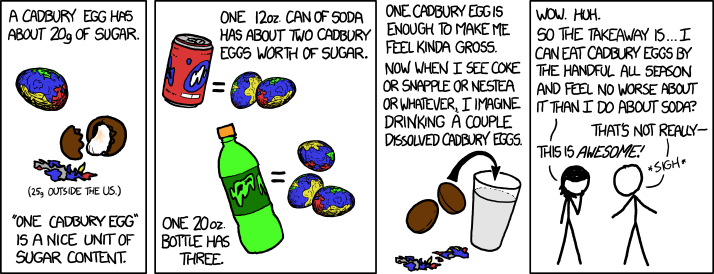
Taking this holiday weekend off and leaving you with the philosophical musings of Duncan Hull.  Until next week!