Archive | February, 2013

Wheelchair Problems

24 Feb

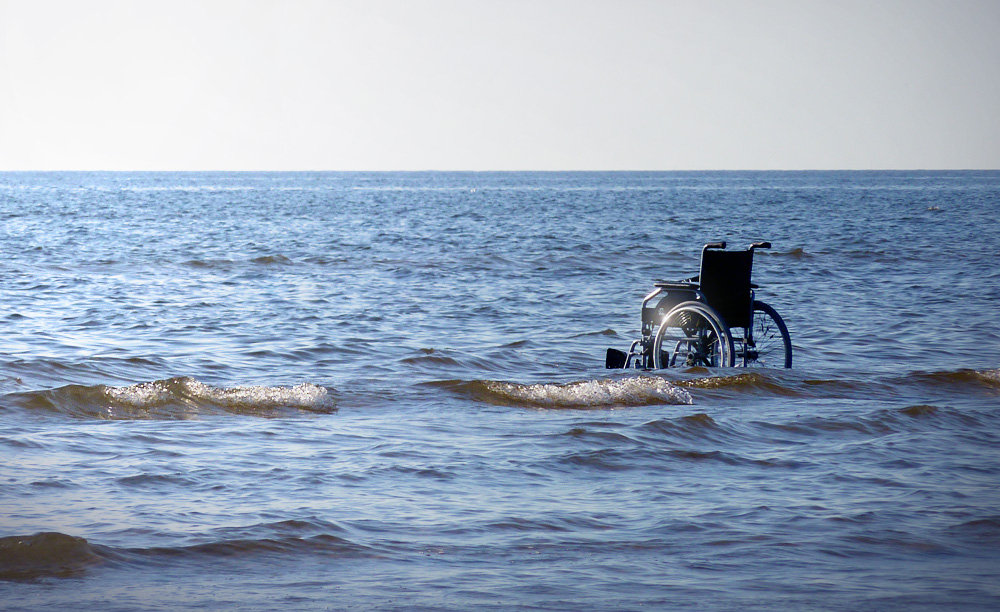
Wheelchair  (Image by Joshua Zader used under Creative Commons license via)


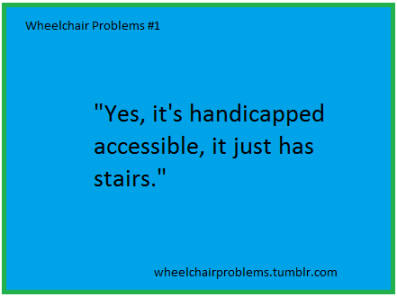
Whether you are left-handed and in search of scissors, or dark-skinned and looking for “flesh-colored” bandages in the West, almost every minority experiences problems not just of prejudice but of practicality.  Facing the combined forces of social constructs and innate challenges can be exhausting.  Few discussions on difference encapsulate this better than Wheelchair Problems.  Run by a high school senior named Gina, the site primarily features memes, such as:


hands

curb

pee

stairs


When I discovered the site this past fall, the memories came flooding back.  I used a wheelchair for a total of only two years (ages 11 to 12 and 16 to 17), so while many of these memes perfectly illustrate my experience, others wake me up to situations I’ve never faced or considered.  It’s an excellent catalyst for simultaneously building community and spreading awareness to those outside the community.  Almost every one of the Problems merits volumes of social critique and philosophical debate, but they also demonstrate that you need not sign up for a three-day seminar on diversity to get the message. 

I’ve discussed the inherent problems of micro-blogging before.  But  when the marginalized have the microphone, brevity is often not just the soul of wit but of agency.  In an age when disabled people are still portrayed as either helpless victims, freakish villains, or larger-than-life heroes, we need more sites like Wheelchair Problems.  Kinda now.


The People You Meet When You Talk About Human Suffering

17 Feb

 plastic crowd

(Image by Boinink used under CC license via)


Not all disabled people are innocents.  I would hope this comes as no surprise.  But in the wake of Oscar Pistorius’s alleged murder of his girlfriend, some are going to the other extreme.  In a bizarre article titled “The Disability Pedestal,” Slate writer William Saletan lists various disabled people who have allegedly committed similarly heinous crimes.  He cites anger over their disability as a frequent motive.  Which evokes the stereotype of the evil freak who kills in order to compensate.  That stereotype is at least as old as wicked witches, and as modern as the albino villain of The DaVinci Code.  Do we really need to feed it? 

And if there is truth to the commonly held belief that disability renders people more likely to lash out at others, then shouldn’t we be investing in a solution?  Saletan doesn’t offer any statistics on how many disabled people commit crimes out of self-pity, but if it’s really so endemic, then we should do something about it.

But I don’t think that’s what he meant.  While never going so far as to declare disabled killers a social problem, Saletan does argue that some see their disability as “just another card they can play,” and that both they and we need to realize that it all comes down to individual responsibility:

Equality isn’t about being special.  It’s about being ordinary.  People with disabilities aren’t above sin or crime.  They’re just like the rest of us…  You run your own race.  You make your own decisions.  Most people with prosthetic legs don’t shoot their lovers.  Most guys who survive testicular cancer don’t run doping rings in the Tour de France.  Something about beating cancer or overcoming a birth defect tugs at our hearts. It paralyzes our judgment.  We don’t want to believe that people who have accomplished such things can do evil.  Most don’t.  But some do.

I know plenty of disabled people who are jerks and nothing about the Pistorius case compels me to think of him as anything but one.  The stereotype of the poor, innocent, helpless, asexual, naïve invalid needs to go.  Yet I’m not comfortable with Saletan’s rather Ayn Randian assertion that compassion impairs judgment.  What impairs judgment is an inability to see someone as more than just a disability.  We should all be smart enough, deep enough, big enough to be humbled by the extraordinary difficulties someone has endured and to simultaneously call out their faults—or crimes—for what they are. 

Having a disability does not automatically make you a brave person or a good person or someone who deserves to be liked.  But disabilities almost invariably cause pain, and equality should not aim to rid us of our impulses toward compassion.  Was my judgment “paralyzed” when I met a girl in the hospital whose body was hot-pink with third-degree burns and immediately thought, “Man, I shouldn’t whine so much”?  Lots of my fellow patients at the hospital turned out to be the sort of people I couldn’t stand.  But almost every one of them had had experiences I could only try to imagine.  Refusing to excuse a disabled person should not preclude trying to understand the privileges we enjoy that they do not.    

To be fair to Saletan, I must admit it’s strange to find myself arguing this way because I am often fed up with discussions of disability and psychiatric disorders that devolve into self-pity and melodrama.  (See Twitter, Tumblr, Facebook… )  But firing off judgment can lead to snap judgments, and focusing our political energy on ranting about the whiners can lead to a cynical, soulless view of humanity.    

It just goes to show that we still have a hard time as a society figuring out what exactly to do with human suffering.  In my experience, four personality types exacerbate this problem.  (I’ve assigned gender randomly):

Mr. Comfort Zone – “I’ve Suffered, But You Don’t See Me Complaining!”  That guy who only sees society through his own lens.  He refuses to recognize any privileges he may enjoy, insists that everything balances out in the end and/or that the system is really rigged against people like him thanks to our oppressive PC culture.  He has a point that self-pity is counterproductive, but his refusal to acknowledge that anyone could have it harder than he does is the epitome of selfishness.  His refusal to explore the possibility of institutionalized chauvinism is intellectually lazy.  And his campaign for self-reliance loses all credibility the moment he blames minorities for his hardships. 

Ms. No Time For It – “It’s Sad Others Suffer, But I Don’t Like to Think About It…”  That lady who avoids political or social issues like the plague.  She wants to “stay positive” and “talk about cheerful things,” like the weather and her favorite TV shows and recent purchases.  She has a point that complaining too much about the world’s problems can wear you down, but she often contradicts this by complaining about mundane problems, like those trashy people who live around the corner and that snobby celebrity who had affairs with three different men, all of them friends of her husband, can you imagine how nasty you’d have to be in order to do such a thing?  In refusing to discuss politics, she ignores how much of her world view is determined by politics; i.e., what is considered “beautiful,” what it is considered “normal,” what is “controversial.”  She doesn’t realize that her ability to avoid certain “political” issues is a privilege

Mr. Oppression Olympics – “My People Have Suffered the Most!”  The activist who thinks the only rights worth fighting for are his own.  He may have a point about the unique nature of the discrimination he’s faced, but he ludicrously believes the more you’ve suffered, the more justice you deserve.  He secretly harbors prejudices about other minorities and this might be revealed when he thinks one of them might be taking time, funding, or attention away from “his” group.  He also refuses to acknowledge any privileges he may have.

Ms. Cry Wolf – “Can I Get Attention for My Suffering?”  The whimpering waif who takes the phrase “Talk about your feelings” to the extreme, turning almost every political discussion into a personal therapy session.  She secretly, or perhaps subconsciously, thinks belonging to a minority is enviable because it grants you sympathy and excuses for why you can’t do something.  She has a point that repression can be dangerous, but she goes overboard by crying, “OPPRESSION!” at any call for modesty or good manners.  She lists her problems in order to attain solace and praise, rather than revelation. 

We’re all prone to feel like these people in certain situations.  As a teen, I often slipped into Ms. Cry Wolf around boys I liked, hoping my saying, “I’m having such a hard day I could just cry!” would get them to be exactly as kind to me as I desired.  During my limb-lengthening procedures, when girlfriends would moan about not being thin enough while I was struggling against my painkillers to keep food down, I felt like Mr. Comfort Zone, wanting to tell them to shut up and be grateful.  In college, I felt like Mr. Oppression Olympics when students would raise their fists for feminism and LGBT rights but squirm and change the subject if I brought up disability rights.  And when it comes to certain matters of injustice—like what’s been going on in the Congo for the past five, ten, fifteen years?—I continue to be Ms. No Time For It, clicking past the headlines to the latest news about Stephen Fry or Jack White. 

Most people I know have had these feelings at certain points.  But we should be wary of acting on any of them, especially in the political sphere, because they’re all counter-productive.  There’s no progress in self-pity.  There’s no progress without empathy.  As I blog about disability and disenfranchisement, I agree with Saletan that I should never, ever be comfortable with the idea of myself as a victim.  But I also never want to be so hardened that I can’t be moved by human suffering.  Because that’s not really the point of trying to get along with the rest of the world, is it?


Note: This post was inspired by Crommunist’s The People You Meet When You Write About Race


“Richard III Was Dwarf, Doctor Says”

10 Feb

KING RICHARD III (Image by Leo Reynolds used under CC license via)


From an article appearing 20 years ago in The Seattle Times on August 23, 1991:

King Richard III was a dwarf, according to a medical diagnosis that has outraged defenders of the monarch.

“The combination of slow growth and short stature, preceded by a difficult breech birth… and intimations of physical weakness and sexual impotence… suggest idiopathic pituitary dwarfism,” Dr. Jacob Van der Werff ten Bosch said in an editorial published today in the medical journal Lancet.

Balderdash, say Richard’s partisans.  “Everyone knows Shakespeare’s Richard III, but not everyone knows the historical evidence,” said Jack Leslau, a biographer of the king. “There are various medical theories that all work on the assumption that he was some sort of monster with a physical deformity.”

The Lancet editorial was timed for the anniversary of Richard’s death in battle Aug. 22, 1485, at Bosworth Field – where, as Shakespeare had it, the monarch offered “my kingdom for a horse!”

Van der Werff ten Bosch, a former professor of medicine, says there is no reason to take offense. “As a doctor I would not think it’s ridiculing a king to call him a dwarf. It’s simply a medical diagnosis,” he said.

Since the excavation and analysis of the royal bones announced this past Monday, the BBC now reports, “Richard III was portrayed by Shakespeare as having a hunched back and the skeleton has a striking curvature to its spine. This was caused by scoliosis, a condition which experts say in this case developed in adolescence. Rather than giving him a stoop, it would have made one shoulder higher than the other.” 

So what Dr. Van der Werff ten Bosch said all those years ago was wrong.  At least half of it, anyway.


“If He Was a Wee Bit Closer, I Could Lob a Caber at Him, Ye Ken”

3 Feb


Time for another break from the tough stuff.  I want to talk about Disney.  (In earnest, mind you.  As always.)  I just saw Pixar’s Brave and no, I’m not going to write about her feminism—or the ludicrous musings about her lesbianism—or the radical imperfectness of her eyebrows.  What pleased me most about this film was its break from the Broadway tradition that has been dominating—dare I say strangling—animated cinema for decades.  Throughout my childhood, Disney and their competitors would take you around the world with Alan Menken and his endless supply of wide-mouthed Middle American show tunes as your guide.  The main characters’ accents ranged from Beverly Hills to Burbank.    

Like The Princess and the Frog, Brave has the guts to feature songs, accents, and expressions native to the story’s setting.  And it’s about time.  The Broadway model has its merits, but it can start to feel like overkill when it forbids any trace of historical or foreign flavor.  When it comes to their family films, Hollywood has traditionally handled their American audiences like cultural infants.  There conventional wisdom asserts that any voice that doesn’t immediately evoke baseball and apple pie risks obliterating our ability to empathize.  Only “artsy” films for grown-ups like Brokeback Mountain or Capote dare to let the dialect match the backdrop.  Hence our heroes Aladdin and Belle and Ariel and Simba and Esmeralda, who all sound like they went to school with the cast of Saved by the Bell.  As The New York Times observed in 1997, the closest the actors in Anastasia ever came to St. Petersburg was Pasadena.  A character speaking the Queen’s English has been permitted with some regularity, but if they’re not Julie Andrews, they’re probably the villain or the butler.         

Paradoxically, these animated family films set in far off lands usually feature one odd character who does speak with a local accent.  So is this proof we can catch words pronounced differently, or does it not matter what Token Foreigner says because his character is inconsequential?  Beauty and the Beast lets one or two sidekicks babble, “Ooo la la!” and “Sacre bleu !” but pretty much leaves the plot exposition up to everyone else.  In Aladdin, the Arabic accent belongs only to the characters with the fewest lines, such as the merchant—who sings the racist song that was later edited—and Gazeem the thief, who dies before the end of Scene One.  And by the way, I haven’t been able to find anyone in The Little Mermaid who sounds Danish, under the sea or above.

Not only does Brave inject its lines with a kick-ass charisma brought on by Scottish brogue, but most of its voice actors—with the exception of Emma Thompson and Julie Walters—are actually, truly, veritably from Scotland.  Traditionally, the Token Foreigner in a children’s film has been provided by an American actor putting on a stereotypical accent.  (Kelsey Grammer as a Russian aristocrat, Jerry Orbach as a French candlestick… )  The ability to imitate an accent is a great skill for both an actor and an interpreter, but it can easily go horribly wrong without anyone in charge of the film noticing.  The fact that Dick van Dyke got away with his impression of Cockney in Mary Poppins suggests that U.S. film critics of the time had pretty low standards.  Meryl Streep has been famously lauded for her ability to sound authentically Italian, Polish, and British, but almost none of those singing her praises are Italian, Polish, or British.  Her portrayals may very well be accurate, but ever since Mary Poppins, Americans have a bit of a reputation for being too easily fooled.  My Nordic partner always rolls his eyes and shakes his head at the Seinfeld episode that tried to pass off this accent as Finnish:


This is not to say that Americans are the only ones who can’t tell Finnish from gibberish.  I’ve met plenty of French people who think Japanese sounds like that pathetically generic “Ching-chong-chang!”  And Brits who have claimed—a little arrogantly—that the U.S. does not have as many dialects or accents as the U.K.  Ethnologue cites 176 living languages in the U.S. compared to the U.K.’s 12.  Great Britain and Northern Ireland may contain more dialects—though I would bet their dialects are fewer in number while boasting more speakers per dialect—but this begs the philosophical question of what separates a dialect from a language.  The joke among linguists goes, “A language has an army and a navy.” 

Every culture tends toward simplistic views of other cultures.  When you begin to type “Brave Pixar” into Google, you get the apparently popular question, “Brave Pixar Irish or Scottish?”  Anyone outside of the Celtic-speaking regions could be asking this question.               

I’m sure Brave is still rife with Scottish stereotypes that are more craved by Hollywood than are authentic.  And the ancient clans of the Highlands most likely sounded nothing like Billy Connolly or Craig Ferguson.  But it is nice to see the filmmakers trust us enough to handle protagonists who do not speak exactly like the average American moviegoer.  After all, what is the point to hearing stories from far off lands if it’s not to hear things we may not have heard before?  And the more we are exposed to different authentic accents, the more likely we are to realize that every one of us has one.  And that somewhere, someone is smiling at the way we talk.